Crypto Prediction Markets Face Existential Threat — 3 States Move To Shut Traders Out

bitcoinistОпубліковано о 2026-04-03Востаннє оновлено о 2026-04-03

Анотація

The U.S. federal government, through the CFTC and DOJ, is suing Illinois, Arizona, and Connecticut to block their attempts to shut down crypto prediction markets like Polymarket and Kalshi. The federal agencies argue they have exclusive jurisdiction to regulate these markets as derivatives, while the states classify them as illegal gambling. This legal clash represents a significant existential threat to the industry. A federal victory would centralize oversight under the CFTC, creating a single regulatory framework. If the states prevail, platforms would face a fragmented landscape of state gambling laws, potentially pushing markets offshore and increasing costs for traders.

Illinois, Arizona and Connecticut are trying to regulate crypto predictions markets, such as Polymarket and Kalshi. The Commodity Futures Trading Commission and the Justice Department are coming to the rescue.

For The First Time, The Scale Moves In Crypto Prediction Markets’ Favor

As contradictory as it may sound, the Trump administration is trying to save crypto prediction markets from the State itself. The coordinated lawsuits the CFTC and the DOJ have filed against the three states argue that only the federal derivatives regulator can police prediction markets.

The lawsuits go as far as to claim the three states are bypassing the CFTC’s authority by trying to shut down “federally regulated DCMs” (designated contract markets). Regarding Illinois, the federal regulator said the state spent the past year issuing cease‐and‐desist letters to Kalshi, Crypto.com, and Polymarket, which the complaint argues are all under CFTC authority:

Illinois’s attempt to shut down federally regulated DCMs intrudes on the exclusive federal scheme Congress designed to oversee national swaps markets.

Related Reading: Crypto Traders On Edge As Korea Stalls Key Law — Is The “Kimchi Premium” At Risk Next?

Put simply, Washington says prediction markets are federally regulated derivatives. States insist, however, that prediction markets are just unlicensed gambling products harming local consumers.

CFTC Chairman Michael Selig explained that this is not the first time states “have tried to impose consistent and contrary obligations on market participants”. Just this past month, a bipartisan Senate bill targeting sports‐style bets on platforms like Polymarket and Kalshi was introduced by Senators Adam Schiff (D-CA) and John Curtis (R-UT).

Also on March, democratic representative Seth Moulton of Massachusetts (MA-06) formally banned all his staff from participating in prediction markets. That same day, Congressman Adrian Smith (R-NE-03) and Congresswoman Nikki Budzinski (D-IL-13) from Nebraska introduced the PREDICT Act, banning members of Congress from trading on political and policy outcome markets.

These are the first lawsuits by the CFTC to block state gaming regulators ​from policing operators of prediction markets, according to Reuters. The outlet also highlighted the fact that all the defendants are Democrats.

Market Implications

The CFTC’s lawsuits build on its recent push to assert “exclusive jurisdiction” over event contracts, including sports and politics, reversing the Biden‐era move that tried to ban broad categories of prediction markets.

Prediction markets are morphing into an information layer and hedging tool for traders, with liquidity increasingly coming from crypto‐native capital and exchange integrations.

A federal win would likely centralize rule‐making at the CFTC, potentially clearing a single regulatory path for crypto prediction platforms, but also tightening surveillance and enforcement. Conversely, if states prevail, platforms may face a patchwork of gambling rules that fracture liquidity, push some markets offshore, and raise operational risk premia for traders.
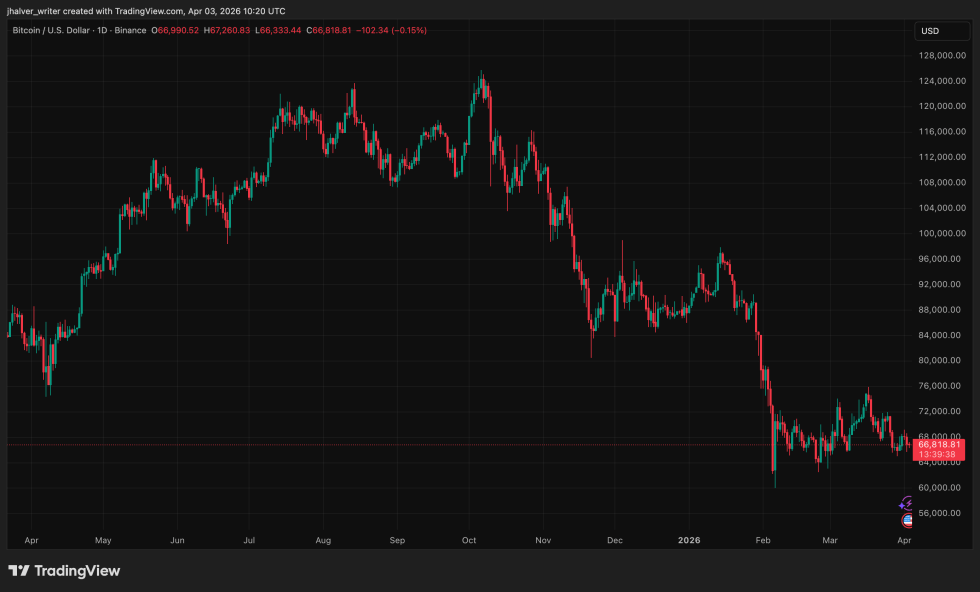
At the moment of writing, BTC trades for almost $67k on the daily chart. Source: BTCUSD on Tradingview.

Cover image from Perplexity. BTCUSD chart from Tradingview.

Пов'язані питання

QWhich three states are mentioned as trying to regulate crypto prediction markets in the article?

AIllinois, Arizona, and Connecticut.

QWhat federal agencies are taking legal action against these states to protect crypto prediction markets?

AThe Commodity Futures Trading Commission (CFTC) and the Department of Justice (DOJ).

QAccording to the CFTC, what is the core legal argument against the states' actions?

AThe CFTC argues that it has exclusive federal jurisdiction to regulate prediction markets as derivatives, and the states are intruding on this federal regulatory scheme.

QWhat is the name of the bipartisan Senate bill mentioned that targets sports-style bets on platforms like Polymarket?

AThe article mentions a bipartisan Senate bill but does not provide its specific name. It was introduced by Senators Adam Schiff and John Curtis.

QWhat are the two potential outcomes for crypto prediction markets discussed, depending on who wins the legal battle?

AA federal win would centralize rule-making at the CFTC, creating a single regulatory path. If states prevail, platforms would face a patchwork of state gambling rules, fracturing liquidity and pushing some markets offshore.

Пов'язані матеріали

Bitcoin Withdrawals Continue: 8 Years of Storage in a Coldcard Cold Wallet Ended in Zero

Coldcard Hardware Wallet Hacked: Losses Mount Due to Vulnerable Seed Generation A critical vulnerability in Coldcard hardware wallets has led to a continued wave of fund thefts. According to Galaxy Research, the total stolen has reached 1,367.05 BTC (approx. $88.6 million) from 4,585 addresses, a significant increase from the initial 594.5 BTC reported on July 30, 2026. Most of the stolen funds remain on the attackers' addresses. The issue is not with the current firmware, which Coinkite has updated, but with seed phrases generated on vulnerable devices between March 2021 and the release of fixed firmware versions. Due to a programmer error, devices switched from using a hardware random number generator to the software-based Yasmarang generator, which was initialized with publicly accessible data like the chip's serial number. This made the seed phrases predictable through offline brute-force attacks, meaning wallets remain at risk until funds are moved to a new wallet generated with the patched firmware. Affected devices include Mk2/Mk3 with firmware 4.0.1–4.1.9 (and up to 5.0.3), Mk4/Mk5 up to version 5.6.0, and Q models up to 1.5.0Q. The only exceptions are seeds created with a high-entropy method like at least 50 independent dice rolls or a strong unique BIP-39 passphrase. All other owners must generate a new seed on the fixed firmware and transfer their assets. A case highlighting the human impact involves a 39-year-old long-term investor who lost 2 BTC (approx. $130,000) in minutes. He had accumulated the Bitcoin over eight years through physical labor, viewing it as a financial lifeline and a retirement plan in a country suffering from hyperinflation. His story underscores that even conservative "buy and hold in cold storage" strategies can be compromised by such underlying technical flaws. From a technical perspective, this incident echoes historical failures where weak random number generators undermined cryptographic security, challenging the assumption that offline storage is automatically foolproof.

cryptonews.ru4 год тому

Bitcoin Withdrawals Continue: 8 Years of Storage in a Coldcard Cold Wallet Ended in Zero

cryptonews.ru4 год тому

Торгівля

Спот
活动图片





