Crypto Prediction Markets Continue To Be Under Siege — Are Traders Now Fair Game For Prosecutors?

bitcoinistОпубліковано о 2026-04-09Востаннє оновлено о 2026-04-09

Анотація

U.S. federal regulators, including the CFTC and DOJ, are seeking a court order to prevent Arizona from enforcing its gambling laws against crypto prediction-market platform Kalshi. They argue that contracts tied to sports, elections, and real-world events qualify as financial derivatives ("swaps") under federal law, not state-regulated gambling. This legal action is part of a broader conflict between federal and state authorities over jurisdiction on prediction markets. Arizona and other states contend these platforms constitute illegal gambling and have initiated criminal charges. Similar legal pressures are affecting Kalshi’s rival, Polymarket, which faces lawsuits and investigations in multiple states. The outcome could either legitimize and boost U.S. prediction markets or fragment them into riskier offshore operations.

U.S. regulators are urging a court to stop Arizona from enforcing its gambling laws against crypto prediction‐market platform Kalshi.

Another Battle Over Crypto Prediction Markets

In a filing from yesterday, the Commodity Futures Trading Commission (CFTC) and the Justice Department (DOJ) commended a federal court to stop Arizona from using its gambling laws against crypto prediction‐market platform Kalshi.

The agencies are asking for a temporary restraining order and preliminary injunction to halt Arizona’s criminal case and gambling‐law enforcement.

Related Reading: Bitcoin Creator Exposed? New Investigation Points At The Real Identity Of Satoshi Nakamoto

CFTC argues that these contracts tied to sports, elections and other real‐world events qualify as swaps (financial derivatives) under U.S. law, rather than falling under state gambling statutes. The federal regulators based their arguments on the fact that since the contracts are settled on future events with economic impact, they are governed by the Commodity Exchange Act and fall under federal law rather than state authority.

Such interpretation curbs how far individual states can go in blocking or constraining these platforms, which regulators say would otherwise splinter the market into a patchwork of state‐by‐state rules.

The Arizona Lawsuit Explained

Arizona charged Kalshi with illegal gambling over sports and election markets. Arizona, along with an expanding list of other states, argue that contracts tied to sports results operate like ordinary bets and must be treated as gambling, subject to licensing rules, age limits, and consumer safeguards.

According to the court filing, Arizona first sent a cease‐and‐desist order to KalshiEx LLC and Kalshi Trading LLC in May 2025, alleging they were taking unlawful bets in breach of state law. The state then brought criminal charges against both entities for “betting and wagering” under several Arizona statutes, with an arraignment set for April 13.

On Monday, a Third Circuit (one of the 13 U.S. federal courts of appeals) ruling stated that sports event contracts on designated contract markets (DCMs) are “swaps” preempting state gambling laws. However, one judge disagreed, blasting Kalshi’s stance as a “performative sleight” designed to hide the fact that its offerings are, in substance, sports betting.

Crypto Prediction Markets Under A Coordinated State Pushback

This move follows a broader CFTC and DOJ litigation against Arizona, Connecticut, and Illinois over prediction‐market jurisdiction. Bitcoinist reported on it last week. This past month, a bipartisan Senate bill targeting sports‐style bets on platforms like Polymarket and Kalshi was introduced by Senators Adam Schiff (D-CA) and John Curtis (R-UT).

Also on March, democratic representative Seth Moulton of Massachusetts (MA-06) formally banned all his staff from participating in prediction markets. That same day, Congressman Adrian Smith (R-NE-03) and Congresswoman Nikki Budzinski (D-IL-13) from Nebraska introduced the PREDICT Act, banning members of Congress from trading on political and policy outcome markets.

Related Reading: SEC Admits Flaws In Crypto Enforment, What Went Wrong?

Kalshi’s main rival, Polymarket, is also under mounting legal fire, with a New York class action filed in February alleging it runs an unlicensed sports‐betting operation. Regulators in Nevada have launched a civil case against its parent company, and authorities in Ohio, Utah, and Iowa have likewise begun probing the platform.

Not too long ago, Argentinian authorities ordered a full national ban of Polymarket after it “predicted” inflation data back in February. On top of that, the platform faced terrible backlash recently after bettors sent death threats to Times of Israel military reporter Emanuel Fabian, following his report of an Iranian ballistic missile on March 10.

Both Kalshi and Polymarket updated their rules at the end of March to preemptively block politicians, candidates and sports insiders from trading on related markets

If the federal preemption is upheld, it will de‐risks U.S. prediction venues, potentially boosting liquidity and making them more attractive as macro and sports‐beta tools for crypto‐savvy traders. However, if states carve out sports and politics as gambling, markets may fragment offshore or into on‐chain, harder‐to‐police venues, raising operational and legal risk premia for anyone treating these contracts as serious hedging instruments.
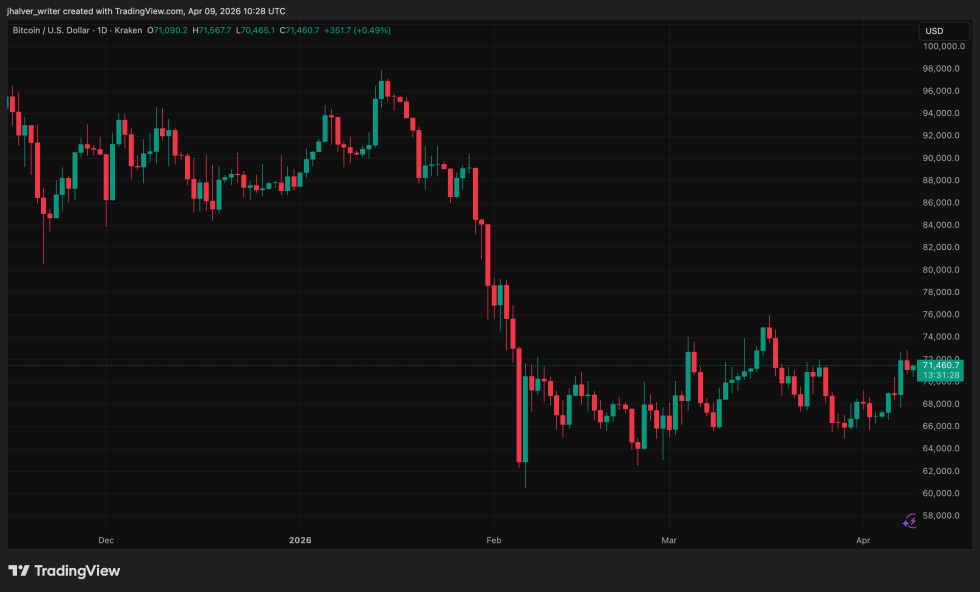
Yesterday, Bitcoin bounced back and reclaimed $72k. At the moment of writing, BTC trades for around $71k on the daily chart. Source: BTCUSD on Tradingview.

Cover image from Perplexity. BTCUSD chart from Tradingview.

Пов'язані питання

QWhat is the main argument of the U.S. regulators (CFTC and DOJ) against Arizona's enforcement of its gambling laws on Kalshi?

AThe CFTC and DOJ argue that the contracts offered by Kalshi, which are tied to sports, elections, and other real-world events, qualify as financial derivatives (swaps) under U.S. federal law, specifically the Commodity Exchange Act. They contend that these contracts, because they are settled on future events with economic impact, fall under federal jurisdiction and preempt state gambling statutes.

QWhat specific legal measures are the federal agencies requesting from the court regarding Arizona's case against Kalshi?

AThe Commodity Futures Trading Commission (CFTC) and the Justice Department (DOJ) are asking the court for a temporary restraining order and a preliminary injunction to halt Arizona's criminal case and its enforcement of gambling laws against Kalshi.

QAccording to the article, what was the recent ruling by the Third Circuit court regarding sports event contracts on designated contract markets (DCMs)?

AA recent Third Circuit ruling stated that sports event contracts on designated contract markets (DCMs) are considered 'swaps,' which preempts state gambling laws. However, one judge dissented, calling Kalshi's stance a 'performative sleight' designed to disguise what is essentially sports betting.

QBesides Kalshi, which other major prediction market platform is facing significant legal challenges, and what are some examples?

AKalshi's main rival, Polymarket, is also under significant legal pressure. A New York class action lawsuit was filed in February alleging it runs an unlicensed sports-betting operation. Regulators in Nevada have launched a civil case against its parent company, and authorities in Ohio, Utah, and Iowa are probing the platform. It was also completely banned in Argentina.

QWhat are the two potential future scenarios for U.S. prediction markets outlined at the end of the article, depending on the legal outcome?

AIf federal preemption is upheld, it would de-risk U.S. prediction venues, potentially boosting their liquidity and attractiveness as trading tools. Conversely, if states successfully classify these markets as gambling, the markets may fragment and move offshore or into on-chain venues that are harder to police, thereby raising operational and legal risks for traders.

Пов'язані матеріали

In Conversation with Ray Dalio: We Are Currently in an AI Bubble, with 1% of My Portfolio in Bitcoin

Ray Dalio, founder of Bridgewater Associates, warns in an interview that the current AI boom shows classic bubble characteristics, which could lead to significant economic downturns as seen in past cycles like 1929 or 2000. He explains that speculative enthusiasm, fueled by debt and overvaluation, often precedes a crash when rising rates or taxation force asset sales, causing widespread losses and recession. Dalio also outlines his "Big Cycle" theory, describing an approximate 80-year pattern where widening wealth gaps, massive government deficits, and shifting geopolitical power (like China's rise) create internal conflict and global instability. He emphasizes that we are in a late-cycle, transitional phase where traditional powers like the US and UK face decline. For personal wealth protection, Dalio advises diversification beyond cash into assets like stocks, bonds, real estate, and particularly gold, which he prefers over Bitcoin. While he holds about 1% of his portfolio in Bitcoin as a non-printable hard asset, he views gold as more secure from technological or governmental threats. Regarding AI's impact, Dalio believes it will disproportionately benefit capital owners, worsening inequality by replacing both physical and cognitive labor. He suggests that human intuition and emotional intelligence, combined with AI, will be key for future workers. On taxation, Dalio argues that wealth taxes are impractical and risk triggering asset sell-offs, reducing productive investment. He points to the UK as a cautionary example of debt, low productivity, and political strife. Geopolitically, Dalio foresees a more regionalized world, with the US showing weakness in prolonged conflicts like with Iran, akin to past imperial declines. The ideal outcome, he suggests, is coexisting powerful blocs (e.g., Americas, China-Asia Pacific) without major war.

marsbit3 год тому

In Conversation with Ray Dalio: We Are Currently in an AI Bubble, with 1% of My Portfolio in Bitcoin

marsbit3 год тому

Daily 7.2 Trillion KRW: Foreign Capital's Record Net Buying on Friday! Wall Street Says Headwinds for Korean Stock Fund Flows Have Subsided

South Korean stock market sees a dramatic shift in fund flows. On July 31, foreign investors made a record net purchase of approximately KRW 7.2 trillion in KOSPI stocks, marking a fundamental reversal from the persistent large-scale net outflows seen in previous months. This contributed to a significant narrowing of foreign net selling in July to KRW 9.8 trillion, down sharply from KRW 48.4 trillion in June and KRW 44.5 trillion in May. Simultaneously, domestic institutional pressure eased. South Korean pension funds and asset managers turned to a net buying position in July, purchasing KRW 1.0 trillion worth of KOSPI shares, contrasting with net sales in May and June. Market volatility is expected to be dampened by new financial regulations. Effective July 31, the Financial Services Commission tightened access for retail investors to single-stock leveraged ETFs by raising the minimum cash deposit requirement. Trading volumes for these products subsequently dropped to about 50% of their monthly average. Citigroup Research maintains its year-end KOSPI target of 10,000 points. The firm cites several supportive factors: the substantial easing of headwinds from capital outflows, a robust fundamental outlook for the semiconductor sector, historically low market valuations, strong economic fundamentals, and the potential for policy support from financial authorities if needed.

marsbit3 год тому

Daily 7.2 Trillion KRW: Foreign Capital's Record Net Buying on Friday! Wall Street Says Headwinds for Korean Stock Fund Flows Have Subsided

marsbit3 год тому

Thanks to Dice Rolls, Bitcoin Keys Are Stored Offline, But Not Everyone Will Do It

The article discusses using dice rolls to generate secure Bitcoin wallet seeds, providing entropy independent of potentially flawed hardware random number generators. It explains that each fair dice roll offers about 2.585 bits of entropy, with around 50 rolls needed for a standard 12-word seed phrase and 99+ recommended for higher security. This method gained attention after a vulnerability was revealed in some Coldcard hardware wallets, where a faulty firmware RNG (dating back to 2021) compromised generated keys. The analysis notes that while a dice-generated main seed was safe from this specific flaw, other Coldcard functions (like creating paper wallets, backup keys, or passwords) could still be vulnerable if they used the defective RNG. The piece argues that while dice-based entropy is technically robust, the manual process is error-prone, tedious, and unrealistic for most new users, who might make mistakes in recording or inputting rolls. It concludes that while manual entropy generation should remain an option for advanced users, the long-term goal is to develop reliable, user-friendly hardware and software that securely generates randomness without requiring specialized knowledge. Coldcard users are advised to check their firmware version and replace any secondary secrets (like paper wallet keys) created with vulnerable devices, while also considering multi-signature setups with devices from different manufacturers for added security.

cryptonews.ru8 год тому

Thanks to Dice Rolls, Bitcoin Keys Are Stored Offline, But Not Everyone Will Do It

cryptonews.ru8 год тому

Торгівля

Спот
活动图片





