Crypto Payments Just Changed In South Korea — Will This Avalanche Bet Rewrite The Rules?

bitcoinistОпубліковано о 2026-04-14Востаннє оновлено о 2026-04-14

Анотація

A South Korean payment giant, NHN KCP, has partnered with Ava Labs to build a new payments-focused Layer-1 blockchain on Avalanche. This chain, developed via Ava Cloud, is designed for real-world payments with features like sub-second authorization, encrypted transaction data, and support for tokenized deposits and multi-stablecoin settlements. The collaboration aims to merge traditional payment expertise with blockchain technology to create an innovative business model. Its success depends on South Korea's upcoming crypto regulations. If implemented, it could position Avalanche (AVAX) as a major real-world payments network, potentially boosting its adoption and market appeal.

A South Korean payment firm has teamed up with Avalanche to create a crypto-like Layer‐1 blockchain tailored specifically for payments.

A Crypto-Spin For TradFi In South Korea

TradFi continues its race to not be left behind DeFi innovation. This time, however, a traditional payments giant most recent move is not aimed at just integrating with crypto, but it’s actually spinning up its own chain intended at real‐world payments.

According to The Block, NHN KCP, one of South Korea’s biggest payment processors, has signed a memorandum of understanding (MOU) with Avalanche developer Ava Labs to build its own payments‐focused Layer 1.

Avalanche is a high‐performance Layer 1 blockchain platform designed for smart contracts and custom blockchains, with near‐instant transaction finality and low fees.

The planned L1 will be built via Ava Cloud and optimized for real‐world payments: sub‐second payment authorization, on‐chain transaction data encryption, and customizable merchant payment infrastructure. NHN KCP and Ava Labs want to plug in tokenized deposits, multi‐stablecoin settlement, and cross‐border payments on top of that base layer.

Jun-seok Park, CEO of NHN KCP, said in a statement:

This agreement is highly significant as it combines NHN KCP’s industry-leading payment operational expertise with world-class blockchain technology to derive an innovative model that can be immediately applied to real-world business.

The pair intend to test whether the project is technically viable via a proof‐of‐concept, and to broaden their ties with financial and payment firms worldwide.

South Korea’s Most Recent History With Crypto

According to the Korean outlet Fntimes, NHN KCP is already positioning itself as a “first mover” in crypto payments and has been working on stablecoin infrastructure and on/off‐ramp tech with a dedicated task force. The payment firm has already filed trademarks for KRW‐ and USD‐pegged stablecoins (e.g., USDW), signaling it wants to operate across both domestic and international rails.

South Korea has been recently pushing toward clear rules for stablecoins and digital assets, with the expectation that a comprehensive crypto bill and bank‐grade rules for exchanges and payment providers will land around this year after it was postponed until after the June 3 local elections. Bitcoinist reported on it at the beginning of the month.

What This Means For AVAX Traders

Let’s keep in mind that launch timing and scale will depend heavily on how South Korea finalizes its crypto and stablecoin framework, something Ava Labs itself acknowledges.

If NHN KCP can route even a small slice of its existing volume through an Avalanche‐based mainnet, it could become one of the largest “real‐world payments” experiments on any L1. AVAX could start looking like a real‐world payments bet, which the market tends to reward with higher multiples in bull phases.

If the proof‐of‐concept leads to live merchant traffic, AVAX gains a concrete adoption case that traders can track in metrics and narratives, making it easier for funds to justify rotating from slower‐growth L1s into Avalanche.
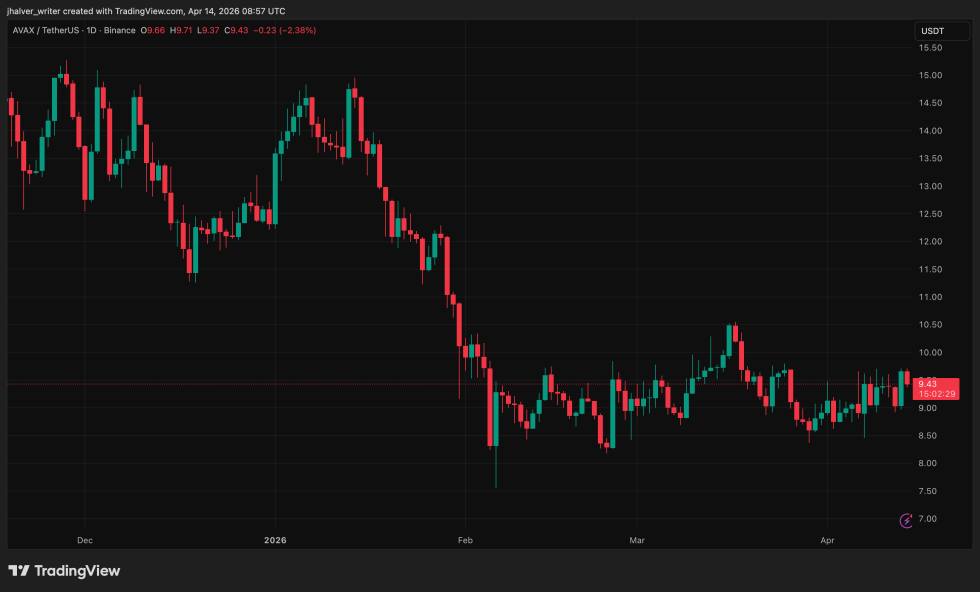
At the moment of writing, AVAX trades for $9,43 on the daily chart. Source: AVAXUSDT on Tradingview.

Cover image from Perplexity. AVAXUSDT chart from Tradingview.

Пов'язані питання

QWhat is the main partnership announced between a South Korean payment firm and Avalanche?

ANHN KCP, one of South Korea's biggest payment processors, has signed an MOU with Avalanche developer Ava Labs to build its own payments-focused Layer 1 blockchain.

QHow is the planned Layer 1 blockchain being built and what are its key features?

AThe planned L1 is being built via Ava Cloud and is optimized for real-world payments, featuring sub-second payment authorization, on-chain transaction data encryption, and customizable merchant payment infrastructure.

QWhat does NHN KCP's CEO say about the significance of this agreement?

AJun-seok Park stated that the agreement is highly significant as it combines NHN KCP's industry-leading payment operational expertise with world-class blockchain technology to create an innovative model for real-world business applications.

QHow is South Korea's regulatory environment influencing this project?

AThe launch timing and scale of the project depend heavily on how South Korea finalizes its crypto and stablecoin framework, with comprehensive regulations expected around this year after being postponed until after the June local elections.

QWhat potential impact could this partnership have on AVAX traders and the token's value?

AIf successful, it could make AVAX a real-world payments bet that the market tends to reward with higher multiples in bull phases, and provide a measurable adoption case that could attract investment from slower-growth L1s.

Пов'язані матеріали

CPU Makes a Comeback to the Table, A $170 Billion "Power Seizure" Drama Begins

A new era is dawning for the server CPU (Central Processing Unit), driven by the shift from AI model training to large-scale reasoning and the rise of Agentic AI. This article explores how the CPU is reclaiming a central role in the AI data center. For years, the focus has been on the GPU (Graphics Processing Unit) for AI training. However, as AI moves to the inference and Agent phase—where tasks involve complex, multi-step reasoning, tool calls, and data management—the workload balance is flipping. Studies show CPUs now handle over 70% of the workload in Agentic AI, up from 10-30% in training. This is because Agent tasks generate massive intermediate data (KV Cache) that exceeds GPU memory, forcing it to be offloaded to the CPU's larger, more scalable memory pools. This increased importance is translating into market changes. Major players are taking note: NVIDIA launched its first standalone CPU line, Vera, based on ARM architecture and optimized for Agent performance. AMD doubled its server CPU market forecast to over $1200 billion by 2030. Analyst reports project the total server CPU market could reach $1700 billion by 2030, with AI-driven demand being a primary driver. Furthermore, the classic ratio of CPUs to GPUs in AI servers is rapidly changing, converging from 1:8 toward 1:1 for Agent deployments. This surge in demand has led to a rare industry-wide price increase of 10-15% for server CPUs from Intel and AMD, breaking a decade-long trend of "more performance for the same price." Demand is bifurcating into high-core-count CPUs for in-rack GPU support and moderate-core CPUs for standalone Agent task orchestration. In China, this global trend presents an opportunity for domestic CPU manufacturers like Hygon (海光信息) and Huawei Kunpeng, who are bolstered by both growing AI infrastructure needs and national policies promoting technological self-reliance ("xin chuang"). The maturity of their software ecosystems is also accelerating, evidenced by faster adaptation to new AI models. In conclusion, the narrative is shifting from a GPU-centric view to one where CPU-GPU synergy is critical. The CPU is no longer a peripheral component but a performance-defining bottleneck and a key growth driver in the AI hardware stack, opening a massive new market estimated in the hundreds of billions of dollars.

marsbit1 год тому

CPU Makes a Comeback to the Table, A $170 Billion "Power Seizure" Drama Begins

marsbit1 год тому

TechFlow Intelligence: AMD AI Director Publicly Criticizes Claude Code for "Becoming Dumber and Lazier", Trump Claims Full Ceasefire in Hormuz But Strait Still Has 80 Unexploded Mines

TechFlow Intelligence Report: This daily digest covers key developments in AI, crypto, hardware, and geopolitics. In AI, SK Telecom faces US export control scrutiny over its partnership with Anthropic, while a Gemini user reports being misled in a scam scenario, sparking safety debates. China's Z.AI launches the GLM-5.2 model, rivaling Claude Opus without NVIDIA chips. In crypto, Bithumb lists ReProtocol, and Upbit delists KernelDAO. On the hardware front, MIT researchers build a custom OS to study chips, ASML denies US claims its advanced lithography machines are in China, and Amazon considers selling its in-house AI chips. Apple's future A21 Pro chip may use TSMC's latest N2P process. Major tech issues include 10,000 GitHub repositories distributing malware and Apple patching a critical eavesdropping flaw in Beats earbuds. US stocks rise, led by semiconductors, with Intel surging 10.6%, while SpaceX falls 3.5%. Geopolitically, despite a US-Iran deal, the Strait of Hormuz remains risky with ~80 uncleared mines, stalling 80M barrels of oil on standby tankers. Iran postpones Switzerland talks, and Trump calls the agreement an "unconditional surrender." The report highlights a contrast: temporary geopolitical calm versus the ongoing, fundamental restructuring of tech supply chains and chip independence.

marsbit1 год тому

TechFlow Intelligence: AMD AI Director Publicly Criticizes Claude Code for "Becoming Dumber and Lazier", Trump Claims Full Ceasefire in Hormuz But Strait Still Has 80 Unexploded Mines

marsbit1 год тому

Торгівля

Спот
Ф'ючерси
活动图片