Author: Deep Tide TechFlow
Yesterday's Market Dynamics
US December ADP Employment Change: 41K, Expected 47K
US December ADP employment change was 41,000, expected 47,000, previous value -32,000.
US Senate to Review Crypto Market Structure Bill Soon, Industry Ramps Up Lobbying Efforts
According to Crypto in America, the Senate Banking Committee plans to mark up the crypto market structure bill for discussion on January 15th. Currently, 13 pro-crypto senators are working to reach bipartisan consensus on issues such as ethics rules for public officials holding crypto and stablecoin yields. Simultaneously, the Senate Agriculture Committee is also preparing for a markup discussion next week. The crypto industry is intensifying its lobbying efforts, with representatives from over 40 companies set to hold an event on Capitol Hill this Thursday to discuss unresolved issues with senators.
China's Central Bank Increases Gold Holdings for the 14th Consecutive Month
People's Bank of China: China's gold reserves at the end of December stood at 74.15 million ounces (approx. 2,306.323 tons), an increase of 30,000 ounces (approx. 0.93 tons) month-on-month, marking the 14th consecutive month of increase.
WLFI Subsidiary Applies to OCC for US National Trust Bank Charter
According to the Wall Street Journal, World Liberty Financial stated that its subsidiary, World Liberty Trust, submitted a de novo application to the Office of the Comptroller of the Currency (OCC) on January 7th, seeking a US national trust bank charter to enable the direct issuance and custody of its dollar stablecoin, USD1. The company claimed that if approved, the trust bank would gradually launch crypto asset custody and stablecoin exchange services, primarily serving institutional clients.
Solana Mobile: SKR Token to Officially Launch on January 21st
Solana Mobile's official X account announced that the SKR token will officially launch on January 21st (UTC time).
Previous news indicated the token has a total supply of 10 billion. The token allocation includes: 30% for airdrops, 25% for growth and partnerships, 10% for liquidity, 10% for community treasury, 15% for Solana Mobile, and 10% for Solana Labs. The inflation mechanism follows a linear model, starting at 10% in the first year, decreasing by 25% annually, and eventually stabilizing at 2%. It is primarily targeted at Seeker device users and active dApp users.
edgeX Announces Transition from Perp DEX to EDGE Chain, Launches Pre TGE Season Event
edgeX officially announced it is transitioning from a Perpetual Contract Decentralized Exchange (Perp DEX) to EDGE Chain and is currently moving from a closed beta to an open beta. To support this transition, edgeX launched the Pre TGE Season event today, which will reward platform users for natural usage behavior through XP incentive units.
According to the official message, XP will be distributed weekly until the TGE (Token Generation Event) is completed, expected by or before March 31, 2026.
CZ: opBNB Has Completed Mainnet Hard Fork, Block Time Reduced from 500ms to 250ms
Binance founder CZ posted on social media, "opBNB just completed the mainnet hard fork about an hour ago. Block time reduced from 500ms to 250ms."
Listed Company Rumble Partners with Tether to Launch Crypto Wallet
Rumble Inc. (Nasdaq: RUM) and crypto giant Tether jointly announced on January 7, 2026, the launch of Rumble Wallet, a non-custodial crypto wallet directly into the Rumble platform.
According to the official press release, the wallet supports Tether (USDT), Tether Gold (XAUt), and Bitcoin (BTC), allowing viewers to tip creators directly with cryptocurrency, eliminating intermediaries like ad networks, banks, or payment processors.
MoonPay will provide on/off-ramp services for Rumble Wallet users, supporting conversions between traditional payment methods like credit cards, Apple Pay, PayPal, and Venmo and cryptocurrencies.
Former Brazilian Central Bank Official Launches High-Yield Stablecoin BRD, Pegged to the Real
According to CoinDesk, former Brazilian Central Bank director Tony Volpon announced the launch of an innovative stablecoin, BRD, pegged to the Brazilian Real and backed by Brazilian government bonds. BRD will offer holders a high yield share of up to 15%, significantly above the Fed's benchmark rate of 3.5%-3.75%.
Volpon stated on CNN Brazil's "Cripto na Real" program that BRD aims to make it easier for foreign investors to access Brazil's high-yield environment, while potentially supporting demand for Brazilian government bonds by broadening the investor base, thus reducing government borrowing costs.
Polymarket Enters Exclusive Partnership with Dow Jones Media
Prediction market platform Polymarket has entered an exclusive partnership with Dow Jones Media to provide prediction market data to media outlets including Barron's and The Wall Street Journal.
Decentralized Protocol Babylon Raises $15 Million in Round Led by a16z Crypto
According to Fortune magazine, the decentralized protocol Babylon, co-founded by Stanford professor David Tse, has raised $15 million. The round was led by Andreessen Horowitz's a16z Crypto, with the project's valuation undisclosed.
Market data shows BABY briefly surged over 15%, currently trading at $0.0209, with an FDV of approximately $200 million.
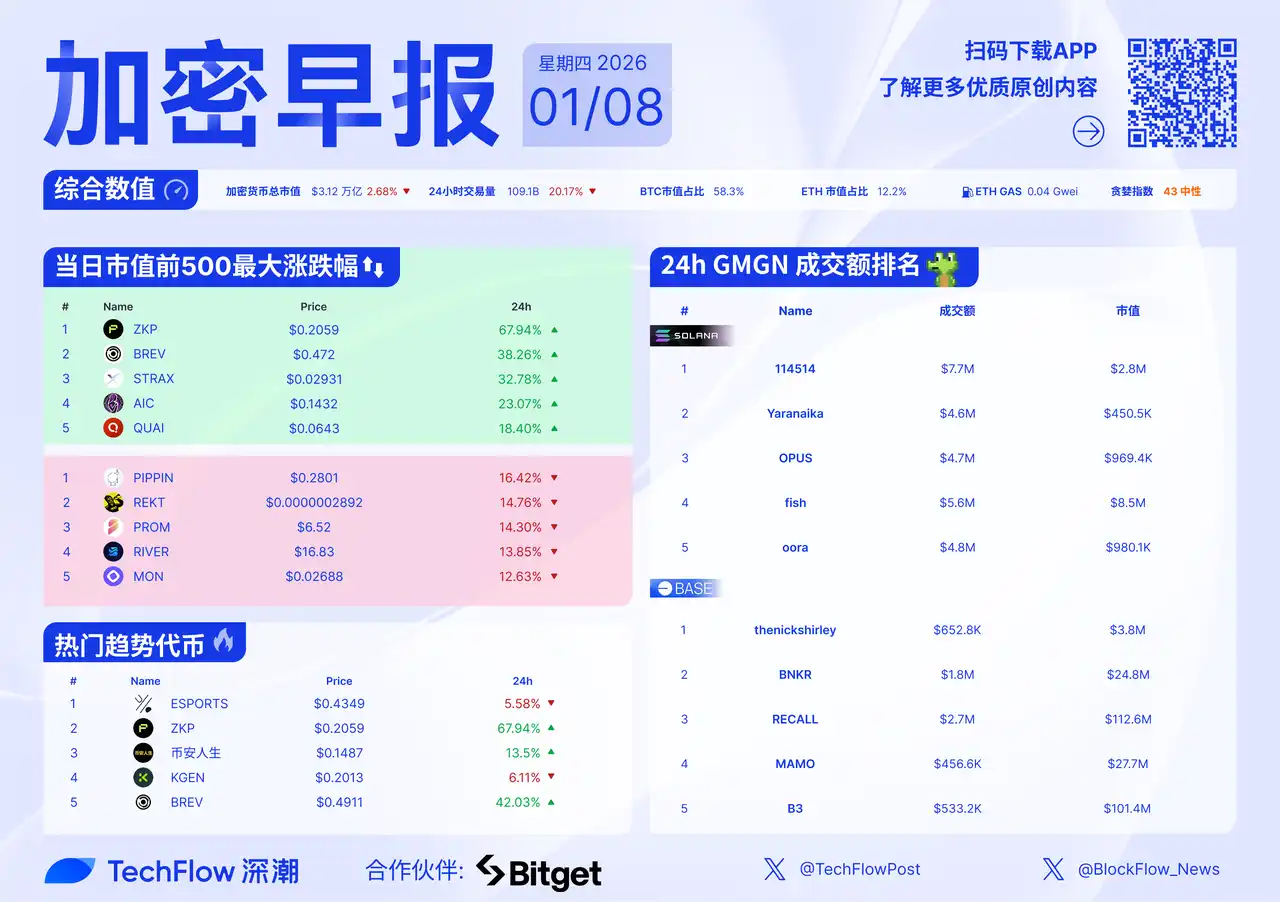
Market Dynamics
Recommended Reading
The People Need a Bad Capitalist, AI Created a Delivery Rumor
This article discusses a recent anonymous爆料 post on Reddit that sparked public outcry. The post accused food delivery platforms of using algorithms to exploit drivers, leading to heated discussions and emergency PR responses from two major delivery companies. However, it was later revealed that the爆料 post and its related "evidence" were generated by AI, highlighting the potential risks of AI technology in creating misinformation and reflecting public distrust towards platform companies.
Conversation with BNB Chain Growth Executive Director: Why Am I Bullish on BNB's Next Decade?
Through an interview with BNB Chain Growth Executive Director Nina Rong, this article explores the BNB Chain ecosystem, growth strategies, the significance of hackathon events, and Nina's advice for the Web3 industry. The article also covers BNB Chain's technical advantages, user base, infrastructure, and competitiveness against other public blockchains. Nina shares her career experience, industry insights, and advice for newcomers.
Conversation with Blockworks Co-founder: 27 Predictions for 2026 — Ethereum Revival, Solana Silence, Bitcoin Faces Quantum Shadow
This article is an in-depth discussion of 27 predictions for the crypto industry in 2026, covering development trends in major ecosystems like DeFi, Ethereum, Bitcoin, and Solana, as well as future prospects in areas such as quantum computing, enterprise chains, and venture capital trends. The author believes 2026 will be a crucial year for industry consolidation and fundamentals-driven development, emphasizing that builders need to focus on long-term value creation while pointing out potential challenges and opportunities.
OKX Ventures 2026 Investment Outlook: Asset On-Chaining, Intelligence and Privacy
This article details future trends in the crypto industry for 2026, including asset on-chaining, changes in entities and rules, and the deep integration of AI and crypto. It also discusses the trend of institutional adoption of crypto assets, the importance of privacy protection, and the development direction of DeFi active intelligent services and prediction markets.
Dragonfly Partner Review: The Three Strongest Figures in Crypto VC History
This article analyzes three of the most outstanding venture capitalists in the crypto space: Dan Robinson, Chris Dixon, and Kyle Samani. Their investment achievements and unique philosophies have secured their prominent positions in the industry. The article also touches upon the current state and future trends of the crypto venture capital industry, along with some hot crypto news.






