Crypto Morning Report: Cryptocurrencies, U.S. Stocks, and Precious Metals Fall Across the Board; Trump to Announce New Fed Chair Tonight

marsbitОпубліковано о 2026-01-30Востаннє оновлено о 2026-01-30

Анотація

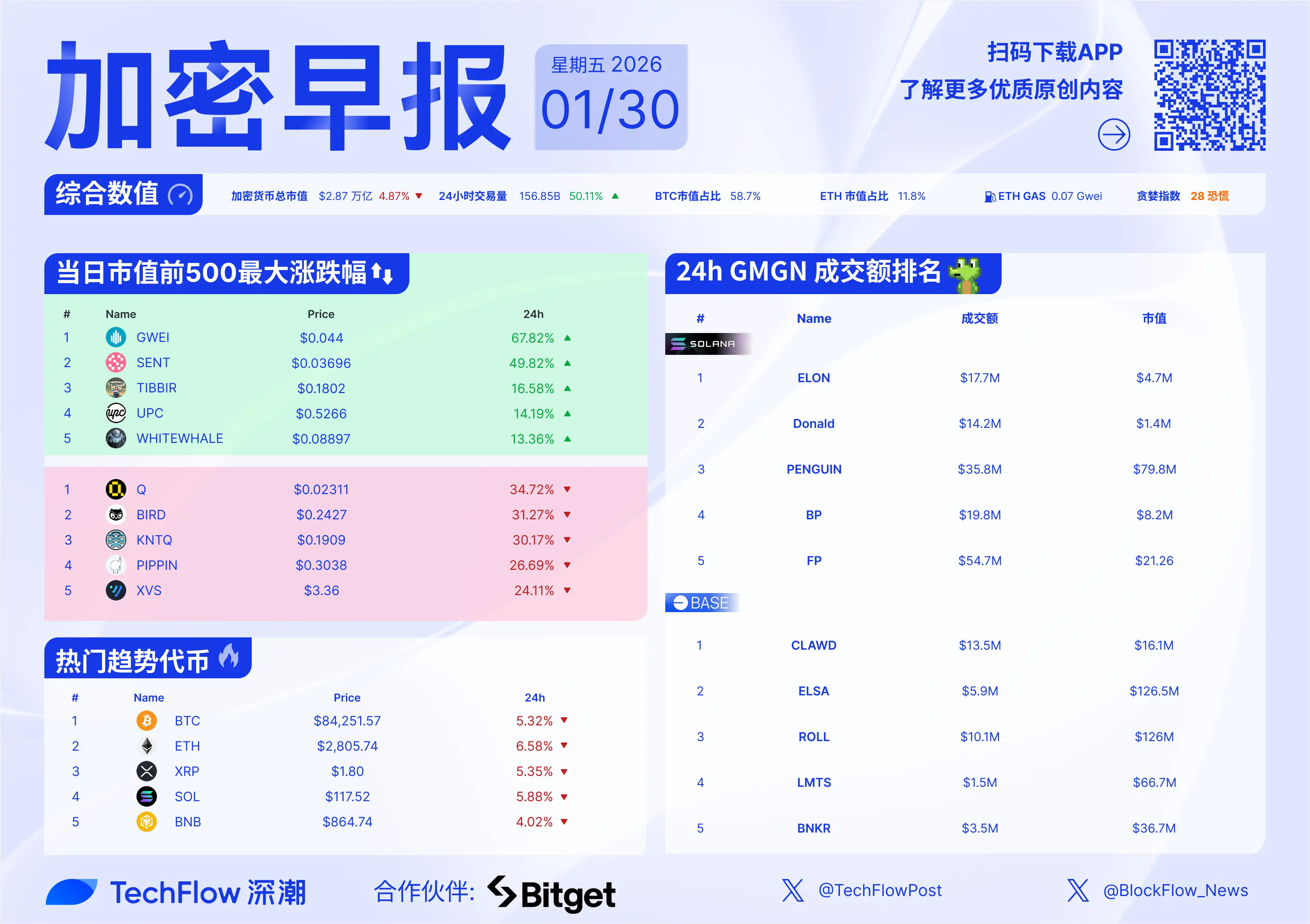
Crypto, U.S. stocks, and precious metals experienced a broad decline. Bitcoin fell below $84,000, while Ethereum dropped under $2,800. Key U.S. economic data showed higher-than-expected initial jobless claims. Meanwhile, progress was reported in U.S. Senate negotiations to avoid a government shutdown. In regulatory news, the SEC Chair suggested it may be time to allow cryptocurrencies into 401(k) retirement accounts. Several major firms made significant moves: BitMine staked an additional 314,496 ETH, ALT5 Sigma approved a $100M stock buyback, and crypto custodian Copper is reportedly exploring an IPO with major banks involved. Talos, a crypto trading software provider, raised $45M with participation from Robinhood and a16z. Metaplanet announced plans to raise approximately $135M primarily to increase Bitcoin holdings, while OSL Group completed a $200M equity financing to expand its global stablecoin and payment services. The article also includes recommended reads covering topics such as criticism against Binance's CZ, Ledger's security issues ahead of its IPO, the 2026 wave of crypto company public listings, and an analysis of privacy in the age of AI featuring Zcash's founder.

Author: Deep Tide TechFlow

Yesterday's Market Dynamics

BTC Fell Below $84,000 This Morning, ETH Dropped Below $2,800

HTX market data shows that BTC fell below $84,000 this morning and is currently trading at $84,520; ETH dropped below $2,800 and is now at $2,813.

U.S. Initial Jobless Claims for the Week Ending January 24: 209,000, Expected 205,000

According to Jinshi Data, U.S. initial jobless claims for the week ending January 24 were 209,000, compared to an expectation of 205,000. The previous figure was revised from 200,000 to 210,000.

U.S. Senate Republican Leader: Closer to Reaching a Deal to Avoid Government Shutdown

As reported by Jinshi Data, U.S. Senate Republican Leader Thune stated that they are closer to reaching a deal to avoid a government shutdown. Under the latest agreement, the Department of Homeland Security will receive temporary funding.

SEC Chair: Now Is the Right Time to Allow Cryptocurrencies into 401k Retirement Accounts

According to Crypto Rover, U.S. Securities and Exchange Commission (SEC) Chair Paul Atkins said, "Now is the right time to allow cryptocurrencies into 401k retirement accounts."

Moonbirds: BIRB Claim Now Open

As per an official announcement, Moonbirds has announced that the BIRB token claim and Nesting 2.0 are now live.

BitMine Stakes Another 314,496 ETH, Valued at $887 Million

According to on-chain analyst Onchain Lens (@OnchainLens), the largest Ethereum holding institution, BitMine, has staked an additional 314,496 ETH, worth $887 million.

BitMine's total staking amount has risen to 2,831,392 ETH, valued at $7.98 billion.

ALT5 Sigma Board Approves Up to $100 Million Stock Buyback Plan and WLFI Accumulation Plan

As reported by Businesswire, the board of NASDAQ-listed WLFI treasury company ALT5 Sigma (NASDAQ: ALTS) has authorized a stock buyback plan of up to $100 million, with repurchase prices below net asset value, allowing the buyback of up to 50 million shares, representing about 40% of outstanding shares. The board also approved increasing holdings of $WLFI tokens. The company currently holds approximately 7.3 billion $WLFI tokens, worth about $1.5 billion.

ALT5 CEO Tony Isaac stated that the company will continue to expand USD1-related integrations to increase corporate utility, trading volume, and long-term revenue opportunities.

Crypto Custody Provider Copper in Talks for IPO; Goldman Sachs, Citi, and Deutsche Bank May Participate

According to CoinDesk, cryptocurrency custody service provider Copper is in preliminary talks for a potential public listing. Insiders revealed that Goldman Sachs, Citi, and Deutsche Bank may be involved in the listing process, with the final decision depending on the company's recent revenue performance.

It is reported that Copper provides institutional-grade crypto infrastructure based on Multi-Party Computation (MPC) technology, including custody, settlement, and prime brokerage services, aiming to reduce counterparty risk for banks and trading firms.

Crypto Trading Software Provider Talos Raises $45 Million; Robinhood, a16z, Among Participants

According to CoinDesk, Robinhood participated in the extended Series B funding round for crypto trading platform Talos, valuing the company at approximately $1.5 billion. This funding round totaled $45 million, with new strategic investors including Sony Innovation Fund, IMC, QCP, and Karatage, alongside returning investors such as a16z crypto, BNY, and Fidelity Investments.

Johann Kerbrat, Senior Vice President and General Manager of Robinhood Crypto, stated that Talos's flexibility and rapid adaptability will help Robinhood deepen liquidity and provide more advanced features for crypto customers.

Metaplanet Announces Plan to Raise Approximately $135 Million, Primarily to Increase Bitcoin Holdings and Invest in Bitcoin Yield Businesses

According to an official announcement, Metaplanet's board has resolved to issue common stock and the 25th series share subscription rights through a third-party placement, planning to raise a total of approximately $135 million.

Metaplanet stated that the proceeds will be primarily used to increase Bitcoin holdings and invest in Bitcoin yield businesses, while also repaying part of the credit line borrowings. The company held 35,102 Bitcoins as of the end of 2025.

OSL Group Completes $200 Million Equity Financing to Accelerate Global Stablecoin and Payment Business Expansion

As reported by PRNewswire, Hong Kong-listed stablecoin trading and payment platform OSL Group (863.HK) announced the completion of a $200 million (approximately HK$1.56 billion) equity financing. According to the plan, the net proceeds will be used for strategic acquisitions, expanding global payment and stablecoin businesses, product and technology infrastructure development, and general working capital.

In 2025, OSL Group made significant progress in developing a compliant stablecoin trading and payment ecosystem, including the acquisition of Web3 payment service provider Banxa, the launch of B2B payment solution OSL BizPay for corporate clients, and the issuance of compliant USD stablecoin USDGO.

Market Dynamics
Recommended Reading

When CZ Was Collectively Criticized

This article discusses the controversies and criticisms surrounding Binance founder Changpeng Zhao (CZ) and his exchange during the bear market, particularly focusing on the flash crash event on October 10, 2022, and the listing issues of Binance's Alpha project. It analyzes the background of these criticisms, market sentiment, and the impact on CZ personally and on Binance.

Ledger IPO: A Dark Comedy About 'Security'

This article focuses on the security issues, data breaches, and the upcoming IPO background of cryptocurrency hardware wallet company Ledger. Despite the company's core selling point being "security," multiple major security vulnerabilities and the resulting trust crisis have had a profound impact on its users and brand. However, thanks to its leading position in the crypto wallet market and industry trends, Ledger has still garnered favor from the capital market.

2026: The Upcoming IPOs of Crypto Companies

This article discusses how 2026 will witness a wave of IPOs in the crypto industry, with multiple crypto companies planning to go public, including leading enterprises in exchanges, wallets, custody, and security auditing. The article provides a detailed analysis of these companies' valuations, business models, and listing plans, and explores the challenges crypto companies face in establishing themselves in the public market.

January 29 Market Summary: Fed Holds Rates Steady as Expected; Storage Sector Continues Bull Run

This article analyzes current market dynamics, including the Fed's interest rate policy, stock and precious metal trends, as well as the volatility and divergence in the cryptocurrency market. The Fed kept rates unchanged, indicating that monetary policy has entered a wait-and-see phase while facing political pressure. The storage sector remains strong due to AI demand, but excessive gains may face a pullback. Precious metals like gold and silver have performed well recently, but speculative risks are increasing. The cryptocurrency market shows divergence, with Bitcoin and Ethereum fluctuating, while some tokens like HYPE have seen significant gains. The overall market is significantly influenced by political uncertainty and AI investment returns.

Zcash Founder on Privacy, Artificial Intelligence, and How ZEC Can Become the 'Crypto Bitcoin'

This article explores the current state and future of cryptocurrency and privacy, through an interview with Zcash founder Zuko, analyzing privacy technology, user experience, governance mechanisms, and privacy challenges in the AI era. The article emphasizes that privacy is an indispensable survival tool in the digital age and introduces the new concept of "static value privacy."


Пов'язані питання

QWhat were the key cryptocurrency price movements mentioned in the article?

ABTC dropped below $84,000 and was trading at $84,520, while ETH fell below $2,800 and was trading at $2,813.

QWhat significant announcement did the SEC Chairman make regarding retirement accounts?

ASEC Chairman Paul Atkins stated that it is the right time to allow cryptocurrencies into 401k retirement accounts.

QWhich company announced a major stock buyback plan and an intention to increase its holdings of WLFI tokens?

AALT5 Sigma (Nasdaq: ALTS) approved a stock buyback plan of up to $100 million and a plan to increase its holdings of WLFI tokens.

QWhat was the purpose of the $2 billion equity financing completed by OSL Group?

AThe net proceeds are intended for strategic acquisitions, expanding global payment and stablecoin businesses, product and technology infrastructure development, and general working capital.

QHow much Bitcoin does Metaplanet plan to acquire with its new funding round?

AMetaplanet announced a funding round of approximately $135 million, with the proceeds to be used primarily to increase its Bitcoin holdings. The company already held 35,102 BTC as of the end of 2025.

Пов'язані матеріали

TechFlow Intelligence Bureau: Chip Stocks Lose Trillions in a Single Day, Bitcoin Falls Below $60,000, US-Iran Conflict Escalates

**Daily Tech & Markets Roundup: AI Advances, Market Turmoil, and Geopolitical Tensions** **AI / LLMs**: Anthropic's internal report on AI self-improvement sparked serious discussions about Recursive Self-Improvement (RSI). Meanwhile, debate continues on AI coding tools after Claude was accused of introducing bugs into the rsync codebase. In positive news, DeepSeek V4 Flash impressed in local deployment tests, and GitHub Copilot now supports custom endpoints for local models. A surprising research turn suggests removing chain-of-thought prompting can sometimes improve LLM performance. **Crypto / Web3**: Bitcoin plunged below $60,000, with its RSI hitting levels last seen during the COVID-19 crash, driven by strong U.S. jobs data reviving interest rate hike fears. Discussions highlight Ethereum DeFi's continued lack of a smooth consumer payment layer. **Chips / Hardware**: Chip stocks suffered a massive sell-off, with the Philadelphia Semiconductor Index posting its worst single-day drop in six years, erasing over a trillion dollars in value. Marvell, Micron, AMD, and Intel were among the biggest losers. **Tech Companies**: A leaked Microsoft document revealing goals to make Copilot "addictive" drew criticism. LinkedIn founder Reid Hoffman left Microsoft's board to focus full-time on his AI agent startup, Manus. Google was revealed to be paying SpaceX $920 million monthly for AI training compute. **Markets & Macro**: A blowout U.S. jobs report (172k vs. 80k expected) crushed hopes for near-term rate cuts, sending Treasury yields soaring and triggering a broad market sell-off. CEOs from Kraft, McDonald's, and Whirlpool simultaneously warned U.S. consumers are exhausting their savings. **Geopolitics**: U.S.-Iran tensions escalated with missile/drone interceptions and U.S. strikes on Iranian radar sites, keeping the critical Strait of Hormuz largely closed since late February and posing ongoing oil supply risks. **The Bottom Line**: The strong jobs data acted as a single trigger for correlated sell-offs across equities, crypto, and chips. Underlying the volatility is a stark contradiction between robust employment data and warnings of consumer weakness, alongside geopolitical risks that could reignite inflation, leaving markets to price in a fraught macro outlook with no clear "soft landing" path.

marsbit1 год тому

TechFlow Intelligence Bureau: Chip Stocks Lose Trillions in a Single Day, Bitcoin Falls Below $60,000, US-Iran Conflict Escalates

marsbit1 год тому

It Took Me a Year to See the Bitter Truth About Agent Payments

After a year building infrastructure for the Agent economy, engaging with major players like Stripe, Visa, and Coinbase, the author shares a sobering analysis of the current state of Agent payments. The core finding is a stark lack of genuine, immediate demand across most envisioned use cases. The article breaks down four key market segments: 1. **Agent-to-Merchant (Consumer Shopping):** For most product categories (e.g., clothing, electronics), conversational AI shopping is a step backwards from visual e-commerce interfaces. While agents excel at understanding needs, they can't replace side-by-side product comparison. Real merchant interest is defensive "Agent Engine Optimization," not driven by current customer demand. Potential exists for high-frequency, low-decision purchases (like food delivery) or navigating complex store UIs, but these require massive B2C distribution channels dominated by giants like Amazon. 2. **Agent-to-API (Developer Services):** Developers already have subscriptions and billing relationships for APIs (compute, data). Prepaid balances solve micro-payment issues for low transaction volumes. A deeper structural problem is that major SaaS vendors' business models rely on enterprise contracts, resisting granular pay-per-call pricing. While protocols like MPP and x402 serve the long tail of niche services, this market is small and developers are historically low-willingness-to-pay. 3. **Agent-to-Agent:** This remains largely theoretical with minimal transaction volume. While it represents a long-term bet on a fundamentally new transaction infrastructure (sub-second, micro-penny to million-dollar, multi-party settlements), it does not constitute a present market. 4. **Agent-to-Finance:** This is the only category with existing, paying demand. Integrating AI into financial workflows (trading, portfolio management) is a natural evolution and enables new capabilities like autonomous rebalancing. However, competition favors established, regulated institutions. The "real problem" is not moving money between agents, but the broader challenge of **coordination**—orchestrating work between agents and humans, verifying outcomes, and settling results. Payment is just one component of settlement, which is itself part of coordination. Companies that solve the coordination layer will subsume payment, not the other way around. While well-funded incumbents build defensively for a long-term future, startups must find where the market is today—which, for the author's team, lies outside these four categories in an area of real, growing, and underserved activity.

marsbit2 год тому

It Took Me a Year to See the Bitter Truth About Agent Payments

marsbit2 год тому

It Took Me a Year to See the Hard Truth About Agent Payments

**Title: It Took Me a Year to See the Hard Truth About Agent Payments** Over the past year, I've worked on infrastructure for the Agent economy, engaging with major players like Stripe, Visa, Coinbase, and numerous startups. The findings reveal a stark reality: genuine, widespread demand for Agent-based payments does not yet exist. **Key Observations:** * **Agent-to-Merchant (Shopping):** The user experience for AI shopping often falls short, especially for visual product discovery. While AI excels at understanding needs, conversational interfaces can't yet replace browsing and comparing multiple products visually. Current merchant interest is largely defensive ("Agent Engine Optimization") for a future that hasn't arrived. High-frequency, low-friction purchases (like food delivery) are potential fits, but lack open APIs and face high AI inference costs. Simpler, more affordable, or cross-language interactions for complex UIs are a niche opportunity but require massive consumer distribution to scale. * **Agent-to-API (Developer Tools):** Developer payment needs for APIs (computing, data, models) are already met through subscriptions and prepaid credits. The core challenge is not payment friction but supplier economics: most large SaaS providers prefer enterprise contracts over micropayments for API calls. Protocols like MPP and x402 suit the long-tail of smaller services but cater to a developer market historically reluctant to pay for these tools. Major infrastructure needs at the top of the stack are already being addressed. * **Agent-to-Agent (Machine Commerce):** This is a long-term vision with almost no current transaction volume. While a future with high-speed, high-frequency, multi-party machine-to-machine transactions would require novel infrastructure, it remains theoretical. The market is not here yet. * **Agent-to-Finance:** This is the only category with clear, present demand. Financial professionals and DeFi users already pay for tools, and AI augmentation is a natural evolution. Autonomous AI agents can enable entirely new financial strategies. However, competition is fierce from established, regulated incumbents who can more easily layer AI onto their existing products. **The Core Insight:** Companies, especially giants with long time horizons, are building defensively for a potential future of mass machine commerce. For them, early investment is a low-cost hedge. For startups, the current market reality is different. The primary challenge isn't just moving money between agents (payments). The larger, unsolved problem is **orchestration** – coordinating work between agents and humans, verifying outcomes, and then settling. Payment is just a part of settlement, which is just a part of orchestration. Companies that solve the orchestration problem will subsume payments, not the other way around. After a year of building, we see the real, growing, and underserved market opportunity lies in this broader domain of orchestration.

链捕手3 год тому

It Took Me a Year to See the Hard Truth About Agent Payments

链捕手3 год тому

Торгівля

Спот
Ф'ючерси
活动图片