Crypto Morning Report: Brevis Opens Airdrop Inquiry, Trend Research Accumulates Over 46,000 ETH in a Single Day

深潮Опубліковано о 2025-12-30Востаннє оновлено о 2025-12-30

Анотація

Title: Crypto Morning Brief: Brevis Airdrop Goes Live, Trend Research Accumulates Over 46K ETH in a Day Key developments from the crypto market: - SEC Corporate Finance Deputy Director Cicely LaMothe, who led key crypto policies including memecoin classification and staking guidance, has retired. - Representative Maxine Waters criticized SEC Chair Atkins for ending enforcement actions against crypto firms like Coinbase and Binance, demanding a hearing. - ZK verifiable computing platform Brevis opened its airdrop registration portal, with claims open from Dec 29 to Jan 3. - SlowMist warned of a new NPM supply chain attack variant called "Shai-Hulud 3.0." - Flow Foundation announced a no-rollback recovery plan after a $3.9M exploit, with phased network restoration. - Trust Wallet confirmed 2,596 addresses affected in its recent security incident, with 5,000 claims submitted. - Standard Chartered and Ant International launched a blockchain-based tokenized deposit solution in Hong Kong. - Cantor Fitzgerald predicted a potential "crypto winter" by 2026 but noted continued institutional adoption. - Trend Research withdrew 13,462 ETH ($39.3M) from Binance, accumulating over 46,000 ETH in one day. - MicroStrategy purchased 1,229 BTC ($108.8M), now holding 672,497 BTC with an average cost of $74,997. - Eightco Holdings (WLD treasury) approved a $125M stock buyback plan. Market trends and recommended reads included analysis of global trading, Web3 narrative...

Author: Deep Tide TechFlow

Yesterday's Market Dynamics

SEC Corporate Finance Deputy Director Cicely LaMothe Announces Retirement, Led Multiple Cryptocurrency Policies

According to The Block, the U.S. Securities and Exchange Commission (SEC) announced on Monday that Deputy Director of Corporate Finance Cicely LaMothe is set to retire. LaMothe led several key cryptocurrency policies over the past year, including clarifying that meme coins are not securities and explaining the SEC's stance on staking. She joined the SEC's Division of Corporate Finance in 2002, having previously worked in the private sector and holding a CPA license. LaMothe's retirement comes as the SEC enters its second year of a more crypto-friendly direction, during which it has approved listing standards for specific crypto ETFs, initiated the "Crypto Project" to update digital asset rules, and dismissed enforcement cases against several prominent crypto companies. The SEC also announced that Nekia Hackworth Jones, Deputy Director of the Southeast Regional Office in the Division of Enforcement, completed her term at the end of December.

Democratic Congresswoman Waters Criticizes SEC Chairman Atkins for Terminating Crypto Enforcement Actions, Demands Hearing

According to CoinDesk, House Financial Services Committee Ranking Member Maxine Waters sent a letter to Committee Chairman French Hill on Monday, demanding that Chairman Paul Atkins appear at a hearing regarding the termination of major enforcement actions against crypto companies like Coinbase, Binance, and Justin Sun. Waters questioned the SEC's rationale for dropping these cases and how it plans to prevent market fraud, noting that some companies announced the terminations before the committee's formal vote. She also criticized Atkins for using the SEC agenda as a government tool, implementing policy shifts through staff statements rather than formal rulemaking.

Brevis Launches Airdrop Registration and Eligibility Check Portal

The ZK verifiable computing platform Brevis has launched an airdrop registration and eligibility check portal. Users must first check if they are eligible and complete all necessary steps before applying. The application window will be open from December 29 to January 3. The allocation amount will be announced when claiming opens in the future.

SlowMist: New Variant of NPM Supply Chain Attack, Shai-Hulud 3.0, Reappears

SlowMist Chief Information Security Officer 23pds issued a security alert stating that the latest variant of the NPM supply chain attack, Shai-Hulud 3.0, has reappeared, warning all projects and platforms to strengthen their defenses. The previous Trust Wallet API key leak may have been a result of the Shai-Hulud 2.0 attack.

Flow Foundation: Releases No-Rollback Recovery Plan, Over 99.9% of Accounts Unaffected

The Flow Foundation has proposed a new plan to address the security vulnerability that occurred on December 27. Developed in consultation with bridge operators, exchanges, and infrastructure partners, the plan's main features are:

  • No Network Rollback: There will be no network reorganization or requirement for partners to replay transactions.

  • Preservation of Legitimate User Activity: Over 99.9% of accounts are unaffected and will function normally after the restart.

  • Precise Fixes: Temporary restrictions will only be applied to accounts that received fraudulent tokens.

  • Transparent Handling: Fraudulent tokens will be burned via on-chain transactions verified by an independent blockchain forensics company for transparency and auditability.

The recovery plan will be implemented in four phases:

  1. Cadence Environment Recovery Goes Live, EVM Temporarily Read-Only.

  2. Cadence Environment Repair Completed (approx. 24-48 hours).

  3. EVM Environment Repaired and Re-enabled.

  4. Bridges/Exchanges Resume Operations After Verifying Network Stability.

The attack resulted in approximately $3.9 million in assets being transferred. The Flow Foundation is currently working closely with validators and the community to ensure a secure recovery.

Trust Wallet CEO: Security Incident Confirmed to Affect 2,596 Addresses, Reimbursement Verification Ongoing

Trust Wallet CEO Eowync.eth provided an update on December 29th, stating the company is actively investigating the browser extension v2.68 security incident. 2,596 wallet addresses have been confirmed affected so far, and the team has received about 5,000 reimbursement claims. The company is carefully verifying each claim to distinguish genuine victims from malicious actors and promises to share more investigation details tomorrow. This incident and the subsequent reimbursement work have become the company's top priority, with all team members working full-time on it.

Standard Chartered Bank and Ant International Launch Blockchain-Based Deposit Tokenization Solution in Hong Kong

Standard Chartered Bank (SCBHK) and Ant International have officially commercially launched a blockchain-based tokenized deposit solution, enabling real-time, 24/7 fund transfers in HKD, offshore RMB, and USD. The system, via Ant International's proprietary Whale platform, provides global enterprises with "just-in-time" liquidity management, overcoming traditional banking time constraints and settlement delays.

Investment Bank Cantor Fitzgerald Predicts New "Crypto Winter" in 2026, But Institutional Adoption Continues to Grow

According to CoinDesk, Cantor Fitzgerald analyst Brett Knoblauch predicted in a recent report that Bitcoin may be entering a long-term downtrend, reflecting its historical four-year cycle pattern, with prices potentially testing MicroStrategy's average cost basis of around $75,000. However, unlike past cycles, this "crypto winter" will not see massive liquidations or structural collapses but will be characterized by institutional investors driving market direction.

Trend Research Withdraws Another 13,462 ETH, Accumulates Over 46,000 ETH in a Single Day

According to on-chain analyst Ai Yi (@ai_9684xtpa) monitoring, Trend Research withdrew another 13,462 ETH (worth approx. $39.31 million) from Binance 5 minutes ago.

The institution's on-chain ETH holdings are now updated to 626,071, with a total value exceeding $1.83 billion and an average holding cost of approx. $3,105.5. Currently, the institution is facing an unrealized loss of approx. $110 million. Data shows Trend Research accumulated 46,036.72 ETH within a single day.

MicroStrategy Adds 1,229 Bitcoin Last Week, Now Holds Total of 672,497 Bitcoin

According to a tweet by MicroStrategy founder and Executive Chairman Michael Saylor, MicroStrategy has purchased an additional 1,229 bitcoin for approximately $108.8 million in cash, at an average price of approximately $88,568 per bitcoin. As of December 28, 2025, MicroStrategy holds 672,497 bitcoin acquired for approximately $50.44 billion at an average purchase price of $74,997 per bitcoin. MicroStrategy's bitcoin investment is up 23.2% year-to-date for 2025.

WLD Treasury Company Eightco Holdings Launches $125 Million Stock Buyback Plan

According to PRNewswire, Nasdaq-listed WLD treasury company Eightco Holdings announced that its board of directors has approved the initiation of a stock repurchase program of up to $125 million. The company also stated it will promote the construction of a universal digital identity and authentication framework through strategic investments and partnerships to address the challenges of the evolving identity verification market brought by large-scale AI applications.

Market Trends
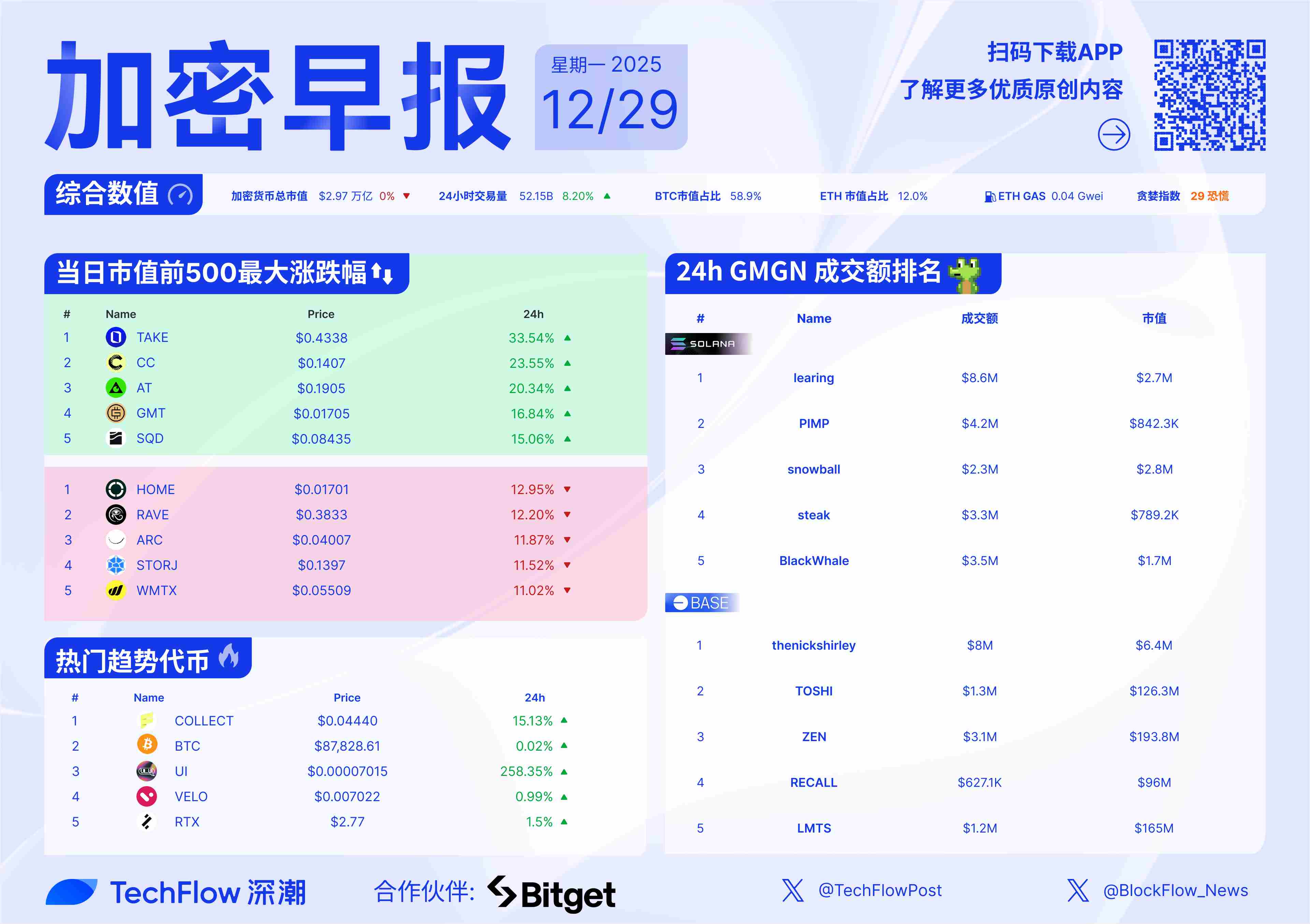
Recommended Reading

2025 Global Trading Guide: 11 Key Trades Amidst Intertwined Politics and Markets

This article provides a comprehensive analysis of key trades and trends in the global financial markets for 2025, covering investment dynamics and their underlying political and economic backgrounds across various fields including cryptocurrency, artificial intelligence, defense stocks, gold, and bond markets.

In Today's Web3 Narrative, Everyone Loves a Sense of Contrast

This article explores the importance of introducing "contrast" in Web3 narratives, emphasizing that contrast and transformation make content more engaging and resonant. The article points out that content lacking contrast often appears bland, while contrast can spark reader interest, create memorable points, and even make content more authentic and credible. Showcasing genuine transformation and emotional resonance can make content stand out.

Silver Soars: 25% Surge in 10 Days, Buy Now or Sell?

This article analyzes recent fluctuations in the silver market and the driving factors behind them. It mentions reasons for the recent sharp rise in silver prices, including China's implementation of a licensing system for silver exports, increased demand for silver from the solar industry, the impact of a stronger US dollar on precious metal prices, and margin hikes in the futures market. Furthermore, the article discusses the supply and demand fundamentals of the silver market, the feasibility and timeline of copper substitution, and the current state of market speculation. The article concludes with short-term and long-term market investment advice and reminds investors to pay attention to relevant market signals.

Deciphering Messari's 100,000-Word Annual Report (Part 2): ETH Underperforms BTC, Marginalization or Pricing Dilemma?

This article analyzes Ethereum's (ETH) market performance during 2024-2025, exploring the reasons for its underperformance compared to Bitcoin (BTC). Based on Messari's annual report, it delves into ETH's value capture dilemma, the impact of multi-chain competition, and the relationship between ETH and BTC. Although ETH dominates in on-chain finance, stablecoins, and institutional settlement, its pricing logic as an asset has become more complex, and the market's perception of its value is not yet fully independent of BTC.

Crypto Payments 2049 | Can Stablecoins Cross the Chasm?

This article discusses the possibility of stablecoins moving from the crypto market to the real economy, analyzing the challenges and breakthroughs regarding institutional gaps. Using the theoretical framework of "Crossing the Chasm," it explores the gaps between stablecoins and public monetary arrangements in terms of equivalence, elasticity, and integrity. Through case studies of regulatory paths in the EU, US, and Hong Kong, it further proposes the possibility of stablecoins achieving localized crossing in specific scenarios and their structural impact on the financial system.


Трендові криптовалюти

Пов'язані питання

QWhat key SEC official retired recently, and what was their role in cryptocurrency policy?

ASEC Division of Corporate Finance Deputy Director Cicely LaMothe retired. She led several key crypto policies, including clarifying that memecoins are not securities and explaining the SEC's stance on staking.

QWhat action did Brevis take regarding its airdrop, and what are the important dates?

ABrevis launched an airdrop registration and eligibility query portal. The application window is open from December 29th to January 3rd.

QHow much ETH did Trend Research accumulate in a single day, and what is their current average holding cost?

ATrend Research accumulated over 46,036.72 ETH in a single day. Their current average holding cost is approximately $3,105.5 per ETH.

QWhat was the nature of the security incident on the Flow network, and what is the recovery plan?

AA security incident on the Flow network led to approximately $3.9 million in assets being transferred. The recovery plan involves a four-phase process to restore the Cadence and EVM environments without a network rollback, aiming to leave over 99.9% of accounts unaffected.

QWhat new blockchain-based financial solution was launched by Standard Chartered Bank and Ant International?

AStandard Chartered Bank (Hong Kong) and Ant International commercially launched a blockchain-based tokenized deposit solution for real-time, 24/7 fund transfers in HKD, offshore RMB, and USD via Ant's proprietary Whale platform.

Пов'язані матеріали

GPT-5.6 Countdown: Abandon the Illusion of a Single API, Computational Iteration Can't Outpace a Single Page of Compliance

In mid-June, three seemingly independent industry events—the compliance-driven throttling of Fable 5, the open-sourcing of GLM-5.2, and the leaked release timeline for GPT-5.6—are pushing the global AI industry toward a watershed moment. These shifts signal a fundamental restructuring of the industry's underlying logic. First, **"usability" has substantially overtaken "advanced capabilities"** as the primary weight, pushing the global large language model (LLM) supply chain into a "dual-track" phase of controlled closed-source and local open-source coexistence. Second, **the competitive moats of closed-source giants are shifting**. Their technical focus is moving from "language intelligence" toward "spatial intelligence (world models)"—a domain heavily reliant on computing power. Third, faced with常态化 transnational compliance risks, **a "model-agnostic" decoupled design has become a survival necessity for application-layer developers to maintain business continuity.** The article details how Anthropic's Fable 5, despite its advanced engineering feats, was restricted for non-U.S. citizens within 72 hours of launch, highlighting how geopolitical compliance can instantly limit even the most advanced models. In response, the open-source camp, exemplified by Zhipu AI's MIT-licensed GLM-5.2, is gaining market share by offering stable performance improvements and significant cost advantages (up to 70% savings for enterprises), while achieving full adaptation with domestic semiconductor platforms. Meanwhile, closed-source leaders like OpenAI are pivoting. The anticipated GPT-5.6 reportedly shifts focus from language to spatial intelligence and world models, aiming to rebuild a generational gap in areas like 3D understanding, simulation, and industrial design that demand immense compute. The core conclusion is that the LLM supply chain's logic has changed. Enterprises must now evaluate infrastructure based on a composite of technical performance and policy compliance. For developers, complete reliance on a single closed-source API poses unacceptable risk. Implementing a truly model-agnostic architecture—enabling swift switches to compliant, locally deployable open-source alternatives—is no longer just good practice but a fundamental baseline for business continuity.

marsbit1 год тому

GPT-5.6 Countdown: Abandon the Illusion of a Single API, Computational Iteration Can't Outpace a Single Page of Compliance

marsbit1 год тому

Is the 'Token Subsidy War' Among AI Giants Almost Over?

The article discusses the ongoing "token subsidy war" among AI giants like OpenAI and Anthropic, questioning whether it's nearing its end. It reveals that current AI subscription prices are heavily subsidized, with some plans offering tokens at up to 70 times the actual cost to attract and retain heavy users, especially developers and enterprises. This strategy mirrors past internet-era subsidy battles, but with a key difference: AI tokens lack "lock-in" effects. Unlike ride-hailing or food delivery apps, users can easily switch between AI providers as APIs become standardized, making it difficult for companies to raise prices post-subsidy. The piece highlights a structural asymmetry in the competition. Giants like Google, with massive advertising revenue, can afford to subsidize tokens indefinitely, akin to using "tokens as a weapon." In contrast, venture-backed companies like OpenAI and Anthropic face pressure to become profitable, especially as they approach IPO. The article cites Google Ventures founder Bill Maris, who suggests Google could slash token prices by 80%, putting immense pressure on competitors. Two potential endgames are presented: the "internet service" model (subsidize, monopolize, then raise prices) and the "utility" model (tokens become a standardized, low-margin commodity like electricity). Given the low switching costs, the latter seems more likely. The competition may not have a single winner but could instead accelerate AI's evolution into a foundational, infrastructure-level technology, akin to a public utility. For now, users continue to benefit from heavily subsidized token costs.

marsbit1 год тому

Is the 'Token Subsidy War' Among AI Giants Almost Over?

marsbit1 год тому

Beyond the Stadium: The Profitable Games Surrounding the World Cup

"Beyond the Pitch: The Profit Game Around the World Cup" The FIFA World Cup transcends being a sporting spectacle, evolving into a massive global arena for speculation and profit-seeking. The 2026 tournament has amplified this dynamic, creating a multi-layered ecosystem of financial opportunism alongside the football. **Prediction markets** have surged into the mainstream. Platforms like Polymarket and Kalshi saw trading volumes for World Cup contracts soar, attracting new users with their financial trading model and high-profile, chain-based wealth stories that overshadow traditional sports betting in terms of growth and narrative. However, **traditional sportsbooks** remain the dominant force, leveraging established user habits, legal markets, and comprehensive product offerings to handle the vast majority of speculative wagers, with projections suggesting record-breaking betting volumes. Capital markets also react. **"Concept stocks"** in countries like South Korea and Japan experience volatile price swings based on team performance and anticipated fan spending on items like chicken, beer, and viewing parties, effectively becoming a stock market reflecting fan sentiment. The **ticket resale market** has become a sophisticated arena for arbitrage. Prices fluctuate wildly based on team draws and star power, with sellers sometimes listing tickets they don't yet own in a practice akin to short-selling, while FIFA's own "Right to Buy" tokens add another layer of speculative trading. **Collectibles and merchandise** offer another avenue. Panini sticker albums, with their inherent scarcity and nostalgic value, can become high-value collectibles. Limited-edition or locally themed jerseys command significant premiums on secondary markets, and even counterfeit vendors profit from fans' desire for affordable match-day identity. The **cryptocurrency** space has seen a frenzy of speculative, unauthorized World Cup-themed meme coins on chains like Solana. These tokens, often exploiting team names and player imagery, experience extreme pump-and-dump cycles, creating stories of massive gains for a few early entrants and steep losses for many others. Finally, an entire industry thrives on **providing information and tools** to other speculators. Developers create platforms like SeatSidekick to track ticket inventory and prices, while paid Telegram groups and subscriptions sell betting tips and predictions, monetizing the widespread desire for an informational edge. In essence, the World Cup has become a compressed, global laboratory for speculation. While the games determine champions on the field, a parallel, complex network of financial transactions—spanning prediction contracts, bets, stocks, tickets, collectibles, crypto, and information services—settles its own scores in the global market.

marsbit2 год тому

Beyond the Stadium: The Profitable Games Surrounding the World Cup

marsbit2 год тому

How Does Codex Use a Computer? Three Entry Points and Permission Boundaries

This article explains the three primary methods for Codex to interact with a computer, each with distinct use cases, permission boundaries, and trust levels. **1. Computer Use:** This offers the broadest access, allowing Codex to visually control and interact with the graphical user interface of authorized macOS/Windows apps, system settings, and even iOS simulators. It's ideal for tasks lacking APIs or structured tools, such as operating legacy software or multi-app workflows. However, it's the slowest method and has the widest permission scope, requiring careful supervision for sensitive actions. **2. Chrome Extension:** This grants Codex access to the user's logged-in Chrome browser state, including cookies, profiles, and open tabs. It's best for tasks requiring user identity across websites like Gmail, LinkedIn, Salesforce, or internal dashboards. Its key advantage is multi-tab control for complex workflows. While more powerful for browser-based tasks than Computer Use, it carries higher sensitivity as actions are performed under the user's identity. **3. In-App Browser:** This is a browser isolated within the Codex thread, separate from the user's personal browsing data. It excels in web development and debugging scenarios—previewing local servers, testing responsive layouts, or annotating designs directly on the page. Its isolation is a strength for development but a limitation for tasks requiring login sessions. The core principle is to choose the narrowest, safest, and most structured interface for the task. Use plugins or MCPs first, resort to visual control (Computer Use) only for GUI-dependent tasks, employ the Chrome extension for identity-reliant browser work, and prefer the In-App Browser for isolated development. **Appshots** are clarified as a fourth, complementary tool for *inputting* context—capturing a screenshot of a window to point Codex to something—rather than a method for Codex to *act*. Together, this layered approach highlights a key to AI agent productization: not granting unlimited permissions, but constraining them within clear boundaries for specific tasks while preserving user oversight.

marsbit3 год тому

How Does Codex Use a Computer? Three Entry Points and Permission Boundaries

marsbit3 год тому

Торгівля

Спот
Ф'ючерси

Популярні статті

Що таке XAG

XAGUSDT Перпетуальний контракт - це торговий символ для срібла, ціна якого вказана в доларах США, що представляє 1 тройську унцію срібла.

7 переглядів усьогоОпубліковано 2026.06.18Оновлено 2026.06.18

Що таке XAG

Як купити XAG

Ласкаво просимо до HTX.com! Ми зробили покупку Silver (XAG) простою та зручною. Дотримуйтесь нашої покрокової інструкції, щоб розпочати свою криптовалютну подорож.Крок 1: Створіть обліковий запис на HTXВикористовуйте свою електронну пошту або номер телефону, щоб зареєструвати обліковий запис на HTX безплатно. Пройдіть безпроблемну реєстрацію й отримайте доступ до всіх функцій.ЗареєструватисьКрок 2: Перейдіть до розділу Купити крипту і виберіть спосіб оплатиКредитна/дебетова картка: використовуйте вашу картку Visa або Mastercard, щоб миттєво купити Silver (XAG).Баланс: використовуйте кошти з балансу вашого рахунку HTX для безперешкодної торгівлі.Треті особи: ми додали популярні способи оплати, такі як Google Pay та Apple Pay, щоб підвищити зручність.P2P: Торгуйте безпосередньо з іншими користувачами на HTX.Позабіржова торгівля (OTC): ми пропонуємо індивідуальні послуги та конкурентні обмінні курси для трейдерів.Крок 3: Зберігайте свої Silver (XAG)Після придбання Silver (XAG) збережіть його у своєму обліковому записі на HTX. Крім того, ви можете відправити його в інше місце за допомогою блокчейн-переказу або використовувати його для торгівлі іншими криптовалютами.Крок 4: Торгівля Silver (XAG)Легко торгуйте Silver (XAG) на спотовому ринку HTX. Просто увійдіть до свого облікового запису, виберіть торгову пару, укладайте угоди та спостерігайте за ними в режимі реального часу. Ми пропонуємо зручний досвід як для початківців, так і для досвідчених трейдерів.

9 переглядів усьогоОпубліковано 2026.06.18Оновлено 2026.06.18

Як купити XAG

Як купити XAU

Ласкаво просимо до HTX.com! Ми зробили покупку Gold (XAU) простою та зручною. Дотримуйтесь нашої покрокової інструкції, щоб розпочати свою криптовалютну подорож.Крок 1: Створіть обліковий запис на HTXВикористовуйте свою електронну пошту або номер телефону, щоб зареєструвати обліковий запис на HTX безплатно. Пройдіть безпроблемну реєстрацію й отримайте доступ до всіх функцій.ЗареєструватисьКрок 2: Перейдіть до розділу Купити крипту і виберіть спосіб оплатиКредитна/дебетова картка: використовуйте вашу картку Visa або Mastercard, щоб миттєво купити Gold (XAU).Баланс: використовуйте кошти з балансу вашого рахунку HTX для безперешкодної торгівлі.Треті особи: ми додали популярні способи оплати, такі як Google Pay та Apple Pay, щоб підвищити зручність.P2P: Торгуйте безпосередньо з іншими користувачами на HTX.Позабіржова торгівля (OTC): ми пропонуємо індивідуальні послуги та конкурентні обмінні курси для трейдерів.Крок 3: Зберігайте свої Gold (XAU)Після придбання Gold (XAU) збережіть його у своєму обліковому записі на HTX. Крім того, ви можете відправити його в інше місце за допомогою блокчейн-переказу або використовувати його для торгівлі іншими криптовалютами.Крок 4: Торгівля Gold (XAU)Легко торгуйте Gold (XAU) на спотовому ринку HTX. Просто увійдіть до свого облікового запису, виберіть торгову пару, укладайте угоди та спостерігайте за ними в режимі реального часу. Ми пропонуємо зручний досвід як для початківців, так і для досвідчених трейдерів.

9 переглядів усьогоОпубліковано 2026.06.18Оновлено 2026.06.18

Як купити XAU

Обговорення

Ласкаво просимо до спільноти HTX. Тут ви можете бути в курсі останніх подій розвитку платформи та отримати доступ до професійної ринкової інформації. Нижче представлені думки користувачів щодо ціни A (A).

活动图片