Crypto Morning Brief: U.S. Government Shutdown Ends, MetaMask Integrates Ondo Finance to Launch Tokenized U.S. Stock Trading Feature

marsbitОпубліковано о 2026-02-04Востаннє оновлено о 2026-02-04

Анотація

This crypto market digest covers key developments from February 3, 2026. The U.S. government ended its partial shutdown after President Trump signed a funding bill. Regulatory progress continues as Senate Democrats plan another closed-door meeting on the CLARITY Act, while the Avalanche Policy Alliance established an advisory committee to push for global regulatory coordination. In product updates, MetaMask integrated with Ondo Finance, enabling non-U.S. users to trade over 200 tokenized U.S. stocks and ETFs directly using USDC. BNB Chain introduced new application-layer standards (BAPs) and a non-fungible agent (NFA) token standard. Tether launched MiningOS, an open-source Bitcoin mining operating system. On the security front, Step Finance confirmed a $40 million treasury exploit due to a team device breach but has recovered approximately $4.7 million so far. Market sentiment was impacted by a triple threat: poor earnings from major tech companies, uncertainty around the new Fed chair nomination, and a sharp correction in precious metals. Bitcoin fell below $80,000, triggering a record $2.55 billion in liquidations. Despite the bearish trend, analysts from Wintermute anticipate a potential market recovery in the second half of 2026, citing solid industry infrastructure. Other notable news includes Tria's tokenomics reveal for its 10 billion TRIA token supply and a court filing suggesting Jeffrey Epstein may have indirectly invested $3.25 million in Coinbase's 2014 Serie...

Author: Deep Tide TechFlow

Yesterday's Market Dynamics

Trump Signs Funding Bill Early This Morning, Ending Partial Government Shutdown

According to Jinshi Data, on February 3 local time, U.S. President Trump signed the government funding bill in the Oval Office of the White House, ending the partial government shutdown. Earlier that day, the U.S. House of Representatives voted to pass the funding bill for several federal departments for the remainder of the fiscal year, resolving the partial government shutdown that began on January 31. The bill will provide funding for several federal departments until September 30, the end of the fiscal year, and provide two weeks of funding for the Department of Homeland Security, which has recently faced controversy and protests over immigration enforcement actions, to allow all parties to continue negotiations on improving the department's operations.

Crypto Journalist: U.S. Senate Democrats Plan Another Closed-Door Meeting on the CLARITY Act Tomorrow

According to cryptocurrency journalist Eleanor Terrett early this morning, U.S. Senate Democrats plan to convene another closed-door meeting tomorrow to discuss the CLARITY Act (Cryptocurrency Market Structure Act). Two informed sources revealed that this will be the first meeting of Democratic members since the Senate Banking Committee postponed the bill's review last month.

Avalanche Policy Alliance Forms Advisory Committee, Calls for Global Crypto Regulatory Coordination

According to The Block, the Avalanche Policy Alliance announced the formation of an advisory committee on February 3, led by Ava Labs General Counsel Lee Schneider, with UK House of Lords member Chris Holmes and several Avalanche ecosystem executives joining. The committee will focus on three core priorities in 2026: token classification, definition of intermediaries, and protecting internet access rights.

The committee's formation comes as the U.S. is working to pass comprehensive crypto regulation, the EU has begun implementing MiCA regulations, the UK plans to introduce a new regulatory framework by 2027, and Japan continues to lead in rule-making.

BNB Chain Releases Application Layer Standard BAPs and NFA Token Standard BAP-578

According to an official announcement, BNB Chain has released a new application layer standard, BAPs, and a Non-Fungible Agent (NFA) token standard, BAP-578.

The BAPs standard aims to make the application layer more consistent, interoperable, and easier to build, enabling faster development, clearer integration methods, and a better developer experience. It focuses on standardizing the application layer, covering application interfaces, wallet and identity conventions, token and NFT utility standards, and interoperability between applications.

BAP-578 is a Non-Fungible Agent (NFA) token standard. NFA is an AI-driven asset that can operate autonomously on-chain.

Step Finance Confirms Theft Amount Reached $40 Million, Advises Users to Temporarily Avoid Interaction

According to an official statement from Step Finance, the security incident on January 31 resulted in approximately $40 million being stolen from its treasury due to the compromise of an executive team device. Step Finance is currently collaborating with cybersecurity researchers and relevant departments to investigate the matter and has notified law enforcement agencies.

During the enhanced security measures, Step Finance has suspended multiple operational activities. Through the built-in security protection of Token22 and rapid coordination with partners, Step Finance has successfully recovered approximately $3.7 million in Remora assets and $1 million in other assets.

The official advice is for users to temporarily avoid interacting with the STEP token until the investigation is complete. The project will take a snapshot from before the attack and is seeking solutions for STEP token holders. Remora Markets was not affected by this incident, and all rTokens remain 1:1 backed by custodial collateral.

Tether Launches Open-Source Bitcoin Mining Operating System MiningOS

According to The Block, Tether has released an open-source Bitcoin mining operating system called MiningOS (MOS), providing miners with a new alternative to proprietary, vendor-controlled software. The system is designed with a modular, peer-to-peer architecture, capable of managing mining activities without relying on centralized services, suitable for setups ranging from small home operations to large industrial sites. MOS is released under the Apache 2.0 open-source license, is hardware-agnostic, and can coordinate hardware, energy usage, device health status, and site-level infrastructure.

Tether CEO Paolo Ardoino stated that MiningOS aims to make Bitcoin mining infrastructure more open, modular, and accessible.

Additionally, Tether announced that it will release and develop the Mining SDK in collaboration with the open-source community in the coming months. This move is part of Tether's ongoing business expansion. The company reported a net profit of over $10 billion in 2025, and its business has expanded from core stablecoins to mining, payments, and infrastructure.

Tria Reveals Tokenomics: Total Supply 10 Billion, Community Allocation 41.04%

According to official news, the self-custody digital bank Tria has unveiled the TRIA tokenomics model. The total supply is 10 billion tokens, adopting a fixed supply, hard cap model with no inflation design.

The TRIA token has five core functions within the system: BestPath settlement, staking and routing access, gas and fee subsidies, governance, and membership benefits. In the token allocation, the community receives 41.04%, the foundation 18%, ecosystem and liquidity 15%, investors 13.96%, and core contributors 12%. The genesis circulating supply is 2.189 billion tokens, accounting for 21.89% of the total.

Previous news reported that the self-custody digital bank Tria completed a $12 million funding round with participation from the Ethereum Foundation, Wintermute, and others.

MetaMask Integrates Ondo Finance to Launch Tokenized U.S. Stock Trading Feature

MetaMask and Ondo Finance announced a partnership. On February 3, 2026, Ondo Global Markets was integrated into the MetaMask mobile wallet, providing eligible non-U.S. users with access to trade over 200 tokenized U.S. stocks, ETFs, and commodities.

Users can purchase these tokenized assets using USDC on the Ethereum mainnet, enjoying 24/5 trading and 24/7 transfer functions without the need to open a traditional brokerage account. Tradable assets include well-known stocks like Tesla, Nvidia, and Apple, as well as ETFs such as SLV (silver), IAU (gold), and QQQ.

Trend Research, Under Yi Lihua, Transfers Another 15,000 Ethereum to Binance, Total Sold Reaches 153,000

According to Onchain Lens monitoring, Trend Research, under Yi Lihua, transferred another 15,000 Ethereum (worth approximately $33.08 million) to Binance.

Data shows that Trend Research has now transferred a total of 153,588 Ethereum (worth approximately $352.43 million) to Binance for sale and loan repayment.

Wintermute: Bitcoin Falling Below $80,000 Due to Triple Blow, Market Recovery Expected in Second Half of 2026

Wintermute stated that the Bitcoin price fell below $80,000 for the first time since April 2025, triggering a record $2.55 billion in liquidations over the weekend, making it the tenth-largest liquidation event in cryptocurrency history.

This decline was caused by multiple factors: disappointing earnings from Mag7 tech giants (especially Microsoft) weakening the AI narrative, policy uncertainty triggered by the nomination of Kevin Warsh as Fed Chair, and a sharp adjustment in the precious metals market (gold down 9%, silver plummeting 26%).

Analysts pointed out that although the market is currently in a bearish state, unlike previous cycles, this decline is not due to structural issues (like the FTX collapse) but is driven by macro trends and market sentiment fluctuations. The crypto industry's infrastructure is relatively solid, and a recovery is expected in the second half of 2026 as the macro environment becomes clearer.

U.S. DOJ Documents Suggest Epstein May Have Invested $3.25 Million in Coinbase in 2014

According to Cointelegraph, newly released emails by the U.S. Department of Justice indicate that the late financier Jeffrey Epstein may have invested $3.25 million in cryptocurrency exchange Coinbase in 2014, purchasing 195,910 Series C shares. At that time, Coinbase was valued at $400 million. According to the documents, Epstein sold half of his stake in 2018 at a $2 billion valuation, profiting $15 million. The investment was made through intermediaries, including Blockchain Capital founders Bradford Stephens and Brock Pierce. The documents do not show that Coinbase executives had direct contact with Epstein or were aware of the investor's true identity.

Market Dynamics
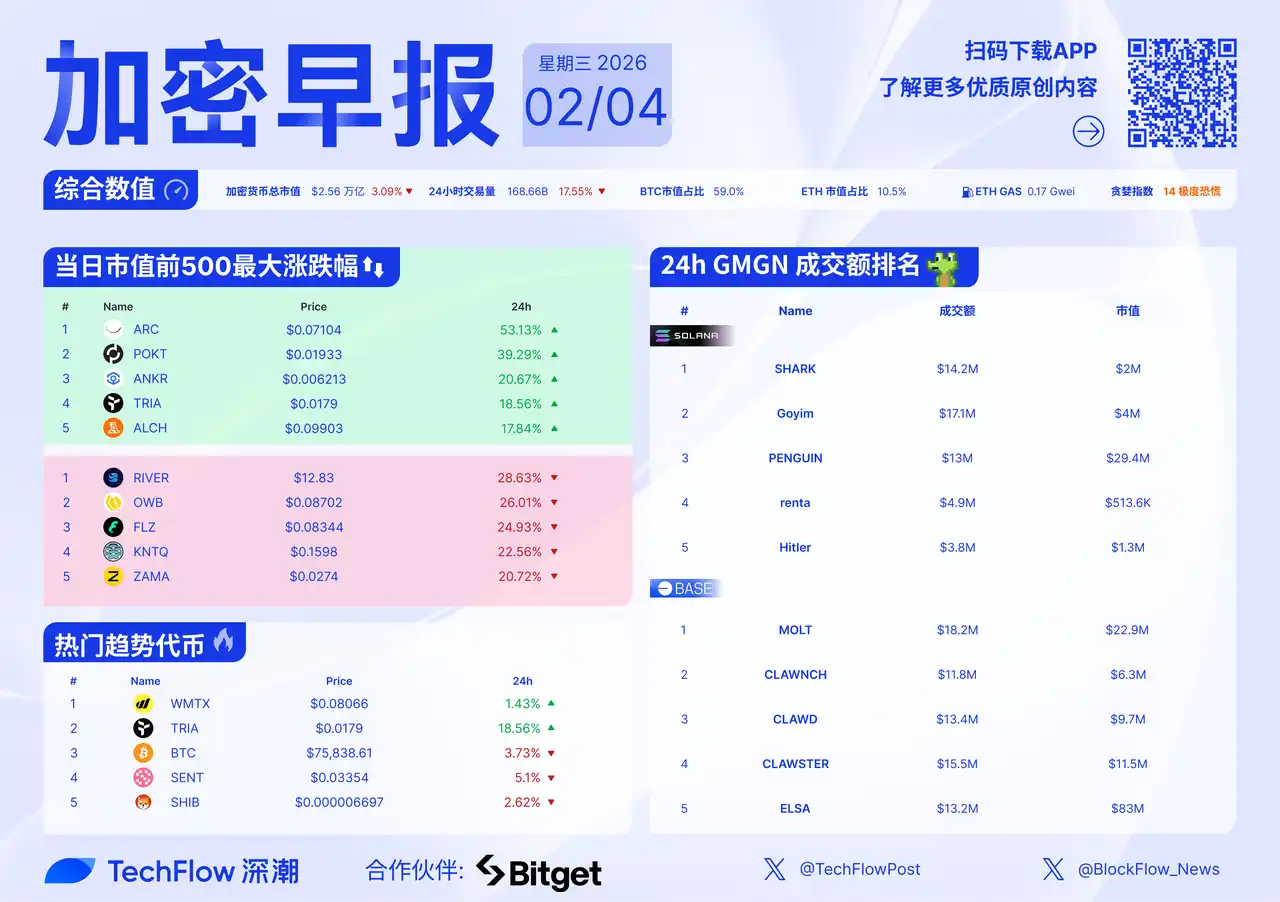
Recommended Reading

SpaceX Swallows xAI, Musk's Trillion-Dollar 'Internal Cycle'

This article analyzes Musk's strategy of integrating his companies (such as SpaceX, xAI, Tesla, etc.) to build a "super narrative." This narrative centers on space and artificial intelligence, aiming to create enormous market value for the upcoming IPO. However, this integration has also raised questions from investors, particularly dissatisfaction among Tesla shareholders.

Conversation with Tom Lee: Gold Targets $8900, ETH $2400 is the Bottom, U.S. Stocks May Correct 20% Mid-Year

This article is an analysis and outlook on the global market, cryptocurrency, precious metals, AI technology, robotics, and international market trends in 2026. Through expert interviews and market data interpretation, the article explores the potential opportunities and challenges the market may face in the future.

Market Bleeds, $HYPE Stands Out: Understanding Hyperliquid's HIP-4 Upgrade Entering the Prediction Market

This article reviews Hyperliquid's product iteration process from HIP-1 to HIP-4, showcasing its strategic transformation from a perpetual contracts DEX to a full-category on-chain derivatives platform. The article also mentions the recent rise of the HYPE token and its underlying market logic, as well as an analysis of future prediction market demand and regulatory challenges.

February 3 Market Summary: U.S. Stocks and Gold Rebound Together, Fed Still Mired in Independence Crisis

This article discusses recent dynamics in the global financial markets, including price fluctuations in gold and Bitcoin, the rebound in U.S. stocks, the Federal Reserve's independence crisis, and the impact of future economic data on the market.

Virtuals Launches '60-Day Trial': Projects Can Tokenize Without Betting the Farm, Full Refund if Unsuccessful

This article introduces the "60-Day Trial" framework launched by Virtuals Protocol, a reversible tokenization experiment mechanism designed to help AI founders test crypto-native distribution and monetization methods without bearing irreversible risks. Through public building and market testing, founders can decide within 60 days whether to commit to continuing the project or exit and get a refund.


Пов'язані питання

QWhat significant action did the U.S. government take to end the partial shutdown, and when was it signed?

APresident Trump signed the government funding bill on February 3rd, ending the partial government shutdown that began on January 31st.

QWhat new feature did MetaMask integrate in partnership with Ondo Finance, and which users are eligible?

AMetaMask integrated Ondo Global Markets, offering trading for over 200 tokenized U.S. stocks, ETFs, and commodities for eligible non-U.S. users via its mobile wallet.

QWhat was the cause and scale of the security incident at Step Finance, and how much funds were recovered?

AStep Finance suffered a security breach due to compromised executive team devices, resulting in the theft of approximately $40 million from its treasury. They recovered about $4.7 million ($3.7M in Remora assets and $1M in other assets).

QWhat new open-source system did Tether launch for Bitcoin mining, and what are its key features?

ATether launched MiningOS (MOS), an open-source Bitcoin mining operating system. It features a modular, peer-to-peer architecture, is hardware-agnostic, and manages mining activities without relying on centralized services.

QAccording to Wintermute, what were the three main factors that caused Bitcoin to fall below $80,000?

AWintermute attributed the drop to a 'triple whammy': disappointing earnings from Mag7 tech giants (like Microsoft) weakening the AI narrative, policy uncertainty from Kevin Warsh's Fed Chair nomination, and a sharp correction in precious metals (gold down 9%, silver down 26%).

Пов'язані матеріали

STAR 50 Soars 10.73%, Why Did A-Shares Stage a "V-Shaped Reversal"?

After a prolonged decline, the Chinese A-share market staged a strong rally on July 21. The STAR 50 index surged 10.73%, its largest single-day gain in nearly a year, leading a broad-based "V-shaped" reversal. The Shanghai Composite Index rose 1.79%, the Shenzhen Component Index gained 4.81%, and the ChiNext Index jumped 7.05%. Total market turnover reached 2.97 trillion yuan, an increase of 256.1 billion yuan from the previous session, with over 3,100 stocks advancing. The semiconductor sector spearheaded the rebound, with related ETFs posting significant gains. Analysts attribute the surge to three converging factors. First, coordinated capital inflows from "national team" institutions, insurance funds, listed company buybacks, and fund house self-purchases have bolstered market liquidity and confidence. Second, supportive policy signals, including commitments from regulators to ensure stable market operations, provided a favorable backdrop. Third, a stabilization and recovery in overseas markets, notably South Korea, created a positive external environment. Institutions suggest the most severe panic selling phase for the tech sector has likely passed, following a significant digestion of crowded positions and leveraged funds. While short-term volatility may persist, the medium to long-term outlook remains underpinned by enduring trends like AI computing demand expansion and semiconductor localization. The market's focus now shifts to the sustainability of supportive fund flows, earnings reports, and upcoming catalysts from the global AI industry chain.

marsbit31 хв тому

STAR 50 Soars 10.73%, Why Did A-Shares Stage a "V-Shaped Reversal"?

marsbit31 хв тому

U.S. Tech Momentum Stocks Post Largest Single-Day Gain Ever, But Is the Plunge Over?

US tech momentum stocks staged a sharp rebound on Tuesday (July 21st). Morgan Stanley's TMT Momentum Factor surged over 12%, marking its largest single-day gain on record, exceeding even peaks from the 2000 dot-com bubble. Key momentum indices from Goldman Sachs also posted their strongest daily performances in years. The rally was led by semiconductors, with the Philadelphia Semiconductor Index jumping 4.6%. This rebound followed three consecutive down days and a cumulative 33% plunge in momentum stocks, one of the steepest drawdowns since the dot-com era. Analysts attribute the surge largely to a short squeeze. Heavy selling had pushed high-beta momentum stocks into deeply oversold territory, forcing many short sellers, particularly in Asia, to cover their positions, creating a self-reinforcing buying spiral. However, the rebound's internals appear weak. Trading volume was notably low, and advancing stocks still lagged decliners on the S&P 500, indicating a narrow, concentrated rally rather than broad market participation. Diverging views emerge on the outlook. BTIG warns the bounce has hit key resistance and recommends selling into strength, citing extreme volatility and historical parallels to past market tops. Conversely, Goldman Sachs and UBS believe the momentum unwind is nearing its end, suggesting it may be time to gradually add exposure, as positioning has been significantly reduced. They caution, however, that high volatility warrants a measured approach, potentially using defined-risk strategies. The upcoming earnings season, particularly reports from major tech firms like Alphabet, is seen as a critical test for the rally's sustainability. Simultaneously, bond markets flashed a warning, with yields rising partly due to spiking oil prices. Analysts note that if long-term Treasury yields break decisively higher, it could pose a significant headwind for equities, especially growth stocks.

marsbit38 хв тому

U.S. Tech Momentum Stocks Post Largest Single-Day Gain Ever, But Is the Plunge Over?

marsbit38 хв тому

U.S. Tech Momentum Stocks Record Largest Single-Day Gain Ever, but Has the Rout Ended?

U.S. tech momentum stocks staged a dramatic rebound on Tuesday, July 21st. Key momentum indices like the Morgan Stanley TMT Momentum Factor and Goldman Sachs' High Beta Momentum Long Index posted historic or near-historic single-day gains, fueled largely by semiconductor stocks. This sharp rally followed a severe three-day sell-off that saw momentum stocks plunge 33%, marking one of the steepest pullbacks since the dot-com bubble. Analysts attribute the bounce primarily to a short squeeze, as forced covering from over-leveraged traders, particularly in Asia, created a buying spiral. However, the rally's health is questioned due to weak market breadth—overall trading volume was low, and decliners outnumbered advancers in the S&P 500 despite the index's gain—suggesting a narrow, concentrated surge rather than broad recovery. Opinions on the sustainability diverge. BTIG strategists warn the rebound has hit key resistance levels, citing extreme volatility and historic stock dispersion as signs of an ongoing broader correction, and recommend selling into strength. Conversely, Goldman Sachs and UBS view the aggressive momentum unwinding as nearing its end, noting reduced positioning and a lack of new fundamental catalysts. They suggest the sell-off presents a selective opportunity to add exposure, albeit cautiously and gradually using defined-risk strategies. The immediate trajectory hinges on the ongoing earnings season, with market focus on Alphabet's capital expenditure guidance for AI investment clarity. Meanwhile, bond markets present a risk, with rising Treasury yields—potentially heading toward 5.5%—and widening credit spreads for mega-cap tech companies posing a threat to equity valuations. The combination of technical factors, earnings results, and macro conditions leaves the durability of the rebound in doubt.

链捕手41 хв тому

U.S. Tech Momentum Stocks Record Largest Single-Day Gain Ever, but Has the Rout Ended?

链捕手41 хв тому

Long-Divided Must Unite, Long-United Must Divide: When L1 Becomes Its Own Rollup, What Is Ethereum's Endgame?

"The Inevitable Cycle: When L1 Becomes Its Own Rollup – What is Ethereum's Endgame?" For years, the Ethereum community grappled with concerns that L2s were fragmenting the ecosystem and eroding L1's value. While L2s provided cheaper execution, they also splintered liquidity and the unified user experience of a single chain. This has prompted a fundamental reassessment of the relationship between L1 and L2. Ethereum's roadmap is evolving. The "Scale" initiative merges L1 and L2 expansion into a holistic framework. L1 itself is advancing with higher gas limits, statelessness, and zkEVM verification, no longer content to be just a low-throughput settlement layer. Consequently, the primary value proposition of L2s is shifting from merely providing cheap blockspace to offering L1 cannot easily provide: application-specific optimizations, privacy features, and flexible governance models. L2s are becoming a spectrum of execution environments with varying degrees of security inheritance from Ethereum. A critical challenge in this multi-chain future is interoperability. The vision is to make Ethereum "feel like one chain again." This relies on advancements in native account abstraction (like EIP-7702) and intent-based architectures (Open Intents Framework), where users declare desired outcomes, and solvers handle the complex cross-chain execution. Furthermore, shortening Ethereum's finality time from minutes to seconds is crucial, as it underpins trust between chains for bridges, stablecoins, and cross-chain applications. Perhaps the most provocative idea is that Ethereum L1 itself could become a form of "its own Rollup." As zkEVM and proof systems mature, high-performance nodes could execute transactions and generate validity proofs. Regular validators would then verify these proofs instead of re-executing all transactions. This blurs the traditional L1/L2 hierarchy, making "Rollup" more of a general execution-verification architecture. Native Rollup aims to integrate L2 validation more directly into the Ethereum protocol, allowing L2s to inherit L1's security more fully and move away from reliance on security councils. In the end, L2s are not destined to replace L1 or be made obsolete by it. The likely future is a unified system where diverse execution environments—each optimized for specific use cases like DeFi, gaming, or privacy—coexist. They will share a common foundation of security, liquidity, and verifiable state, seamlessly connected to restore a cohesive user experience. The next phase for Ethereum is not just about scaling through separation, but about intelligently reintegrating what was separated back into a coherent whole.

链捕手57 хв тому

Long-Divided Must Unite, Long-United Must Divide: When L1 Becomes Its Own Rollup, What Is Ethereum's Endgame?

链捕手57 хв тому

Торгівля

Спот
活动图片




