Crypto Morning Brief: Meta Acquires Moltbook, Nvidia Plans to Launch NemoClaw

marsbitОпубліковано о 2026-03-11Востаннє оновлено о 2026-03-11

Анотація

Crypto Morning Brief: Meta acquires Moltbook, Nvidia plans to launch NemoClaw U.S. Defense Secretary announced plans for high-intensity strikes against Iran. The IEA proposed its largest-ever oil reserve release to curb rising prices. The first "Lobster Conference" on AI agents will be held in Shanghai in March 2026. In tech and crypto news, Meta acquired Moltbook, terms undisclosed. SolanaFloor was acquired by Jito and resumed operations. Kraken's xStocks platform launched a points program, hinting at a potential token. Nasdaq partnered with Seturion to advance tokenized settlement in Europe. China's national internet emergency center issued a security risk warning for OpenClaw AI agents, recommending enhanced security measures for deployment. Nvidia plans to introduce an open-source AI agent platform named NemoClaw, targeting enterprise use without hardware restrictions. Peter Thiel's Founders Fund is nearing a $6 billion raise for its new growth fund. Tencent is reportedly building a new AI agent for its WeChat app. Recommended reads include analysis on Bitcoin as AI's native currency, a market summary of volatile oil prices and a stable crypto market, and perspectives on how AI and institutional capital are transforming crypto.

Author: Deep Tide TechFlow

Yesterday's Market Dynamics

US Defense Secretary Announces "Highest Intensity" Strikes Against Iran

According to Jinshi Data, on the 10th local time, US Defense Secretary Haggeseth stated that the US military would launch the "highest intensity" strikes of this military operation against Iran that day. Haggeseth said at a press conference, "Today will once again be the day of our highest intensity strikes against targets inside Iran." The US military will deploy the largest number of fighter jets and bombers in this military operation to strike Iranian targets based on intelligence that is "more precise and of higher quality than ever before." Haggeseth also stated that Iran's missile launches hit a new low in the past 24 hours.

US Media: IEA Proposes Largest-Ever Release of Oil Reserves

According to the Wall Street Journal, informed sources revealed that the International Energy Agency (IEA) has proposed the largest-ever release of its oil reserves to curb the soaring crude oil prices driven by the war between the US-Israel and Iran. Officials stated that the amount of oil released this time would exceed the 182 million barrels of oil released by IEA member countries in two batches during the Russia-Ukraine conflict in 2022. The proposal was discussed at an emergency meeting of energy officials from the 32 IEA member countries on Tuesday. Countries are expected to decide on the proposal on Wednesday. If no one objects, the proposal will be approved; but even one country's objection could delay the plan. Affected by this news, WTI crude oil fell below $82/barrel, down 5.20% on the day.

First "Lobster Conference" to be Held in Shanghai on March 15

According to the Shanghai Municipal Commission of Economy and Informatization, the first "Lobster Conference" will be held from 13:00 to 18:00 on March 15, 2026, at the MoSu Space in Xuhui District, Shanghai. The event revolves around the AI agent OpenClaw, covering concept explanations, technical demos, live hands-on sessions, and results demonstrations. Participants include Chuanyang Technology, Baidu Intelligent Cloud, StepStar, and others. The goal of the event is to enable participants to build their own AI agent system from 0 to 1.

Meta Acquires Moltbook, Terms Not Disclosed

According to AXIOS: Meta has acquired Moltbook; terms were not disclosed.

SolanaFloor Resumes Operations After Acquisition by Jito

Solana ecosystem news service SolanaFloor announced that it has been acquired by Jito and has resumed operations with the support of the Jito Foundation, while still maintaining complete editorial independence. Updates on the editorial structure, commercial products, and team will be announced later. Previously, SolanaFloor announced it would cease operations after its parent company suffered a fund theft incident and explored but failed to find a way to continue operating.

Kraken's Tokenized Stock Platform xStocks Launches Points Program, Hinting at Potential Ecosystem Token Issuance

According to CoinDesk, xStocks, a tokenized stock platform associated with Kraken, announced the launch of the xPoints rewards program for traders, liquidity providers, and DeFi developers. Users can earn points by trading tokenized US stocks, providing liquidity, or participating in DeFi applications. In the crypto market, points programs are often seen as a precursor to token issuance, but xStocks has not officially announced any token plans yet.

Nasdaq Partners with Boerse Stuttgart's Seturion to Advance Tokenized Settlement in Europe

According to The Block, Nasdaq has partnered with Seturion, a tokenized settlement platform under Boerse Stuttgart Group, to promote the application of securities tokenization in Europe.

The collaboration will connect Nasdaq's European trading venues to Seturion's blockchain platform, supporting the trading and settlement of tokenized securities. The initial focus is on structured products, with plans to expand to more asset classes and market participants in the future. The Seturion platform supports all asset classes across public and private chains.

Roland Chai, President of Nasdaq European Market Services and Head of Digital Assets, stated that tokenization offers a transformative opportunity to address inefficiencies in settlement and securities processing.

National Internet Emergency Center Issues OpenClaw Security Risk Warning

The National Internet Emergency Center issued a security risk warning for the OpenClaw application. Previously, due to improper installation and use of the OpenClaw agent, some serious security risks have emerged. It is recommended that relevant organizations and individual users take the following security measures when deploying and applying OpenClaw: 1. Strengthen network control by not exposing OpenClaw's default management port directly to the public internet, and implement security management for access services through identity authentication, access control, and other security measures.

Strictly isolate the runtime environment using technologies like containers to limit OpenClaw's excessive permissions; 2. Enhance credential management, avoid storing keys in plain text in environment variables; establish a complete operational log audit mechanism; 3. Strictly manage plugin sources, disable automatic updates, and only install signed and verified extensions from trusted channels. 4. Continuously monitor patches and security updates, and promptly perform version updates and install security patches.

Nvidia Plans to Launch Open-Source AI Agent Platform NemoClaw

According to WIRED, Nvidia plans to launch an open-source AI agent platform called NemoClaw. The platform allows enterprise software companies to deploy AI agents for their employees to perform tasks. Sources say the platform does not restrict the use of Nvidia chips.

Nvidia has pitched the product to companies like Salesforce, Cisco, Google, Adobe, and CrowdStrike, seeking to establish partnerships. The platform will provide security and privacy tools, and partners may gain free early access by contributing to the project.

Peter Thiel's Founders Fund Nearing $6 Billion Fundraising for Fourth Growth Fund

According to TechCrunch, Founders Fund, the venture capital fund led by PayPal co-founder Peter Thiel, is nearing the completion of fundraising for its fourth growth fund, Founders Fund Growth IV, with total capital commitments reaching $6 billion. Informed sources revealed that external investor demand exceeded the fund's capacity, with about $1.5 billion coming from Founders Fund's partners.

The Information: Tencent Building New AI Agent for WeChat App

According to The Information: Tencent is building a new AI agent for the WeChat app.

Market Dynamics
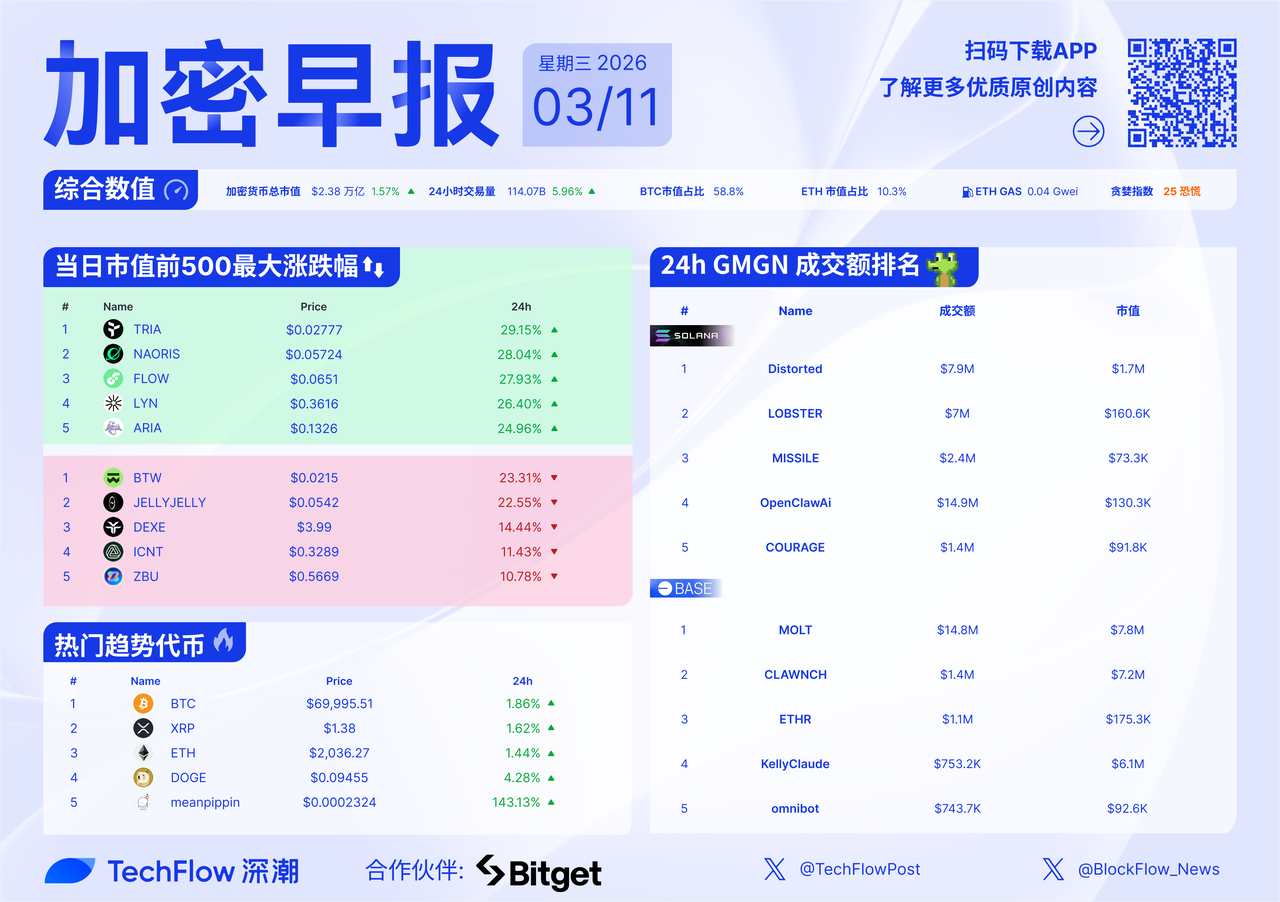
Recommended Reading

Conversation with Mark Yusko: Is the Crypto Winter Half Over? Bitcoin to Become the Native Currency of the AI Era

This article delves into the value of Bitcoin, its price volatility, and its potential in the future financial system. By comparing Bitcoin with gold, it analyzes Bitcoin's advantages as a store of value and discusses why AI agents choose Bitcoin as a payment method. Additionally, the article addresses the centralization risks of the current financial system and how Bitcoin can address these challenges.

March 10 Market Summary: The Wildest Day in Oil History, US Stocks V-Shaped Reversal

This article describes the sharp drop in oil prices on March 10, the strong rebound in US stocks, and the stable performance of the cryptocurrency market. Trump hinted that the war is nearing its end, the Strait of Hormuz reopened, and market sentiment shifted from panic to optimism.

Former Binance Labs Executive: Under the Impact of AI + Institutions, the Crypto Industry Will Look Very Different in Two Years

This article explores the current transformation of the crypto industry, pointing out that institutional capital and artificial intelligence (AI) are the two major structural forces driving change. The article argues that the era of token speculation is ending, and the future winners will be licensed infrastructure companies with real revenue that can serve AI Agents. Stablecoins and zero-knowledge proof technology are considered the core of the future crypto industry.

Virtuals and Ethereum Foundation Jointly Release ERC-8183: A Trustless On-Chain Commerce Protocol

This article introduces the ERC-8183 standard, jointly proposed by Virtuals Protocol and the Ethereum Foundation's dAI team, which aims to establish a trustless on-chain commerce protocol for economic interactions between AI Agents. The article details the design principles, core functions, key concepts, and potential application scenarios of the standard, emphasizing its symbiotic relationship with ERC-8004 (Agent Identity and Reputation Standard). Through ERC-8183, Agents can achieve open, trustless commercial transactions, promoting the development of a decentralized AI economy.

IOSG: On-Chain Yield Panorama, Evolution from Yield-Bearing Stablecoins to Crypto Credit Products

This article delves into the trend of the crypto industry entering the application era, analyzes the performance of on-chain yield products in bull and bear markets, introduces the growth of yield-bearing stablecoins and their impact on the market, and discusses the risk stratification and future development direction of on-chain yield products. Additionally, the article mentions the on-chain yield model of real-world assets (RWA) and how institutions can obtain on-chain yields through end-to-end services and crypto credit products.


Пов'язані питання

QWhat major acquisition did Meta announce, and what details were disclosed about the terms?

AMeta announced the acquisition of Moltbook, but no terms of the deal were disclosed.

QWhat is NemoClaw, and which companies has NVIDIA pitched this platform to?

ANemoClaw is an open-source AI agent platform planned by NVIDIA that allows enterprise software companies to deploy AI agents for tasks. NVIDIA has pitched it to companies including Salesforce, Cisco, Google, Adobe, and CrowdStrike.

QWhat significant action did the U.S. Defense Secretary announce regarding Iran?

AU.S. Defense Secretary Lloyd Austin announced that the U.S. military would launch the 'highest-intensity' strikes of its military operation against Iran that day, using the largest number of fighter jets and bombers based on highly precise intelligence.

QWhat was the proposed action by the International Energy Agency (IEA) to address soaring oil prices, and what was the market reaction?

AThe IEA proposed releasing the largest oil reserves in its history to curb soaring prices caused by the war. This proposal, reported by the Wall Street Journal, caused WTI crude oil to fall below $82 a barrel, down 5.20% for the day.

QWhat security measures did China's National Internet Emergency Center recommend for OpenClaw users?

AThe center recommended: 1. Strengthening network controls and not exposing OpenClaw's default management port to the public internet. 2. Isolating the runtime environment and restricting excessive permissions using container technology. 3. Enhancing credential management and avoiding storing keys in plain text in environment variables. 4. Strictly managing plugin sources, disabling auto-updates, and only installing signed extensions from trusted channels. 5. Applying patches and security updates promptly.

Пов'язані матеріали

KOL's Perspective: Why Is SOL Set to Rise from This Point?

**Summary: Why SOL is Positioned for Growth at This Level** The article argues that SOL is poised for an upward move from its current price point, citing several key factors. Primarily, SOL has just broken out of a 4-month consolidation phase. This breakout signals a return of risk appetite to the broader crypto market, as SOL is seen as a key indicator of overall crypto health. The token's ownership has reportedly shifted from short-term traders and tourists to long-term accumulators, leading to low volume. Any meaningful increase in trading activity could thus trigger significant upward momentum. Fundamental strengths include strong institutional adoption, integration with DeFi and RWAs (Real-World Assets), and the potential benefits from the Clarity Act. Despite its high volatility—having dropped 70% from its all-time high but still up 12x from its bear market low—SOL is highlighted as one of the few tokens from the last cycle to reach new highs. It boasts a robust ecosystem of applications, users, and protocols. Future catalysts include the expected influx of AI developers following the Miami Accelerate conference, which focused on AI on Solana. Furthermore, Solana is positioned as the premier chain for memecoin activity, a trend expected to continue and drive network usage and fees. The article concludes that recent price action reflects a healthy transfer to long-term holders, setting the stage for growth.

marsbit21 хв тому

KOL's Perspective: Why Is SOL Set to Rise from This Point?

marsbit21 хв тому

Those Pre-Bitcoin PoW Protocols Have Recently Been Reimplemented

This article details a recent surge in replicating pre-Bitcoin Proof-of-Work (PoW) protocols, specifically focusing on Hal Finney's 2004 RPOW (Reusable Proofs of Work). Within five days in May 2026, multiple independent builders in the Bitcoin/cypherpunk community launched projects inspired by this early electronic cash proposal. The initiative began with Fred Krueger's `rpow2.com`, a centralized but auditable system that replaced RPOW's original IBM 4758 hardware with Ed25519 signatures. Initially a faithful replica, it later adopted Bitcoin-like features (21M supply cap, difficulty adjustment) and a controversial 5.24% founder allocation. This sparked rapid forks, including `rpow4.com` which incorporated full Bitcoin parameters, a prediction market (`rpowmarket.com`), and a DEX (`rpow2swap.com`). Concurrently, Mike In Space created a prototype of Wei Dai's 1998 b-money proposal (`b-money.replit.app`), pushing the historical exploration even further back. The article contrasts these centralized, server-dependent experiments with Bitcoin's core innovation of decentralized, trustless consensus. It also highlights a parallel development: the `HASH` project on Ethereum, which uses smart contract hooks to enable a purely fair-launch, browser-mineable PoW token with 0% allocations to team or VCs. The collective activity is framed as a meme-driven, educational exploration of cypherpunk history rather than a serious financial movement, with all projects heavily disclaiming any investment value.

marsbit25 хв тому

Those Pre-Bitcoin PoW Protocols Have Recently Been Reimplemented

marsbit25 хв тому

South Korean Exchanges 'Battle' Regulators, Challenging the Boundaries of Enforcement and Legislation

South Korea's cryptocurrency industry is engaged in a rare, direct confrontation with regulators. The Financial Intelligence Unit (FIU), the primary anti-money laundering (AML) watchdog, has recently imposed heavy penalties on major exchanges like Upbit and Bithumb for alleged violations involving unregistered overseas VASPs and AML procedures. However, exchanges are now actively challenging these actions in court and through industry associations. In a significant shift, the Seoul Administrative Court ruled in favor of Upbit's operator, Dunamu, overturning part of an FIU-ordered business suspension. The court found the FIU's penalty criteria and justification insufficiently clear. Similarly, the court suspended the enforcement of a six-month business suspension against Bithumb pending a final ruling, citing potential irreversible harm to the exchange. Beyond legal battles, the industry is contesting proposed legislative amendments. The Digital Asset eXchange Alliance (DAXA) strongly opposes a draft rule that would mandate Suspicious Transaction Reports (STRs) for all crypto transfers over 10 million KRW (~$6,800). DAXA argues this "poison pill" clause violates legal principles and would overwhelm the STR system, increasing reports from 63,000 to an estimated 5.45 million annually for major exchanges, thereby crippling effective AML monitoring. This conflict highlights a structural tension in South Korea's crypto governance: comprehensive digital asset laws are still developing, while regulators rely heavily on AML enforcement. The industry's move from passive compliance to active legal and legislative challenges signifies a new phase, pressing for clearer rules and more proportionate enforcement. While short-term disputes may intensify, this clash could ultimately lead to a more mature and sustainable regulatory framework for South Korea's vibrant crypto market.

marsbit1 год тому

South Korean Exchanges 'Battle' Regulators, Challenging the Boundaries of Enforcement and Legislation

marsbit1 год тому

After 50x Storage Surge, Justin Sun Always Looks to the Next Decade

Sun Yuchen, known for his controversial stunts like a $30 million lunch with Warren Buffett (canceled due to a kidney stone) and eating a $6.2 million duct-taped banana, is often overshadowed by a significant fact: his decade-long track record of spotting major investment trends. In 2016, he famously advised young people to invest in Bitcoin, Nvidia, Tesla, and Tencent instead of buying property. A hypothetical $20,000 investment in Nvidia and Tesla from that list would now be worth over 50 million RMB. His latest major call was on November 6, 2025, predicting a "50x storage opportunity" tied to the AI boom, which materialized with Sandisk's stock surging nearly 50-fold by 2026. Looking ahead, Sun now focuses on the next frontier: Physical AI. He identifies four key areas: 1. **Embodied AI/Robotics**: He sees this reaching its "iPhone moment," with companies like UBTech and Galaxy General leading in commercialization. 2. **Drones**: Viewed as the first commercially viable form of Physical AI, revolutionizing sectors from warfare (e.g., AeroVironment's Switchblade) to logistics. 3. **Spatial Computing**: Beyond VR, it's about AI understanding physical space, a foundational technology for robotics and autonomous systems, exemplified by Apple's Vision Pro. 4. **Space Exploration**: After a 2025 suborbital flight with Blue Origin, Sun advocates for space as the ultimate frontier, discussing blockchain's potential role in space asset management and data transactions. His investment philosophy involves betting on entire, inevitable trends rather than single companies. For robotics, he sees Tesla (the body/manufacturer) and Nvidia (the brain/AI platform) as complementary plays. In defense drones, he highlights companies making tanks obsolete (AeroVironment) and those augmenting fighter jets (Kratos). For space, he participated in Blue Origin's flight and anticipates SpaceX's potential IPO to redefine the sector's valuation. Sun Yuchen's vision frames the next two decades not as a revolution in information flow (like the internet), but in the fundamental operation of the physical world through AI-powered robots, autonomous systems, and spatial intelligence, ultimately extending human and AI activity into space. While many still focus on conventional assets, he continues to look toward the next technological horizon.

marsbit2 год тому

After 50x Storage Surge, Justin Sun Always Looks to the Next Decade

marsbit2 год тому

Торгівля

Спот
Ф'ючерси
活动图片




