Crypto Morning Brief: CoinGecko Considers Sale at Approximately $500 Million Valuation, Privacy Protocol Zama Launches Token Sale

marsbitОпубліковано о 2026-01-14Востаннє оновлено о 2026-01-14

Анотація

CoinGecko is reportedly considering a sale at a valuation of around $500 million, with investment bank Moelis handling the process. In other major news, privacy protocol Zama launched a token sale with a floor valuation of $55 million, distributing 12% of its total 1.1 billion ZAMA tokens through a sealed-bid Dutch auction. Key market developments include the U.S. December CPI meeting expectations at 2.7% year-over-year, with analysts suggesting it won’t immediately alter the Federal Reserve’s current wait-and-see stance on rate cuts. U.S. Senate committees have rescheduled hearings on crypto market structure bills to late January. Other notable updates: PancakeSwap proposed reducing the max supply of CAKE from 450 million to 400 million tokens; ETHGas revealed its tokenomics with a 10 billion GWEI supply; Grayscale added several new assets to its consideration list; and YZi Labs made a multi-million dollar investment in Genius Trading, with Binance's Changpeng Zhao joining as an advisor. Additionally, Polygon Labs acquired companies Coinme and Sequence for over $250 million to advance its stablecoin strategy, and European crypto platform Bitpanda is planning a Frankfurt IPO in early 2026 targeting a €4-5 billion valuation.

Author: Deep Tide TechFlow

Yesterday's Market Dynamics

US December Unadjusted CPI Year-over-Year 2.7%, Expected 2.70%, Previous 2.70%

According to Jinshi data, the US December unadjusted Consumer Price Index (CPI) year-over-year was 2.7%, matching the expected 2.70% and the previous value of 2.70%.

The US December seasonally adjusted CPI month-over-month was 0.3%, meeting the expectation of 0.30%.

Fed Mouthpiece: December CPI Unlikely to Change Fed's Current Wait-and-See Stance

According to Jinshi data, "Fed Mouthpiece" Nick Timiraos stated that the December Consumer Price Index (CPI) is unlikely to change the Federal Reserve's current wait-and-see attitude, as officials likely want to see more evidence that inflation is stabilizing and gradually declining before cutting rates. The Fed has paused its benchmark rate cuts in the last three meetings, most recently in December, even though inflation had stopped falling last year. Officials paused the cuts due to concerns about the risk of a larger-than-expected slowdown in the labor market. To resume rate cuts, Fed officials may need to see new evidence that labor market conditions are deteriorating or that price pressures are easing. The latter might require at least a few more months of inflation data to become apparent.

US Senate Agriculture Committee Reschedules Crypto Bill Hearing to January 27th

According to CoinDesk, the US Senate Agriculture Committee announced it will release its crypto market structure bill on January 21, 2026, followed by a key hearing on January 27th at 3 PM. This hearing was originally scheduled for January 15th but was postponed. Committee Chairman John Boozman stated that the revised schedule ensures transparency and allows for a comprehensive review of the bill.

Meanwhile, the Senate Banking Committee will hold a review of its version of the bill this Thursday. Differences remain between the two committee versions on issues such as ethics provisions and bipartisan representation of regulators, which could affect the final prospects for bipartisan support.

Privacy Protocol Zama Launches Token Sale with a Floor Valuation of $55 Million

According to The Block, the encryption privacy protocol Zama will launch a fully on-chain token sale through CoinList and its own auction application, using a sealed-bid Dutch auction structure with a floor valuation of $55 million. This sale will allocate 12% of the total supply of 11 billion ZAMA tokens.

The sale is divided into three parts: a 2% community sale for NFT holders this week, an 8% main auction via CoinList from January 21st to 24th, and a 2% follow-on sale at the auction settlement price from January 27th to February 2nd.

New PancakeSwap Proposal Aims to Reduce CAKE Maximum Supply from 450 Million to 400 Million Tokens

According to the PancakeSwap governance forum, the PancakeSwap team has proposed a plan to reduce the maximum supply of CAKE tokens from 450 million to 400 million.

The PancakeSwap team stated that CAKE has been deflationary since September 2023, and this trend is expected to continue. The team has accumulated approximately 3.5 million CAKE as an ecosystem growth fund, which will be prioritized for protocol development needs, making it unlikely for the protocol to return to an inflationary state.

The proposal will enter the voting stage after community discussion. If passed, it will reduce the maximum supply cap by 50 million CAKE.

ETHGas Unveils Token Economic Model: Total Supply 10 Billion Tokens, 10% Allocated to Community

According to an official announcement, the Ethereum block space futures market ETHGas unveiled its token economic model. Its token GWEI has a total supply of 10 billion tokens, allocated as follows: Ecosystem 31%, Investors 27%, Team 22%, Community 10%, Foundation 8%, Advisors 2%. Additionally, the eligibility snapshot for the token airdrop will be taken on January 19th at 00:00 UTC.

Previous news reported that ETHGas announced the completion of a $12 million funding round led by Polychain Capital late last year.

Grayscale Adds MegaETH, Horizen, and Other Tokens to Asset Consideration List

According to The Block, Grayscale has updated its Asset Consideration List, expanding it to 27 tokens covering categories such as Artificial Intelligence, Decentralized Finance, Consumer, and Infrastructure.

This update, published on January 12th, adds assets including MegaETH, Horizen, ARIA Protocol, Playtron, Nous Research, Poseidon, and Geodnet.

Grayscale clarified that inclusion on the consideration list does not guarantee the launch of a corresponding investment product, as product creation involves internal review, custody arrangements, and regulatory considerations. The next routine update is expected around April 15th, 2026.

YZi Labs Makes "Multi-Million Dollar" Investment in Genius Trading, Changpeng Zhao to Serve as Advisor

According to The Block, YZi Labs has made a "multi-8-figure" (tens of millions of dollars) investment in Genius Trading, and Binance founder Changpeng Zhao will join the startup as an advisor.

Genius Trading is building a privacy-first on-chain trading platform offering spot, perpetual contracts, and copy trading, aiming to become a decentralized version of "Binance".

Polygon Labs Acquires Crypto Startups Coinme and Sequence for Over $250 Million

According to Fortune, Polygon Labs has completed the acquisition of crypto startups Coinme and Sequence for a total of over $250 million.

Polygon Labs CEO Marc Boiron and Polygon Foundation founder Sandeep Nailwal stated that these acquisitions aim to advance their stablecoin strategy. Seattle-based Coinme focuses on cash-to-crypto conversion services and holds several US money transmitter licenses; New York-based Sequence focuses on building blockchain infrastructure, including crypto wallets. Nailwal described this as a move for Polygon to compete with fintech giant Stripe.

Sources: CoinGecko Considers Sale at Approximately $500 Million Valuation

According to CoinDesk, sources, CoinGecko is considering a sale at a valuation of approximately $500 million. Informed sources revealed that the company has hired investment bank Moelis to manage the sale process, but some reports indicate the valuation is not yet final as the process only began late last year.

Notably, CoinGecko's competitor CoinMarketCap was acquired by Binance for approximately $400 million in April 2020. CoinGecko was founded by TM Lee and Bobby Ong in 2014.

Crypto Trading Platform Bitpanda Plans Frankfurt IPO in H1 2026, Valuation Could Reach €5 Billion

According to Bloomberg, cryptocurrency trading platform Bitpanda GmbH, backed by billionaire Peter Thiel, plans to conduct an initial public offering (IPO) on the Frankfurt Stock Exchange as early as the first half of 2026. Informed sources revealed that the Vienna-based company's valuation for this IPO could be between €4 billion (approximately $4.7 billion) and €5 billion.

Bitpanda has hired Goldman Sachs Group, Citigroup, and Deutsche Bank to arrange the offering. Some sources indicated the company could go public as early as the first quarter.

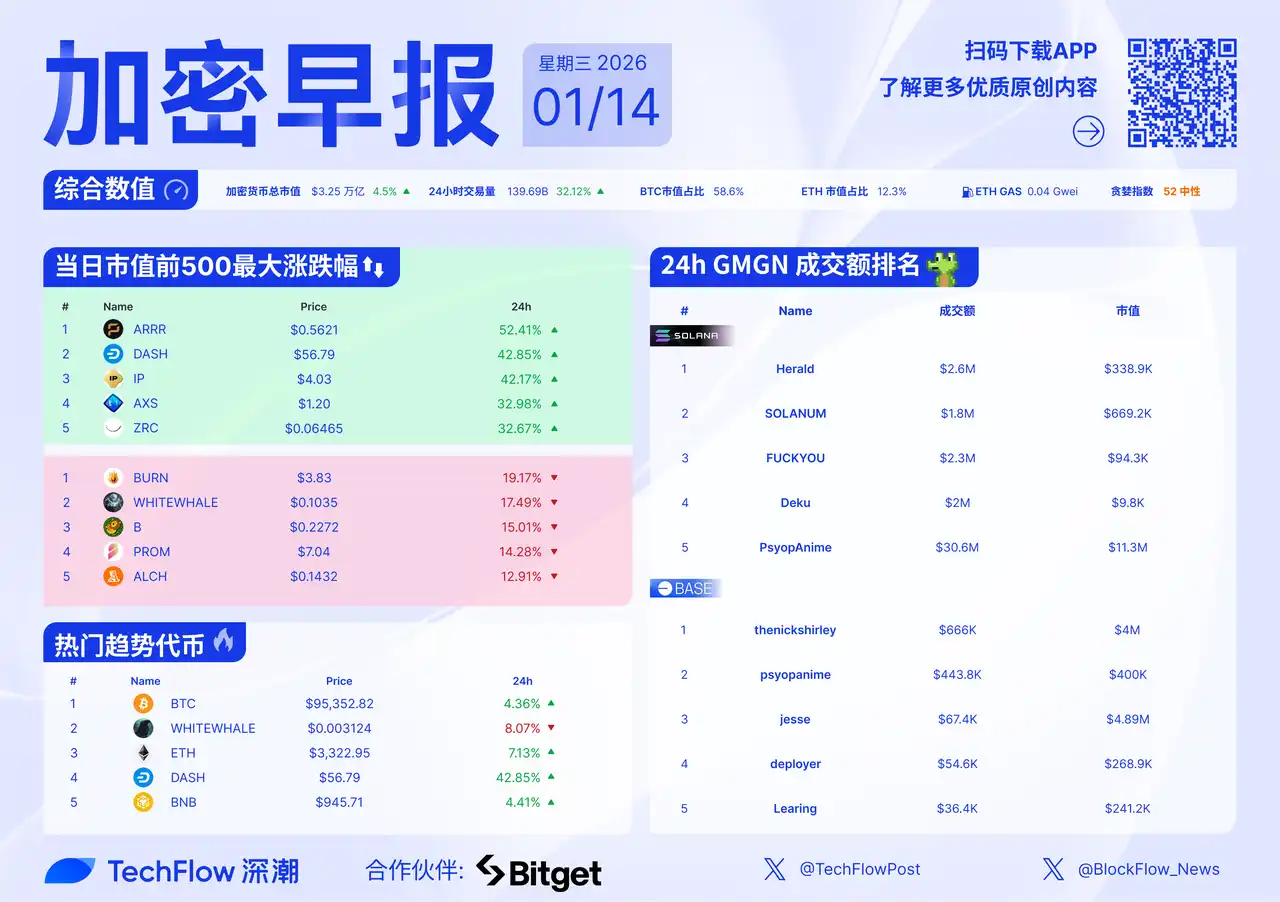
Market Trends
Recommended Reading

a16z Raised $15 Billion, Says It Will Make America Win

This article discusses a16z's completion of a $15 billion fundraising, making it a leader in the US venture capital industry. This capital will primarily invest in long-term companies, application layers, underlying technology, biomedicine, and the "American Vitality" theme, with a particular focus on the military manufacturing industry. Through its powerful resource integration capabilities and policy influence, a16z not only bets on technology cycle but also seeks opportunities in the political cycle. Despite the risks, its unique strategy and resource accumulation have earned the trust of its LPs.

Monero's Hidden Selling Pressure is Disappearing

This article provides an in-depth analysis of Monero (XMR)'s market dynamics after being delisted from major exchanges. It reveals the impact of the instant exchange industry on Monero's price and how the new platform Wagyu is breaking this negative cycle by offering fairer trading conditions, helping Monero achieve more authentic price discovery.

Frequent Pokémon Card Heists: Is On-Chaining Physical Collectibles a Risky Solution?

This article discusses the security issues, including robberies and scams, surrounding Pokémon card collectible transactions in recent years. It analyzes the limitations of traditional trading models and proposes using blockchain technology to put collectibles on-chain as a solution to enhance transaction transparency, security, and liquidity.

2026: The 'Solar Term' in the AI Circle Has Changed, How Should Entrepreneurs Fine-Tune Their 'Algorithm'?

This article explores AI entrepreneurship trends in 2026, changes in the capital environment, and how entrepreneurs should respond. Through metaphors and case studies, the article emphasizes the importance of focusing on specific scenarios, building deep supply chains, and adopting a gradual advancement strategy for entrepreneurship.

Monero, Zcash, and Canton Network: Who is the True King of Privacy?

This article discusses how privacy has become a key technological feature for connecting with real-world business as institutional players gain prominence in the blockchain space. It covers the importance of blockchain privacy and its forms, including full anonymity privacy and selective privacy, and analyzes why financial institutions prefer selective privacy. Canton Network is considered a representative privacy blockchain meeting institutional needs, while projects like Monero and Zcash have certain limitations in terms of full anonymity privacy and selective privacy.


Пов'язані питання

QWhat is the reported valuation at which CoinGecko is considering a sale?

ACoinGecko is considering a sale at a valuation of approximately $500 million.

QWhat is the total supply of ZAMA tokens and what percentage is being allocated for its token sale?

AThe total supply of ZAMA tokens is 11 billion, and 12% of the total supply is being allocated for its token sale.

QWhat is the new proposed maximum supply for CAKE tokens according to the PancakeSwap proposal?

AThe new proposed maximum supply for CAKE tokens is 400 million, a reduction from the previous 450 million.

QWhich two companies did Polygon Labs acquire for a combined total of over $250 million?

APolygon Labs acquired the crypto startups Coinme and Sequence for a combined total of over $250 million.

QWhat was the reported annual CPI rate for the U.S. in December, and did it meet expectations?

AThe U.S. annual CPI rate for December was 2.7%, which met the expectation of 2.70%.

Пов'язані матеріали

KOL's Perspective: Why Is SOL Set to Rise from This Point?

**Summary: Why SOL is Positioned for Growth at This Level** The article argues that SOL is poised for an upward move from its current price point, citing several key factors. Primarily, SOL has just broken out of a 4-month consolidation phase. This breakout signals a return of risk appetite to the broader crypto market, as SOL is seen as a key indicator of overall crypto health. The token's ownership has reportedly shifted from short-term traders and tourists to long-term accumulators, leading to low volume. Any meaningful increase in trading activity could thus trigger significant upward momentum. Fundamental strengths include strong institutional adoption, integration with DeFi and RWAs (Real-World Assets), and the potential benefits from the Clarity Act. Despite its high volatility—having dropped 70% from its all-time high but still up 12x from its bear market low—SOL is highlighted as one of the few tokens from the last cycle to reach new highs. It boasts a robust ecosystem of applications, users, and protocols. Future catalysts include the expected influx of AI developers following the Miami Accelerate conference, which focused on AI on Solana. Furthermore, Solana is positioned as the premier chain for memecoin activity, a trend expected to continue and drive network usage and fees. The article concludes that recent price action reflects a healthy transfer to long-term holders, setting the stage for growth.

marsbit18 хв тому

KOL's Perspective: Why Is SOL Set to Rise from This Point?

marsbit18 хв тому

Those Pre-Bitcoin PoW Protocols Have Recently Been Reimplemented

This article details a recent surge in replicating pre-Bitcoin Proof-of-Work (PoW) protocols, specifically focusing on Hal Finney's 2004 RPOW (Reusable Proofs of Work). Within five days in May 2026, multiple independent builders in the Bitcoin/cypherpunk community launched projects inspired by this early electronic cash proposal. The initiative began with Fred Krueger's `rpow2.com`, a centralized but auditable system that replaced RPOW's original IBM 4758 hardware with Ed25519 signatures. Initially a faithful replica, it later adopted Bitcoin-like features (21M supply cap, difficulty adjustment) and a controversial 5.24% founder allocation. This sparked rapid forks, including `rpow4.com` which incorporated full Bitcoin parameters, a prediction market (`rpowmarket.com`), and a DEX (`rpow2swap.com`). Concurrently, Mike In Space created a prototype of Wei Dai's 1998 b-money proposal (`b-money.replit.app`), pushing the historical exploration even further back. The article contrasts these centralized, server-dependent experiments with Bitcoin's core innovation of decentralized, trustless consensus. It also highlights a parallel development: the `HASH` project on Ethereum, which uses smart contract hooks to enable a purely fair-launch, browser-mineable PoW token with 0% allocations to team or VCs. The collective activity is framed as a meme-driven, educational exploration of cypherpunk history rather than a serious financial movement, with all projects heavily disclaiming any investment value.

marsbit23 хв тому

Those Pre-Bitcoin PoW Protocols Have Recently Been Reimplemented

marsbit23 хв тому

South Korean Exchanges 'Battle' Regulators, Challenging the Boundaries of Enforcement and Legislation

South Korea's cryptocurrency industry is engaged in a rare, direct confrontation with regulators. The Financial Intelligence Unit (FIU), the primary anti-money laundering (AML) watchdog, has recently imposed heavy penalties on major exchanges like Upbit and Bithumb for alleged violations involving unregistered overseas VASPs and AML procedures. However, exchanges are now actively challenging these actions in court and through industry associations. In a significant shift, the Seoul Administrative Court ruled in favor of Upbit's operator, Dunamu, overturning part of an FIU-ordered business suspension. The court found the FIU's penalty criteria and justification insufficiently clear. Similarly, the court suspended the enforcement of a six-month business suspension against Bithumb pending a final ruling, citing potential irreversible harm to the exchange. Beyond legal battles, the industry is contesting proposed legislative amendments. The Digital Asset eXchange Alliance (DAXA) strongly opposes a draft rule that would mandate Suspicious Transaction Reports (STRs) for all crypto transfers over 10 million KRW (~$6,800). DAXA argues this "poison pill" clause violates legal principles and would overwhelm the STR system, increasing reports from 63,000 to an estimated 5.45 million annually for major exchanges, thereby crippling effective AML monitoring. This conflict highlights a structural tension in South Korea's crypto governance: comprehensive digital asset laws are still developing, while regulators rely heavily on AML enforcement. The industry's move from passive compliance to active legal and legislative challenges signifies a new phase, pressing for clearer rules and more proportionate enforcement. While short-term disputes may intensify, this clash could ultimately lead to a more mature and sustainable regulatory framework for South Korea's vibrant crypto market.

marsbit1 год тому

South Korean Exchanges 'Battle' Regulators, Challenging the Boundaries of Enforcement and Legislation

marsbit1 год тому

After 50x Storage Surge, Justin Sun Always Looks to the Next Decade

Sun Yuchen, known for his controversial stunts like a $30 million lunch with Warren Buffett (canceled due to a kidney stone) and eating a $6.2 million duct-taped banana, is often overshadowed by a significant fact: his decade-long track record of spotting major investment trends. In 2016, he famously advised young people to invest in Bitcoin, Nvidia, Tesla, and Tencent instead of buying property. A hypothetical $20,000 investment in Nvidia and Tesla from that list would now be worth over 50 million RMB. His latest major call was on November 6, 2025, predicting a "50x storage opportunity" tied to the AI boom, which materialized with Sandisk's stock surging nearly 50-fold by 2026. Looking ahead, Sun now focuses on the next frontier: Physical AI. He identifies four key areas: 1. **Embodied AI/Robotics**: He sees this reaching its "iPhone moment," with companies like UBTech and Galaxy General leading in commercialization. 2. **Drones**: Viewed as the first commercially viable form of Physical AI, revolutionizing sectors from warfare (e.g., AeroVironment's Switchblade) to logistics. 3. **Spatial Computing**: Beyond VR, it's about AI understanding physical space, a foundational technology for robotics and autonomous systems, exemplified by Apple's Vision Pro. 4. **Space Exploration**: After a 2025 suborbital flight with Blue Origin, Sun advocates for space as the ultimate frontier, discussing blockchain's potential role in space asset management and data transactions. His investment philosophy involves betting on entire, inevitable trends rather than single companies. For robotics, he sees Tesla (the body/manufacturer) and Nvidia (the brain/AI platform) as complementary plays. In defense drones, he highlights companies making tanks obsolete (AeroVironment) and those augmenting fighter jets (Kratos). For space, he participated in Blue Origin's flight and anticipates SpaceX's potential IPO to redefine the sector's valuation. Sun Yuchen's vision frames the next two decades not as a revolution in information flow (like the internet), but in the fundamental operation of the physical world through AI-powered robots, autonomous systems, and spatial intelligence, ultimately extending human and AI activity into space. While many still focus on conventional assets, he continues to look toward the next technological horizon.

marsbit2 год тому

After 50x Storage Surge, Justin Sun Always Looks to the Next Decade

marsbit2 год тому

Торгівля

Спот
Ф'ючерси
活动图片