Crypto May Be Loud Online, But Only 4% Of Voters Care: Poll

bitcoinistОпубліковано о 2026-05-14Востаннє оновлено о 2026-05-14

Анотація

A Politico survey reveals a stark disconnect between crypto industry lobbying and U.S. voter priorities. While crypto groups have spent over $130 million on the 2024 elections, only 4% of voters say a candidate's position on crypto would influence their vote. Affordable housing, consumer fraud protection, and lower bank fees rank as far more important issues for voters. The poll also shows public ambivalence toward digital assets. Only 27% support government efforts to make crypto mainstream, while 31% oppose it. Over half of respondents have never traded crypto and don't plan to. Among those who have traded, 7% say a candidate's stance would sway their vote. Furthermore, 45% view crypto investing as a risk not worth taking. Despite low voter interest, Congress is advancing crypto regulation. The Senate Banking Committee is set to vote on a regulatory framework bill, a version of which already passed the House in June.

A separate poll released Friday by HarrisX found that 47% of registered voters said they would consider crossing party lines to support a candidate who backed crypto regulation legislation — a figure that stands in sharp contrast to new data showing crypto barely moves the needle for most Americans when they head to the polls.

The Lobbying Machine Behind The Legislation

The Politico survey, conducted by polling firm Public First and covering 2,035 US adults, found that only 4% of respondents would factor a candidate’s position on crypto into their voting decision.

Source: Politico

Affordable housing topped the list of issues voters want Congress to address, followed by consumer fraud protection and lower bank fees. Crypto regulation came in last.

That gap between voter priorities and industry muscle is hard to ignore. Crypto lobbies spent more than $130 million during the 2024 elections — more than any other industry — and have already committed $320 million to shape the upcoming November midterms, according to data compiled by researcher Molly White.
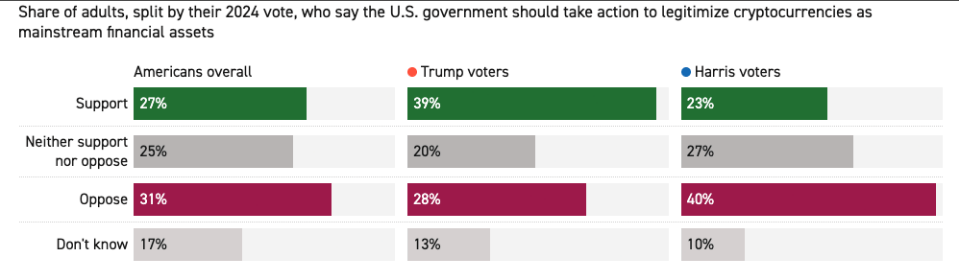
Survey results on public opinion regarding whether the US government should formally adopt crypto as a mainstream financial asset. Source: Politico.

In Illinois alone, crypto-aligned PACs have spent over $5.5 million opposing specific congressional candidates this year.

BTCUSD currently trading at $79,593. Chart: TradingView

Republican Representative Dusty Johnson acknowledged the disconnect. Most voters don’t think about digital assets, he told Politico, but those who do feel strongly about it. He described it as a high-intensity issue that is slowly growing in public awareness, even if the numbers remain small.

A Public Still Divided On Digital Assets

The survey also captured a broader wariness toward crypto among ordinary Americans. Only 27% said they support or strongly support the US government taking steps to make crypto a mainstream financial asset.

A slightly larger share — 31% — said they oppose or strongly oppose such a move. More than half of respondents said they had never traded crypto and had no plans to do so.

Image: Pexels

Among the 19% who had actually traded crypto, 7% said a candidate’s stance on the issue would influence their vote. The poll also found that 45% of respondents considered crypto investing a risk not worth taking, even with the promise of high returns. Only 25% disagreed.

Senate Moving On Crypto Regulation This Week

Meanwhile, Congress is pushing ahead. The Senate Banking Committee is set to vote on whether to advance a long-awaited bill that would establish a regulatory framework for the crypto industry.

A version of the bill — known as the Clarity Act — already cleared the House in June. Reports indicate the White House has been involved in negotiations between crypto interests and banking lobbies to shape the final version.

Featured image from Unsplash, chart from TradingView

Трендові криптовалюти

Пов'язані питання

QAccording to the poll, what percentage of voters would factor a candidate's position on crypto into their voting decision?

AAccording to the Politico survey, only 4% of respondents would factor a candidate's position on crypto into their voting decision.

QWhat issue topped the list of voter priorities that they want Congress to address, as revealed in the article?

AAffordable housing topped the list of issues voters want Congress to address, according to the survey.

QHow much money did crypto lobbies spend during the 2024 elections, and how does this compare to other industries according to the data cited?

ACrypto lobbies spent more than $130 million during the 2024 elections, which was more than any other industry.

QWhat percentage of survey respondents support the US government taking steps to make crypto a mainstream financial asset?

AOnly 27% of survey respondents said they support or strongly support the US government taking steps to make crypto a mainstream financial asset.

QWhat legislative action is the Senate Banking Committee set to take regarding crypto, as mentioned in the article?

AThe Senate Banking Committee is set to vote on whether to advance a long-awaited bill, known as the Clarity Act, which would establish a regulatory framework for the crypto industry.

Пов'язані матеріали

The End of Old Cryptography: How Ethereum is Preparing for the Era of Quantum Computing

Ethereum developers have proposed a new system for handling staking deposits, aiming to future-proof the network against the potential threat of quantum computers. Currently, Ethereum's security relies on elliptic curve cryptography, which could be broken by sufficiently powerful quantum machines capable of deriving private keys from public ones. While estimates of the timeline for this threat vary, with Google research in March 2026 suggesting it could be closer than previously thought, major blockchains are proactively preparing. The new proposal introduces a more flexible deposit contract capable of accepting keys of various types and lengths, identified by a scheme label. It also changes how deposit data is communicated within the network's layers. Crucially, the transition plan involves a three-phase process to ensure a controlled and predictable shift, initially disabling new deposits, then re-enabling the current format, and finally permanently switching to new post-quantum cryptography in a future update. The proposal is currently a draft with no set implementation date. It represents a strategic move to build infrastructure in advance, rather than a direct solution for existing accounts. Analysis notes that Ethereum is structurally vulnerable to a "store now, decrypt later" attack, as public keys revealed in past transactions remain permanently on-chain. This proposal prepares for a signature algorithm change but does not address the risk to keys already exposed.

cryptonews.ru5 хв тому

The End of Old Cryptography: How Ethereum is Preparing for the Era of Quantum Computing

cryptonews.ru5 хв тому

Meta Faces a $1.4 Trillion Penalty: Algorithmic Recommendation in the Dock. Will the Rules Change in the Second Half of the Internet Era?

A landmark federal trial in Oakland, California, has begun against Meta, with 29 states accusing the company of harming children and teens through its social media platform designs. The states seek a potential maximum penalty of $1.4 trillion, calculated from alleged repeated violations of consumer protection laws and the Children's Online Privacy Protection Act (COPPA) involving millions of underage users. The core legal strategy bypasses the traditional shield of Section 230 by targeting Meta's own platform features—like its recommendation algorithms, infinite scroll, and "like" buttons—rather than user-generated content. The plaintiffs argue these designs are addictive and deceptive. Meta denies the claims, calling the penalty "unprecedented" and disputing the methodology. While the astronomical $1.4 trillion figure is seen as a starting point for negotiations, even a significantly reduced penalty in the hundreds of billions could establish a critical precedent. The case focuses on holding platforms legally responsible for their algorithmic designs. A ruling against Meta could force product changes, such as removing "likes" or imposing usage limits, and provide a legal template for similar suits against other tech giants like TikTok and YouTube. The trial's outcome may redefine accountability for algorithm-driven business models across the internet.

marsbit15 хв тому

Meta Faces a $1.4 Trillion Penalty: Algorithmic Recommendation in the Dock. Will the Rules Change in the Second Half of the Internet Era?

marsbit15 хв тому

A Precedent for the Prediction Markets: CFTC Aims to Prove Authority Over Polymarket via Criminal Case

A U.S. Army soldier, Gannon Ken Van Dyke, who earned $400,000 using non-public information on the crypto event-prediction platform Polymarket, is contesting the U.S. Commodity Futures Trading Commission's (CFTC) attempt to intervene in his criminal case. The CFTC, which initiated a separate civil suit against Van Dyke but has not pursued it to trial, seeks to submit arguments in the ongoing criminal proceeding. Van Dyke's lawyers filed a motion opposing this, arguing the CFTC is improperly trying to influence the criminal case as an outside expert rather than through its own lawsuit. They contend that event contracts traded on platforms like Polymarket are not swaps and thus fall outside the CFTC's jurisdiction, calling the regulator's tactics a procedural maneuver. Van Dyke faces criminal fraud charges for allegedly trading based on confidential information about potential regime change in Venezuela. His civil case with the CFTC is stayed pending the criminal trial, expected in late 2026 or early 2027. The court's decision on whether to allow the CFTC's intervention could set a precedent for how such event contracts are regulated. An AI analysis notes inconsistency in the CFTC's approach compared to a similar case involving a Google employee, raising questions about the legal strategy for the prediction market industry, which includes platforms like Kalshi. The outcome may define future regulatory standards for the entire market.

cryptonews.ru19 хв тому

A Precedent for the Prediction Markets: CFTC Aims to Prove Authority Over Polymarket via Criminal Case

cryptonews.ru19 хв тому

Торгівля

Спот

Популярні статті

Як купити 4

Ласкаво просимо до HTX.com! Ми зробили покупку 4 (4) простою та зручною. Дотримуйтесь нашої покрокової інструкції, щоб розпочати свою криптовалютну подорож.Крок 1: Створіть обліковий запис на HTXВикористовуйте свою електронну пошту або номер телефону, щоб зареєструвати обліковий запис на HTX безплатно. Пройдіть безпроблемну реєстрацію й отримайте доступ до всіх функцій.ЗареєструватисьКрок 2: Перейдіть до розділу Купити крипту і виберіть спосіб оплатиКредитна/дебетова картка: використовуйте вашу картку Visa або Mastercard, щоб миттєво купити 4 (4).Баланс: використовуйте кошти з балансу вашого рахунку HTX для безперешкодної торгівлі.Треті особи: ми додали популярні способи оплати, такі як Google Pay та Apple Pay, щоб підвищити зручність.P2P: Торгуйте безпосередньо з іншими користувачами на HTX.Позабіржова торгівля (OTC): ми пропонуємо індивідуальні послуги та конкурентні обмінні курси для трейдерів.Крок 3: Зберігайте свої 4 (4)Після придбання 4 (4) збережіть його у своєму обліковому записі на HTX. Крім того, ви можете відправити його в інше місце за допомогою блокчейн-переказу або використовувати його для торгівлі іншими криптовалютами.Крок 4: Торгівля 4 (4)Легко торгуйте 4 (4) на спотовому ринку HTX. Просто увійдіть до свого облікового запису, виберіть торгову пару, укладайте угоди та спостерігайте за ними в режимі реального часу. Ми пропонуємо зручний досвід як для початківців, так і для досвідчених трейдерів.

664 переглядів усьогоОпубліковано 2025.10.20Оновлено 2026.06.02

Як купити 4

Обговорення

Ласкаво просимо до спільноти HTX. Тут ви можете бути в курсі останніх подій розвитку платформи та отримати доступ до професійної ринкової інформації. Нижче представлені думки користувачів щодо ціни 4 (4).

活动图片