Crypto Libra Scandal: New Evidence Exposes Payments From Lobbyist To President Milei

bitcoinistОпубліковано о 2026-03-19Востаннє оновлено о 2026-03-19

Анотація

New forensic evidence and leaked court documents reveal that Mauricio Novelli, a lobbyist for the cryptocurrency Libra (LIBRA), made thousands of dollars in payments to Argentine President Javier Milei and his inner circle since 2021. The payments, initially around $2,000 monthly during Milei's time as a congressman, increased to $4,000 routed through his sister after he became president. Prosecutors found that Novelli financed these transactions by selling cryptocurrencies like USDT for cash. Additional documents suggest a coordinated effort to leverage Milei’s influence to promote Libra, including a proposed $5 million package for his endorsement. Milei’s public promotion of the token in February 2025 led to a 1,300% price surge followed by a crash, causing significant investor losses and triggering legal and congressional investigations. Opposition lawmakers are now accusing Milei of being a "necessary participant" in a premeditated crypto scam, though the presidency maintains he acted in "good faith."

New forensic reports and leaked court documents show years of dollar payments from crypto Libra (LIBRA) lobbyist Mauricio Novelli to Javier Milei and his inner circle, well before the memecoin collapsed.

Dollar Payments For A Crypto Scandal

Thirteen months after Argentina and the entire crypto world was shaken by the accusations of insider trading against the President of Argentina, Javier Milei, new uncovered evidence shows references to thousands of dollars Novelli had paid the libertarian since 2021, back when he was a congressman, for teaching classes and promoting Novelli’s investment consulting firm, Argentinian outlet La Nación reported yesterday.

A selfie of Novelli and Milei, taken in 2024. Source: La Nación.

Messages and audios recovered by prosecutors reveal that Novelli financed the payouts with crypto, mainly selling USDT and other assets for cash and then delivering physical dollars labeled as the “usual” amount for Milei and associated influencers: monthly payments of around $2,000 during Milei’s time as deputy, later rising to $4,000 routed to his sister and chief of staff, Karina Milei, once he became president in 2023.

A Long List Of New LIBRA Case Findings

The new evidence comes from the forensic analysis of Novelli’s phone and it adds to the long list of revelations regarding the case that have been exposed since last week. On March 14, local outlet El Destape reported the finding of a document that show coordinated calls and messages between Milei, Karina Milei, strategist Santiago Caputo and Libra promoters in the minutes before and after Milei posted the Libra smart contract on X in February 2025. A seized “5 million memo” from Novelli’s notes app describes a potential USD 5 million package (tokens or cash) for Milei’s social‐media promotion and political backing of Libra, framing him as a central “asset” in the project, though no signed contract has surfaced.

A memo outlining a public statement intended to quell the scandal also surfaced. Written in Spanish and dated February 16, 2025, the statement was likely a narrative designed for Milei to share on his social media or to use later in the interview he was scheduled to have the following day with Jonatan Viale, Argentinian outlet Clarín claims.

Additional documents reveal multiple agreements between Novelli and U.S. entrepreneur Hayden Mark Davis, detailing a strategy to leverage Milei’s image and online reach to legitimize Libra.

When Crypto Turmoil Turns Into High Political Stakes

In February 2025, Milei promoted the $LIBRA token on X as a project to fund Argentinian entrepreneurs, triggering a 1,300% spike and then a violent crash that left late buyers nursing heavy losses of as much as $100 million. The episode sparked criminal complaints, a congressional inquiry and allegations that the president used his office to pump a high‐risk crypto asset.
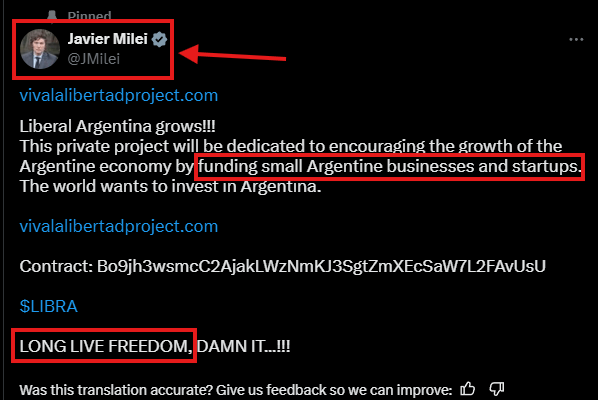
Milei’s original X’s post promoting the cryptocurrency. Source: The Kobeissi Letter.

Opposition deputies in Argentina’s lower house have called a new press conference and are moving to reactivate the special Libra commission in Congress after the latest leaks, now accusing Milei of being a “necessary participant” in a premeditated crypto scam. Representative Maximiliano Ferraro (CC), chairman of the Investigative Committee, stated:

We want to be very clear. Nothing will save them. This evidence confirms the president’s political responsibility and his deliberate involvement. We believe they will have to answer to the courts and this Congress.

The presidency maintains its line that Milei only shared Libra “in good faith” and was not fully informed about the project’s details, while officials dismiss media leaks as biased parts of a flawed case file. The Libra affair hits just as Argentina tries to present itself as a crypto hub, with policymakers debating how far to go in formalizing digital‐asset rules and bank participation.

For traders, the lesson is clear: politically branded tokens like Libra carry extreme risk, while more established crypto and stablecoin rails are likely to remain the preferred instruments for hedging local macro volatility.
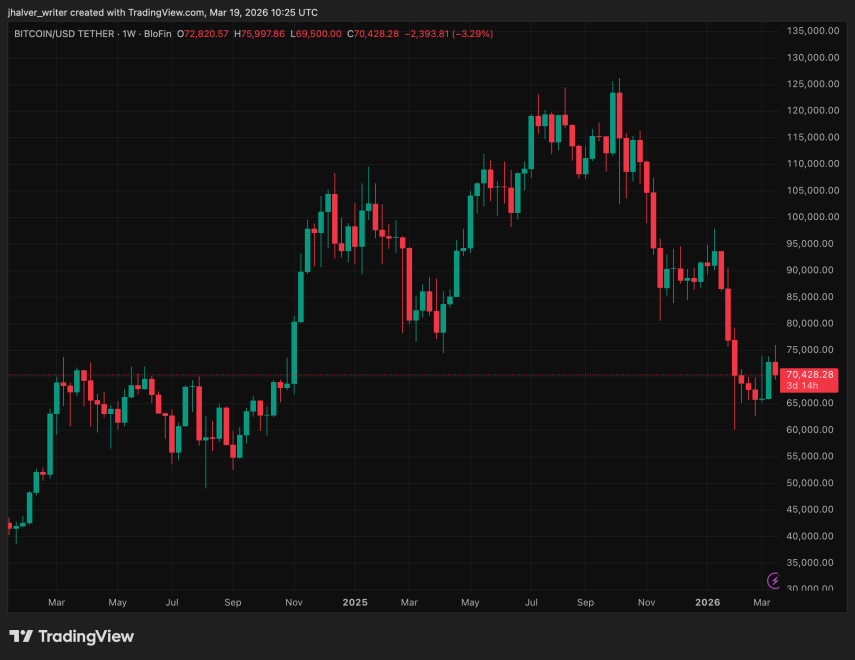
At the moment of writing, BTC’s trades for $70k on the daily chart. Source: BTCUSDT on Tradingview

Cover image from Perplexity, BTCUSD chart from Tradingview

Пов'язані питання

QWhat new evidence has been uncovered regarding payments from Mauricio Novelli to Javier Milei?

ANew forensic reports and leaked court documents show years of dollar payments from crypto Libra lobbyist Mauricio Novelli to Javier Milei and his inner circle, dating back to 2021. These payments were for teaching classes and promoting Novelli's investment consulting firm.

QHow were the payments from Novelli to Milei's circle financed and delivered?

AProsecutors found that Mauricio Novelli financed the payouts by selling USDT and other crypto assets for cash. He then delivered physical dollars, which were labeled as the 'usual' amount. Monthly payments were around $2,000 during Milei's time as a deputy and later rose to $4,000, routed to his sister Karina Milei once he became president.

QWhat was the content of the '5 million memo' found in Novelli's notes?

AThe seized '5 million memo' from Novelli's notes app described a potential USD 5 million package, which could be in tokens or cash, for Milei's social-media promotion and political backing of Libra. It framed Milei as a central 'asset' in the project, though no signed contract has been found.

QWhat were the consequences of President Milei promoting the $LIBRA token on social media?

AWhen President Milei promoted the $LIBRA token on X in February 2025, it triggered a 1,300% price spike followed by a violent crash. This resulted in late buyers suffering heavy losses of as much as $100 million, sparking criminal complaints, a congressional inquiry, and allegations that the president used his office to pump a high-risk crypto asset.

QHow has the Argentine presidency responded to the allegations in the Libra scandal?

AThe presidency maintains that Milei only shared information about Libra 'in good faith' and was not fully informed about the project's details. Officials have dismissed the media leaks as biased parts of a flawed case file.

Пов'язані матеріали

From South Korea to the United States: Blue-Collar Jobs Are Becoming Increasingly Popular, Thanks to AI

AI is reshaping the labor market's value proposition. The traditional four-year college degree is losing its appeal as a guaranteed career path, while skilled blue-collar trades like electricians, welders, and plumbers are experiencing historic demand and wage premiums. This shift is driven by dual pressures: AI's displacement of certain white-collar roles and a booming need for physical infrastructure and data center construction. Data confirms the trend. In the U.S., vocational school revenue surged, and a significant portion of recent layoffs are AI-related. Surveys show a majority of Gen Z adults plan to pursue blue-collar work, citing better job security against AI automation. Vocational education interest has exploded recently. Experts cite a psychological shift as younger generations seek tangible, AI-resistant careers and avoid high student debt. In many cases, salaries for skilled trades now match or exceed those requiring a bachelor's degree. In South Korea, semiconductor vocational high schools boast near-total employment, with graduates securing high-paying roles at companies like Samsung. The shortage is structural, exacerbated by a retiring baby boomer workforce and massive infrastructure projects. Companies like JPMorgan Chase, Meta, and Lowe's are investing heavily in training programs. However, overcoming historical stigma and a "perception gap" around trade careers remains a key challenge to closing the talent gap.

marsbit20 хв тому

From South Korea to the United States: Blue-Collar Jobs Are Becoming Increasingly Popular, Thanks to AI

marsbit20 хв тому

Qualcomm: AI Hype Subsides, When Will Smartphones Emerge from the Gloom?

Qualcomm reported its Q3 FY2026 results (ending June 2026), with revenue of $9.95B, down 4% YoY but above expectations. Gross margin declined to 53.1%, pressured by rising costs across manufacturing and memory. Key business segments showed mixed performance: Handset revenue fell 19.6% YoY to $5.09B, dragged by an 11% decline in non-Apple Android shipments and weaker high-end mix. Conversely, Automotive revenue surged 61% to $1.59B, and IoT grew 9% to $1.83B. Core operating profit dropped 41% YoY due to margin compression and higher expenses. Management's Q4 FY2026 guidance projects revenue of $9.7B-$10.5B, in line with consensus, but Non-GAAP EPS guidance of $2.05-$2.25 fell short of expectations. Amidst persistent weakness in its core handset market, Qualcomm is pursuing growth in AI, focusing on Edge AI (smartphones, PCs, automotive) and Data Center AI. Its data center strategy includes four pillars: AI accelerators (e.g., AI200), commercial CPUs (Dragonfly C1000), custom silicon, and connectivity solutions. While these initiatives initially boosted its stock, concerns over AI capital expenditure sustainability have since erased those gains. The company targets $5B in data center revenue for FY2027 and $15B for FY2029. The report concludes that with the traditional handset business still under pressure, the data center opportunity is currently viewed as a longer-term option, and a more conservative valuation based on core operations may be warranted until AI contributions materialize.

marsbit24 хв тому

Qualcomm: AI Hype Subsides, When Will Smartphones Emerge from the Gloom?

marsbit24 хв тому

From TPU to Self-Evolving Agents: How Jeff Dean Predicts the Next Step in AI

At the 2026 YC Startup School, Jeff Dean outlined his vision for AI's next phase, shifting focus from simply scaling models to building intelligent, autonomous systems. He believes AI's progress is no longer just about creating smarter models, but about integrating them into systems capable of long-term, iterative work, automated experimentation, and continuous learning. This evolution moves the competition from "who has the bigger model" to "who can best organize intelligence." Dean suggests AI capabilities are now comparable to a junior engineer, enabling the automation of complex workflows. However, the true challenge and opportunity lie in managing these AI "workers" at scale. He emphasizes the importance of **context engineering**—structuring tools, memory, and feedback loops—over raw model power. For startups, this means building deep expertise in niche domains where general models currently fail (near 0-1% success rates), leveraging proprietary data, specialized tools, and domain-specific evaluators. A recurring theme is re-examining fundamental constraints. Dean's past work, like moving Google's search index to memory or creating the TPU, stemmed from questioning outdated assumptions about hardware and cost. He sees similar inflection points today, particularly in **specialized inference hardware** to drastically reduce latency and energy consumption for real-time Agent operation. Notably, he points out that in modern AI systems, the dominant cost is often not computation but **data movement**. Reliable, long-running Agents require robust system design, borrowing concepts from distributed computing like checkpointing, state management, and parallel exploration to handle failures and maintain progress over days or weeks. As AI automates execution, the scarcest human skills will shift to **defining clear specifications**, **judging what problems are worth solving** (taste), and designing effective feedback loops. Ultimately, Dean's framework prioritizes understanding the problem deeply, identifying the true bottlenecks, and systematically building closed-loop systems where AI can not only perform tasks but also improve AI itself.

marsbit24 хв тому

From TPU to Self-Evolving Agents: How Jeff Dean Predicts the Next Step in AI

marsbit24 хв тому

Торгівля

Спот
活动图片





