Crypto Investors Cheer As South Korea Scraps Punishing Tax Plan

bitcoinistОпубліковано о 2026-03-20Востаннє оновлено о 2026-03-20

Анотація

South Korea's main opposition party, the People Power Party, has proposed a bill to abolish the planned 20% tax on cryptocurrency gains, which was scheduled to take effect in 2027. The tax had been repeatedly delayed due to political debates and concerns over fairness, as it imposed a lower threshold compared to stock gains. The proposal aims to integrate crypto income into a unified financial investment tax framework instead of maintaining a separate regime. While this offers short-term relief for investors, the country continues to advance broader crypto regulations, including user protection laws and AI-powered tracking systems, indicating that a more comprehensive and integrated tax environment may still emerge in the future.

South Korean right-wing lawmakers have proposed a bill to abolish the taxation of crypto assets scheduled to take effect on January 1, 2027.

A Long Chain Of Regulation Delays

According to Korean outlet Digital Asset, Korea’s main opposition party the People Power Party is advancing a plan that would effectively abolish the dedicated 20% “crypto tax” by merging virtual‐asset income into a unified financial investment tax framework, instead of enforcing a separate regime just for digital assets.

The proposal comes after multiple postponements. Ruling and opposition parties alternated between promising delays and demanding quick implementation, repeatedly using crypto tax timelines as an election wedge with youth voters. The original 20% tax on gains over roughly ₩2.5 million was pushed from 2022 to 2023, then to 2025, and then again toward 2027 amid political infighting and concerns over investor protection.

The core issue has lays in parity. Crypto gains were set to be taxed at 20% above a very low threshold, while stock gains only paid similar rates above ₩50 million, fueling claims that young, retail‐heavy crypto traders were being unfairly targeted. Song Eon-seok, floor leader of the party and the responsible for introducing the bill, explained:

Given that the financial investment income tax has been abolished for the development of the capital market and the protection of investors, imposing a separate income tax on digital assets raises issues regarding equity and consistency in the tax system.

Kim Han-gyu, senior deputy floor leader for policy of the Democratic Party, responded to the proposal saying that they ruling party will discuss the bill now that it’s been introduced, although “there is no serious discussion or consensus within the party”, local media reported.

South Korea In The Forefront Of Crypto Regulation

South Korea has already rolled out the Virtual Asset User Protection Act and is still fighting over a second‐phase “Virtual Asset Law” covering stablecoins and more comprehensive oversight, underscoring that taxation is only one piece of a much tougher framework.

While many jurisdictions are tightening tax enforcement on digital assets, South Korea is prioritizing regulatory safeguards and market structure first. It’s worth noting, however, that South Korea’s National Tax Service is also moving ahead with a strong AI Crypto Tracking System, as reported by Bitcoinist on March 12.

A more balanced tax design could reduce incentives for Korean traders to move volume offshore or into grey‐area platforms, potentially supporting onshore liquidity and institutional participation. The apparent end of a standalone crypto tax is a short‐term relief, but once the unified financial investment tax kicks in, sophisticated reporting and on‐chain tracing tools mean evasion risks will climb. Active traders should prepare for stricter KYC, better record‐keeping, and the possibility that today’s relief turns into tomorrow’s more robust, integrated tax regime.
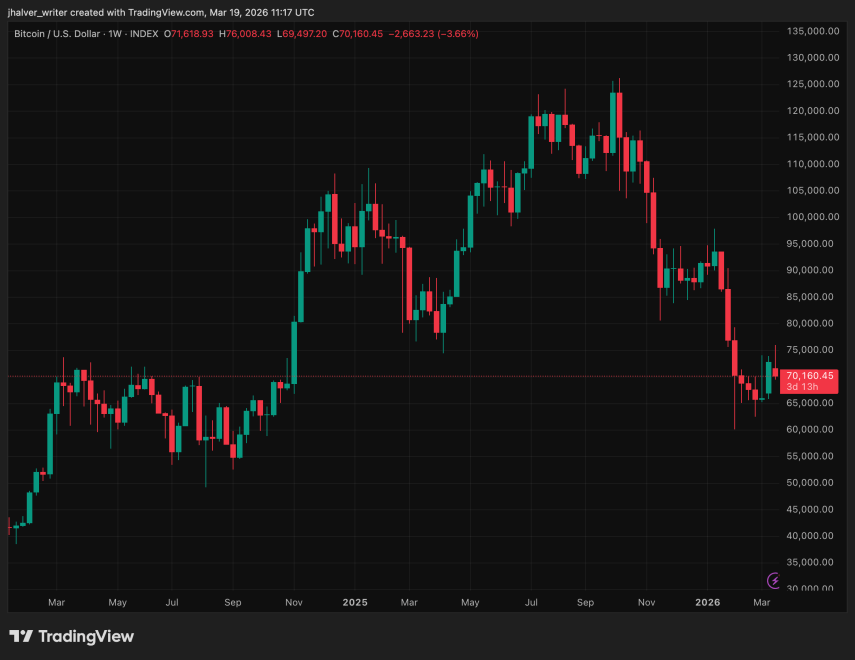
At the moment of writing, BTC’s trades for $70k on the daily chart. Source: BTCUSD on Tradingview

Cover image from Perplexity, BTCUSD chart from Tradingview

Пов'язані питання

QWhat is the main reason South Korean lawmakers are proposing to abolish the dedicated crypto tax?

AThey aim to address issues of equity and consistency in the tax system by merging virtual-asset income into a unified financial investment tax framework, rather than having a separate regime just for digital assets.

QHow many times has the implementation of South Korea's 20% crypto tax been postponed?

AThe tax has been postponed multiple times, originally from 2022 to 2023, then to 2025, and again to 2027.

QWhat was the key disparity between crypto and stock taxation that fueled claims of unfair targeting?

ACrypto gains were set to be taxed at 20% above a very low threshold (around ₩2.5 million), while stock gains only paid similar rates above a much higher threshold of ₩50 million.

QWhat broader regulatory framework is South Korea implementing alongside the tax discussion?

ASouth Korea has rolled out the Virtual Asset User Protection Act and is developing a second-phase 'Virtual Asset Law' covering stablecoins and more comprehensive oversight.

QWhat potential market impact could a more balanced tax design have according to the article?

AIt could reduce incentives for Korean traders to move volume offshore or into grey-area platforms, potentially supporting onshore liquidity and institutional participation.

Пов'язані матеріали

NEAR to Airdrop 330,000 Tokens, Betting on TVL Reaching $70 Million

On June 11th, NEAR Protocol launched the Near@3.33 Milestone Incentive Program, targeting users of its Confidential Intents privacy cross-chain execution feature. The program will distribute 333,333 milestone tokens when the Confidential Intents Total Value Locked (TVL) reaches $70 million. Users must have conducted Confidential transactions on near.com and maintain a Confidential balance above $100 in any asset to qualify, with a single wallet capped at 2% of the current airdrop pool. The milestone tokens will be locked upon receipt and cannot be sold or transferred. They can only be converted 1:1 to NEAR tokens once NEAR's Volume Weighted Average Price (VWAP) maintains $3.33 or higher for three consecutive trading days. As of the report, Confidential Intents TVL exceeds $20.69 million, needing roughly a 3x increase to trigger the airdrop. Confidential Intents, launched in February 2026, is NEAR's privacy execution layer designed to prevent MEV, front-running, and strategy leaks by building confidentiality directly into the execution environment. Its TVL has grown from zero to approximately $15 million in about three months. NEAR token price, which surged from around $1 in April to a peak of $3.08, currently trades near $2. The program aims to boost user activity for Confidential Intents, with future incentive rounds planned as community engagement increases.

Foresight News16 хв тому

NEAR to Airdrop 330,000 Tokens, Betting on TVL Reaching $70 Million

Foresight News16 хв тому

Crypto Market Makers Are Collectively Seeking Change as Money Becomes Harder to Earn

**Summary: Crypto Market Makers Adapt as Margins Shrink** Leading crypto market maker GSR exemplifies a broader industry shift, moving beyond traditional market-making to become a full-service "Web3 investment bank." Its recent strategic acquisitions—including an SEC-registered broker-dealer, rebranded as GSR Securities—and purchases of token advisory firms aim to create an integrated platform covering token design, fundraising, listing, liquidity provision, and asset management. This includes launching an ETF and investing in tokenization platforms like Libeara, backed by a strategic investment from Standard Chartered's SC Ventures. This transformation is not unique to GSR. Other major players like Keyrock, B2C2, Wintermute, and DWF Labs are also expanding geographically, pursuing regulatory licenses (especially under frameworks like MiCA in the EU), and diversifying into over-the-counter (OTC) trading, asset management, and real-world asset tokenization. The driving force behind this collective pivot is a rapidly changing market. Profits from traditional altcoin market-making are declining due to fewer viable projects, reduced client budgets, increased competition, and smarter, more demanding clients. Simultaneously, regulatory pressures are mounting, making compliance a baseline cost. Extreme market events further expose teams lacking robust risk controls. Consequently, the crypto market-making business model is evolving from one reliant on information asymmetry and volatility to a more institutionalized, regulated, and service-diverse industry. Survival now depends on building systemic capabilities beyond mere liquidity provision.

marsbit21 хв тому

Crypto Market Makers Are Collectively Seeking Change as Money Becomes Harder to Earn

marsbit21 хв тому

Market Adjusts Following Google's $84.7 Billion Fundraising, AI Valuations Now Focus on Payback Speed

After Alphabet's announcement of an $84.75 billion equity financing round, market focus for AI investment is shifting from pure growth narratives to capital efficiency and payback periods. The core argument is that AI is being re-priced from a software-like growth story into a heavy-asset infrastructure cycle, requiring massive capital expenditure (CapEx) on chips, data centers, and power grids. While Alphabet's financing itself is not a distress signal—part of it is for administrative purposes like tax obligations on stock compensation—it highlights the enormous capital demands of AI infrastructure. This demand extends beyond tech giants to pure-play AI model companies (like OpenAI, Anthropic), data center REITs, and utilities. Major tech firms are projected to spend heavily on AI data centers in 2026, signaling a broad-based capital cycle the market must absorb. Consequently, valuation logic is changing. Investors are moving away from questions about who has the strongest AI narrative and are now prioritizing clear visibility into orders, stable cash flows, and the cost of capital. This has led to recent pressure on high-multiple AI software and semiconductor stocks, while "picks-and-shovels" hardware, data center, and power assets with firmer near-term demand may see relative support. The key going forward will be monitoring whether rising CapEx guidance across companies is matched by a timely monetization of AI investments into revenue and cash flow. The market's tolerance for high spending depends on demonstrable returns. While the long-term AI thesis remains intact, the valuation framework has fundamentally shifted to emphasize capital discipline and payback speed.

marsbit28 хв тому

Market Adjusts Following Google's $84.7 Billion Fundraising, AI Valuations Now Focus on Payback Speed

marsbit28 хв тому

Торгівля

Спот
Ф'ючерси
活动图片





