Crypto Industry Watches As Poland Advances Long-Delayed Regulatory Bill

bitcoinistОпубліковано о 2026-05-16Востаннє оновлено о 2026-05-16

Анотація

Poland's parliament has passed a long-delayed cryptocurrency regulatory bill, driven by urgency following a fraud scandal at a local exchange. Prime Minister Donald Tusk cited the Zondacrypto case, where users lost access to funds and which had alleged Russian ties, as proof of the need for investor protections. The approved bill grants Poland's Financial Supervision Authority (KNF) broad powers to oversee the market, impose penalties, and block accounts or transactions. However, the legislation faces potential rejection, as it retains contentious account-blocking provisions that led President Karol Nawrocki to veto two prior versions. Critics argue it lacks sufficient judicial oversight. A third veto would prolong regulatory uncertainty as Poland races to align with the EU's MiCA framework by a July deadline. The bill prevailed over three other competing proposals in a parliamentary vote.

Poland’s prime minister has tied the country’s repeated failure to pass crypto rules to a high-profile fraud case — a charge that added urgency to a parliamentary vote that had already failed twice before.

A Scandal Shapes The Debate

Prime Minister Donald Tusk pointed to Zondacrypto, a Polish crypto exchange now under a prosecutor’s fraud probe, as evidence of what happens when investor protections are not in place.

Thousands of the exchange’s users reportedly could not access their funds, and Tusk alleged the platform had ties to Russian capital and influence dating to its early years.

He argued that Poland’s inability to finalize a regulatory framework had slowed any official response to the crisis.

The exchange scandal cast a long shadow over this week’s sitting of the Sejm, Poland’s lower house of parliament, where lawmakers debated four separate crypto bills simultaneously.
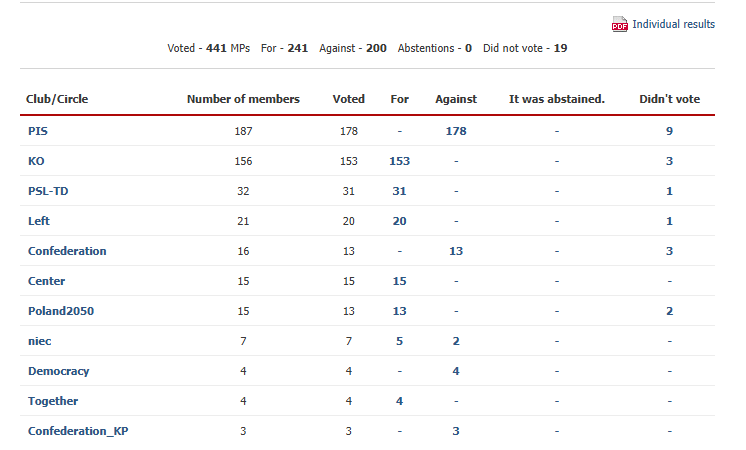
Source: SEJM

On Friday, they approved the government-backed bill — numbered 2529 and supported by the Ministry of Finance — by a vote of 241 to 200. It was the third time the government had pushed this kind of legislation through parliament after President Karol Nawrocki vetoed two earlier versions.

The approved bill hands broad authority to Poland’s Financial Supervision Authority, known as the KNF, to monitor crypto market participants, impose administrative penalties, and block accounts and transactions when deemed necessary.

Critics Point To Unchanged Provisions

Not everyone in the crypto community welcomed the outcome. Market participants and commentators noted that the account and transaction blocking provisions — the same ones that prompted Nawrocki’s previous vetoes — remained largely intact in the final text. Proposed changes such as stronger judicial oversight of enforcement actions were not included.

BTCUSD trading at $79,182 on the 24-hour chart: TradingView

With those concerns unresolved, many observers expect the president to veto the bill again. That prospect worries industry players, since a third rejection would deepen regulatory uncertainty at a particularly inconvenient time.

Poland is required to bring its rules in line with the European Union’s Markets in Crypto-Assets Regulation, known as MiCA, with implementation deadlines approaching in July.

Four Bills, One Outcome

The vote came after lawmakers reviewed competing proposals from four separate sources: the government, the president, the Confederation party, and a parliamentary group. A committee merged the texts before the final vote, and the government version ultimately prevailed.

Featured image from Hotels.com, chart from TradingView

Пов'язані питання

QWhat event did Poland's Prime Minister Donald Tusk link to the need for cryptocurrency regulation?

APrime Minister Donald Tusk linked the need for cryptocurrency regulation to the scandal surrounding the Zondacrypto exchange, which is under a fraud probe, where thousands of users reportedly could not access their funds.

QWhat is the main regulatory body granted authority under the newly passed Polish crypto bill, and what powers does it have?

AUnder the newly passed bill, Poland's Financial Supervision Authority (KNF) is granted broad authority to monitor crypto market participants, impose administrative penalties, and temporarily block accounts and transactions when deemed necessary.

QWhy do critics expect the Polish President to veto the recently passed cryptocurrency bill?

ACritics expect the President to veto the bill because it retains controversial provisions, such as the power to block accounts and transactions without the stronger judicial oversight that was proposed but not included, which were the same reasons for his previous vetoes.

QWhat is the external regulatory deadline that Poland is facing regarding cryptocurrency legislation?

APoland is facing a deadline to align its national rules with the European Union's Markets in Crypto-Assets Regulation (MiCA), with implementation deadlines approaching in July.

QHow many different cryptocurrency bills were debated in the Sejm, and which one was ultimately approved?

ALawmakers debated four separate cryptocurrency bills from different sources: the government, the president, the Confederation party, and a parliamentary group. The government-backed bill (number 2529) was the one ultimately approved after a committee merged the texts for a final vote.

Пов'язані матеріали

Bloomberg Uncovered: How Do China's Wealthy Circumvent the Annual $50,000 Limit to Transfer Assets?

**Summary: How Wealthy Chinese Circumvent $50,000 Annual Foreign Exchange Limits** Despite China's strict capital controls, including an annual $50,000 per person foreign exchange quota, an estimated $150 billion in funds still leaves the country annually via various gray and underground channels. This report outlines the evolution of China's "capital wall" and the methods used to bypass it. **The Evolving Capital Controls:** * **Foundation (1994):** The system of "current account convertibility with strict capital account controls" was established. * **Quota Set (2007):** The $50,000 individual annual forex purchase limit was formalized. * **Crackdown Begins (2015-2017):** Following market volatility, enforcement tightened. Banks were required to scrutinize transactions, and channels like using UnionPay cards for Hong Kong insurance premiums or buying overseas property were blocked. * **Digital & Legal Upgrades (2024-2026):** Enhanced algorithms now flag suspicious patterns (e.g., "smurfing"). The Common Reporting Standard (CRS) provides Chinese tax authorities with data on citizens' offshore accounts. Unlicensed cross-border brokers have been targeted. **Five Primary Methods for Moving Capital:** 1. **Underground Banking / "Hawala" (Duiqiao):** The largest-scale method. No money crosses borders. Clients pay RMB to a domestic account; an overseas associate deposits equivalent foreign currency into the client's offshore account. Risks include high fees, account freezes, and legal penalties. 2. **"Smurfing" or "Ant Moving":** Using multiple individuals' $50,000 quotas to pool funds for one offshore recipient. Increasingly detected by anti-money laundering algorithms. 3. **Trade Invoice Manipulation:** Businesses over-invoice imports or under-invoice exports via offshore shell companies, creating a pretext to transfer excess funds abroad under the guise of trade. 4. **Channel Migration:** After a crackdown on internet brokers, funds flow toward more compliant but costly channels like major banks' cross-border wealth management services or Qualified Domestic Institutional Investor (QDII) quotas. 5. **Structural Arrangements:** High-net-worth individuals use complex, high-cost legal structures involving offshore trusts, insurance, and investment migration programs to transfer asset ownership. **Regulatory Response: Focusing on People, Not Just Money** The current strategy extends oversight from enterprises to **individual residents**. Tools like CRS allow retroactive visibility into offshore assets. Cryptocurrencies, once seen as a potential loophole, are now actively monitored and prosecuted as an illegal channel. The underlying driver remains: with significant wealth concentrated among millions of affluent households seeking diversification amid domestic economic shifts, the incentive to move assets offshore persists despite regulatory barriers.

marsbit4 хв тому

Bloomberg Uncovered: How Do China's Wealthy Circumvent the Annual $50,000 Limit to Transfer Assets?

marsbit4 хв тому

Ethereum's Ballmer Moment: As Everyone Is Bearish, the Circulating Supply Is Disappearing

"Ethereum's Ballmer Moment: Circulation Shrinks Amid Bearish Sentiment" Amid widespread bearish sentiment, with prominent figures like Bankless founder David Hoffman selling ETH and young developers flocking to Solana, some argue Ethereum is entering its "Ballmer era"—akin to Microsoft's perceived stagnation under Steve Ballmer. While surface-level criticisms about slow protocol development, cautious leadership, and competitive pressure are valid, underlying fundamentals tell a different story. Approximately 30% of ETH is staked, major holders like BitMine are accumulating, and spot ETFs continue to absorb supply. Regulatory clarity, including the SEC/CFTC's March ruling on staking rewards and the potential passage of the CLARITY Act, is transforming crypto from a regulatory threat into a legitimized framework. This institutionalization, alongside a shrinking circulating supply (with net issuance around 0.23% annually), creates significant buy-side pressure independent of fee-based value capture. The broader crypto total addressable market is expanding through regulated stablecoins, tokenized assets, and institutional adoption. While public chains face competition from permissioned alternatives, the winning model appears to be permissioned assets settling on public chains like Ethereum and Solana. The author advocates a non-maximalist, barbell strategy: holding ETH for its institutional role and supply squeeze, SOL for consumer/throughput trends, BTC as a macro hedge, and a basket of next-gen L1s. Key bullish drivers for ETH include rapid circulation shrinkage, potential Q2 staked ETF approvals, regulatory tailwinds solidifying its role as a default settlement layer, and the optionality of an eventual "Satya moment" leadership shift. Despite bearish consensus, the current setup—where crypto is "not hot" and regulatory groundwork is being laid—presents a compelling investment opportunity. The crypto cycle's focus may have shifted to AI, but blockchain infrastructure is gaining a legal and institutional foothold precisely while attention is elsewhere.

marsbit5 хв тому

Ethereum's Ballmer Moment: As Everyone Is Bearish, the Circulating Supply Is Disappearing

marsbit5 хв тому

Claude Code Introduces Dynamic Workflows: Enabling AI to Form Teams and Collaborate

Claude Code introduces dynamic workflows, enabling AI to coordinate teams of specialized agents for complex tasks. This transforms Claude from a code assistant into a programmable workbench. Workflows address key limitations of single-agent systems: agentic laziness (premature task completion), self-preferential bias (favoring own outputs), and goal drift (losing sight of original objectives). The system allows Claude to dynamically create execution frameworks using JavaScript. It can split tasks, dispatch parallel agents for isolated work (e.g., in separate worktrees), implement adversarial validation, run tournaments, and synthesize results. This multi-agent approach is valuable for tasks requiring deep research, factual verification, code migration, root cause analysis, large-scale triage, and qualitative sorting. Key patterns include: classify-and-route, fan-out-and-synthesize, adversarial verification, generate-and-filter, tournaments, and loop-until-done. While token usage is higher, workflows excel where tasks resemble programming—needing problem decomposition, isolated context, hypothesis testing, and handling many details. They extend Claude Code's utility beyond technical work to areas like business plan review, resume screening, and naming brainstorm. The feature is not a universal solution but points to a future where AI tool competitiveness depends on organizing reliable, reusable, and auditable execution flows for complex goals.

marsbit46 хв тому

Claude Code Introduces Dynamic Workflows: Enabling AI to Form Teams and Collaborate

marsbit46 хв тому

Hyperliquid, Wall Street's 24/7 Trading Convenience Store

Hyperliquid: The 24/7 Trading "Convenience Store" for Wall Street Hyperliquid, a decentralized cryptocurrency exchange, has become a go-to platform for Wall Street traders seeking to trade around the clock, especially during traditional market closures. Founded by Jeff Yan, a former quantitative trader, after the FTX collapse, the platform emphasizes user self-custody of assets. It offers a wide range of perpetual contracts—leveraged derivatives with no expiry—on assets from Bitcoin and crude oil to the S&P 500 and even pre-IPO companies like SpaceX. A notable example involves a hedge fund trader who capitalized on geopolitical news over a weekend, securing a 243% return on oil derivatives before markets reopened. The platform, run by just 11 employees, generated approximately $800 million in revenue last year, and its native token HYPE has seen significant growth. Its rise highlights the merging of traditional finance and crypto. While U.S. users are currently restricted, recent CFTC rule changes could open access. The platform is known for its transparency, having processed $10 billion in liquidations during a market crash while competitors faltered. Regulators warn of the high risks and complexity of perpetual contracts for retail investors. Key to its appeal is a strong community culture, direct engagement with founders, and a simple interface. Despite rules against VPN use, it attracts global users with its permissionless approach. Hyperliquid plans to expand into prediction markets and options, aiming to eventually host all financial activity.

marsbit46 хв тому

Hyperliquid, Wall Street's 24/7 Trading Convenience Store

marsbit46 хв тому

Торгівля

Спот
Ф'ючерси

Популярні статті

Як купити BILL

Ласкаво просимо до HTX.com! Ми зробили покупку Billions Network (BILL) простою та зручною. Дотримуйтесь нашої покрокової інструкції, щоб розпочати свою криптовалютну подорож.Крок 1: Створіть обліковий запис на HTXВикористовуйте свою електронну пошту або номер телефону, щоб зареєструвати обліковий запис на HTX безплатно. Пройдіть безпроблемну реєстрацію й отримайте доступ до всіх функцій.ЗареєструватисьКрок 2: Перейдіть до розділу Купити крипту і виберіть спосіб оплатиКредитна/дебетова картка: використовуйте вашу картку Visa або Mastercard, щоб миттєво купити Billions Network (BILL).Баланс: використовуйте кошти з балансу вашого рахунку HTX для безперешкодної торгівлі.Треті особи: ми додали популярні способи оплати, такі як Google Pay та Apple Pay, щоб підвищити зручність.P2P: Торгуйте безпосередньо з іншими користувачами на HTX.Позабіржова торгівля (OTC): ми пропонуємо індивідуальні послуги та конкурентні обмінні курси для трейдерів.Крок 3: Зберігайте свої Billions Network (BILL)Після придбання Billions Network (BILL) збережіть його у своєму обліковому записі на HTX. Крім того, ви можете відправити його в інше місце за допомогою блокчейн-переказу або використовувати його для торгівлі іншими криптовалютами.Крок 4: Торгівля Billions Network (BILL)Легко торгуйте Billions Network (BILL) на спотовому ринку HTX. Просто увійдіть до свого облікового запису, виберіть торгову пару, укладайте угоди та спостерігайте за ними в режимі реального часу. Ми пропонуємо зручний досвід як для початківців, так і для досвідчених трейдерів.

239 переглядів усьогоОпубліковано 2026.05.07Оновлено 2026.06.02

Як купити BILL

Обговорення

Ласкаво просимо до спільноти HTX. Тут ви можете бути в курсі останніх подій розвитку платформи та отримати доступ до професійної ринкової інформації. Нижче представлені думки користувачів щодо ціни BILL (BILL).

活动图片













