Crypto groups slam Citadel for urging tighter DeFi tokenization rules

cointelegraphОпубліковано о 2025-12-13Востаннє оновлено о 2025-12-13

Анотація

A coalition of crypto organizations, including Andreessen Horowitz and the Uniswap Foundation, has criticized Citadel Securities for urging the SEC to impose stricter regulations on DeFi platforms offering tokenized stocks. The group argues that Citadel's proposal relies on a flawed analysis of securities laws and would inappropriately extend registration requirements to decentralized entities. They contend that regulating DeFi under traditional securities frameworks is impractical and fails to recognize that autonomous software cannot act as a regulated intermediary. While sharing the goal of investor protection, the coalition believes it can be achieved through onchain markets without mandatory registration. Citadel had warned that exempting DeFi could create a dual regulatory system and deprive investors of key protections. The debate arises as the SEC seeks feedback on regulating tokenized assets.

A group of crypto organizations has pushed back on Citadel Securities’ request that the Securities and Exchange Commission tighten regulations on decentralized finance when it comes to tokenized stocks.

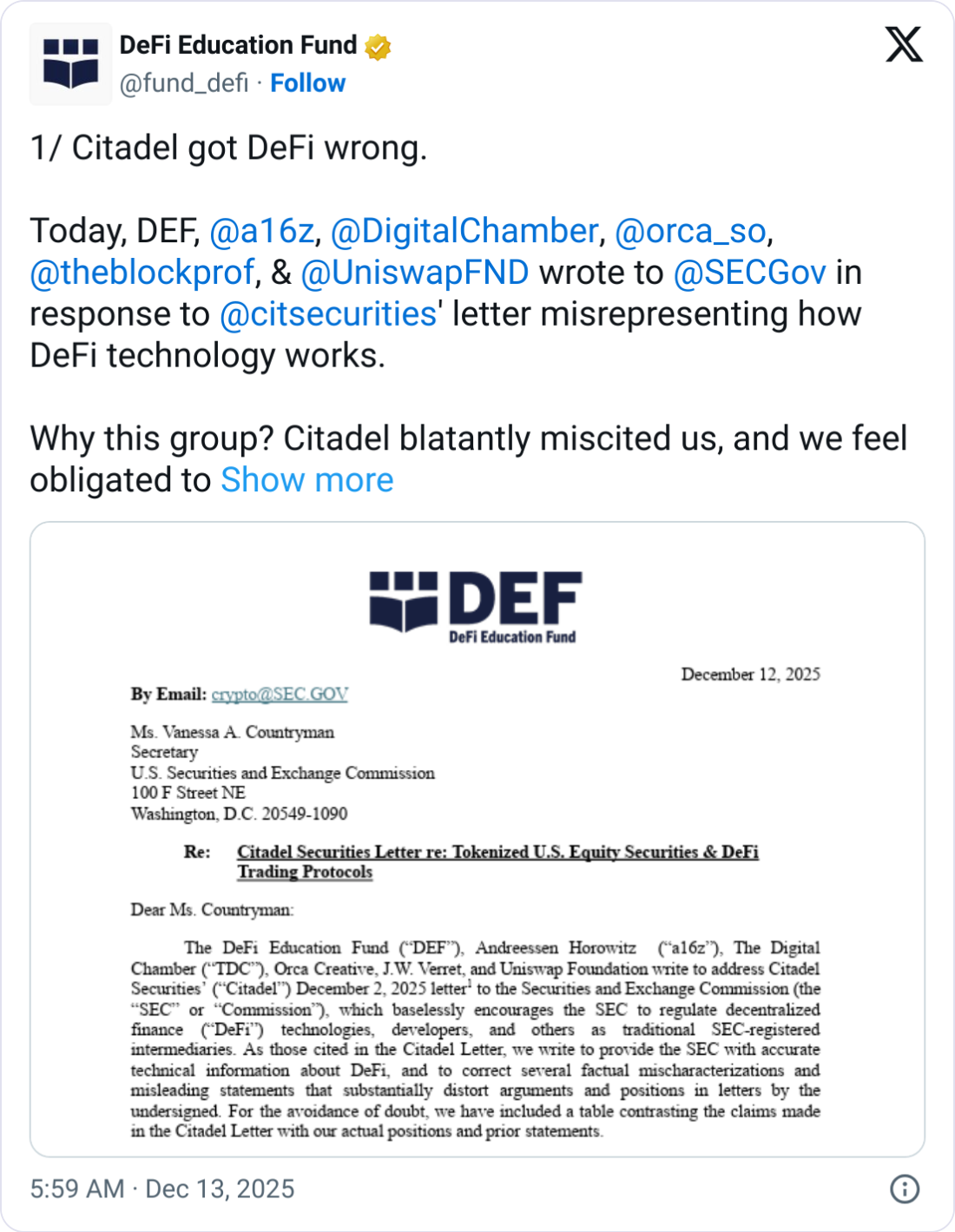
Andreessen Horowitz, the Uniswap Foundation, along with crypto lobby groups the DeFi Education Fund and The Digital Chamber, among others, said they wanted “to correct several factual mischaracterizations and misleading statements” in a letter to the SEC on Friday.

The group was responding to a letter from Citadel earlier this month, which urged the SEC not to give DeFi platforms “broad exemptive relief” for offering trading of tokenized US equities, arguing they could likely be defined as an “exchange” or “broker-dealer” regulated under securities laws.

“Citadel’s letter rests on a flawed analysis of the securities laws that attempts to extend SEC registration requirements to essentially any entity with even the most tangential connection to a DeFi transaction,” the group said.

The group added they shared Citadel’s aims of investor protection and market integrity, but disagreed “that achieving these goals always necessitates registration as traditional SEC intermediaries and cannot, in certain circumstances, be met through thoughtfully designed onchain markets.”

Citadel’s ask would be impractical, group says

The group argued that regulating decentralized platforms under securities laws “would be impracticable given their functions” and could capture a broad range of onchain activities that aren’t usually considered as offering exchange services.

The letter also took aim at Citadel’s characterization that autonomous software was an intermediary, arguing it can’t be a “‘middleman’ in a financial transaction because it is not a person capable of exercising independent discretion or judgment.”
Source: DeFi Education Fund

“DeFi technology is a new innovation that was designed to address market risks and resiliency in a different way than traditional financial systems do, and DeFi protects investors in ways that traditional finance cannot,” the group argued.

Related: SEC’s Crenshaw takes aim at crypto in final weeks at agency

In its letter, Citadel had argued that the SEC giving the green light to tokenized shares on DeFi “would create two separate regulatory regimes for the trading of the same security” and would undermine “the ‘technology-neutral’ approach taken by the Exchange Act.”

Citadel argued that exempting DeFi platforms from securities laws could harm investors, as the platforms wouldn’t have protections such as venue transparency, market surveillance and volatility controls, among others.

The letter initially drew considerable backlash, with Blockchain Association CEO Summer Mersinger saying Citadel’s stance was an “overbroad and unworkable approach.”

The letters come as the SEC looks for feedback on how it should approach regulating tokenized stocks, and agency chair Paul Atkins has said that the US financial system could embrace tokenization in a “couple of years.”

Tokenization has exploded in popularity this year, but NYDIG warned on Friday that assets moving onchain won’t immediately be of great benefit to the crypto market until regulations allow them to more deeply integrate with DeFi.

Magazine: SEC’s U-turn on crypto leaves key questions unanswered

Пов'язані матеріали

Within Strategy's Framework, STRC's Dividend Yield Remains at 12% as Share Price Stays Below Par Value

Michael Saylor, Executive Chairman of Strategy (MSTR), confirmed that the dividend rate for its STRC perpetual preferred shares will remain at 12.00% through August 2026. The rate has increased from 9% at its July 2025 launch to the current high via a "ratchet" mechanism, which permanently raises the rate by 0.5% whenever the share price falls below $95. This mechanism is intended to push the price back toward its $100 par value and support Strategy's "at-the-market" (ATM) program for issuing new shares to fund Bitcoin purchases. However, the mechanism has not worked as intended. STRC shares closed at $89.46 on July 31, remaining about 10-11% below par value despite the record-high dividend. Competition from rival Strive's higher-yielding SATA securities has pressured demand. The persistent discount has forced Strategy to suspend new STRC issuances via its ATM program, limiting this funding channel for Bitcoin acquisitions. STRC's struggles reflect Bitcoin's own volatility, as the preferred shares historically move in tandem. Analysts have warned the ratchet structure carries long-term, one-way risk. A law firm is investigating Strategy's ability to maintain dividend payments if Bitcoin's price stays low. Retail investors own roughly 83% of outstanding STRC shares, a group seen as prone to panic selling during downturns. In response, Strategy has established financial reserves, including a liquidity cushion covering about 26 months of dividend/interest obligations, and a $2 billion share buyback program alongside a Bitcoin monetization framework, though the company emphasized it is not obligated to sell any Bitcoin.

cryptonews.ru27 хв тому

Within Strategy's Framework, STRC's Dividend Yield Remains at 12% as Share Price Stays Below Par Value

cryptonews.ru27 хв тому

Analyst: Bitcoin's Price Will Drop to $60k in August, Then Rebound to $70k

Financial analyst Andrey Poroshin has provided a new forecast for Bitcoin's price dynamics in August. Poroshin, an analyst at the Bitbanker exchange, expects the cryptocurrency market to experience a downturn this month, with prices retesting the $60,000 level due to a lack of supportive macroeconomic catalysts. He noted that the recent US Federal Reserve decision to hold interest rates did not significantly impact the market, while inflation remains above the 2% target. Poroshin stated that Bitcoin is ending July under pressure from moderate volatility and a lack of new macroeconomic stimuli, leading to continued market caution. According to his base scenario, Bitcoin will drop to a range of $60,000 to $62,000 before recovering to $70,000. He pointed out that even $70,000 remains below the cost of mining in the US, which has prompted some miners to shift towards AI data center operations. Poroshin cited the winding down of BitMEX's operations as a potential catalyst for a price rebound, suggesting the exit of weaker players often coincides with market reversals and reduced short-term selling pressure. He believes Bitcoin is currently less susceptible to geopolitical shocks, such as the Iran-US conflict, and does not expect significant market changes in August related to the pending CLARITY Act. Looking ahead, Poroshin forecasts that September will bring more active price fluctuations driven by potential Fed rate decisions and possible discussions or approval of the CLARITY Act.

cryptonews.ru28 хв тому

Analyst: Bitcoin's Price Will Drop to $60k in August, Then Rebound to $70k

cryptonews.ru28 хв тому

Торгівля

Спот
活动图片




