A group of crypto organizations has pushed back on Citadel Securities’ request that the Securities and Exchange Commission tighten regulations on decentralized finance when it comes to tokenized stocks.
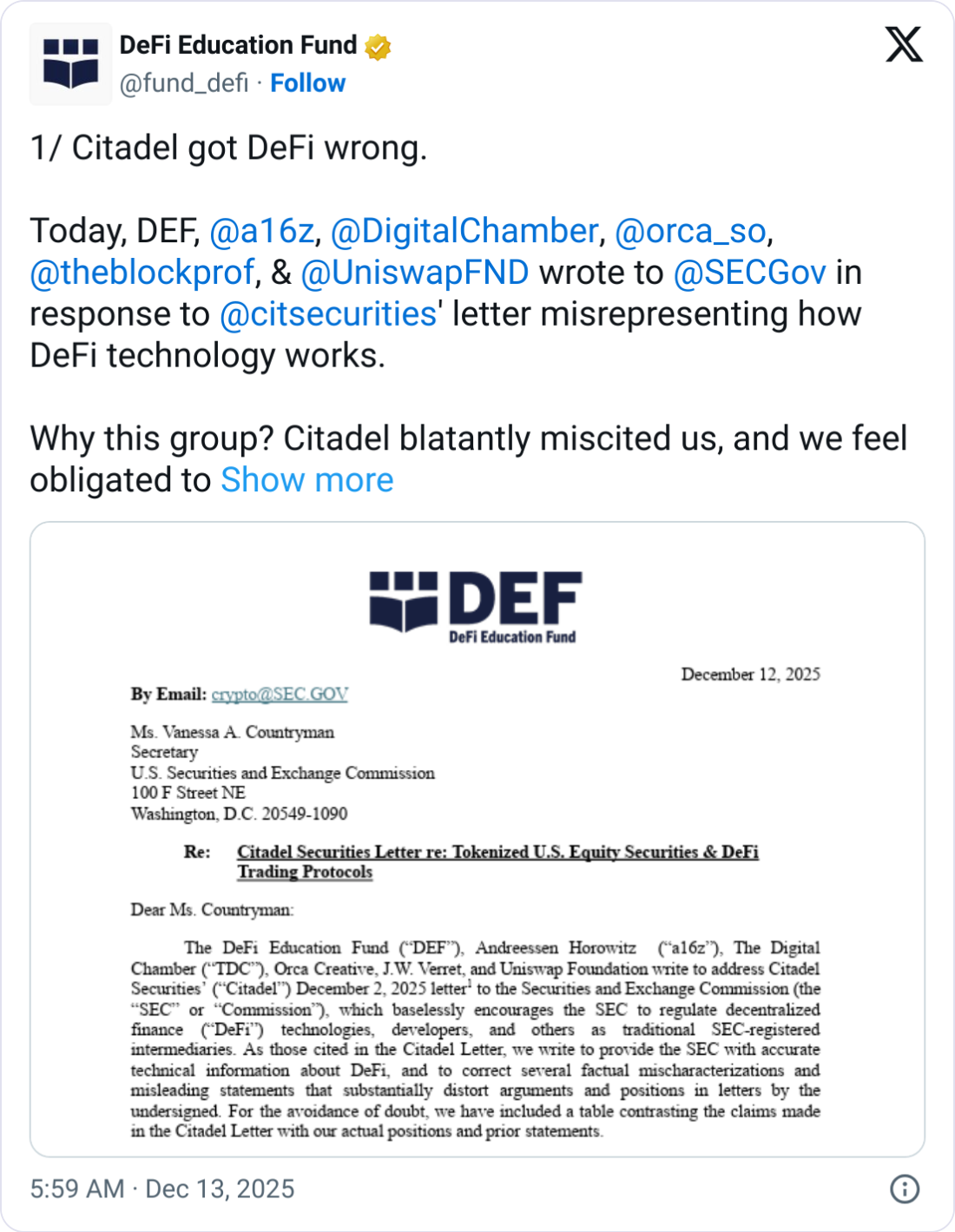
Andreessen Horowitz, the Uniswap Foundation, along with crypto lobby groups the DeFi Education Fund and The Digital Chamber, among others, said they wanted “to correct several factual mischaracterizations and misleading statements” in a letter to the SEC on Friday.
The group was responding to a letter from Citadel earlier this month, which urged the SEC not to give DeFi platforms “broad exemptive relief” for offering trading of tokenized US equities, arguing they could likely be defined as an “exchange” or “broker-dealer” regulated under securities laws.
“Citadel’s letter rests on a flawed analysis of the securities laws that attempts to extend SEC registration requirements to essentially any entity with even the most tangential connection to a DeFi transaction,” the group said.
The group added they shared Citadel’s aims of investor protection and market integrity, but disagreed “that achieving these goals always necessitates registration as traditional SEC intermediaries and cannot, in certain circumstances, be met through thoughtfully designed onchain markets.”
Citadel’s ask would be impractical, group says
The group argued that regulating decentralized platforms under securities laws “would be impracticable given their functions” and could capture a broad range of onchain activities that aren’t usually considered as offering exchange services.
The letter also took aim at Citadel’s characterization that autonomous software was an intermediary, arguing it can’t be a “‘middleman’ in a financial transaction because it is not a person capable of exercising independent discretion or judgment.”
“DeFi technology is a new innovation that was designed to address market risks and resiliency in a different way than traditional financial systems do, and DeFi protects investors in ways that traditional finance cannot,” the group argued.
Related: SEC’s Crenshaw takes aim at crypto in final weeks at agency
In its letter, Citadel had argued that the SEC giving the green light to tokenized shares on DeFi “would create two separate regulatory regimes for the trading of the same security” and would undermine “the ‘technology-neutral’ approach taken by the Exchange Act.”
Citadel argued that exempting DeFi platforms from securities laws could harm investors, as the platforms wouldn’t have protections such as venue transparency, market surveillance and volatility controls, among others.
The letter initially drew considerable backlash, with Blockchain Association CEO Summer Mersinger saying Citadel’s stance was an “overbroad and unworkable approach.”
The letters come as the SEC looks for feedback on how it should approach regulating tokenized stocks, and agency chair Paul Atkins has said that the US financial system could embrace tokenization in a “couple of years.”
Tokenization has exploded in popularity this year, but NYDIG warned on Friday that assets moving onchain won’t immediately be of great benefit to the crypto market until regulations allow them to more deeply integrate with DeFi.
Magazine: SEC’s U-turn on crypto leaves key questions unanswered





