Crypto groups slam Citadel for urging tighter DeFi tokenization rules

cointelegraphОпубліковано о 2025-12-13Востаннє оновлено о 2025-12-13

Анотація

A coalition of crypto organizations, including Andreessen Horowitz and the Uniswap Foundation, has criticized Citadel Securities for urging the SEC to impose stricter regulations on DeFi platforms offering tokenized stocks. The group argues that Citadel's proposal relies on a flawed analysis of securities laws and would inappropriately extend registration requirements to decentralized entities. They contend that regulating DeFi under traditional securities frameworks is impractical and fails to recognize that autonomous software cannot act as a regulated intermediary. While sharing the goal of investor protection, the coalition believes it can be achieved through onchain markets without mandatory registration. Citadel had warned that exempting DeFi could create a dual regulatory system and deprive investors of key protections. The debate arises as the SEC seeks feedback on regulating tokenized assets.

A group of crypto organizations has pushed back on Citadel Securities’ request that the Securities and Exchange Commission tighten regulations on decentralized finance when it comes to tokenized stocks.

Andreessen Horowitz, the Uniswap Foundation, along with crypto lobby groups the DeFi Education Fund and The Digital Chamber, among others, said they wanted “to correct several factual mischaracterizations and misleading statements” in a letter to the SEC on Friday.

The group was responding to a letter from Citadel earlier this month, which urged the SEC not to give DeFi platforms “broad exemptive relief” for offering trading of tokenized US equities, arguing they could likely be defined as an “exchange” or “broker-dealer” regulated under securities laws.

“Citadel’s letter rests on a flawed analysis of the securities laws that attempts to extend SEC registration requirements to essentially any entity with even the most tangential connection to a DeFi transaction,” the group said.

The group added they shared Citadel’s aims of investor protection and market integrity, but disagreed “that achieving these goals always necessitates registration as traditional SEC intermediaries and cannot, in certain circumstances, be met through thoughtfully designed onchain markets.”

Citadel’s ask would be impractical, group says

The group argued that regulating decentralized platforms under securities laws “would be impracticable given their functions” and could capture a broad range of onchain activities that aren’t usually considered as offering exchange services.

The letter also took aim at Citadel’s characterization that autonomous software was an intermediary, arguing it can’t be a “‘middleman’ in a financial transaction because it is not a person capable of exercising independent discretion or judgment.”
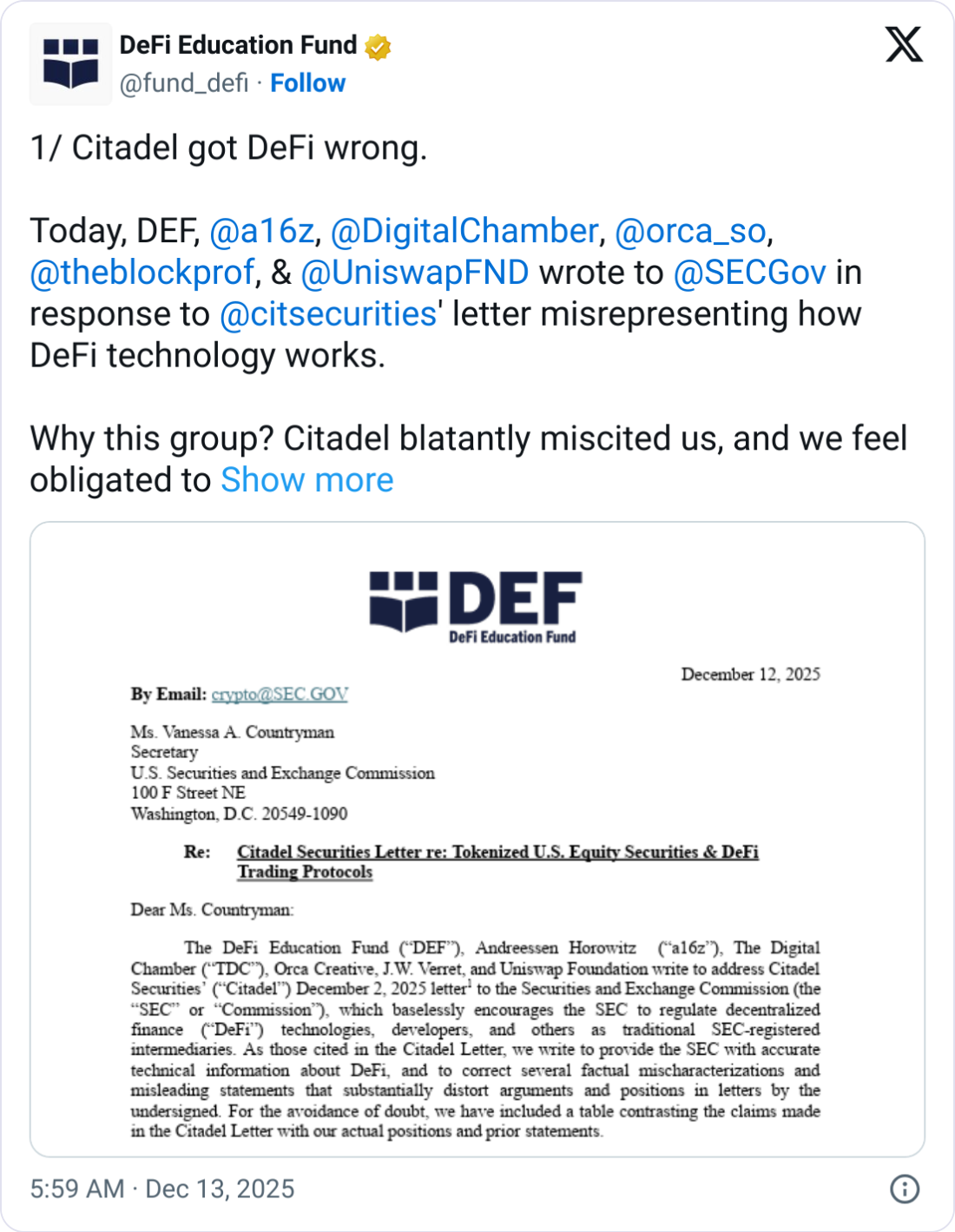
Source: DeFi Education Fund

“DeFi technology is a new innovation that was designed to address market risks and resiliency in a different way than traditional financial systems do, and DeFi protects investors in ways that traditional finance cannot,” the group argued.

Related: SEC’s Crenshaw takes aim at crypto in final weeks at agency

In its letter, Citadel had argued that the SEC giving the green light to tokenized shares on DeFi “would create two separate regulatory regimes for the trading of the same security” and would undermine “the ‘technology-neutral’ approach taken by the Exchange Act.”

Citadel argued that exempting DeFi platforms from securities laws could harm investors, as the platforms wouldn’t have protections such as venue transparency, market surveillance and volatility controls, among others.

The letter initially drew considerable backlash, with Blockchain Association CEO Summer Mersinger saying Citadel’s stance was an “overbroad and unworkable approach.”

The letters come as the SEC looks for feedback on how it should approach regulating tokenized stocks, and agency chair Paul Atkins has said that the US financial system could embrace tokenization in a “couple of years.”

Tokenization has exploded in popularity this year, but NYDIG warned on Friday that assets moving onchain won’t immediately be of great benefit to the crypto market until regulations allow them to more deeply integrate with DeFi.

Magazine: SEC’s U-turn on crypto leaves key questions unanswered

Пов'язані матеріали

Annual Salary of Millions Competing for Electricians, Meta Rushes to Open Its Own Technical School

The AI boom is facing an unexpected bottleneck: a severe shortage of skilled construction workers and electricians. As tech giants like Meta, OpenAI, and Alphabet race to build massive data centers—such as OpenAI's $16 billion "Stargate" project—they are hitting a critical labor wall. The U.S. needs an estimated 130,000 more electricians, 240,000 construction workers, and 150,000 supervisors by 2030 for AI infrastructure alone, but tens of thousands of electrician jobs go unfilled each year. While AI companies offer high premiums, with electricians earning up to $280,000 annually, worker scarcity still causes massive losses—delays on a single project can cost $14.2 million per month. The complexity of building AI data centers, which require immense power (equivalent to powering hundreds of thousands of homes), sophisticated electrical systems, and advanced liquid cooling solutions, demands highly skilled technicians who are in short supply. To combat this, companies are investing heavily in training. Meta has committed $115 million to a free training school offering tuition, housing, and stipends, targeting 5,000 new workers. OpenAI is partnering with unions to secure skilled labor. These efforts are paying off, with a significant rise in Gen Z interest in trade schools over college. However, the power demands are staggering. AI data centers are driving a rapid surge in electricity consumption, projected to account for up to 12% of U.S. power use by 2028 and raising costs for consumers. Furthermore, the construction boom is project-based, leading to a potential future glut of trained workers once building peaks, which could depress wages industry-wide. The race for AI supremacy now depends as much on skilled hands as on advanced chips.

marsbit1 год тому

Annual Salary of Millions Competing for Electricians, Meta Rushes to Open Its Own Technical School

marsbit1 год тому

OpenAI No Longer Sells Its Most Expensive Model for Profit

OpenAI is shifting its business strategy away from promoting its most expensive, flagship models for every task. Recent price cuts—80% for GPT-5.6 Luna and 20% for Terra—signal a deeper change: the company now actively advises users that many tasks don't require the most powerful model. Instead, OpenAI recommends a tiered approach: use the high-end GPT-5.6 Sol for complex planning and analysis, then delegate execution to cheaper models like Luna. This mirrors moves by Anthropic, which recently launched Claude Opus 5 at half the price of its top model, Fable 5. Both companies are de-emphasizing flagship models as primary revenue drivers, using them instead for brand prestige and technological showcases. The industry is entering a "mass-market" phase, similar to automotive, where high-volume, cost-effective models handle daily operations and drive scale. OpenAI's price reductions are partly enabled by AI models themselves optimizing underlying code and infrastructure, creating a self-reinforcing cycle of efficiency gains and cost reduction. Competition is shifting from "who is smartest" to "who offers the best value." The goal is no longer selling individual models but fostering widespread API adoption and ecosystem lock-in. By making AI calls cheap and ubiquitous, companies like OpenAI aim to become the indispensable, utility-like infrastructure powering automated workflows—the "water and electricity" of software, quietly embedded everywhere.

marsbit1 год тому

OpenAI No Longer Sells Its Most Expensive Model for Profit

marsbit1 год тому

Торгівля

Спот
活动图片




