Crypto Firms Propose Key Stablecoin Concessions To Advance CLARITY Act – Report

bitcoinistОпубліковано о 2026-02-06Востаннє оновлено о 2026-02-06

Анотація

Crypto firms are proposing key concessions to banks in an effort to advance the stalled CLARITY Act, a major US crypto market structure bill. The main point of contention is the treatment of stablecoin rewards. Banks argue that interest-bearing stablecoins threaten the financial system and distort credit creation. In response, crypto companies have offered compromises, such as giving community banks a larger role by having them hold a portion of stablecoin reserves or issue tokens. However, not all parties agree, and it's unclear if these proposals will resolve the dispute. The Senate Banking Committee's draft, which bans interest payments to passive token holders, has faced heavy criticism from crypto leaders who argue it would kill innovation. Recent White House-mediated talks ended without a resolution, but lawmakers remain hopeful a compromise can be reached.

Crypto firms are reportedly stepping up efforts to advance the highly anticipated market structure bill by proposing potential compromises to address some of the banking sector’s concerns on stablecoins.

Crypto Firms Offer Stablecoin Compromises

On Wednesday, Bloomberg reported that multiple crypto companies have been allegedly trying to “win over” banks to salvage the crypto market structure bill, known as the CLARITY Act.

The crypto bill has been stalled in the US Senate for weeks as crypto industry leaders and banks have been unable to reach an agreement on one of the bill’s main topics, stablecoin rewards, in the Senate Banking Committee’s portion of the legislation.

The US banking industry has repeatedly expressed concerns about stablecoin policies, claiming that interest payments will distort market dynamics and affect credit creation in the country. Bank of America CEO Brian Moynihan recently told investors that the banking sector, especially small- and medium-sized businesses, could face significant challenges if Congress does not prohibit interest-bearing stablecoins.

According to people familiar with the matter, industry participants are offering banks new concessions regarding these concerns, as part of their efforts to advance the long-awaited crypto legislation.

For instance, the firms have reportedly proposed giving community banks a larger role in the stablecoin system, allowing them to hold reserves or issue tokens through partnerships. Notably, they suggested requiring stablecoin issuers to maintain a portion of their reserves at community banks.

Not all crypto companies agree with the proposed ideas, Bloomberg sources noted, emphasizing that the two sides haven’t resolved their differences. Moreover, it remains unclear whether the concessions satisfactorily address banks’ concerns. However, it is “a sign that they’re redoubling efforts to keep the market-structure bill moving,” the report added.

The Stablecoin Rewards Dispute

As reported by Bitcoinist, banks have heavily criticized the landmark stablecoin legislation, the GENIUS Act, affirming that it has loopholes that could pose risks to the financial system.

For context, the crypto framework prohibits interest payments on the holding or use of payment-purpose stablecoins but only addresses stablecoin issuers. As a result, banking associations across the US pressed the Senate Banking Committee to add language to the CLARITY Act that also bans digital asset exchanges, brokers, dealers, and related entities.

The Senate Banking Committee published its draft last month, which received heavy backlash from crypto industry leaders for introducing key restrictions for stablecoin issuers.

Under the proposed draft, issuers would be able to offer rewards for specific actions, such as account openings and cashback. Nonetheless, they would be prohibited from providing interest payments to passive token holders. Coinbase’s CEO Brian Armstrong argued that “would kill rewards on stablecoins,” and allow banks to “ban their competition.”

This led to a delay of the Senate Banking Committee’s markup session, initially scheduled for mid-January, and an extended negotiation process between lawmakers and leaders from the two industries.

Earlier this week, the Trump administration oversaw a White House meeting with crypto and banking groups, including PayPal, Ripple, Coinbase, Multicoin, Circle, the American Bankers Association, and the Bank Policy Institute, to ease the regulatory debate.

The negotiation reportedly ended without an agreement on how to address the dispute but led to “constructive discussion on the risks and opportunities of stablecoin yield and rewards.”

Senate Banking Committee Chairman Senator Tim Scott recently affirmed that he is still hopeful the two sides can reach a balance. “We can protect consumers and community banks while still allowing innovation and competition to lower prices and expand access,” he stated. “Both sides are working toward a compromise that keeps innovation here in America.”
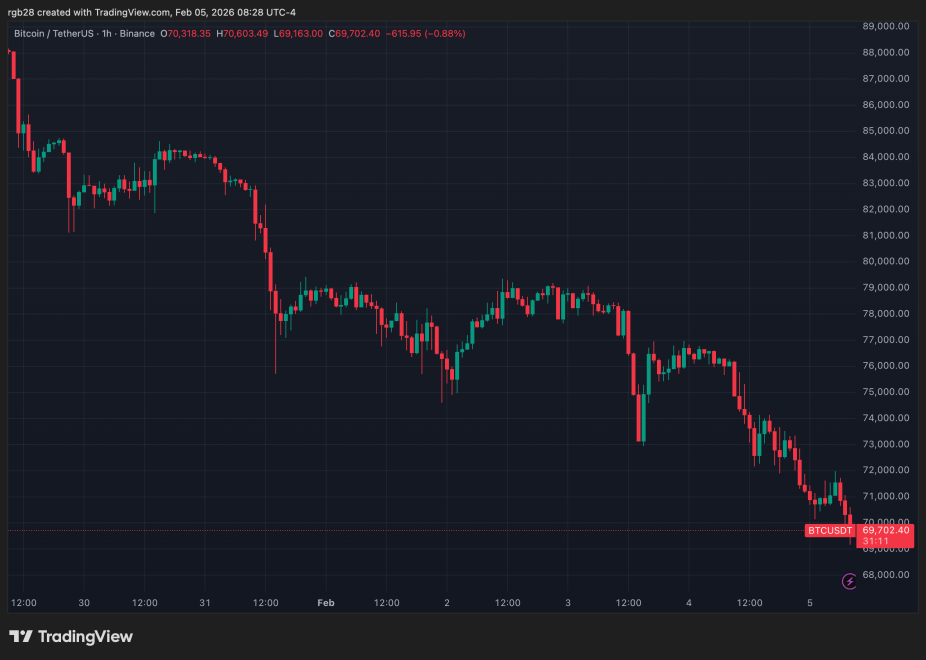
Bitcoin (BTC) trades at $69,702 on the one-week chart. Source: BTCUSDT on TradingView


Пов'язані питання

QWhat is the main purpose of the proposed concessions by crypto firms regarding the CLARITY Act?

AThe main purpose is to address the banking sector's concerns about stablecoins, particularly regarding interest payments, in order to advance the stalled crypto market structure bill and win over banks' support.

QWhat specific compromise did crypto firms propose to involve community banks in the stablecoin system?

ACrypto firms proposed giving community banks a larger role by allowing them to hold reserves or issue tokens through partnerships, and requiring stablecoin issuers to maintain a portion of their reserves at community banks.

QWhy have banks expressed concerns about stablecoin policies, according to Bank of America CEO Brian Moynihan?

ABanks are concerned that interest payments on stablecoins will distort market dynamics and affect credit creation, potentially posing significant challenges to the banking sector, especially small- and medium-sized businesses.

QWhat key restriction in the Senate Banking Committee's draft legislation has drawn criticism from crypto industry leaders like Coinbase's CEO?

AThe draft prohibits stablecoin issuers from providing interest payments to passive token holders, which critics argue would kill rewards on stablecoins and allow banks to ban their competition.

QWhat was the outcome of the recent White House meeting between crypto and banking groups regarding the stablecoin dispute?

AThe meeting ended without an agreement on how to address the dispute but led to a constructive discussion on the risks and opportunities of stablecoin yield and rewards.

Пов'язані матеріали

$30 Billion DeFi Capital Exodus: LayerZero Stumbles, Chainlink Feasts

Following the major DeFi security incident involving Kelp DAO, a significant migration of funds is underway from the cross-chain protocol LayerZero to Chainlink's CCIP (Cross-Chain Interoperability Protocol). Over $30 billion in Total Value Locked (TVL) from protocols like Kelp DAO, Solv Protocol, Re, and Tydro has moved to Chainlink in the past week, driven by security concerns. LayerZero is facing a severe trust crisis after the attack. Initially denying responsibility, LayerZero Labs has now issued a public apology, acknowledging management oversights. These include a vulnerable "1/1" single-node configuration for its Decentralized Verification Network (DVN) and past misuse of a multi-signature wallet by a team member. The protocol's weekly bridge volume has slumped to near-historic lows of around $470 million. In contrast, Chainlink is experiencing a surge in adoption and activity. Its independent active addresses recently hit multi-month highs, and whales have been accumulating LINK tokens. Beyond DeFi, Chainlink is securing partnerships with traditional finance giants like DTCC, European stock exchange operator SIX Group, and asset manager Amundi. While LayerZero has announced security upgrades—such as migrating to stronger multi-signature configurations and developing a second DVN client—and contributed to a rescue fund, the event underscores that security is becoming a decisive competitive factor as DeFi matures.

marsbit3 хв тому

$30 Billion DeFi Capital Exodus: LayerZero Stumbles, Chainlink Feasts

marsbit3 хв тому

The $13 Trillion Repo Market Is Quietly Being Rewritten by Blockchain

The $13 trillion repurchase agreement (repo) market, a crucial artery for global short-term funding, is experiencing a significant transformation through blockchain technology. After years of limited impact in finance, blockchain is finding substantial adoption in repo transactions. Major institutions like JPMorgan Chase, HSBC, and Broadridge are deploying tokenized repo platforms, with daily volumes already reaching tens of billions of dollars. Traditional repo markets operate with fixed hours, rely on intermediaries, and involve manual, time-consuming processes. Tokenized repos, by contrast, use blockchain to create digital tokens representing cash and securities collateral. This enables near-instantaneous settlement, 24/7 trading, automated execution, and enhanced auditability. The key drivers for adoption include maturing technology, more receptive regulators, and growing client recognition of tangible benefits like reduced operational friction and capital efficiency. Analyses, such as one from Broadridge, indicate that moving a portion of repo activity onto blockchain can significantly reduce a bank's required liquidity buffers, potentially freeing up billions in capital. The infrastructure is also seen as foundational for a future of round-the-clock trading for traditional assets. Challenges remain, including the existence of fragmented blockchain networks, the need for stress testing under extreme market conditions, and the loss of operational flexibility compared to manual processes. However, the industry consensus is that these are implementation hurdles. Tokenized repo has moved beyond pilot stages to become one of blockchain's most concrete and impactful applications in traditional finance, marking a pivotal shift in how a core market functions.

marsbit4 хв тому

The $13 Trillion Repo Market Is Quietly Being Rewritten by Blockchain

marsbit4 хв тому

From Gas Limit to 'Keyed Nonces', How to Understand the Next Step in Ethereum Scalability?

Ethereum’s scalability efforts are shifting toward a user-centric approach—focusing not only on higher TPS, but on translating technical upgrades into lower costs, smoother operations, and better wallet experiences. Two recent developments highlight this direction: - **Raising the Gas Limit to 200 million**: Following the Fusaka upgrade that increased it to 60 million, a consensus has formed around a potential future increase to 200 million. This would boost Ethereum’s execution capacity, but it is planned alongside other upgrades—such as ePBS, Block-Level Access Lists (BAL), and EIP-8037—to manage state growth and keep node operation viable for average participants. - **Keyed Nonces (EIP-8250)**: This proposal aims to improve how transactions are queued. Instead of a single linear nonce per account, it introduces multiple independent nonce domains. This prevents different types of transactions—such as private payments, session keys, or batch operations—from blocking each other. Vitalik Buterin views this as a foundational step toward better privacy support and more flexible state scalability. Together, these upgrades are part of a broader move to push complexity from wallets, DApps, and relays back into the protocol layer. For everyday users, this means future Ethereum interactions could become less congested, more intuitive, and safer—especially as core improvements in account abstraction, cross-L2 interoperability, and node decentralization continue to progress. Ultimately, Ethereum is evolving to handle not just more transactions, but more varied and complex on-chain use cases while preserving its decentralized foundation.

marsbit26 хв тому

From Gas Limit to 'Keyed Nonces', How to Understand the Next Step in Ethereum Scalability?

marsbit26 хв тому

Leaving OpenAI, How Much Has Their Net Worth Increased?

Former OpenAI employees have collectively accrued near-trillion dollar valuations through ventures and investments, charting AI's future. The article highlights two main paths: founding high-value companies like Anthropic and Perplexity, or applying insider insights as investors. Leopold Aschenbrenner exemplifies the investor path. After being fired from OpenAI, he leveraged firsthand knowledge of AI's massive energy demands to make hugely successful public market bets on nuclear and fuel cell companies, practicing "cross-industry cognitive arbitrage." Other alumni, like the Zero Shot VC fund founders, use their technical foresight for early-stage investing. Their key advantage lies not just in picking winners, but in knowing which technical approaches are likely dead ends—a "veto list" derived from internal OpenAI experience. Angel investing within the network, as seen with Mira Murati and Sam Altman, operates on deep, pre-existing understanding of a founder's capabilities, reducing due diligence to near zero. This creates an ecosystem bound by a shared belief in AGI's imminent arrival, differing from networks like the "PayPal Mafia" which were built on shared past struggles. The shift of these builders to investors signals a profound conviction: their situational awareness of the AI landscape is now so clear that deploying capital based on that judgment is more efficient than building themselves. They are allocating bets on the future they helped shape from the inside.

marsbit37 хв тому

Leaving OpenAI, How Much Has Their Net Worth Increased?

marsbit37 хв тому

Торгівля

Спот
Ф'ючерси
活动图片




