Crypto Exchange Backpack Targets Token Launch Soon, as BMIC Fires Up Quantum Defense

bitcoinistОпубліковано о 2026-02-10Востаннє оновлено о 2026-02-10

Анотація

Crypto exchange Backpack is signaling an imminent token launch, leveraging growing activity and trading on the Solana ecosystem. The platform, known for its points-based rewards system, is positioning itself as a regulated "super app" combining a non-custodial wallet with exchange services. Meanwhile, a growing security threat is emerging: the risk posed by quantum computing to current encryption standards. Hackers are already using a "Harvest Now, Decrypt Later" strategy, collecting encrypted blockchain data to decrypt later when quantum computers become powerful enough. In response, BMIC is developing a quantum-secure financial infrastructure, featuring a wallet with post-quantum cryptography that avoids public-key exposure and integrates AI-driven threat detection. Its ongoing presale has raised over $445K, reflecting investor interest in long-term security solutions. The trend highlights a market split between short-term speculative trading on platforms like Backpack and long-term investments in infrastructure aimed at mitigating future technological risks.

Trusted Editorial content, reviewed by leading industry experts and seasoned editors. Ad Disclosure

Quick Facts:

  • ➡️ Backpack exchange is signaling an imminent token launch, capitalizing on increased Solana ecosystem activity and trading volume.
  • ➡️ The ‘Harvest Now, Decrypt Later’ strategy by hackers necessitates an urgent upgrade to blockchain encryption standards before quantum computing matures.
  • ➡️ BMIC provides a necessary solution with its quantum-secure wallet and AI-driven threat detection, aiming to protect assets from future decryption threats.
  • ➡️ The industry is seeing a bifurcated trend: immediate speculative trading on exchanges versus long-term infrastructure hedging against existential tech risks.

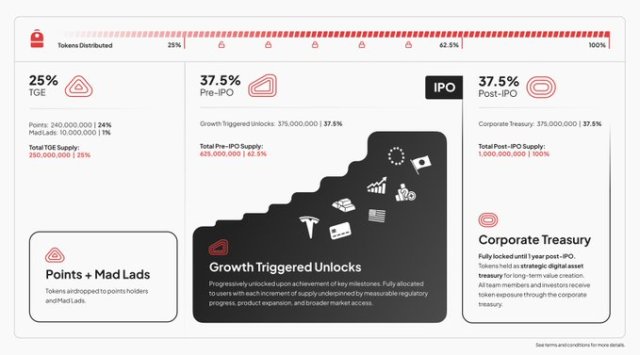
The Solana ecosystem is bracing for another liquidity injection as the highly anticipated Backpack exchange token launch moves closer to reality. For months, the platform, founded by the creators of the Mad Lads NFT collection, has run a points program rewarding volume.

Traders know the drill: points usually mean a native token generation event (TGE) is just around the corner. It’s a strategy that has successfully siphoned volume from established giants, positioning Backpack not just as a centralized exchange (CEX), but as a regulated ‘super app’ blending a non-custodial wallet with a trading venue.

The timing is impeccable. With Bitcoin hovering near all-time highs and liquidity rotating back into high-performance chains like Solana, the appetite for infrastructure plays is peaking. Smart money isn’t just chasing speculative fervor anymore; it’s positioning itself in protocols with tangible utility.

Backpack’s potential launch represents a shift toward platforms that actually blend a compliant user experience with a decentralized ethos.
But while capital floods into these next-gen exchanges, the security architecture supporting them faces a quieter, darker threat. The looming arrival of quantum computing poses a severe risk to the standard encryption protecting nearly every digital asset in circulation.

While traders focus on the immediate upside of a Backpack airdrop, forward-thinking investors are asking a harder question: what protects those gains five years from now? This search for longevity has directed significant attention toward BMIC ($BMIC), a project engineering the first quantum-secure financial stack designed to survive the post-quantum era.

Learn more about BMIC here.

Post-Quantum Cryptography Redefines Wallet Security

The crypto industry faces a ‘Harvest Now, Decrypt Later’ threat vector that most retail participants overlook. Nation-states and malicious actors are currently scraping encrypted blockchain data, which is immutable and public, to store it until quantum computers are powerful enough to break the RSA and Elliptic Curve Cryptography (ECC) standards securing Bitcoin and Ethereum.

BMIC addresses this inevitability by deploying a quantum-secure wallet infrastructure utilizing post-quantum cryptography (PQC). Unlike legacy wallets that leave public keys exposed after transactions, this protocol ensures zero public-key exposure.

And it doesn’t stop at encryption. The project integrates an AI-enhanced threat detection system directly into its Quantum Meta-Cloud.

This creates a dual-layer defense: cryptographic hardness against brute force attacks and active, algorithmic monitoring for anomalous transaction patterns. For enterprises and high-net-worth holders, this distinction is critical. Current security solutions focus on phishing and seed phrase management, but they remain fundamentally vulnerable to the mathematical breakthroughs quantum computing will bring.

This project’s approach to ERC-4337 Smart Accounts further modernizes the user experience, allowing for abstracting gas fees and social recovery without compromising the quantum-proof shield.

$BMIC is available here.

Early Investors Target BMIC Presale for Future-Proof Gains

As the narrative shifts from speed to security, capital is beginning to flow into the BMIC presale, which has already raised $445K+. The project is currently offering tokens at $0.049474, a price point reflecting an early-stage valuation for infrastructure that aims to become an industry standard.
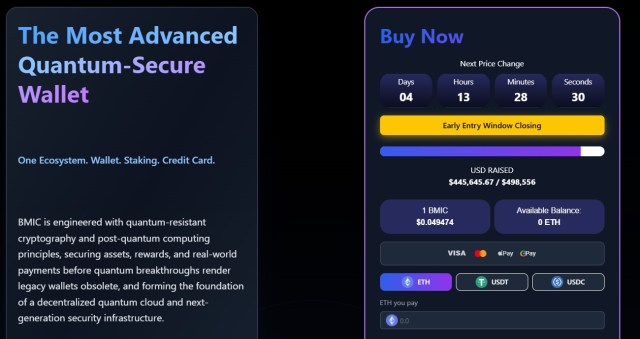
The utility of the token extends beyond simple governance; it functions as ecosystem fuel for the entire stack, including the ‘Burn-to-Compute’ mechanism and access to quantum-secure payment layers.

The robust raise indicates the market is waking up to the necessity of PQC. While exchanges like Backpack capture the current trading zeitgeist, infrastructure protocols like this are hedging against the technological obsolescence of current blockchain security.

The integration of staking and governance within a quantum-secure environment solves the dilemma of having to choose between earning yield and maintaining maximum security. With the presale ongoing, participants are effectively betting that the transition to quantum-resistant ledgers isn’t a matter of ‘if,’ but ‘when.’

Buy your $BMIC here.

Disclaimer: The information provided in this article is for educational purposes only and does not constitute financial advice. Cryptocurrency investments carry high risk, including the potential loss of all invested capital. Always conduct independent research.

Editorial Process for bitcoinist is centered on delivering thoroughly researched, accurate, and unbiased content. We uphold strict sourcing standards, and each page undergoes diligent review by our team of top technology experts and seasoned editors. This process ensures the integrity, relevance, and value of our content for our readers.

patrubogdan

Follow

Full Profile

Related Posts

US Debt Spiral Eyes $39T: Why Bitcoin Hyper ($HYPER) Is The Hedge to Watch

Ethereum Foundation Backs SEAL Initiative as LiquidChain L3 Protocol Gains Traction

Vitalik Buterin Outlines Ethereum’s AI Future, While SUBBD Token Targets the Creator Economy

Binance Dominates Trump’s USD1 Supply as Bitcoin Hyper Breaks Records

Cathie Wood’s Ark Invest Buys More Bullish Assets Just Days After Last Purchase, While LiquidChain Turns Heads

Polymarket Sues Massachusetts Over Prediction Market Regulation – SUBBD Token Takes Advantage

Пов'язані питання

QWhat is the main purpose of the Backpack exchange's points program, and what event does it typically signal?

AThe Backpack exchange's points program rewards trading volume and typically signals an imminent native token generation event (TGE).

QWhat is the 'Harvest Now, Decrypt Later' threat mentioned in the article, and why is it a concern for blockchain security?

AThe 'Harvest Now, Decrypt Later' threat is a strategy where hackers scrape and store encrypted blockchain data now, with the intention of decrypting it later when quantum computers become powerful enough to break current encryption standards like RSA and Elliptic Curve Cryptography (ECC).

QHow does the BMIC project propose to protect digital assets from the threat of quantum computing?

ABMIC proposes a quantum-secure wallet infrastructure that utilizes post-quantum cryptography (PQC) to ensure zero public-key exposure, and an AI-enhanced threat detection system within its Quantum Meta-Cloud for a dual-layer defense.

QWhat are the two distinct investment trends the article identifies in the current crypto market?

AThe article identifies a bifurcated trend: immediate speculative trading on exchanges (e.g., anticipating a Backpack token) versus long-term infrastructure investments hedging against existential technological risks (e.g., investing in quantum-secure protocols like BMIC).

QWhat is the current status of the BMIC token presale and its price, according to the article?

AThe BMIC token presale has raised over $445,000 and is currently offering tokens at a price of $0.049474.

Пов'язані матеріали

Gate Research Institute: The 'Wall Street-ization' Wave of Crypto Financial Products – Competition or Integration?

The article titled "Gate Research Institute: Are Crypto Financial Products Sparking a 'Wall Street' Wave—Competition or Convergence?" explores the evolving relationship between the crypto ecosystem and traditional finance (TradFi). The piece begins by reflecting on Bitcoin's original 2009 vision of decentralization, disintermediation, and moving away from banks. It then contrasts this with the 2024 landscape, where key crypto assets like Bitcoin are increasingly held through Wall Street products like ETFs issued by giants like BlackRock. The article questions whether this signifies that TradFi is systematically taking over the rights to issue, price, custody, and distribute crypto financial assets. The core argument is that this is not a zero-sum takeover but rather a bidirectional convergence where each side addresses the other's weaknesses. Crypto offers 24/7 global markets, programmable settlement, and open access but lacks compliant channels, institutional-grade custody, deep fiat liquidity, and mainstream distribution. TradFi possesses these but is constrained by legacy systems, limited operating hours, and slow settlement. Two primary convergence paths are highlighted: * **Path A (CEX to TradFi):** Exemplified by Gate, which has progressed from offering tokenized stocks and CFDs to providing direct, real stock trading (US, Hong Kong, South Korea) within its platform, using USDT. * **Path B (TradFi to Crypto):** Exemplified by Robinhood, which has integrated crypto trading, acquired exchanges like Bitstamp, and is moving traditional assets like stocks onto the blockchain via tokenization and its own Layer 2. Both paths are ultimately competing to become the next-generation, unified financial account—a "super account" where users can seamlessly trade cryptocurrencies, stocks, ETFs, RWA (Real World Assets), and tokenized treasury products in one interface. The growth of RWA and tokenized treasuries (e.g., BlackRock's BUIDL) is presented as the asset-layer fusion, providing stable, yield-bearing assets on-chain and acting as a bridge between the two worlds. In conclusion, the "Wall Street-ization" of crypto is framed as a mutual transformation. Decentralized ideals persist in the protocol layer, while at the application layer, a more efficient, global, and accessible unified capital market is emerging from this convergence. The future competition lies not between crypto exchanges and stockbrokers, but between platforms vying to offer the most comprehensive asset coverage, liquidity, and user experience within a single account.

marsbit2 хв тому

Gate Research Institute: The 'Wall Street-ization' Wave of Crypto Financial Products – Competition or Integration?

marsbit2 хв тому

Claude's Major New Feature: Screen Recording + Voice, Distilling Your Skills into AI Tasks in One Click

Claude has introduced a major new feature called "Record a Skill," available for Pro, Max, and Team users. This function, found in the Claude desktop app's CoWork menu, allows users to create reusable AI skills simply by recording their screen and providing voice narration while performing a task. Claude then automatically analyzes the recording and generates a functional Skill. A hands-on test confirmed the feature works seamlessly. Users start recording via the Skills manager, perform their workflow while verbally explaining the steps and logic, and avoid including sensitive information. After recording, Claude processes the content and creates the Skill, which can be saved and later invoked with a slash command (/). This eliminates the need for manual adjustments or writing complex instruction files. The innovation goes beyond mere efficiency. Previously, creating a Skill required writing a detailed SKILL.md file in Markdown—a significant barrier for non-technical users. "Record a Skill" bypasses this by directly capturing both actions and the implicit reasoning shared in the narration. This lowers the barrier to knowledge transfer and automation, addressing a core challenge in corporate knowledge management: the difficulty of getting experts to write and maintain documentation. However, the feature also highlights a shift in the nature of work. A case study from March 2026 showed a freelancer whose five-year client relationship was effectively replaced by a hand-coded Claude Skill automating their content workflow. With the even lower barrier of screen recording, the ability to distill personal expertise into automatable skills accelerates this trend. The "moat" for work is moving from simply knowing how to do a task to mastering tasks that are difficult or impossible to automate.

marsbit7 хв тому

Claude's Major New Feature: Screen Recording + Voice, Distilling Your Skills into AI Tasks in One Click

marsbit7 хв тому

Feeding AI "Noise" Can Also Boost Scores, This Work Enables Positive Transfer with Noise

Feeding "Noise" to AI Can Improve Performance: A Method Enables Positive Transfer from Noise This work, Semi-Supervised Noise Adaptation (SSNA), introduces a Noise Adaptation Framework (NAF) that challenges traditional transfer learning. Instead of requiring a labeled source domain of real data (e.g., images, text), NAF uses randomly generated Gaussian noise as the source. For a target task with C classes, it constructs C noise clusters by sampling from Gaussian distributions. Although this synthetic noise contains no semantic meaning, NAF trains it to form a discriminative class structure in a shared representation space—clustering same-class noise and separating different classes. The key is aligning this learned structure from the noise domain to the real, sparsely labeled target domain. A small number of target labels are still essential to establish the correspondence between noise clusters and actual classes. The training objective combines: 1) supervised loss on the few labeled target samples, 2) classification loss for the noise to build its structure, and 3) a distribution alignment loss (using Negative Domain Similarity) to minimize the gap between the noise and target domains in the shared space. Experiments show significant gains in few-label settings. With just 4 labels per class, NAF with a ResNet-18 backbone improves accuracy over a standard supervised baseline (ERM) by +12.35% on CIFAR-10, +7.61% on CIFAR-100, +4.38% on DTD-47, and +2.74% on Caltech-101. It also benefits fine-grained datasets and scales to ImageNet-1K (with 100 labels/class) and text classification (AG News). NAF can be integrated into existing semi-supervised methods like FixMatch for further gains. Ablation studies confirm the transferred benefit comes from the discriminative structure of the noise, not randomness itself. Collapsing all noise into a single point causes negative transfer, while increasing separation between noise cluster centers improves performance. The amount of noise per class is less critical once a basic structure forms. In conclusion, this work demonstrates that for positive transfer, the semantic content of source data may not be necessary. What can be effectively transferred is the *organizational structure* of categories within a representation space. This offers a promising alternative for scenarios where real source data is unavailable due to privacy, copyright, or procurement constraints.

marsbit8 хв тому

Feeding AI "Noise" Can Also Boost Scores, This Work Enables Positive Transfer with Noise

marsbit8 хв тому

Торгівля

Спот
活动图片