Crypto Exchange Backpack Targets Token Launch Soon, as BMIC Fires Up Quantum Defense

bitcoinistОпубліковано о 2026-02-10Востаннє оновлено о 2026-02-10

Анотація

Crypto exchange Backpack is signaling an imminent token launch, leveraging growing activity and trading on the Solana ecosystem. The platform, known for its points-based rewards system, is positioning itself as a regulated "super app" combining a non-custodial wallet with exchange services. Meanwhile, a growing security threat is emerging: the risk posed by quantum computing to current encryption standards. Hackers are already using a "Harvest Now, Decrypt Later" strategy, collecting encrypted blockchain data to decrypt later when quantum computers become powerful enough. In response, BMIC is developing a quantum-secure financial infrastructure, featuring a wallet with post-quantum cryptography that avoids public-key exposure and integrates AI-driven threat detection. Its ongoing presale has raised over $445K, reflecting investor interest in long-term security solutions. The trend highlights a market split between short-term speculative trading on platforms like Backpack and long-term investments in infrastructure aimed at mitigating future technological risks.

Trusted Editorial content, reviewed by leading industry experts and seasoned editors. Ad Disclosure

Quick Facts:

  • ➡️ Backpack exchange is signaling an imminent token launch, capitalizing on increased Solana ecosystem activity and trading volume.
  • ➡️ The ‘Harvest Now, Decrypt Later’ strategy by hackers necessitates an urgent upgrade to blockchain encryption standards before quantum computing matures.
  • ➡️ BMIC provides a necessary solution with its quantum-secure wallet and AI-driven threat detection, aiming to protect assets from future decryption threats.
  • ➡️ The industry is seeing a bifurcated trend: immediate speculative trading on exchanges versus long-term infrastructure hedging against existential tech risks.

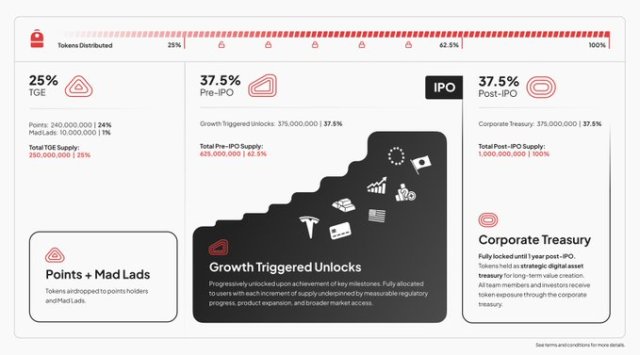
The Solana ecosystem is bracing for another liquidity injection as the highly anticipated Backpack exchange token launch moves closer to reality. For months, the platform, founded by the creators of the Mad Lads NFT collection, has run a points program rewarding volume.

Traders know the drill: points usually mean a native token generation event (TGE) is just around the corner. It’s a strategy that has successfully siphoned volume from established giants, positioning Backpack not just as a centralized exchange (CEX), but as a regulated ‘super app’ blending a non-custodial wallet with a trading venue.

The timing is impeccable. With Bitcoin hovering near all-time highs and liquidity rotating back into high-performance chains like Solana, the appetite for infrastructure plays is peaking. Smart money isn’t just chasing speculative fervor anymore; it’s positioning itself in protocols with tangible utility.

Backpack’s potential launch represents a shift toward platforms that actually blend a compliant user experience with a decentralized ethos.
But while capital floods into these next-gen exchanges, the security architecture supporting them faces a quieter, darker threat. The looming arrival of quantum computing poses a severe risk to the standard encryption protecting nearly every digital asset in circulation.

While traders focus on the immediate upside of a Backpack airdrop, forward-thinking investors are asking a harder question: what protects those gains five years from now? This search for longevity has directed significant attention toward BMIC ($BMIC), a project engineering the first quantum-secure financial stack designed to survive the post-quantum era.

Learn more about BMIC here.

Post-Quantum Cryptography Redefines Wallet Security

The crypto industry faces a ‘Harvest Now, Decrypt Later’ threat vector that most retail participants overlook. Nation-states and malicious actors are currently scraping encrypted blockchain data, which is immutable and public, to store it until quantum computers are powerful enough to break the RSA and Elliptic Curve Cryptography (ECC) standards securing Bitcoin and Ethereum.

BMIC addresses this inevitability by deploying a quantum-secure wallet infrastructure utilizing post-quantum cryptography (PQC). Unlike legacy wallets that leave public keys exposed after transactions, this protocol ensures zero public-key exposure.

And it doesn’t stop at encryption. The project integrates an AI-enhanced threat detection system directly into its Quantum Meta-Cloud.

This creates a dual-layer defense: cryptographic hardness against brute force attacks and active, algorithmic monitoring for anomalous transaction patterns. For enterprises and high-net-worth holders, this distinction is critical. Current security solutions focus on phishing and seed phrase management, but they remain fundamentally vulnerable to the mathematical breakthroughs quantum computing will bring.

This project’s approach to ERC-4337 Smart Accounts further modernizes the user experience, allowing for abstracting gas fees and social recovery without compromising the quantum-proof shield.

$BMIC is available here.

Early Investors Target BMIC Presale for Future-Proof Gains

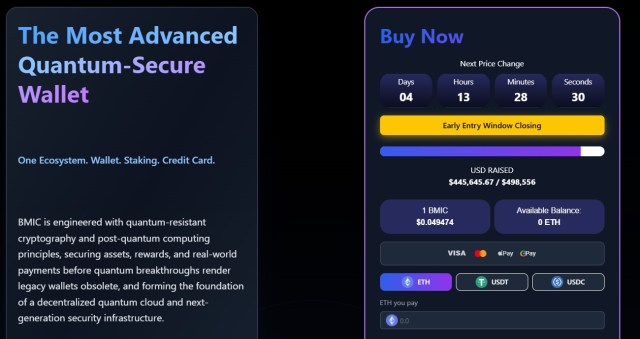
As the narrative shifts from speed to security, capital is beginning to flow into the BMIC presale, which has already raised $445K+. The project is currently offering tokens at $0.049474, a price point reflecting an early-stage valuation for infrastructure that aims to become an industry standard.
The utility of the token extends beyond simple governance; it functions as ecosystem fuel for the entire stack, including the ‘Burn-to-Compute’ mechanism and access to quantum-secure payment layers.

The robust raise indicates the market is waking up to the necessity of PQC. While exchanges like Backpack capture the current trading zeitgeist, infrastructure protocols like this are hedging against the technological obsolescence of current blockchain security.

The integration of staking and governance within a quantum-secure environment solves the dilemma of having to choose between earning yield and maintaining maximum security. With the presale ongoing, participants are effectively betting that the transition to quantum-resistant ledgers isn’t a matter of ‘if,’ but ‘when.’

Buy your $BMIC here.

Disclaimer: The information provided in this article is for educational purposes only and does not constitute financial advice. Cryptocurrency investments carry high risk, including the potential loss of all invested capital. Always conduct independent research.

Editorial Process for bitcoinist is centered on delivering thoroughly researched, accurate, and unbiased content. We uphold strict sourcing standards, and each page undergoes diligent review by our team of top technology experts and seasoned editors. This process ensures the integrity, relevance, and value of our content for our readers.

patrubogdan

Follow

Full Profile

Related Posts

US Debt Spiral Eyes $39T: Why Bitcoin Hyper ($HYPER) Is The Hedge to Watch

Ethereum Foundation Backs SEAL Initiative as LiquidChain L3 Protocol Gains Traction

Vitalik Buterin Outlines Ethereum’s AI Future, While SUBBD Token Targets the Creator Economy

Binance Dominates Trump’s USD1 Supply as Bitcoin Hyper Breaks Records

Cathie Wood’s Ark Invest Buys More Bullish Assets Just Days After Last Purchase, While LiquidChain Turns Heads

Polymarket Sues Massachusetts Over Prediction Market Regulation – SUBBD Token Takes Advantage

Пов'язані питання

QWhat is the main purpose of the Backpack exchange's points program, and what event does it typically signal?

AThe Backpack exchange's points program rewards trading volume and typically signals an imminent native token generation event (TGE).

QWhat is the 'Harvest Now, Decrypt Later' threat mentioned in the article, and why is it a concern for blockchain security?

AThe 'Harvest Now, Decrypt Later' threat is a strategy where hackers scrape and store encrypted blockchain data now, with the intention of decrypting it later when quantum computers become powerful enough to break current encryption standards like RSA and Elliptic Curve Cryptography (ECC).

QHow does the BMIC project propose to protect digital assets from the threat of quantum computing?

ABMIC proposes a quantum-secure wallet infrastructure that utilizes post-quantum cryptography (PQC) to ensure zero public-key exposure, and an AI-enhanced threat detection system within its Quantum Meta-Cloud for a dual-layer defense.

QWhat are the two distinct investment trends the article identifies in the current crypto market?

AThe article identifies a bifurcated trend: immediate speculative trading on exchanges (e.g., anticipating a Backpack token) versus long-term infrastructure investments hedging against existential technological risks (e.g., investing in quantum-secure protocols like BMIC).

QWhat is the current status of the BMIC token presale and its price, according to the article?

AThe BMIC token presale has raised over $445,000 and is currently offering tokens at a price of $0.049474.

Пов'язані матеріали

After the Passage of the GENIUS Act and the CLARITY Act, What Is the Correct Architecture for On-Chain Yield?

The article discusses the evolution of on-chain credit, distinguishing three markets: overcollateralized crypto lending, unsecured lending (largely unsuccessful), and asset-backed credit (ABC). ABC, backed by identifiable real-world collateral with legal recourse, is identified as the fastest-growing category and the only one credibly addressing adverse selection—the core problem in credit where the riskiest borrowers self-select. Current growth in on-chain Real World Assets (RWAs), particularly tokenized private credit funds (e.g., Maple Finance, Centrifuge), is substantial but often merely "wraps" existing fund structures, inheriting their risks rather than solving adverse selection at the protocol level. The regulatory landscape is a key driver, with the US GENIUS Act (prohibiting stablecoin issuers from paying yield) and the proposed CLARITY Act (closing loopholes on indirect yield) set to redefine permissible yield-bearing products. This makes vaults (like ERC-4626) the critical architecture—they become the primary compliant vehicle for delivering yield, functioning as issuance, disclosure, distribution, and recovery mechanisms. The author's thesis is that the correct post-GENIUS/CLARITY architecture involves building ABC solutions where credit assessment, structure, and recovery are encoded directly into the smart contract vault layer, moving beyond mere tokenized fund wrappers to solve adverse selection fundamentally and ensure regulatory compliance.

Foresight News25 хв тому

After the Passage of the GENIUS Act and the CLARITY Act, What Is the Correct Architecture for On-Chain Yield?

Foresight News25 хв тому

TechFlow Intelligence Bureau: Anthropic's New Model Fable Sparks Controversy by Restricting Biosafety Research, US CPI Soars to 4.2%, a Three-Year High

**Summary of TechFlow Intelligence Report:** The newsletter covers several key tech and finance developments. In AI, Anthropic's new Fable model faced backlash for secretly limiting biomedical research capabilities and enforcing a 30-day data retention policy, prompting the company to promise more transparent adjustments. In a related story, Anthropic's founder revealed his departure from OpenAI was due to dishonesty from Sam Altman, not safety concerns. Meanwhile, OpenAI is considering significant price cuts to compete with Anthropic, potentially sparking a price war. In crypto/Web3, BlackRock filed a new amendment for a yield-generating Bitcoin ETF, while Bank of America's CEO warned that stablecoin yields could drain trillions from traditional banks. U.S. Senator Cynthia Lummis advocated for the U.S. to officially accumulate Bitcoin reserves. In hardware, Nvidia released the DiffusionGemma-2-6B image model optimized for efficient inference, and AMD promoted its unified memory architecture to challenge Nvidia's dominance. TSMC's CFO hinted at possible price increases due to soaring AI chip demand. A major legal ruling in Germany held Google legally responsible for inaccurate information generated by its AI Overviews feature. Google Chrome also moved to fully block ad-blocker workarounds like uBlock Origin. Macroeconomic headlines included U.S. CPI rising to 4.2% (a 3-year high) and Iran's complete closure of the Strait of Hormuz, raising oil price and inflation fears. South Korean markets saw continued volatility with massive foreign capital outflow. Other notable stories: Microsoft expanded its Copilot AI assistant "Mico" globally; a study found r/wallstreetbets users' stock picks outperformed Wall Street; a fully autonomous drone killed a human soldier for the first time, raising AI ethics concerns; and a Chinese hospital used brain-computer interface technology to help a blind person "see." The overarching theme connects debates over AI boundaries and responsibility (Anthropic's restrictions, Google's liability, lethal autonomous drones) with real-world economic and geopolitical turmoil (inflation, Strait of Hormuz closure, market instability), highlighting the tense interplay between technological advancement and global chaos.

marsbit38 хв тому

TechFlow Intelligence Bureau: Anthropic's New Model Fable Sparks Controversy by Restricting Biosafety Research, US CPI Soars to 4.2%, a Three-Year High

marsbit38 хв тому

Alibaba's Yet Another New Business Division: What Signal Does It Send?

Alibaba has established a new "Token Foundry" business unit, merging its Tongyi large model division and Future Life Lab. Led directly by Group CEO Wu Yongming, this marks the company's third significant AI organizational reshuffle in 2026, following the creation of the Alibaba Token Hub (ATH) and a Group Technology Committee. The move signals a strategic shift from consolidating AI resources to accelerating productization and commercialization. The "Token Foundry" name reflects Alibaba's ambition to become a foundational supplier in the AI era, focusing on model development and commercial application. Key teams, including those behind the high-performing HappyHorse video generation model, have been integrated into the new unit. Concurrently, Zhou Jingren, architect of the Qwen model series, has been appointed Group Chief Scientist to lead a new AI Future Research Institute, focusing on long-term technological breakthroughs like Agent capabilities. This restructuring creates a clear four-layer AI architecture within Alibaba: the research institute for frontier exploration, Token Foundry for core models and commercialization, MaaS for platform services, and business units like Qianwen (C端) and Wukong (B端) for end-user applications. The adjustments align with a global trend among tech giants like Google and Microsoft to centralize AI leadership under the CEO and deeply integrate research with business units. The urgency is driven by a narrowing competitive window. Alibaba has announced its AI business is now entering a commercialization phase, with AI-related revenue seeing triple-digit growth for eleven consecutive quarters. The company faces intense competition in the MaaS (Model-as-a-Service) sector from rivals like ByteDance and Tencent. The Token Foundry initiative represents Alibaba's effort to streamline execution and enhance competitiveness in this critical, fast-evolving landscape.

marsbit1 год тому

Alibaba's Yet Another New Business Division: What Signal Does It Send?

marsbit1 год тому

From Return to Resignation: Chen Hang's 437 Days at DingTalk

The 437-Day Return and Departure of Chen Hang at DingTalk This article chronicles the 437-day period from March 31, 2025, to June 11, 2026, when Chen Hang (also known as "No Move") returned as CEO of DingTalk, the enterprise communication platform he originally founded, only to later step down. Chen Hang, the creator of DingTalk in 2015, was brought back by Alibaba in 2025 after the company acquired his subsequent startup, HHO. His return was driven by Alibaba's renewed focus on AI and DingTalk's strategic role as its key to-B AI application. However, his aggressive management style, marked by strict work policies like mandatory clock-ins and extended hours, quickly caused internal friction and was criticized as being at odds with Alibaba's culture. Despite the internal turmoil, Chen Hang drove significant product launches. In August 2025, he unveiled "AI DingTalk 1.0," featuring new products like the AI-native entry point "DingTalk ONE." By March 2026, he announced "Wukong," touted as the world's first enterprise-grade AI-native work platform, representing a fundamental rebuild of DingTalk's architecture. The turning point came in early June 2026. A detailed internal post criticizing DingTalk's work culture went viral, followed by a public critique from a former executive. This prompted an unprecedented public rebuke from the Alibaba Partners Committee, which stated such management was not aligned with company values. One day later, on June 11, Alibaba announced Chen Hang's departure. He was succeeded by Chen Yusen, a 32-year-old technical expert known for founding cybersecurity firm Changting Technology. While Chen Hang's tenure laid the technical foundation for DingTalk's AI transformation with "Wukong," his leadership style ultimately led to his replacement as the company seeks a new direction under younger leadership.

marsbit1 год тому

From Return to Resignation: Chen Hang's 437 Days at DingTalk

marsbit1 год тому

Торгівля

Спот
Ф'ючерси
活动图片