Crypto drops alongside equities as risk-off sentiment spreads across markets

ambcryptoОпубліковано о 2026-03-26Востаннє оновлено о 2026-03-26

Анотація

Cryptocurrencies experienced a broad sell-off alongside U.S. equities, signaling a market-wide shift toward risk-off sentiment rather than crypto-specific weakness. Major digital assets declined, with Ethereum falling 4.1% and Solana dropping over 5%, while Bitcoin saw a more modest 2.1% decrease. Losses extended across altcoins and large-cap tokens like BNB and XRP, with stablecoins remaining stable as investors sought safety. Similarly, tech stocks such as Meta and Nvidia fell sharply, highlighting a retreat from high-risk assets. The synchronized decline underscores continued correlation between crypto and equities during periods of market stress, reflecting their increased sensitivity to macro sentiment and institutional flows.

A broad sell-off across digital assets mirrored declines in U.S. equities, signaling a coordinated pullback in risk assets rather than an isolated crypto move.

Market heatmaps showed widespread losses across major cryptocurrencies, with Ethereum down 4.1% and Solana falling over 5%. Bitcoin, the largest asset by market cap, posted a more modest 2.1% decline but remained firmly in negative territory.

The weakness extended across altcoins, with few sectors showing resilience, pointing to a broad-based shift in sentiment rather than token-specific developments.

Crypto market sees broad sell-off led by ETH and SOL

The decline was led by higher-beta assets, a common pattern during periods of market stress. Ethereum and Solana both underperformed Bitcoin, suggesting reduced risk appetite among traders.

Large-cap tokens, including BNB and XRP, also moved lower, reinforcing the market-wide nature of the sell-off. Stablecoins such as USDC and Tether remained largely unchanged, reflecting a shift toward capital preservation.
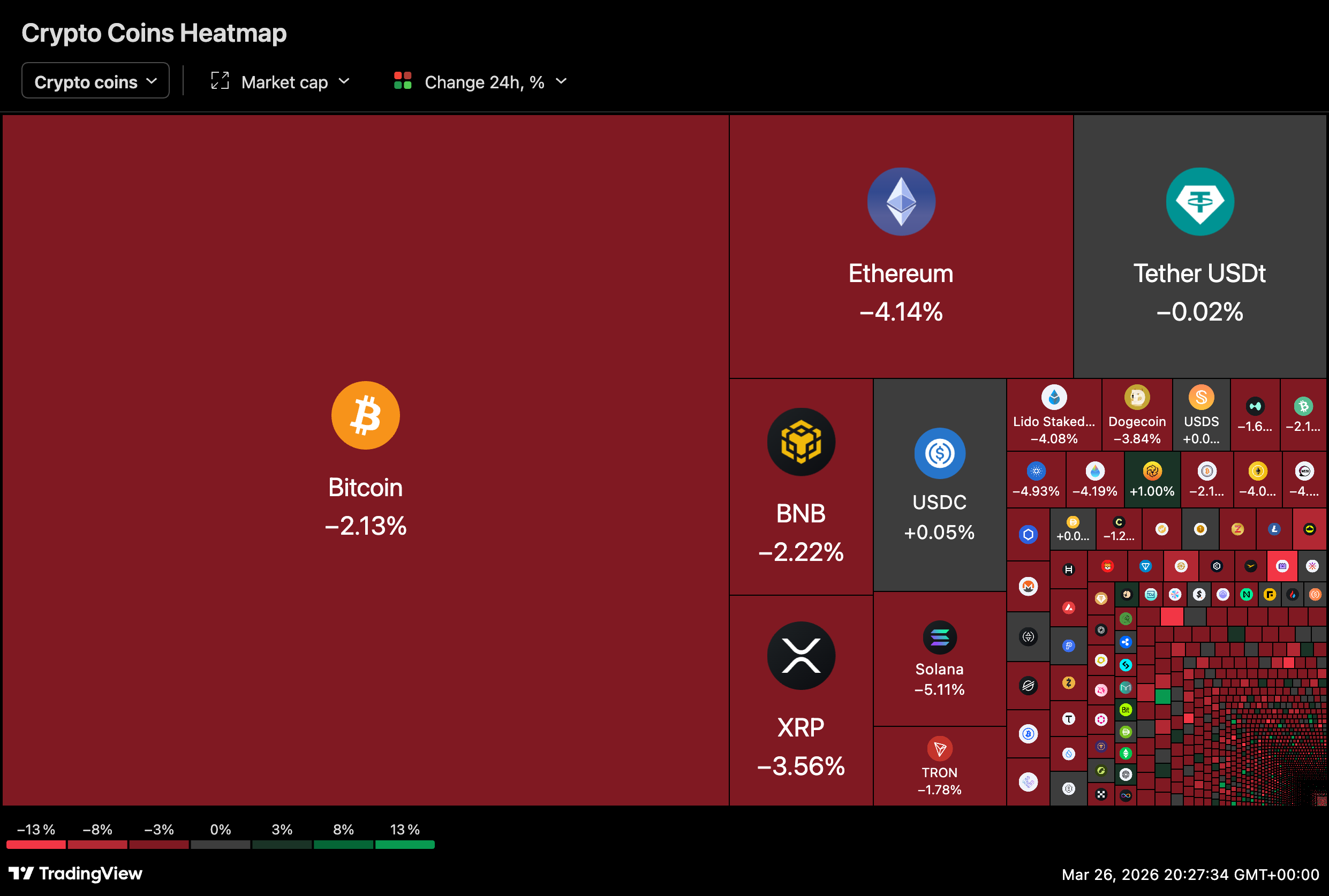
Source: TradingView

The absence of a clear catalyst suggests the move may be tied to broader macro positioning rather than crypto-specific developments.

Equities mirror the move with tech stocks under pressure

A similar pattern was visible in equity markets, particularly within the technology sector.

Major stocks such as NVIDIA and Meta Platforms fell sharply, with Meta dropping nearly 8% and Nvidia declining over 4%. Alphabet Inc. and Amazon also posted losses, contributing to a broader decline across the S&P 500.
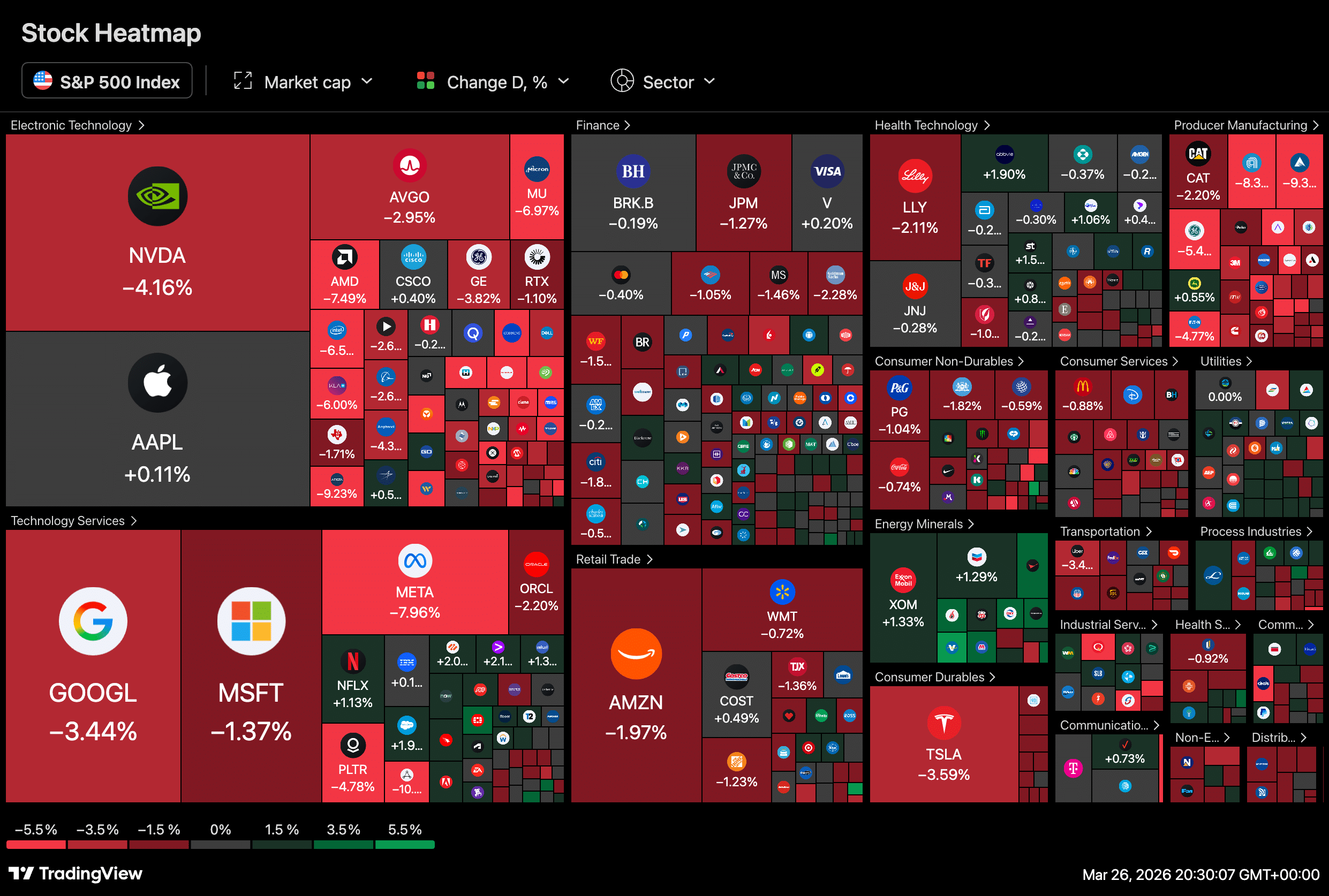
Source: TradingView

The concentration of losses in growth and tech names highlights a retreat from higher-risk segments of the market.

Correlation highlights risk-off sentiment across markets

The synchronized decline across crypto and equities points to a continued correlation between the two asset classes, particularly during periods of uncertainty.

Rather than acting as a hedge, crypto is trading in line with broader risk sentiment, moving alongside equities when investors reduce exposure to volatile assets.

This alignment has become more pronounced in recent years as institutional participation in digital assets has increased, linking crypto performance more closely to macro-driven market flows.


Final Summary

  • Crypto and equities declined simultaneously, reflecting a broader risk-off move rather than isolated weakness.
  • Continued correlation suggests digital assets remain tied to macro sentiment, especially during periods of market stress.


Пов'язані питання

QWhat was the main reason for the simultaneous decline in both cryptocurrency and equity markets according to the article?

AThe decline was due to a broad risk-off sentiment spreading across markets, rather than isolated crypto-specific factors, indicating a coordinated pullback in risk assets.

QWhich two major cryptocurrencies led the sell-off in the crypto market and by how much did they decline?

AEthereum led with a 4.1% decline, and Solana fell over 5%.

QHow did Bitcoin's performance compare to other major cryptocurrencies during this market downturn?

ABitcoin posted a more modest decline of 2.1%, underperforming compared to Ethereum and Solana but still in negative territory.

QWhich technology stocks were mentioned as declining sharply in the equity market, and what were their approximate losses?

AMeta Platforms dropped nearly 8%, and Nvidia declined over 4%. Alphabet and Amazon also posted losses.

QWhat does the synchronized decline between crypto and equities suggest about their correlation according to the article?

AIt suggests that crypto is trading in line with broader risk sentiment and moving alongside equities during periods of uncertainty, rather than acting as a hedge, due to increased institutional participation linking crypto to macro-driven market flows.

Пов'язані матеріали

Google and Amazon Simultaneously Invest Heavily in a Competitor: The Most Absurd Business Logic of the AI Era Is Becoming Reality

In a span of four days, Amazon announced an additional $25 billion investment, and Google pledged up to $40 billion—both direct competitors pouring over $65 billion into the same AI startup, Anthropic. Rather than a typical venture capital move, this signals the latest escalation in the cloud wars. The core of the deal is not equity but compute pre-orders: Anthropic must spend the majority of these funds on AWS and Google Cloud services and chips, effectively locking in massive future compute consumption. This reflects a shift in cloud market dynamics—enterprises now choose cloud providers based on which hosts the best AI models, not just price or stability. With OpenAI deeply tied to Microsoft, Anthropic’s Claude has become the only viable strategic asset for Google and Amazon to remain competitive. Anthropic’s annualized revenue has surged to $30 billion, and it is expanding into verticals like biotech, positioning itself as a cross-industry AI infrastructure layer. However, this funding comes with constraints: Anthropic’s independence is challenged as it balances two rival investors, its safety-first narrative faces pressure from regulatory scrutiny, and its path to IPO introduces new financial pressures. Globally, this accelerates a "tri-polar" closed-loop structure in AI infrastructure, with Microsoft-OpenAI, Google-Anthropic, and Amazon-Anthropic forming exclusive model-cloud alliances. In contrast, China’s landscape differs—investments like Alibaba and Tencent backing open-source model firm DeepSeek reflect a more decoupled approach, though closed-source models from major cloud providers still dominate. The $65 billion bet is ultimately about securing a seat at the table in an AI-defined future—where missing the model layer means losing the cloud war.

marsbit15 хв тому

Google and Amazon Simultaneously Invest Heavily in a Competitor: The Most Absurd Business Logic of the AI Era Is Becoming Reality

marsbit15 хв тому

Computing Power Constrained, Why Did DeepSeek-V4 Open Source?

DeepSeek-V4 has been released as a preview open-source model, featuring 1 million tokens of context length as a baseline capability—previously a premium feature locked behind enterprise paywalls by major overseas AI firms. The official announcement, however, openly acknowledges computational constraints, particularly limited service throughput for the high-end DeepSeek-V4-Pro version due to restricted high-end computing power. Rather than competing on pure scale, DeepSeek adopts a pragmatic approach that balances algorithmic innovation with hardware realities in China’s AI ecosystem. The V4-Pro model uses a highly sparse architecture with 1.6T total parameters but only activates 49B during inference. It performs strongly in agentic coding, knowledge-intensive tasks, and STEM reasoning, competing closely with top-tier closed models like Gemini Pro 3.1 and Claude Opus 4.6 in certain scenarios. A key strategic product is the Flash edition, with 284B total parameters but only 13B activated—making it cost-effective and accessible for mid- and low-tier hardware, including domestic AI chips from Huawei (Ascend), Cambricon, and Hygon. This design supports broader adoption across developers and SMEs while stimulating China's domestic semiconductor ecosystem. Despite facing talent outflow and intense competition in user traffic—with rivals like Doubao and Qianwen leading in monthly active users—DeepSeek has maintained technical momentum. The release also comes amid reports of a new funding round targeting a valuation exceeding $10 billion, potentially setting a new record in China’s LLM sector. Ultimately, DeepSeek-V4 represents a shift toward open yet realistic infrastructure development in the constrained compute landscape of Chinese AI, emphasizing engineering efficiency and domestic hardware compatibility over pure model scale.

marsbit52 хв тому

Computing Power Constrained, Why Did DeepSeek-V4 Open Source?

marsbit52 хв тому

Торгівля

Спот
Ф'ючерси
活动图片




