Crypto Downturn Slams Galaxy Digital With $241 Million Annual Loss

bitcoinistОпубліковано о 2026-02-05Востаннє оновлено о 2026-02-05

Анотація

Galaxy Digital reported a significant annual loss of $241 million, driven by a sharp downturn in crypto markets. The fourth quarter alone saw a net loss of $482 million due to declining digital asset valuations and reduced trading volumes. These results fell well below Wall Street expectations. The company also incurred one-time charges related to mining infrastructure and reorganization. Despite the losses, Galaxy strengthened its liquidity, ending the year with $2.6 billion in cash and stablecoins. It is expanding into data centers and cloud partnerships to create more stable revenue streams. Market reaction was negative, with shares declining as analysts remain divided on the company’s near-term prospects.

Galaxy Digital posted a heavy loss for the year as the crypto slump bit into its holdings and trading business. The numbers show a company that weathered big markdowns on digital assets while trying to bulk up its cash and new revenue streams.

Losses And Liquidity

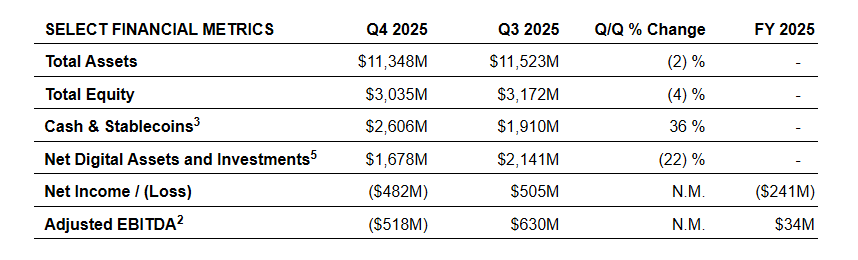
Reports say Galaxy recorded a GAAP net loss of $241 million for the full year, and a much larger hit in the fourth quarter alone: a $482 million net loss.

The quarterly shortfall came after a steep drop in the value of the firm’s crypto holdings and lower trading volumes, which together pushed reported results well below Wall Street expectations.

The Downturn Behind The Numbers

According to the company’s results, the value of its digital assets and investments fell sharply late in the year, producing most of the headline losses.

Trading activity cooled, and that reduced fees and transaction income. At the same time, one-time charges tied to mining infrastructure and a corporate reorganization added to the drag on annual results.
Source: Galaxy Digital

Data Center And New Business

Galaxy has not only been a crypto trading and asset management shop. It has been building out a large data-center footprint in Texas, including the Helios campus with approvals to scale power capacity to over 1.6 GW.

The company says that infrastructure work and deals with cloud partners could produce steadier revenue streams over time, even if crypto markets stay weak in the near term.

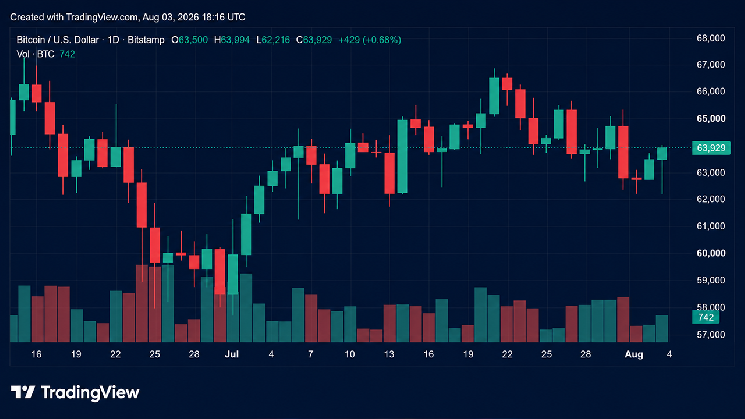
BTCUSD currently trading at $75,736. Chart: TradingView

Cash Cushion And Balance-Sheet Moves

Reports note that Galaxy finished the year with roughly $2.6 billion in cash and stablecoins, a position management highlights as a buffer against further market volatility.

The firm also raised capital and tapped debt markets late in the year, steps meant to preserve optionality while trading revenues slump.

At the same time, some asset management lines reported record activity, which helped offset a part of the losses when measured on an adjusted basis.

Market Reaction And Outlook

The market reacted quickly. Shares slid in premarket trading after the release and then fell further as investors digested the scale of the write-downs.

Analysts are split: some see the data-center push as a sensible hedge against volatile crypto returns, while others point out that near-term earnings will remain pressured until trading volumes and asset prices recover.

Featured image from Unsplash, chart from TradingView

Пов'язані питання

QWhat was the total GAAP net loss reported by Galaxy Digital for the full year?

AGalaxy Digital reported a GAAP net loss of $241 million for the full year.

QWhat were the two main factors that contributed to the company's large net loss in the fourth quarter?

AThe quarterly net loss of $482 million was primarily due to a steep drop in the value of the firm’s crypto holdings and lower trading volumes.

QBesides trading losses, what other one-time charges added to the drag on the company's annual results?

AOne-time charges tied to mining infrastructure and a corporate reorganization also added to the drag on the annual results.

QWhat new business initiative is Galaxy Digital building in Texas to create steadier revenue streams?

AThe company is building out a large data-center footprint in Texas, including the Helios campus, which is approved to scale power capacity to over 1.6 GW.

QHow much cash and stablecoins did Galaxy Digital have at the end of the year to act as a buffer against market volatility?

AGalaxy Digital finished the year with roughly $2.6 billion in cash and stablecoins.

Пов'язані матеріали

Winter for Crypto IPOs: Consensys and Ledger Withdraw Applications

The crypto IPO window is tightening significantly in 2026, marked by prominent companies delaying or pausing their public listing plans. Following a successful 2025 "harvest year" that saw Circle, Bullish, and Gemini go public amidst a bull market, the tide has turned. Consensys, developer of MetaMask, recently postponed its IPO until at least fall 2026. Hardware wallet leader Ledger also suspended its planned US listing due to unfavorable market conditions, with Kraken having previously delayed its own plans. This shift is driven by a cooling market in 2026, characterized by a significant Bitcoin price correction, declining trading volumes, and reduced investor risk appetite for crypto stocks. The poor post-IPO performance of 2025 listings like Circle and Bullish, which saw major share price declines, has heightened investor caution. This contrasts sharply with the current AI sector, where companies like SpaceX, OpenAI, and Anthropic are commanding massive valuations and investor enthusiasm based on narratives of stable, exponential growth. Crypto companies now face pressure to transition from hype-driven models to demonstrating reliable cash flows and robust compliance. While the paused IPO plans may lead to valuation resets and affect ecosystem liquidity, they also accelerate industry consolidation toward stronger, more compliant infrastructure players. A potential recovery in Bitcoin's price and clearer regulations could reopen the IPO window in the latter half of 2026.

marsbit42 хв тому

Winter for Crypto IPOs: Consensys and Ledger Withdraw Applications

marsbit42 хв тому

ChatGPT Can Manage Your Money for You. Would You Trust It with Your Bank Account?

OpenAI has launched a personal finance tool for ChatGPT, currently in preview for US-based ChatGPT Pro users. This feature allows users to connect their bank and investment accounts (via Plaid, supporting over 12,000 institutions) directly to ChatGPT. It analyzes transactions, generates visual dashboards, and offers conversational financial advice—such as budgeting or planning for major purchases—based on the user's actual data. This move follows OpenAI's acquisitions of fintech startups Roi and Hiro Finance, signaling a strategic push into vertical "super assistant" applications, similar to its earlier health-focused feature. However, the launch has sparked significant privacy concerns. Critics question the safety of granting such sensitive financial access to an AI, especially amid ongoing lawsuits alleging OpenAI shared user chat data with third parties like Meta and Google. OpenAI emphasizes that ChatGPT only reads data (no transaction capabilities), deletes it within 30 days if disconnected, and offers opt-out options for model training. Yet, trust remains a major hurdle. The trend reflects a broader industry shift: AI companies like Anthropic and Perplexity are also targeting high-value, data-rich domains like finance and health. While technically promising, the tool operates in a regulatory gray area—it provides personalized guidance but disclaims formal financial advice or liability. Ultimately, OpenAI's challenge is convincing users to trust an AI with their most private financial information.

marsbit42 хв тому

ChatGPT Can Manage Your Money for You. Would You Trust It with Your Bank Account?

marsbit42 хв тому

Торгівля

Спот
Ф'ючерси
活动图片