Crypto Crime Hit Hard: $700 Million Frozen By DOJ Strike Force

bitcoinistОпубліковано о 2026-04-25Востаннє оновлено о 2026-04-25

Анотація

A US law enforcement task force has frozen over $700 million in cryptocurrency linked to investment scams targeting Americans. The operation, which involved cooperation from crypto exchanges and legal processes, also took down more than 500 fraudulent websites and a Telegram channel used to recruit victims. Two Chinese nationals were named in arrest warrants for operating a scam compound in Burma. In a related move, the US State Department announced a $10 million reward for information disrupting scam centers in Burma. Singaporean authorities, alongside major crypto exchanges and analytics firms, also prevented nearly $3 million in losses through a parallel operation. The scale of cybercrime remains vast, with the FBI reporting over $20 billion in losses in 2025.

A US law enforcement task force seized hundreds of fake investment websites and unsealed warrants against two suspects tied to a Burmese crypto scam compound.

US Reward For Scam Center Tips

The US State Department is offering $10 million to anyone who helps disrupt the Tai Chang scam centers in Burma — a bounty that signals just how seriously Washington is taking the problem of industrialized fraud in Southeast Asia.

That announcement came alongside a sweeping action Thursday by the US Scam Center Strike Force, which said it had frozen more than $700 million in crypto connected to investment scams targeting American victims.

The funds were restrained through a combination of voluntary cooperation from crypto exchanges and formal legal processes.

Fake Sites, A Seized Telegram Channel, And Two Arrest Warrants

The operation’s reach went beyond asset freezes. Authorities pulled down over 500 fraudulent investment websites that had been used to lure victims into depositing cryptocurrency. Visitors who try to access those domains now see a government seizure notice.

A Telegram channel was also seized. Reports say it had been used to recruit unsuspecting job seekers into a crypto scam center operating in Cambodia — a common tactic in Southeast Asia, where traffickers pose as employers to lure workers into forced labor at fraud compounds.
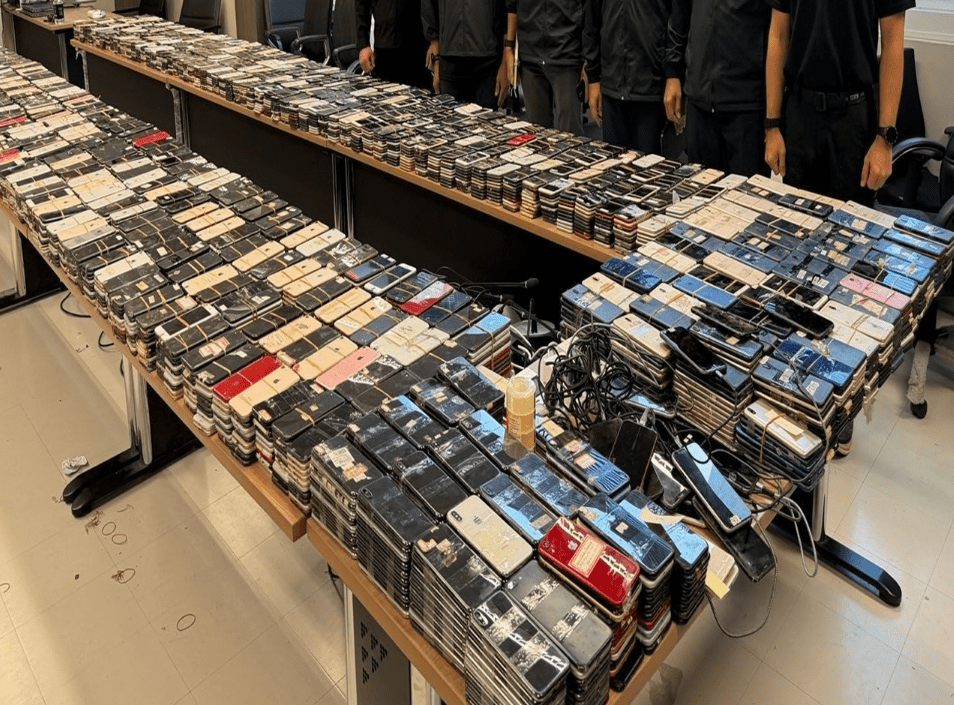
Source: US DOJ

Two Chinese nationals, Huang Xingshan and Jiang Wen Jie, were named in criminal complaints and arrest warrants unsealed as part of the operation. The pair is accused of running a crypto investment fraud scheme at the Shunda compound in Burma. That facility was seized by the Karen National Liberation Army in November 2025.

Exchanges And Blockchain Firms Join The Fight

The US was not alone in acting Thursday. Singapore’s police force ran a parallel month-long operation from mid-March through mid-April, working alongside Coinbase, Gemini, Coinhako, Independent Reserve, and blockchain analytics companies TRM Labs and Chainalysis.

BTCUSD currently trading at $78,076. Chart: TradingView

That effort stopped more than $2.86 million in potential losses and included over 90 direct interventions with scam victims — some by phone, others in person.

The willingness of major crypto platforms to cooperate with law enforcement marks a shift in how these cases are being handled. Blockchain transactions are traceable, and that transparency is increasingly being used against the very criminals who rely on crypto for speed and anonymity.

Losses Running Into The Billions

The scale of the problem is hard to overstate. The FBI received more than a million cybercrime complaints in 2025 alone, with total reported losses hitting more than $20 billion.

The $701 million frozen Thursday, while a significant number, represents a fraction of what has already been lost.

Featured image from Meta, chart from TradingView

Пов'язані питання

QWhat was the total amount of cryptocurrency frozen by the US Scam Center Strike Force?

AThe US Scam Center Strike Force froze more than $700 million in cryptocurrency connected to investment scams.

QWhat reward is the US State Department offering for information on the Tai Chang scam centers in Burma?

AThe US State Department is offering a $10 million reward for information that helps disrupt the Tai Chang scam centers in Burma.

QHow many fraudulent investment websites were taken down as part of the operation?

AAuthorities pulled down over 500 fraudulent investment websites used to lure victims.

QWho were the two individuals named in the criminal complaints and arrest warrants?

AThe two individuals named were Chinese nationals Huang Xingshan and Jiang Wen Jie, accused of running a crypto investment fraud scheme.

QWhich organizations did Singapore's police force collaborate with in their parallel operation?

ASingapore's police force worked with Coinbase, Gemini, Coinhako, Independent Reserve, and blockchain analytics companies TRM Labs and Chainalysis.

Пов'язані матеріали

Standing in the Light: A Comprehensive Guide to the Optical Module and CPO Supply Chain

"Standing in the Light: Understanding the Optical Module and CPO Industry Chain" This article analyzes the critical role of optical communication technology, specifically optical modules and Co-Packaged Optics (CPO), as the "nervous system" for modern AI data centers. With exponential growth in AI computational demands (e.g., NVIDIA's Vera Rubin architecture), traditional electrical interconnects using copper cables face severe bottlenecks in bandwidth, power consumption, and signal integrity over distance. The core function of an optical module is to act as a "translator," converting electrical signals from chips into optical signals for transmission over fiber (and vice-versa). Key internal components include lasers, modulators, photodetectors, drivers, and DSP chips. The industry is currently transitioning from 800G to 1.6T modules. However, the future lies in CPO. This next-generation technology integrates the optical engine directly with the switch ASIC/XPU on the same package substrate, drastically reducing power consumption (by ~3.5x according to NVIDIA), overcoming bandwidth density limits, and minimizing signal attenuation compared to traditional pluggable modules. Key challenges for CPO include advanced packaging capacity (dominated by TSMC), thermal management, repairability, and standardization. The article details the broader technology landscape, including Near-Packaged Optics (NPO, a pragmatic intermediate step), Linear-drive Pluggable Optics (LPO), Optical I/O (OIO for chip-level integration), and Optical Circuit Switches (OCS). A comprehensive CPO industry chain is mapped, highlighting shifting power dynamics: * **Architecture Definers:** NVIDIA, Broadcom, and Marvell now hold greater influence. * **Advanced Packaging & Manufacturing:** TSMC is central; Fabrinet is a key EMS player. * **Lasers ("The Heart"):** A strategic bottleneck. EML lasers are led by Lumentum and Coherent (both receiving major NVIDIA investments). CW lasers, favored for CPO/silicon photonics, see strong Chinese players like Source Photonics and Sicoya. * **Silicon Photonics Chips:** The mainstream path for CPO engines, with key players like Broadcom, Intel, Marvell, and China's Accelink. * **Fiber Connectivity Components:** A major new, high-growth market created by CPO, including Fiber Array Units (FAU), Polarization-Maintaining Fiber (PMF), and MPO connectors. Companies like Tianfu Communication and US Conec are leaders. * **Fiber & Cable:** Experiencing a super-cycle (e.g., Corning, Yangtze Optical Fiber). * **PCB/Substrates:** Requiring advanced materials (e.g., Shengyi Tech). * **DSP & SerDes:** Functions are integrated into switch ASICs in the CPO era (e.g., Broadcom, Astera Labs). * **Optical Module Makers:** Transitioning from standalone module suppliers to providers of optical engines and NPO/LPO solutions while riding the current pluggable boom (e.g., Zhongji Innolight, Eoptolink). The investment timeline is segmented: Short-term (2026-2027) features the "last feast" for pluggable modules and CPO's initial rollout. Medium-term (2027-2029) will see CPO expand and NPO peak. Long-term (2029-2032+) involves CPO/OIO penetration into intra-rack scaling. In conclusion, optical interconnects are fundamental to AI infrastructure. The competitive landscape sees US firms leading in architecture and high-end chips, TSMC in advanced packaging, and Chinese firms holding strong positions in modules, connectivity components, CW lasers, and fiber/cable. The future belongs to companies that can navigate the technological shift from "selling shovels" (modules) to "building highways" (CPO/OIO infrastructure).

marsbit5 хв тому

Standing in the Light: A Comprehensive Guide to the Optical Module and CPO Supply Chain

marsbit5 хв тому

Торгівля

Спот
Ф'ючерси
活动图片





