Crypto Courtroom Drama: Kevin O’Leary Wins Nearly $3M Against YouTuber ‘Bitboy’

bitcoinistОпубліковано о 2026-02-16Востаннє оновлено о 2026-02-16

Анотація

Kevin O'Leary, known as "Mr. Wonderful" from Shark Tank, has been awarded a $2.8 million default judgment by a US federal court against YouTuber Ben "BitBoy" Armstrong. The ruling stems from a defamation lawsuit after Armstrong failed to respond to allegations that he made false social media posts accusing O'Leary of involvement in a fatal 2019 boating incident. The damages include $78,000 for reputational harm, $750,000 for emotional distress, and $2 million in punitive damages. The case is unrelated to crypto, but highlights legal risks for influencers spreading unverified claims.

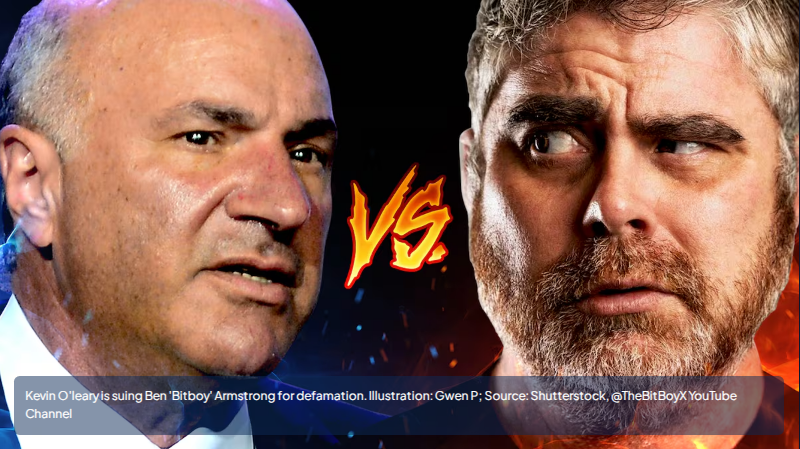
Businessman and TV personality Kevin O’Leary, known as “Mr. Wonderful” from Shark Tank, has won a $2.8 million judgment after a US federal court entered default against popular YouTuber Ben “BitBoy” Armstrong.

The ruling comes after Armstrong failed to respond to a defamation lawsuit related to false claims he made on social media, which accused O’Leary of involvement in a 2019 boating accident that resulted in fatalities.

Those claims were never proven in court, and reporters have noted the legal action focused on restoring reputation and seeking damages for harm caused by the statements.
Court Enters Default Judgment

The court award totals roughly $2.8 million in combined damages. That figure breaks down into about $78,000 for reputational injury, $750,000 for emotional distress, and $2,000,000 in punitive damages meant to punish the conduct.

Judge Beth Bloom presided over the matter in the US District Court for the Southern District of Florida, which handled filings and issued the judgment. The ruling came after procedural steps that allow a plaintiff to obtain judgment when a defendant fails to respond.

Allegations And Timeline

Reports say the posts at the center of the case appeared in March of last year. They accused the businessman of being connected to lethal conduct and alleged a cover-up. O’Leary has never been charged in relation to that incident, and later court records showed related parties were cleared at trial.

Total crypto market cap currently at $2.33 trillion. Chart: TradingView

The defamation suit alleged the statements crossed the line from opinion into false factual claims that damaged reputation and caused distress. Because Armstrong did not appear or meaningfully answer the complaint, the court treated the claims as conceded for purposes of final judgment.

Crypto Connection And Implications

Armstrong is a well-known personality in the world of cryptocurrency, operating the popular site BitBoy Crypto. His messages reach thousands of cryptocurrency fans and investors, which helped to spread the false claims.

Although the case itself is not related to cryptocurrency, it shows the legal danger that cryptocurrency influencers may face when posting unverified or defamatory information online. This decision may make other personalities in the cryptocurrency world more careful about what they post online.

Featured image from Getty Images, chart from TradingView

Пов'язані питання

QWhat was the total amount of the default judgment awarded to Kevin O'Leary against Ben Armstrong?

AThe total default judgment awarded to Kevin O'Leary was approximately $2.8 million.

QWhat were the three categories of damages included in the court's award and what were their amounts?

AThe damages were broken down into $78,000 for reputational injury, $750,000 for emotional distress, and $2,000,000 in punitive damages.

QWhy did the US federal court enter a default judgment in this case?

AThe court entered a default judgment because Ben Armstrong failed to respond to the defamation lawsuit.

QWhat was the nature of the false claims that Ben Armstrong made about Kevin O'Leary?

AArmstrong made false claims on social media accusing Kevin O'Leary of involvement in and a cover-up of a fatal 2019 boating accident.

QWhat potential impact does this case have on other cryptocurrency influencers, according to the article?

AThe article suggests the ruling may make other cryptocurrency influencers more careful about posting unverified or defamatory information online due to the legal dangers it highlights.

Пов'язані матеріали

The AI Investment Landscape Is Being Reshaped: Beyond the 'Magnificent Seven', What Opportunities Lie in the Semiconductor Supply Chain?

AI Investment Map is Reshaping: Opportunities Beyond the 'Magnificent Seven' Since ChatGPT ignited the AI wave, investment initially focused on the "Magnificent Seven" tech giants dominating cloud infrastructure. However, the rise of DeepSeek and debates on AI capital expenditure effectiveness are shifting this dynamic. Investors now recognize opportunities deeper in the supply chain—the companies providing the essential "picks and shovels." Early concerns about an AI investment "arms race" and potential low returns were partly alleviated by strong Q1 earnings from cloud providers, validating robust compute demand. This has highlighted a more certain investment thesis: regardless of which AI applications ultimately win, massive capital expenditure will first fuel demand for semiconductors and related components. This "pick-and-shovel" logic has driven semiconductor ETFs to record highs. Key beneficiaries include: * **Memory Chipmakers (e.g., SK Hynix, Samsung, Micron)**: High Bandwidth Memory (HBM) is a critical bottleneck for AI training. * **Photonics Companies**: Crucial for high-speed data transfer within AI data centers. * **The Broader "AI-11" Semiconductor Ecosystem**: This encompasses foundries & lithography (TSMC, ASML), logic & custom chips (AMD, Broadcom, Intel, Marvell), and enterprise storage (SanDisk, Western Digital). Every dollar of AI infrastructure spending flows through this chain. While the "Magnificent Seven" remain dominant in market size, their earnings growth premium over the rest of the S&P 500 ("S&P 493") is narrowing. Market attention and marginal investment are shifting towards the expanding semiconductor supply chain. The investment narrative is evolving from "betting on the ultimate AI winner" to "investing in the certainty of the infrastructure build-out." Understanding this shift from the demand side to the supply side is key to identifying future AI investment opportunities.

marsbit2 хв тому

The AI Investment Landscape Is Being Reshaped: Beyond the 'Magnificent Seven', What Opportunities Lie in the Semiconductor Supply Chain?

marsbit2 хв тому

600 People, $66 Billion: The First Major Cash-Out in the Era of Large Models

The first systematic "big cash-out" of the AI era occurred in October 2025, when over 600 current and former OpenAI employees sold a total of $6.6 billion in shares via a secondary market. Approximately 75 individuals maxed out a $30 million per-person sale limit, while around 525 others cashed out an average of $8.3 million each. This event, exceeding the scale of any 2024 US IPO, functioned as a "shadow IPO." It marked a radical departure from the traditional Silicon Valley path of waiting for a public listing, instead allowing employees to convert equity to cash after just two years of tenure—a direct retention tool in a fiercely competitive talent market where rivals like Meta have offered packages worth hundreds of millions. This massive liquidity event presents a dual-edged sword for OpenAI. While it helps retain talent, it also risks triggering a brain drain as newly wealthy employees may depart. Furthermore, it creates a dilemma for those who sold: they forfeited potential future gains as the company's valuation soared from $400 billion to $852 billion within months. In stark contrast, employees at rival Anthropic demonstrated greater reluctance to sell during their own secondary offering. The financial narratives of the two labs also diverge sharply. OpenAI, while achieving over $20 billion in annualized revenue by 2025, faces massive projected losses (up to $14 billion in 2026), a long path to cash flow positivity, and significant revenue-sharing payments to Microsoft. Anthropic reports rapid revenue growth, improving gross margins, and a faster path to profitability. OpenAI's trajectory is thus balanced precariously between skyrocketing valuation based on funding narratives and the pressures of sustained financial losses post-cash-out. The event underscores that the AI race has evolved into a capital and human experiment, where immense wealth crystallizes the complex calculations of greed, fear, and ambition within the industry.

marsbit22 хв тому

600 People, $66 Billion: The First Major Cash-Out in the Era of Large Models

marsbit22 хв тому

NVIDIA Begins Adding Soap to the Bubble

NVIDIA is taking on a dual role: not just as a leading chip supplier, but as a massive capital allocator across the entire AI supply chain. In 2026, the company has committed over $40 billion in investments within five months, targeting everything from optical fiber manufacturing and data center operations to foundational AI model development. This investment spree, described as a systematic "sprinkler" approach, primarily funds companies that are major buyers of NVIDIA's own GPUs. Critics, including analysts from Goldman Sachs, label this a "circular revenue" loop—comparable to a supplier financing a customer to buy more of its products. A prominent example is NVIDIA's investment in OpenAI, which is expected to generate around $13 billion in revenue for NVIDIA, much of which may be reinvested back into OpenAI. While CEO Jensen Huang dismisses the "circular financing" critique as "absurd," arguing the investments are confidence votes in long-term generational shifts, some analysts express discomfort. They note that while investments in critical supply chain components like optics are strategically sound, funding new cloud providers like CoreWeave feels like "pre-paying for your own GPUs." The strategy carries significant risks. If the AI investment cycle turns, the market may question how much demand is genuine versus artificially sustained by NVIDIA's own balance sheet. Despite posting record-breaking earnings—$215.9 billion in annual revenue and $120 billion in net profit for FY2026—NVIDIA's stock fell after its report, signaling that "beating expectations" may no longer be enough to assure investors about the duration of the AI spending boom. The article concludes that while a bubble isn't necessarily a fraud, NVIDIA's actions resemble adding soap to a bubble—making it appear more robust and durable. This creates a complex scenario requiring extreme冷静 from investors to distinguish between real structural growth and financial engineering.

marsbit39 хв тому

NVIDIA Begins Adding Soap to the Bubble

marsbit39 хв тому

Short Positions Have Been Squeezed Out: Will the Next Leg of the U.S. Stock AI Rally Continue in Seoul?

"Short Squeeze Exhausted: Will the Next Leg of the AI Rally Continue in Seoul?" A Nomura report suggests the US AI stock rally, which saw the S&P 500 rise ~16.6% in 28 days largely driven by 10 key stocks, may be pausing. The fuel from short covering, CTA fund positioning, and volatility-control strategies is nearing its limit. For the rally to continue, new momentum from retail and sentiment-driven FOMO (Fear Of Missing Out) is needed. South Korea's market provided a potential answer on the very day the report was published. The KOSPI index surged 4.32%, triggering a buy-side circuit breaker, led by massive gains in chip giants SK Hynix (+11.98%) and Samsung. This surge is characterized by retail "hynix FOMO" and overseas funds precisely buying into AI themes via chip-focused ETFs, shifting from broad Korean market ETFs. The Korean rally is a high-beta extension of the US AI capital expenditure story, as major cloud providers plan massive infrastructure spending, directly benefiting memory chip leaders. However, this linkage also implies vulnerability. The sustainability of this next leg depends on whether US tech stocks correct, the trajectory of US inflation (with upcoming CPI data key), and geopolitical tensions around the Strait of Hormuz. Seoul has emerged as the new epicenter of the AI trade, but its fate remains tied to these broader macro and market dynamics.

marsbit43 хв тому

Short Positions Have Been Squeezed Out: Will the Next Leg of the U.S. Stock AI Rally Continue in Seoul?

marsbit43 хв тому

Торгівля

Спот
Ф'ючерси
活动图片





