Crypto Courtroom Drama: Kevin O’Leary Wins Nearly $3M Against YouTuber ‘Bitboy’

bitcoinistОпубліковано о 2026-02-16Востаннє оновлено о 2026-02-16

Анотація

Kevin O'Leary, known as "Mr. Wonderful" from Shark Tank, has been awarded a $2.8 million default judgment by a US federal court against YouTuber Ben "BitBoy" Armstrong. The ruling stems from a defamation lawsuit after Armstrong failed to respond to allegations that he made false social media posts accusing O'Leary of involvement in a fatal 2019 boating incident. The damages include $78,000 for reputational harm, $750,000 for emotional distress, and $2 million in punitive damages. The case is unrelated to crypto, but highlights legal risks for influencers spreading unverified claims.

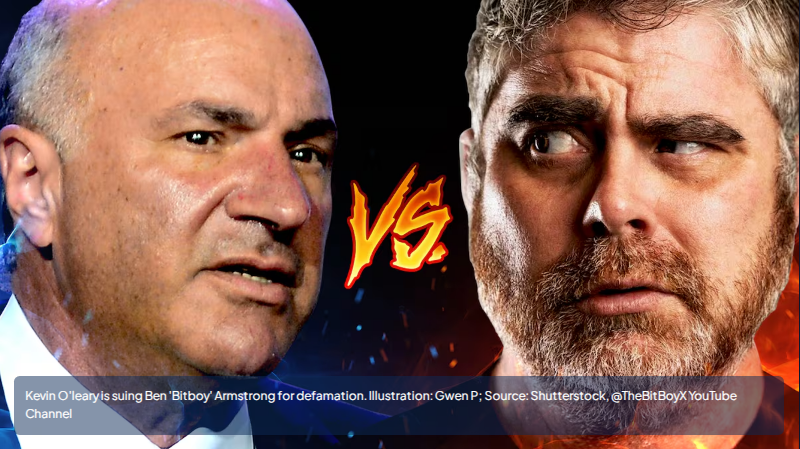
Businessman and TV personality Kevin O’Leary, known as “Mr. Wonderful” from Shark Tank, has won a $2.8 million judgment after a US federal court entered default against popular YouTuber Ben “BitBoy” Armstrong.

The ruling comes after Armstrong failed to respond to a defamation lawsuit related to false claims he made on social media, which accused O’Leary of involvement in a 2019 boating accident that resulted in fatalities.

Those claims were never proven in court, and reporters have noted the legal action focused on restoring reputation and seeking damages for harm caused by the statements.
Court Enters Default Judgment

The court award totals roughly $2.8 million in combined damages. That figure breaks down into about $78,000 for reputational injury, $750,000 for emotional distress, and $2,000,000 in punitive damages meant to punish the conduct.

Judge Beth Bloom presided over the matter in the US District Court for the Southern District of Florida, which handled filings and issued the judgment. The ruling came after procedural steps that allow a plaintiff to obtain judgment when a defendant fails to respond.

Allegations And Timeline

Reports say the posts at the center of the case appeared in March of last year. They accused the businessman of being connected to lethal conduct and alleged a cover-up. O’Leary has never been charged in relation to that incident, and later court records showed related parties were cleared at trial.

Total crypto market cap currently at $2.33 trillion. Chart: TradingView

The defamation suit alleged the statements crossed the line from opinion into false factual claims that damaged reputation and caused distress. Because Armstrong did not appear or meaningfully answer the complaint, the court treated the claims as conceded for purposes of final judgment.

Crypto Connection And Implications

Armstrong is a well-known personality in the world of cryptocurrency, operating the popular site BitBoy Crypto. His messages reach thousands of cryptocurrency fans and investors, which helped to spread the false claims.

Although the case itself is not related to cryptocurrency, it shows the legal danger that cryptocurrency influencers may face when posting unverified or defamatory information online. This decision may make other personalities in the cryptocurrency world more careful about what they post online.

Featured image from Getty Images, chart from TradingView

Пов'язані питання

QWhat was the total amount of the default judgment awarded to Kevin O'Leary against Ben Armstrong?

AThe total default judgment awarded to Kevin O'Leary was approximately $2.8 million.

QWhat were the three categories of damages included in the court's award and what were their amounts?

AThe damages were broken down into $78,000 for reputational injury, $750,000 for emotional distress, and $2,000,000 in punitive damages.

QWhy did the US federal court enter a default judgment in this case?

AThe court entered a default judgment because Ben Armstrong failed to respond to the defamation lawsuit.

QWhat was the nature of the false claims that Ben Armstrong made about Kevin O'Leary?

AArmstrong made false claims on social media accusing Kevin O'Leary of involvement in and a cover-up of a fatal 2019 boating accident.

QWhat potential impact does this case have on other cryptocurrency influencers, according to the article?

AThe article suggests the ruling may make other cryptocurrency influencers more careful about posting unverified or defamatory information online due to the legal dangers it highlights.

Пов'язані матеріали

Once-Popular Web3 Enters Wave of Layoffs

The once-hot Web3 industry is experiencing a severe wave of layoffs. While many companies attribute job cuts to AI-driven restructuring, the primary reason is often financial pressure. The Web3 sector, at the intersection of tech and finance, has been hit particularly hard. Employees at major cryptocurrency exchanges report sudden, impersonal layoffs—often with system access revoked overnight—and minimal or no severance. Common tactics include setting impossible performance targets or terminating employees for minor policy violations. The working atmosphere has become toxic, marked by intense monitoring, excessive meetings, and management obsessed with control and internal politics rather than product innovation. The industry's core business model is collapsing. Exchange revenue from trading fees and listing charges has plummeted due to a decline in quality projects and retail investor exodus. Events like the massive forced liquidation on October 10th further shattered confidence. Competition from on-chain derivatives platforms and prediction markets is intensifying the downturn. As layoffs continue, displaced workers struggle to find new opportunities. Many transition to the AI sector, but face significant bias from traditional finance and even some AI firms, which view crypto industry experience with suspicion. The current downturn appears more structural than cyclical, driven by unsustainable practices, internal strife, and a failure to innovate, raising questions about the industry's future trajectory.

marsbit10 хв тому

Once-Popular Web3 Enters Wave of Layoffs

marsbit10 хв тому

Sales Drop 26% But Prices Rise? Xiaomi's Dilemma

Xiaomi, facing a significant 26.3% year-on-year decline in global smartphone shipments in Q2 2026, has implemented its third price hike of the year. On August 2nd, prices were raised for nine models, including the flagship Mi 17 series (up 400-500 yuan) and Redmi K90/Turbo 5 series (up 300 yuan). This move completes a pattern where cost pressure, originating from surging memory chip prices, has climbed from entry-level to mid-range and now flagship products. The primary driver is a severe supply squeeze on consumer-grade DRAM and NAND flash memory, as major manufacturers like Samsung shift advanced capacity to more profitable HBM for AI applications. According to Xiaomi President Lu Weibing, memory prices for the same configuration have skyrocketed nearly fourfold since Q1 2025, adding roughly 1500 yuan to the cost of a mainstream 12GB+512GB phone. IDC estimates consumer memory costs have risen nearly 300% year-on-year. While the price increases hurt demand and contributed to the sales slump, Xiaomi's strategy of reducing entry-level models and upgrading its product mix also played a role. Domestically, its market share in China fell to 12% (5th place), while leaders Huawei and Apple saw shipments grow over 24%. To mitigate future risks, Xiaomi is accelerating its in-house "Surge" chip development and optimizing memory configurations across its lineup. Xiaomi is not alone; major brands like OPPO, vivo, and Apple have already raised prices in 2026, with industry insiders predicting another round of increases (200-800 yuan) in the second half. A full-scale industry-wide涨价 cycle is underway, forcing both manufacturers and consumers to recalibrate their strategies and purchasing decisions amid sustained cost pressures.

marsbit21 хв тому

Sales Drop 26% But Prices Rise? Xiaomi's Dilemma

marsbit21 хв тому

Three Consecutive Quarters of Decline: The Crypto Market is Experiencing Its Longest Ebb Since 2022

The cryptocurrency market experienced its third consecutive quarterly decline in Q2 2026, marking its longest downturn since 2022, according to a CoinGecko report. The total market capitalization fell 12.6% to $2.1 trillion, a retreat of roughly 52% from its October 2025 peak. Multiple indicators signal an orderly capital exit from the sector. For the first time since Q3 2023, the total stablecoin market cap shrank (-1.6% to $305.1B), indicating funds are leaving the ecosystem entirely, not just rotating to safer crypto assets. Trading volumes on centralized exchanges dropped 27.9%, while DeFi's Total Value Locked (TVL) plummeted 23.4%. Both Bitcoin (-14.2%) and Ethereum (-25.4%) underperformed traditional risk assets like equities in Q2, breaking from previous correlative narratives. Ethereum saw its first-ever three-quarter losing streak, with its market share falling to around 10%. A few areas saw growth. Prediction market volumes surged 48.7%, largely driven by sports betting. Hyperliquid's HYPE token entered the top 10 by market cap, and tokenized collectibles platforms grew, though primarily via gamified mechanics. Despite a ~9.8% Bitcoin rebound in July, historical trends suggest caution for August. The market, now ~49% below its 2025 high, is undergoing a measured retreat. Its recovery hinges on future Federal Reserve policy and the industry's ability to develop sustainable revenue streams beyond speculation.

marsbit35 хв тому

Three Consecutive Quarters of Decline: The Crypto Market is Experiencing Its Longest Ebb Since 2022

marsbit35 хв тому

Торгівля

Спот
活动图片