Crypto Clarity Act: No Deal in White House Yield Meeting

bitcoinistОпубліковано о 2026-02-11Востаннє оновлено о 2026-02-11

Анотація

A White House meeting on the Clarity Act, focused on the contentious issue of stablecoin rewards, ended without a deal. Banking groups pushed for a near-total ban on offering any form of reward to stablecoin holders, arguing such payments could destabilize traditional banking and reduce lending. Crypto advocates sought broader definitions for "permissible activities" that would allow rewards. Despite the lack of a compromise, participants from both sides described the talks as productive and a shift toward serious problem-solving. The White House urged stakeholders to reach an agreement by March 1, with further discussions expected soon.

A White House meeting aimed at breaking the logjam over stablecoin rewards under pending crypto market structure legislation aka Clarity Act ended without a compromise, even as both banking and crypto participants described the session as “productive,” according to details shared by Crypto In America reporter Eleanor Terrett citing sources in the room.

The follow-up gathering, smaller than the first meeting last week, zoomed in on what has become the most combustible line item in the Clarity Act debate: whether, and under what constraints, crypto firms can offer “rewards” tied to stablecoin usage. The White House urged both sides to reach a deal by March 1, Terrett reported, though it remains unclear whether another meeting of this scale will occur before the end of the month.

Crypto Clarity Act Update

Terrett said banks and banking trade groups came prepared with a written handout titled “Yield and Interest Prohibition Principles,” framing “payment stablecoins” as payment instruments and pushing for a bright-line ban on consideration paid to holders.

“In the GENIUS Act, Congress specifically designed payment stablecoins to be payment instruments,” the document states. “Consistent with this design, market structure legislation should incorporate the following yield and interest prohibition principles to limit deposit outflows that reduce the availability of credit for communities.”

The handout’s core demand is sweeping: “No person may provide any form of financial or non-financial consideration to a payment stablecoin holder in connection with the payment stablecoin holder’s purchase, use, ownership, possession, custody, holding, or retention of a payment stablecoin.” It pairs that with a call for regulator enforcement authority and civil monetary penalties, anti-evasion language, and strict marketing and disclosure rules that would bar firms from implying rewards are “interest,” “risk-free,” or comparable to insured deposits.

One source highlighted a narrow shift in bank posture: the inclusion of “any proposed exemptions” language, which Terrett said was viewed as a concession because banks had previously been unwilling to discuss exemptions “with respect to offering rewards on a transaction-based basis at all.” Even so, the handout insists exemptions must be “extremely limited in scope” and must not “drive deposit flight that would undercut Main Street lending.”

Terrett reported that a major share of the discussion centered on “permissible activities”: the types of account behavior that could qualify a crypto firm to offer rewards. Crypto representatives want those definitions broad; banks want them narrowed. That framing captures the heart of the dispute: whether rewards can be designed as functional incentives for payments activity, or whether any such consideration is inherently deposit-like and therefore destabilizing for traditional funding models.

Ripple Chief Legal Officer Stuart Alderoty struck an optimistic tone after the session, writing via X: “Productive session at the White House today – compromise is in the air. Clear, bipartisan momentum remains behind sensible crypto market structure legislation. We should move now – while the window is still open – and deliver a real win for consumers and America.”

Dan Spuller, EVP of the Blockchain Association, described the meeting as a shift from general debate to “serious problem-solving,” while underscoring the gap that remains. “Stablecoin rewards were front and center,” he wrote. “Banks did not come to negotiate from the bill text, instead arriving with broad prohibitive principles, which remains a key disagreement.”

The meeting was led by Patrick Witt, Executive Director of the President’s Crypto Council, and included Senate Banking Committee staff, Terrett reported. Crypto-side attendees included Coinbase’s Paul Grewal, a16z’s Miles Jennings, Ripple’s Alderoty, Paxos’s Josh Rosner, Blockchain Association CEO Summer Mersinger, and Ji Kim of the Crypto Council. Banks represented included Goldman Sachs, JPMorgan, Bank of America, Wells Fargo, Citi, PNC Bank, and U.S. Bank, alongside trade groups including the Bank Policy Institute, the American Bankers Association, and ICBA.

Mersinger said the continued convenings signal momentum even without a deal. “Today’s second White House meeting reflects continued, meaningful momentum toward delivering bipartisan digital asset market structure legislation, and we’re encouraged by the progress being made as stakeholders remain constructively engaged on resolving outstanding issues,” she said. “We’re thankful to Patrick Witt and the Administration for their continued leadership and commitment to keeping this process moving forward.”

For now, the White House appears to be applying time pressure rather than dictating terms. Further discussions are expected “in the coming days,” Terrett reported, setting up a race to define “permissible activities” narrowly enough to satisfy banks, but broadly enough for crypto firms to preserve rewards as a competitive product feature before the March 1 target date.

At press time, the total crypto market cap stood at $2.26 trillion.
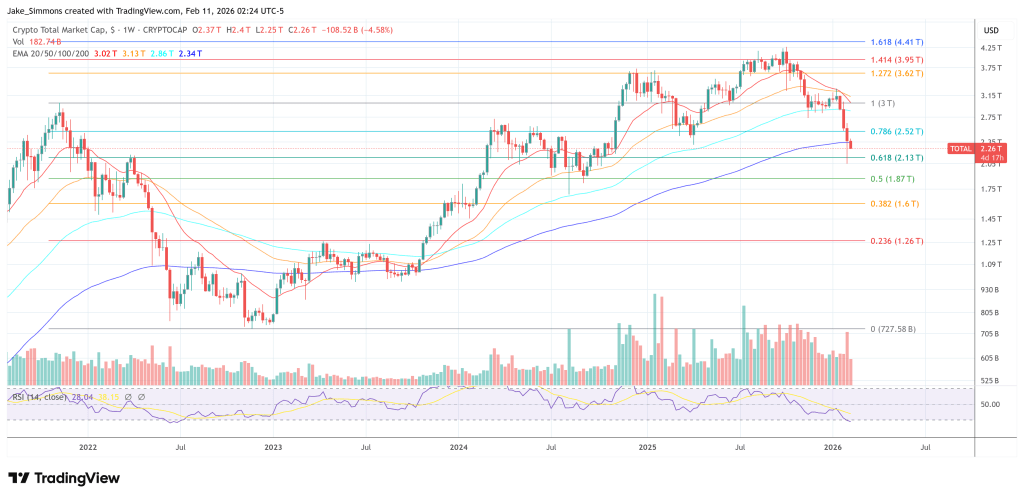
Total crypto market cap falls below the 200-week EMA, 1-week chart | Source: TOTAL on TradingView.com

Трендові криптовалюти

Пов'язані питання

QWhat was the main topic of disagreement discussed in the White House meeting regarding the Crypto Clarity Act?

AThe main topic of disagreement was whether, and under what constraints, crypto firms can offer 'rewards' tied to stablecoin usage.

QWhat was the core demand of the banking trade groups' document titled 'Yield and Interest Prohibition Principles'?

AThe core demand was a sweeping prohibition: 'No person may provide any form of financial or non-financial consideration to a payment stablecoin holder' in connection with their use of the stablecoin, effectively pushing for a ban on rewards.

QHow did Ripple's Chief Legal Officer, Stuart Alderoty, characterize the meeting?

AStuart Alderoty struck an optimistic tone, calling it a 'productive session' and stating that 'compromise is in the air' with 'clear, bipartisan momentum' behind sensible legislation.

QWhat did Dan Spuller of the Blockchain Association identify as a 'key disagreement' with the banks?

AHe identified that the banks 'did not come to negotiate from the bill text, instead arriving with broad prohibitive principles,' which was a key point of disagreement.

QWhat is the deadline the White House urged both sides to reach a deal by, and what is the focus of the ongoing discussions?

AThe White House urged both sides to reach a deal by March 1. The ongoing discussions are focused on defining 'permissible activities' narrowly enough to satisfy banks but broadly enough for crypto firms to preserve rewards as a competitive product.

Пов'язані матеріали

From South Korea to the United States: Blue-Collar Jobs Are Becoming Increasingly Popular, Thanks to AI

AI is reshaping the labor market's value proposition. The traditional four-year college degree is losing its appeal as a guaranteed career path, while skilled blue-collar trades like electricians, welders, and plumbers are experiencing historic demand and wage premiums. This shift is driven by dual pressures: AI's displacement of certain white-collar roles and a booming need for physical infrastructure and data center construction. Data confirms the trend. In the U.S., vocational school revenue surged, and a significant portion of recent layoffs are AI-related. Surveys show a majority of Gen Z adults plan to pursue blue-collar work, citing better job security against AI automation. Vocational education interest has exploded recently. Experts cite a psychological shift as younger generations seek tangible, AI-resistant careers and avoid high student debt. In many cases, salaries for skilled trades now match or exceed those requiring a bachelor's degree. In South Korea, semiconductor vocational high schools boast near-total employment, with graduates securing high-paying roles at companies like Samsung. The shortage is structural, exacerbated by a retiring baby boomer workforce and massive infrastructure projects. Companies like JPMorgan Chase, Meta, and Lowe's are investing heavily in training programs. However, overcoming historical stigma and a "perception gap" around trade careers remains a key challenge to closing the talent gap.

marsbit4 хв тому

From South Korea to the United States: Blue-Collar Jobs Are Becoming Increasingly Popular, Thanks to AI

marsbit4 хв тому

Qualcomm: AI Hype Subsides, When Will Smartphones Emerge from the Gloom?

Qualcomm reported its Q3 FY2026 results (ending June 2026), with revenue of $9.95B, down 4% YoY but above expectations. Gross margin declined to 53.1%, pressured by rising costs across manufacturing and memory. Key business segments showed mixed performance: Handset revenue fell 19.6% YoY to $5.09B, dragged by an 11% decline in non-Apple Android shipments and weaker high-end mix. Conversely, Automotive revenue surged 61% to $1.59B, and IoT grew 9% to $1.83B. Core operating profit dropped 41% YoY due to margin compression and higher expenses. Management's Q4 FY2026 guidance projects revenue of $9.7B-$10.5B, in line with consensus, but Non-GAAP EPS guidance of $2.05-$2.25 fell short of expectations. Amidst persistent weakness in its core handset market, Qualcomm is pursuing growth in AI, focusing on Edge AI (smartphones, PCs, automotive) and Data Center AI. Its data center strategy includes four pillars: AI accelerators (e.g., AI200), commercial CPUs (Dragonfly C1000), custom silicon, and connectivity solutions. While these initiatives initially boosted its stock, concerns over AI capital expenditure sustainability have since erased those gains. The company targets $5B in data center revenue for FY2027 and $15B for FY2029. The report concludes that with the traditional handset business still under pressure, the data center opportunity is currently viewed as a longer-term option, and a more conservative valuation based on core operations may be warranted until AI contributions materialize.

marsbit8 хв тому

Qualcomm: AI Hype Subsides, When Will Smartphones Emerge from the Gloom?

marsbit8 хв тому

From TPU to Self-Evolving Agents: How Jeff Dean Predicts the Next Step in AI

At the 2026 YC Startup School, Jeff Dean outlined his vision for AI's next phase, shifting focus from simply scaling models to building intelligent, autonomous systems. He believes AI's progress is no longer just about creating smarter models, but about integrating them into systems capable of long-term, iterative work, automated experimentation, and continuous learning. This evolution moves the competition from "who has the bigger model" to "who can best organize intelligence." Dean suggests AI capabilities are now comparable to a junior engineer, enabling the automation of complex workflows. However, the true challenge and opportunity lie in managing these AI "workers" at scale. He emphasizes the importance of **context engineering**—structuring tools, memory, and feedback loops—over raw model power. For startups, this means building deep expertise in niche domains where general models currently fail (near 0-1% success rates), leveraging proprietary data, specialized tools, and domain-specific evaluators. A recurring theme is re-examining fundamental constraints. Dean's past work, like moving Google's search index to memory or creating the TPU, stemmed from questioning outdated assumptions about hardware and cost. He sees similar inflection points today, particularly in **specialized inference hardware** to drastically reduce latency and energy consumption for real-time Agent operation. Notably, he points out that in modern AI systems, the dominant cost is often not computation but **data movement**. Reliable, long-running Agents require robust system design, borrowing concepts from distributed computing like checkpointing, state management, and parallel exploration to handle failures and maintain progress over days or weeks. As AI automates execution, the scarcest human skills will shift to **defining clear specifications**, **judging what problems are worth solving** (taste), and designing effective feedback loops. Ultimately, Dean's framework prioritizes understanding the problem deeply, identifying the true bottlenecks, and systematically building closed-loop systems where AI can not only perform tasks but also improve AI itself.

marsbit8 хв тому

From TPU to Self-Evolving Agents: How Jeff Dean Predicts the Next Step in AI

marsbit8 хв тому

Торгівля

Спот

Популярні статті

Як купити HOUSE

Ласкаво просимо до HTX.com! Ми зробили покупку Housecoin (HOUSE) простою та зручною. Дотримуйтесь нашої покрокової інструкції, щоб розпочати свою криптовалютну подорож.Крок 1: Створіть обліковий запис на HTXВикористовуйте свою електронну пошту або номер телефону, щоб зареєструвати обліковий запис на HTX безплатно. Пройдіть безпроблемну реєстрацію й отримайте доступ до всіх функцій.ЗареєструватисьКрок 2: Перейдіть до розділу Купити крипту і виберіть спосіб оплатиКредитна/дебетова картка: використовуйте вашу картку Visa або Mastercard, щоб миттєво купити Housecoin (HOUSE).Баланс: використовуйте кошти з балансу вашого рахунку HTX для безперешкодної торгівлі.Треті особи: ми додали популярні способи оплати, такі як Google Pay та Apple Pay, щоб підвищити зручність.P2P: Торгуйте безпосередньо з іншими користувачами на HTX.Позабіржова торгівля (OTC): ми пропонуємо індивідуальні послуги та конкурентні обмінні курси для трейдерів.Крок 3: Зберігайте свої Housecoin (HOUSE)Після придбання Housecoin (HOUSE) збережіть його у своєму обліковому записі на HTX. Крім того, ви можете відправити його в інше місце за допомогою блокчейн-переказу або використовувати його для торгівлі іншими криптовалютами.Крок 4: Торгівля Housecoin (HOUSE)Легко торгуйте Housecoin (HOUSE) на спотовому ринку HTX. Просто увійдіть до свого облікового запису, виберіть торгову пару, укладайте угоди та спостерігайте за ними в режимі реального часу. Ми пропонуємо зручний досвід як для початківців, так і для досвідчених трейдерів.

548 переглядів усьогоОпубліковано 2025.04.27Оновлено 2026.06.02

Як купити HOUSE

Обговорення

Ласкаво просимо до спільноти HTX. Тут ви можете бути в курсі останніх подій розвитку платформи та отримати доступ до професійної ринкової інформації. Нижче представлені думки користувачів щодо ціни HOUSE (HOUSE).

活动图片













