Crypto CLARITY Act Faces 100-Plus Amendments As Stablecoin, Banking Fight Intensifies

bitcoinistОпубліковано о 2026-05-13Востаннє оновлено о 2026-05-13

Анотація

The U.S. Senate Banking Committee's CLARITY Act faces over 100 proposed amendments ahead of a key markup vote, intensifying debates on stablecoins, banking, and crypto regulation. Key points of contention include stablecoin rewards, with proposed bans on yield for idle balances and bank-backed amendments seeking stricter rules. Senator Elizabeth Warren filed over 40 amendments, including one to block crypto firms from Federal Reserve accounts, while another from Senator Jack Reed aims to prohibit using crypto for tax payments, countering industry goals for broader adoption. The bill, positioned as a consumer protection measure, also proposes treating crypto exchanges as financial institutions under anti-money laundering laws and creating exemptions for small fundraising. Banking industry groups are actively lobbying for tighter restrictions. Despite some Democratic leadership support, the bill's path remains uncertain due to ongoing negotiations on ethics and conflict-of-interest provisions, with critics warning of risks to investors and financial stability.

The US Senate Banking Committee’s crypto market structure push is running into a dense wall of amendments ahead of Thursday’s markup, with lawmakers filing more than 100 proposed changes to the CLARITY Act. The amendment rush puts stablecoin rewards, crypto firms’ access to the Federal Reserve system and even the use of digital assets for tax payments at the center of Washington’s latest fight over crypto regulation.

According to Politico, committee members submitted more than 100 amendments before the markup vote. Crypto journalist Eleanor Terrett reported that Senator Elizabeth Warren alone filed more than 40 amendments, including one that would prevent the Federal Reserve from issuing master accounts to crypto companies. Terrett also flagged an amendment from Senator Jack Reed that would “prohibit crypto from being used as legal tender, for example, to pay taxes.”

That language would cut directly against one of the industry’s longer-running policy goals: expanding digital assets beyond investment and trading into payments, settlement and public-sector use cases. Terrett noted the contrast with prior pro-Bitcoin tax-payment proposals, writing that Representative Warren Davidson had introduced a bill last year “to do that very thing” with BTC.

Crypto Bill Enters High-Stakes Senate Markup

The latest clash comes after Senate Banking Committee Chairman Tim Scott, Senator Cynthia Lummis and Senator Thom Tillis released new market structure text that will serve as the basis for the committee markup. The committee said the text reflects negotiations with Democrats and input from lawmakers, regulators, law enforcement, financial institutions, innovators and consumer advocates. Scott framed the bill as a consumer-protection and national-competitiveness measure.

“Over the past year, we have listened, negotiated, and strengthened this bill because families, small businesses, investors, and innovators all benefit from clear rules of the road,” Scott said. “This bill reflects serious, good-faith work across the Committee and delivers the certainty, safeguards, and accountability Americans deserve.”

The most immediate fault line remains stablecoin rewards. The Senate text would ban rewards on idle stablecoin balances that closely resemble bank deposits, while allowing rewards tied to transaction-based activity, such as stablecoin payments. The SEC, CFTC and Treasury Department would be tasked with issuing joint rules to implement that provision.

Banks are not satisfied. Brendan Pedersen reported that Reed and Senator Tina Smith filed an amendment that would incorporate bank-requested changes to stablecoin yield restrictions, forcing lawmakers to choose between the crypto and banking industries. The amendment would target rewards “substantially similar” to deposit interest, a phrase that goes to the core of the banking lobby’s argument: that crypto platforms should not be allowed to compete with deposits through yield-like incentives while avoiding bank-style regulation.

Terrett reported separately that American Bankers Association members had sent more than 8,000 letters to Senate offices urging lawmakers to revise the stablecoin-yield compromise. The ABA has argued that the current language does not adequately close what it calls a loophole allowing exchanges and other digital asset service providers to bypass the GENIUS Act’s ban on interest or yield on payment stablecoins.

The bill also reaches well beyond stablecoins. Digital commodity exchanges, brokers and dealers would be treated as financial institutions under the Bank Secrecy Act, bringing them into anti-money-laundering, customer-identification and due-diligence regimes. The text would also allow crypto companies to raise up to $50 million annually, and up to $200 million total, without SEC registration, while clarifying that tokenized securities remain subject to securities law.

The political path is still fragile. Terrett said Senate Minority Leader Chuck Schumer appeared engaged in a Democratic member meeting and eager for members to reach a “yes” on the CLARITY Act, but stressed that ethics negotiations needed to move further before Thursday’s markup. Warren, the committee’s top Democrat, has been pressing that issue hard, saying the bill “puts investors, our national security and our entire financial system at risk” and would “turbocharge Donald Trump’s crypto corruption” without stronger conflict-of-interest provisions.

At press time, the total crypto market cap stood at $2.67 trillion.
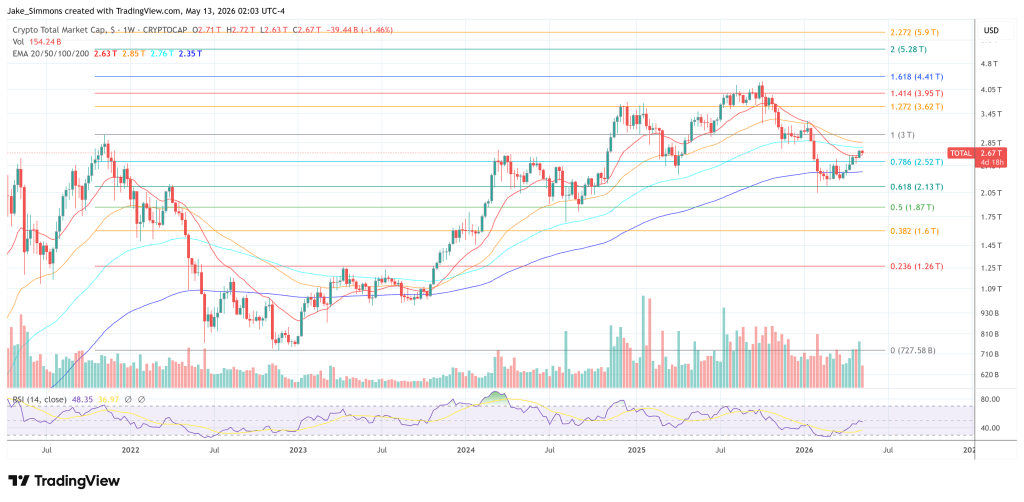
Total crypto market cap faces the 100-week EMA, 1-week chart | Source: TOTAL on TradingView.com

Пов'язані питання

QWhat is the CLARITY Act, and what key issues are highlighted by the large number of amendments it faces?

AThe CLARITY Act is a crypto market structure bill under consideration by the US Senate Banking Committee. The large number of amendments (over 100) highlights intense debate over key issues including: banning or restricting stablecoin rewards that resemble bank deposit interest, crypto firms' access to Federal Reserve master accounts, and whether digital assets can be used for payments like tax settlements.

QWhich specific amendment proposed by Senator Elizabeth Warren is mentioned, and what would it prevent?

AThe article mentions that Senator Elizabeth Warren filed an amendment that would prevent the Federal Reserve from issuing master accounts to crypto companies. Master accounts are crucial for financial institutions to access Fed payment and settlement services directly.

QAccording to the article, what is the core argument of the banking lobby regarding stablecoin rewards?

AThe banking lobby's core argument is that crypto platforms should not be allowed to offer rewards 'substantially similar' to bank deposit interest while avoiding the stringent regulations that banks face. They view this as an unfair competitive loophole.

QHow does the current Senate bill text propose to handle stablecoin rewards?

AThe Senate bill text proposes to ban rewards on idle stablecoin balances that closely resemble bank deposits. However, it would allow rewards tied to transaction-based activities, such as making stablecoin payments. Regulatory agencies would be tasked with creating joint rules to implement this provision.

QBeyond stablecoins, what are two other significant regulatory changes proposed in the bill's text?

ATwo other significant changes are: 1) Treating digital commodity exchanges, brokers, and dealers as financial institutions under the Bank Secrecy Act, subjecting them to AML, KYC, and due diligence rules. 2) Allowing crypto companies to raise up to $50 million annually (up to $200M total) without SEC registration, while clarifying that tokenized securities remain under securities law.

Пов'язані матеріали

Will the Fed Definitely Raise Interest Rates in September? How Will Crypto and U.S. Stocks Withstand the Pressure?

The market's expectation for a September Fed rate hike surged dramatically in early August, jumping from under 50% to over 80% within a week. This shift followed a contentious July FOMC meeting, where a 9-3 vote to hold rates revealed growing dissent from hawkish members advocating for an immediate hike to combat persistent inflation. The primary catalyst for this repricing is rising oil prices, driven by renewed geopolitical tensions around the Strait of Hormuz, which threaten global supply. Energy costs directly influence inflation metrics, making the upcoming July CPI report (due August 12th) a critical data point. If it shows inflation reaccelerating, the probability of a September hike will solidify. For Bitcoin and crypto assets, this is typically bearish news. Bitcoin continues to behave as a high-beta, liquidity-sensitive risk asset. A rate hike raises the opportunity cost of holding non-yielding assets and could drive capital toward money markets, pressuring crypto prices in the short term. However, historical patterns suggest that if a hike is perceived as the end of a tightening cycle rather than the start, any negative price impact may be brief. U.S. stocks, particularly crypto-linked equities like Coinbase and growth-oriented tech stocks, are also vulnerable. Higher rates increase discount rates in valuation models, putting pressure on high-multiple companies. This coincides with a pivotal tech earnings season where investor focus has shifted from massive AI capital expenditure to tangible revenue and cash flow generation. Companies with negative cash flow and weak growth narratives could face heightened volatility if borrowing costs rise in September. In summary, a September Fed hike has evolved into a mainstream market scenario. Key factors to watch are oil prices, the July CPI report, and Fed communications, which will determine the final decision and its impact on volatile crypto and equity markets.

marsbit6 хв тому

Will the Fed Definitely Raise Interest Rates in September? How Will Crypto and U.S. Stocks Withstand the Pressure?

marsbit6 хв тому

A 'Overlooked' Market Event: Joint US-Japan-South Korea Intervention, Rare US Treasury Involvement, and Bessent's Quiet 'Market Rescue'?

Summary: The United States, Japan, and South Korea executed their largest coordinated foreign exchange intervention in nearly 30 years. The action targeted depreciation pressure on the Japanese yen and South Korean won. This move is seen as a significant effort by the US to stabilize the financial markets of its key allies and prevent the spillover of risks. Key details: * Japan reportedly intervened on July 30 using approximately 8.45 trillion yen (about $52.8 billion). South Korean authorities also intervened that day, selling dollars to support the won. * Notably, the US Treasury Department intervened directly in yen markets for the first time in roughly 30 years. The New York Fed, reportedly acting on behalf of the Treasury, sold euros to buy yen via Goldman Sachs and Morgan Stanley on July 31. Analysts view the use of the euro-yen pair as a way to alleviate yen pressure without adding selling pressure to the US dollar. * Prior to the action, the New York Fed conducted "rate checks" on both USD/JPY and EUR/JPY, a newer signaling tool that falls between verbal and physical intervention. The intervention is interpreted as going beyond traditional currency stabilization. Analysts, such as Michael Hartnett of Bank of America, suggest it resembles a "Price Keeping Operation" for the AI era. The core US objectives are perceived to be: 1. Preventing rapid yen depreciation from triggering a sharp rise in Japanese government bond yields. 2. Containing financial stress from spreading across Asian markets like South Korea and Japan. 3. Reducing the risk of disorderly capital flows impacting the US bond market. This coordinated action underscores the importance of Japan and South Korea as critical partners in the US semiconductor and AI supply chain. Stabilizing their financial markets is seen as vital to mitigating risks to the broader tech industry and the US market itself. The intervention coincides with market pressures, including the KOSDAQ index hitting a low since October 2022. While seen as a move to control volatility, some analysts caution it may not fundamentally reverse existing market trends.

marsbit9 хв тому

A 'Overlooked' Market Event: Joint US-Japan-South Korea Intervention, Rare US Treasury Involvement, and Bessent's Quiet 'Market Rescue'?

marsbit9 хв тому

Will the Federal Reserve Definitely Raise Interest Rates in September? How Will Cryptocurrencies and US Stocks Bear the Pressure?

In early August 2024, market expectations for a September Federal Reserve rate hike surged dramatically, from below 50% to over 80%, driven by renewed inflation concerns. This shift followed a contentious July FOMC meeting where a 9-3 vote to hold rates revealed a growing hawkish faction advocating for an immediate hike, citing prolonged above-target inflation. The key catalyst is escalating conflict near the Strait of Hormuz, which has pushed oil prices up approximately 20% in July, threatening to reignite inflation. The next critical data point is the July CPI report on August 12th; a hot reading could solidify hike expectations. For crypto assets, particularly Bitcoin, this represents near-term pressure. Bitcoin continues to exhibit high-beta, risk-on characteristics, making it sensitive to tightening liquidity and higher opportunity costs. However, historical precedent suggests that if a hike is perceived as the cycle's end rather than its start, the negative impact may be brief, with markets quickly pivoting to anticipate future rate cuts. U.S. stocks, especially crypto-linked equities like Coinbase and high-valuation tech stocks, face amplified volatility. Higher rates increase discount rates in valuation models, pressuring growth stocks. This coincides with a pivotal tech earnings season where investor focus has shifted from massive AI capital expenditures to demonstrable revenue and cash flow generation. Companies with negative cash flows and weak growth narratives could see severe pressure if a September hike materializes, as financing costs would rise. Key indicators to watch include oil prices, upcoming inflation data, and Fed commentary at events like the Jackson Hole symposium.

Odaily星球日报9 хв тому

Will the Federal Reserve Definitely Raise Interest Rates in September? How Will Cryptocurrencies and US Stocks Bear the Pressure?

Odaily星球日报9 хв тому

Торгівля

Спот
活动图片





