Crypto Bets On Argentina Inflation Stoke Fears Of Insider Trading On Polymarket

bitcoinistОпубліковано о 2026-03-17Востаннє оновлено о 2026-03-17

Анотація

Argentinian authorities have ordered a nationwide blockade of the crypto prediction platform Polymarket, enforced by regulators and internet providers, following a court ruling that deemed it an unlicensed gambling operation. The move comes after allegations of insider trading emerged when suspicious betting activity occurred just before the release of official inflation data in February. Argentina follows Colombia as the second Latin American country to ban the platform, reflecting a broader global trend of regulators treating prediction markets as gambling rather than financial tools. This could fragment liquidity and push users into less regulated markets.

Argentinian authorities have ordered a full national blockade of Polymarket after it predicted inflation data.

An Authoritarian Crypto Ban?

Argentinian outlets reported this Monday that a court ruling in Buenos Aires ordered a nationwide blockade of Polymarket, one of the largest crypto prediction market platforms globally. The blockade will be enforced via the Ente Nacional de Comunicaciones (ENACOM) and local internet service providers (ISPs), in addition to its removal from Apple and Google app stores. The restriction goes as far as affecting already signed up Polymarket users, another local outlet claims.

Buenos Aires Lottery Regulators (Lotería de la Ciudad de Buenos Aires and the Cámara Argentina de Casinos y Bingos) argue that Polymarket is operating as an unlicensed online gambling platform, not just a neutral "prediction market". This led to a case being brought by the City's Special Prosecutor's Office for Gambling (FEJA) and presided over by Judge Susana Parada.

The Public Prosecutor's Office explained that despite the blocking order having already been issued, the implementation depends on ENACOM notifying all ISP's so the companies can cut off access. Therefore, the full and final implementation will most likely be gradual.

A "Degen Casino" That Played With The Country's Inflation

This drastic ruling follows a suspicious trading scandal in the inflation market back in February, where odds moved around fifteen minutes before INDEC released official CPI data, raising allegations of insider trading by politically connected actors.

The local media has echoed the "degen casino" narrative, arguing that these markets let users place peso‐linked wagers on macro data, elections and high‐profile political outcomes without any Argentine license or KYC/age checks. Clarín claims that, in Polymarket, "it all comes down to betting money on a question that can be answered with a yes or a no":

Polymarket presents itself as a prediction market, but in practice it's a way to bet on almost anything that emerged during the pandemic and gained popularity during the election campaign between Donald Trump and Kamala Harris, when the tycoon began promoting these markets because they gave him better results than the polls: 55.5% were literally betting on him.

A Global Trend

Despite some claims that place Argentina as the first country in the region to implement such measures, the truth is that last year Colombia became the first country in Latin America to ban Polymarket. Coljuegos, Colombian gambling regulators, declared the platform ilegal in September 2025 and, similarly to the Argentinian ban, instructed their ISPs to block access to it.

It its worth noting that prediction markets had become a popular way for global crypto traders to price political risk, inflation paths and macro events in real time, often anticipating official data. In line with this, this is not the first clash between Polymarket's and regulatory entities. Besides Colombia, other earlier blocks or investigations have been registered in France, Taiwan and Singapore, in addition to the US regulatory pressure over unregistered derivatives and gambling concerns.

Argentina's move reinforces a growing trend of regulators increasingly treating crypto prediction platforms as gambling first and market infrastructure second, which could fragment liquidity and push activity into friendlier jurisdictions or darker venues.
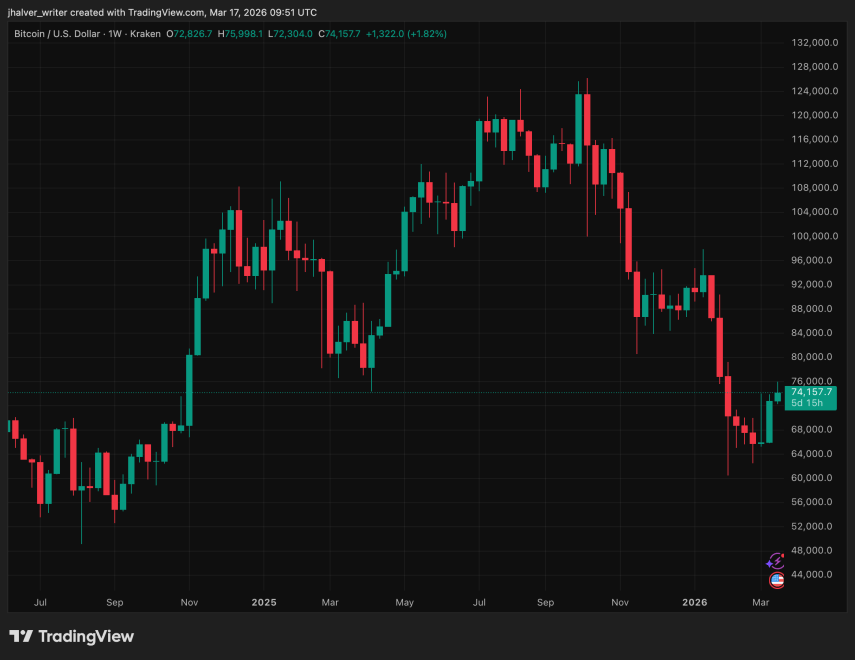
BTC's price trends reaches $74K on the daily chart, the highest since January. Source: BTCUSD on Tradingview

Cover image from Perplexity, BTCUSD chart from Tradingview

Пов'язані питання

QWhy did Argentinian authorities order a national blockade of Polymarket?

AArgentinian authorities ordered a national blockade of Polymarket because they argue it is an unlicensed online gambling platform, not just a neutral prediction market, following a suspicious trading scandal involving inflation data.

QWhat was the suspicious trading activity on Polymarket related to in Argentina?

AThe suspicious trading activity was related to Argentina's inflation data, where odds moved around fifteen minutes before the official CPI data was released by INDEC, raising allegations of insider trading.

QWhich other Latin American country banned Polymarket before Argentina?

AColombia became the first country in Latin America to ban Polymarket, declaring the platform illegal in September 2025 and instructing ISPs to block access.

QHow does Polymarket present itself versus how it is viewed by regulators?

APolymarket presents itself as a prediction market, but regulators view it as an unlicensed online gambling platform that allows users to place wagers on events without proper licensing or KYC/age checks.

QWhat global trend does Argentina's move against Polymarket reinforce?

AArgentina's move reinforces a growing trend of regulators treating crypto prediction platforms as gambling first and market infrastructure second, which could fragment liquidity and push activity into friendlier jurisdictions.

Пов'язані матеріали

The "Impossible Triad" Is Fundamentally a Pseudo-Problem

The article argues that blockchain's fundamental limitation is not the scalability trilemma (decentralization, scalability, security), which has been largely solved, but the lack of **privacy** and, until recently, clear **legitimacy**. Blockchain is described as a slow, expensive, globally shared computer whose core value is censorship resistance and verifiability. While ideal for native digital assets like money (e.g., stablecoins), its default transparency acts as a **tax**, exposing all transactions and enabling MEV extraction, which deters serious institutional capital. Simultaneously, its permissionless nature created regulatory ambiguity. The piece contends that **privacy** is the missing critical feature. It rejects the false choice between total transparency and complete anonymity. Modern cryptography (like zero-knowledge proofs) enables **compliant privacy**: users can prove facts (solvency, KYC status, compliance) without revealing the underlying sensitive data (specific holdings, identities). This preserves auditability for regulators and eliminates the leak of financial information. With recent regulatory progress (e.g., the GENIUS Act) addressing legitimacy, adding default, provably compliant privacy becomes a pure upgrade. It transforms blockchain from a costly, public ledger into a confidential settlement layer, finally bridging the gap to mainstream institutional and individual adoption of on-chain finance.

链捕手11 год тому

The "Impossible Triad" Is Fundamentally a Pseudo-Problem

链捕手11 год тому

Optical Chips: Collective Capacity Expansion

The global optical chip industry is experiencing a massive wave of expansion driven by surging AI data center demand. Major players across the US, Japan, Europe, and China are aggressively investing to ramp up production capacity. In the US, Coherent is expanding its 6-inch Indium Phosphide (InP) semiconductor fab in Texas, supported by CHIPS Act funding and a $2 billion strategic investment from NVIDIA. Lumentum is building a new factory for InP optical devices, and Nokia is scaling its advanced photonic chip packaging and testing capabilities. NVIDIA's investments aim to secure future supply of critical lasers and optical interconnect products for AI infrastructure. Japan's JX Advanced Metals, a leading InP substrate supplier, plans a multi-billion yen investment to increase its capacity 7-10 times, strengthening its grip on the crucial upstream materials market. In Europe, IQE and Tower Semiconductor settled a patent dispute and signed a multi-year InP epitaxial wafer supply agreement, highlighting that next-generation silicon photonics platforms will integrate high-performance InP components. STMicroelectronics and Sivers Semiconductors are also expanding silicon photonics production and partnerships. China is rapidly building out its domestic supply chain. Dongshan Precision's subsidiary, Source Photonics, announced a $12 billion project to expand optical chip and module production. Companies like Sanan Optoelectronics and Yunnan Germanium are scaling up InP chip manufacturing and substrate production, moving towards vertical integration from materials to modules. While debate continues around the exact future architecture—whether CPO (Co-Packaged Optics), NPO, or pluggables will dominate—analysts like Morgan Stanley argue the underlying driver is unchangeable: the explosive growth in bandwidth demand. This will inevitably increase the volume of optical engines, lasers, and related content per GPU, regardless of the final technical path. The competition for "more light" in the AI era has intensified into a global, full-chain capacity race.

marsbit14 год тому

Optical Chips: Collective Capacity Expansion

marsbit14 год тому

Торгівля

Спот
Ф'ючерси
活动图片