Crypto Alert: 2 Victims Lose Over $60M In Address Poisoning Scam

bitcoinistОпубліковано о 2026-02-09Востаннє оновлено о 2026-02-09

Анотація

Cryptocurrency users are facing significant losses due to address poisoning scams, where attackers send tiny "dust" transactions from lookalike addresses. When users copy what appears to be a familiar address, they instead send funds to a fraudulent account. In January, one victim lost $12.25 million, following a $50 million loss in December. Additionally, signature phishing is rising sharply, with $6.27 million stolen from 4,741 victims in January—a 207% increase from the previous month. These scams trick users into approving malicious smart contracts. Analysts report approximately 270 million poisoning attempts across Ethereum and Binance Smart Chain, targeting 17 million addresses. Over 6,633 confirmed theft cases have resulted in more than $83.8 million in losses. The Fusaka upgrade on Ethereum, which reduced transaction fees, has made it cheaper for scammers to execute these attacks. Stablecoins like DAI are often used to move illicit funds due to a lack of cooperation with freezing mechanisms.

A simple slip of the fingers has turned into huge losses for some crypto users. One wallet lost over $12 million in January after copying the wrong address, and similar high-value mistakes were seen in December.

Reports say attackers are using tiny deposits and subtle address tweaks to trick people into sending funds to accounts they do not control.

How Copying Mistakes Turn Costly

Address lookalikes are the trick. Attackers send tiny “dust” transfers from addresses that mimic ones in a user’s history so that when someone copies an address they get the wrong string.

According to Scam Sniffer, that single mistake cost one user $12.2 million in January and followed a $50 million hit in December.

The tactic relies on people trusting what appears familiar; it works because most wallets show only the first and last few characters, and the middle can be swapped for a malicious match.

Signature Phishing Is Growing Too

Signature scams lure users into approving dangerous contract calls or broad token approvals. Reports say $6.27 million was stolen from 4,741 victims in January, a 207% rise from December.

Two wallets took the lion’s share — accounting for 65% of those signature phishing losses. Attackers increasingly mix both tricks: small deposits to get attention, followed by social engineering that convinces someone to sign a transaction.

Scale And Automation

This is not limited to a few isolated scams. Based on reports from several trackers, roughly 270 million poisoning attempts have been recorded across Ethereum and Binance Smart Chain, targeting around 17 million addresses.

Total crypto market cap at $2.35 trillion on the daily chart: TradingView

Confirmed cases leading to actual theft number about 6,633, but the confirmed loss figure already tops $83.8 million. One campaign alone created 82,030 lookalike wallets, and in September 2025 there were about 32,290 suspicious poisoning events hitting 6,516 unique victims.

The numbers show a picture of automated scripts and high-volume tactics designed to find and exploit simple human errors.
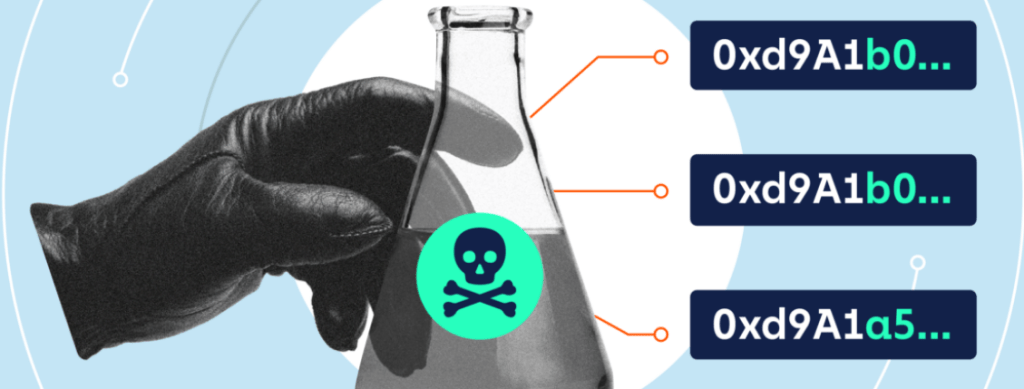
Image: Chainalysis

Why Ethereum Has Seen More Dust Activity

Analysts link part of the recent surge to the Fusaka upgrade, which lowered the cost of sending tiny transactions. Coin Metrics analyzed over 227 million stablecoin balance updates on Ethereum from November 2025 through January 2026 and found that 38% of those updates were under a single penny.

Stablecoin-related dust now makes up an estimated 11% of Ethereum transactions and touches 26% of active addresses on an average day. Lower fees make these spray-and-pray tactics cheap and efficient.

Where Stolen Funds End Up

Blockchain intelligence teams have tracked flows and noticed patterns. Whitestream reports that DAI has become a favored place to park illicit proceeds because its protocol governance does not cooperate with authorities to freeze wallets.

Web3 Antivirus has cataloged a range of large poisonings, with tracked losses spanning from $4 million to $126 million in some incidents. Once funds move through these paths they are often hard to recover.

Featured image from Arek Socha/Pixabay, chart from TradingView

Пов'язані питання

QWhat is an address poisoning scam in the context of cryptocurrency?

AAn address poisoning scam is a tactic where attackers send tiny 'dust' transfers from addresses that mimic ones in a user's transaction history. This tricks the user into copying the wrong, malicious address when they intend to send funds, resulting in the loss of their cryptocurrency.

QHow much did a single user lose in January due to copying the wrong address, and what was the larger loss reported in December?

AIn January, a single user lost $12.2 million by copying the wrong address. This followed a larger loss of $50 million from a similar mistake in December.

QBesides address poisoning, what other type of attack saw a significant increase in January, and by what percentage did it grow?

ASignature phishing attacks also saw a significant increase. $6.27 million was stolen from 4,741 victims in January, representing a 207% rise from December.

QWhat technical upgrade on the Ethereum network is linked to the recent surge in dusting activity for these scams?

AThe Fusaka upgrade on the Ethereum network is linked to the surge in dusting activity because it lowered the cost of sending tiny transactions, making these spray-and-pray tactics cheap and efficient for attackers.

QAccording to the article, which stablecoin has become a favored place for attackers to park illicit proceeds and why?

ADAI has become a favored place for attackers to park illicit proceeds because its protocol governance does not cooperate with authorities to freeze wallets, making it harder to recover stolen funds.

Пов'язані матеріали

The Largest IPO in History Is Approaching, Surpassing SpaceX, 28 Years of AI Self-Iteration, Countdown to Intelligence Explosion

"Anthropic Nears Trillion-Dollar IPO, Fueled by Explosive Growth and 2028 'Intelligence Explosion' Warning Anthropic is considering a deal valuing the AI company near $1 trillion, potentially leading to one of the largest IPOs ever and surpassing SpaceX. Its revenue has skyrocketed, with Annual Recurring Revenue (ARR) reaching $45 billion in May 2026—a 500% increase in just five months. This vertical growth curve is attributed to its key products, Claude Code and Cowork, dominating AI coding and enterprise collaboration. Beyond commercial success, co-founder Jack Clark issued a pivotal warning in an interview: there is a greater than 50% chance that by the end of 2028, AI systems will achieve recursive self-improvement—the ability to autonomously build a 'better version' of themselves, initiating an 'intelligence explosion.' This prophecy underpins the company's astronomical valuation, as the market prices in the potential for transformative and disruptive AI. Further signaling its ambition, Anthropic formed a $1.5 billion joint venture with Goldman Sachs and Blackstone, aiming to disrupt traditional consulting firms like McKinsey by deploying Claude AI for complex strategic work. This move tests AI's capacity to replace high-level cognitive labor, a precursor to its predicted autonomous evolution. The narrative presents a dual future: unprecedented economic opportunity alongside significant risks like economic restructuring and security threats. Anthropic's meteoric rise and Clark's 2028 prediction frame the coming years as a countdown to a potential technological singularity."

marsbit7 хв тому

The Largest IPO in History Is Approaching, Surpassing SpaceX, 28 Years of AI Self-Iteration, Countdown to Intelligence Explosion

marsbit7 хв тому

Has Hook Summer Really Arrived? sato, Lo0p, FLOOD Ignite the New Narrative of Uniswap v4

"Hook Summer" Arrives? Sato, Lo0p, FLOOD Ignite Uniswap v4 Narrative Amidst a slight market recovery, attention within the Ethereum ecosystem has shifted to Meme coins built on Uniswap v4's Hook protocol. Following ASTEROID, tokens like sato, sat1, Lo0p, and FLOOD have become market focal points, with market caps ranging from millions to tens of millions, bringing concentrated liquidity to a narrative-dry market. Uniswap v4 Hooks are "plugin smart contracts" that allow developers to inject custom logic at key points in a liquidity pool's lifecycle (initialization, adding/removing liquidity, swaps, etc.), making the AMM programmable. Recent representative projects include: * **sato**: Market cap peaked over $38M; uses a v4 curve mechanism for minting/burning, locking ETH as reserve. * **sat1**: Market cap briefly exceeded $10M, positioning as an "optimized sato," but later declined significantly. * **Lo0p**: Market cap neared $6.6M; a "lending AMM protocol" allowing users to borrow ETH against deposited LO0P tokens without immediate selling pressure. * **FLOOD**: Market cap approached $6M; channels trading reserves into Aave v3 to generate yield, which is retained in the pool. The emergence of these Hook-based tokens could drive long-term growth for the Uniswap ecosystem by attracting users and liquidity to v4 pools. Combined with Uniswap's activated fee switch (partially used to burn UNI), the long-term outlook for UNI appears positive. However, short-term UNI price appreciation is not directly guaranteed. Factors include the sustainability and lifecycle of these new tokens, their price volatility, overall market conditions, and regulatory pressures. Currently, Uniswap v4's TVL ($595M) lags behind v3 and v2, indicating Hook adoption still requires time to mature. In summary, the Hook ecosystem serves as "long-term nourishment" for UNI, but acts more as a "catalyst" than a direct "booster" in the short term. Note: These are early-stage experimental tokens and may carry unknown risks.

marsbit32 хв тому

Has Hook Summer Really Arrived? sato, Lo0p, FLOOD Ignite the New Narrative of Uniswap v4

marsbit32 хв тому

Has Hook Summer Truly Arrived? sato, Lo0p, FLOOD Ignite the New Uniswap v4 Narrative

With the broader market showing signs of recovery, a new wave of interest has emerged around Ethereum-based meme coins. Following ASTEROID, tokens like sato, sat1, Lo0p, and FLOOD, built upon the Uniswap v4 Hook protocol, are capturing market attention. Their market capitalizations range from millions to tens of millions of dollars, injecting much-needed focused liquidity into a market lacking narratives. This article explores whether this trend signifies an incoming "Hook Summer" and its potential impact on UNI's price. Hooks are essentially plug-in smart contracts for Uniswap v4 liquidity pools, allowing developers to inject custom logic at key points in a pool's lifecycle (like initialization, adding/removing liquidity, swaps). This transforms the AMM into programmable building blocks. Key highlighted projects include: * **sato**: Peaked over $38M market cap. It utilizes a v4 curve for minting/burning; buying locks ETH as reserve to mint new tokens, while selling redeems ETH from the reserve and burns tokens. * **sat1**: Market cap briefly exceeded $10M, promoted as an "optimized sato," but later declined significantly. * **Lo0p**: Reached nearly $6.6M. It's a lending AMM protocol where buying LO0P tokens locks them as collateral, allowing users to borrow ETH from the pool reserve at 40% LTV, aiming to improve capital efficiency for idle ETH in LPs. * **FLOOD**: Peaked near $6M. Its mechanism directs asset reserves from buys into Aave v3 to generate yield, with fees and interest retained in the pool to potentially influence the token's price long-term. In the long term, the development of the Hook ecosystem can attract users and liquidity to Uniswap v4, benefiting UNI's fundamentals—especially combined with the recent activation of the protocol fee switch, where a portion of fees is used to burn UNI. However, in the short term, these Hook-based tokens are unlikely to directly drive significant UNI price appreciation. Their impact is moderated by factors like token sustainability, price volatility, and broader market and regulatory conditions. Currently, Uniswap v4's TVL ($595M) still trails behind v2 and v3, indicating adoption and growth will take time. The article concludes that while the Hook ecosystem provides long-term "nourishment" for UNI, its short-term role is more of a "catalyst" than a "booster." Readers are cautioned that these are early-stage experimental tokens and may carry unknown risks.

Odaily星球日报44 хв тому

Has Hook Summer Truly Arrived? sato, Lo0p, FLOOD Ignite the New Uniswap v4 Narrative

Odaily星球日报44 хв тому

Торгівля

Спот
Ф'ючерси
活动图片





