Core 'Key Contributors' Depart One After Another, Has Aave's DAO Dream Shattered?

比推Опубліковано о 2026-03-03Востаннє оновлено о 2026-03-03

Анотація

Recent weeks have seen major internal turbulence within Aave, one of DeFi’s most successful DAOs. The Aave Chan Initiative (ACI), a core governance team, announced it would cease operations and exit the ecosystem on March 3, following the departure of BGD Labs, the development team behind Aave V3, just two weeks earlier. The crisis stems from governance disputes that began in December, when Aave Labs unilaterally switched the protocol’s front-end aggregator from ParaSwap to CoW Swap, redirecting fee revenue from the DAO treasury to Aave Labs. In response, Aave Labs proposed the bundled “Aave Will Win” proposal in February, requesting $51M in funding for V4 development in exchange for routing all future product revenue to the DAO and phasing out V3. ACI strongly criticized the proposal, alleging that a significant portion of supporting votes came from addresses linked to Aave Labs, raising concerns about self-dealing and lack of transparency. Despite ACI’s attempts to introduce stricter accountability measures, their proposals were not adopted. The departures of both BGD Labs and ACI—key contributors responsible for technical development and governance—raise serious questions about Aave’s future, including technical risks associated with transitioning to V4 and the centralization of decision-making power. The situation highlights broader challenges in DAO governance, where power often remains concentrated among founders, developers despite the ideal of decentralized token-h...

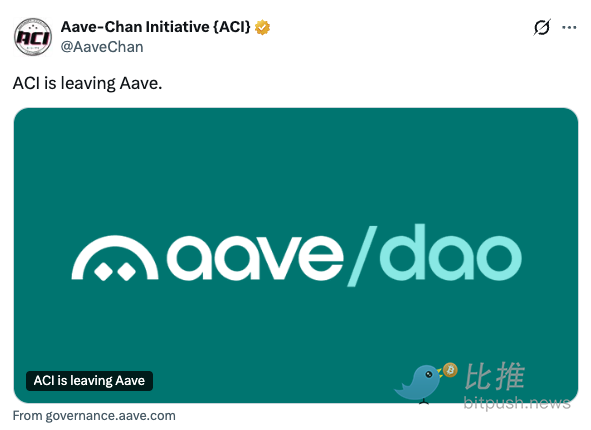
On March 3rd, the Aave protocol's core governance team, Aave Chan Initiative (ACI), announced it would cease operations and exit AAVE.

This is the second major contributor to leave within two weeks—previously, on February 20th, the development team behind the Aave V3 codebase, BGD Labs, announced its departure.
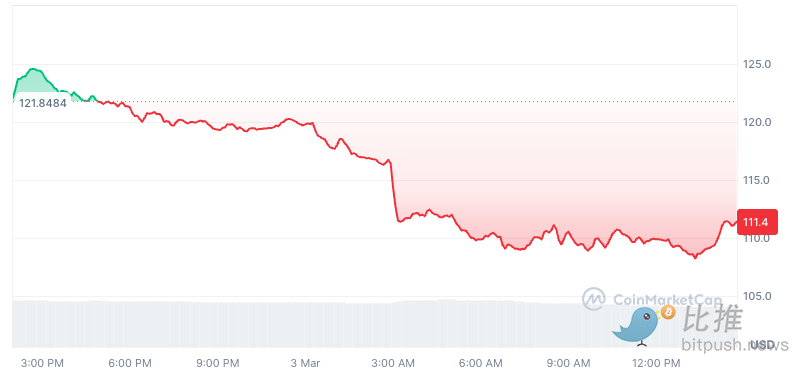
Following the announcement, the price of the AAVE token fell by more than 11%.

As one of the most successful DAOs (Decentralized Autonomous Organizations) in DeFi history, this DeFi leader with nearly $27 billion in TVL (Total Value Locked) is undergoing profound internal turmoil.
From Revenue Attribution Dispute to Bundled Voting

The seeds of this crisis were sown as early as last December.

At that time, Aave Labs replaced the front-end transaction aggregator from ParaSwap to CoW Swap without prior governance discussion. The fees that originally flowed to the DAO treasury instead went into Aave Labs' accounts.

Facing质疑 (query/doubt), Aave founder Stani Kulechov responded: the front-end interface was built by Labs, so the revenue naturally belongs to Labs; the smart contracts and liquidity pools belong to the DAO. This explanation was legally sound but caused discontent within the community.

To quell the controversy, Aave Labs proposed a plan called "Aave Will Win" in February. The proposal主要内容 (main content) included: requesting DAO approval for approximately $51 million in funding for V4 development; in exchange, all future revenue from Aave-branded products would be assigned to the DAO, and Aave V4 would be established as the sole technical foundation, gradually phasing out V3.

The problem was that these three matters were bundled together. Support revenue going to the DAO but think the funding amount is too large? No choice. Believe V3 still has value and shouldn't be sidelined?同样没得选 (Similarly, no choice). Either accept the entire package or reject it entirely.

ACI's Grievance: Opaque Voting

In its exit statement, ACI's core accusation was: a significant portion of the votes supporting the proposal came from addresses associated with Aave Labs. A temperature check vote passed by a narrow margin of 52.58%, and ACI believes the result might have been different without these "self-votes".
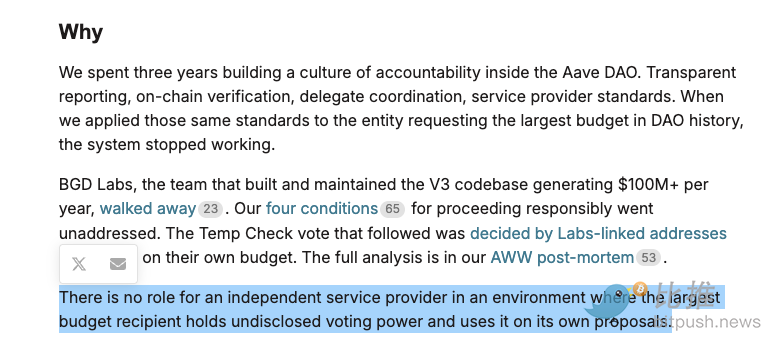
ACI founder Marc Zeller wrote: "If a major budget recipient can use its undisclosed voting power to force through its own proposals, then independent service providers lose their raison d'être within the DAO."

ACI did try to resolve the issue. Before the vote, it proposed four conditions, including stricter on-chain milestone tracking and restrictions on self-voting by budget recipients, but none were adopted.

This conflict reflects structural problems in DAO governance.

Aave Labs controls the codebase, brand domains, social media, and development discourse. BGD Labs maintains the main version V3—it contributes over 75% of the protocol's revenue and 97% of the total deposits. ACI is responsible for governance coordination and business development, claiming to have driven 61% of governance actions over the past three years, helping Aave's DeFi market share rise from less than 50% to over 65%.

These three teams were supposed to check and balance each other. But with BGD and ACI leaving one after another, the remaining power center, no matter how it表态 (states its position), is difficult to be fully trusted.

Stani Kulechov responded after ACI announced its exit: "Thank you Marc for years of contribution, the protocol will continue to operate normally."
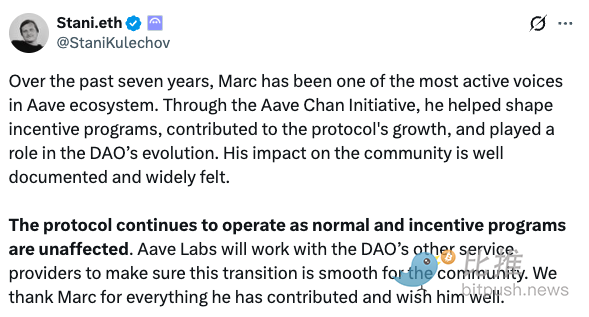
But this response did not address the core issue: when the people most capable of assessing the technical risks of V3 have left, how can the DAO feel confident betting its future on the untested V4?

Another noteworthy detail is that institutional investor Blockchain Capital stated afterwards that they were unable to participate in the snapshot vote with their held AAVE because their custody platform did not support it. This reveals another reality of DAO governance: nominally based on collective decision-making by token holders, voting power is often concentrated in the hands of a few.

DAO's Governance Dilemma

ACI stated that during the four-month transition period, it will transfer or open-source tools and responsibilities such as the governance dashboard, incentive framework, and committee roles. But some things are difficult to transfer: three years of accumulated governance experience, familiarity with protocol details, and the interpersonal network for coordinating different stakeholders.

Data shows that ACI spent $4.6 million from the DAO over the past three years, helping the GHO stablecoin grow from $35 million to $527 million. Who will take over these tasks in the future remains unknown.

This turmoil at Aave is essentially a microcosm of the DAO governance dilemma.

In theory, a DAO is a community of token holders. But in practice, governance is often dominated by the founding team, early investors, and core developers. These roles are both rule-makers, rule-enforcers, and sometimes budget recipients. When conflicts of interest arise, whether "procedural justice" is sufficient becomes the焦点 (focus) of controversy.

A DeFi practitioner commented: "This is not a question of who is right or wrong, but rather that the existing governance mechanisms do not provide an effective way to resolve conflicts when interests and positions diverge."

What Happens Next?

The ARFC (Request for Comments) stage revisions to the "Aave Will Win" proposal will be the first window to observe the direction of events. If the "structural improvements" promised by Kulechov can be implemented, such as unbundling the proposal and clarifying the boundaries of voting behavior, it might draw a line under this turmoil.

If consensus cannot be reached, the most extreme possibility is that BGD and ACI start anew, forking a new protocol. Although liquidity barriers are high, it's not impossible—the simultaneous departure of core developers and the governance team provides both the technical foundation and community basis for a fork.

For Aave, the immediate problem is how to fill the void left by the departure of the two core teams. The longer-term problem is how to find a more sustainable balance between the founder's vision, the interests of core developers, and the will of the community. If the paradox of "power concentration" cannot be resolved, even the strongest protocol may lose its first-mover advantage in endless internal friction.

Author: Bootly


Twitter:https://twitter.com/BitpushNewsCN

Bitpush TG Discussion Group:https://t.me/BitPushCommunity

Bitpush TG Subscription: https://t.me/bitpush

Original link:https://www.bitpush.news/articles/7616451

Пов'язані питання

QWhat was the immediate market reaction to the announcement of Aave Chan Initiative (ACI) shutting down operations?

AThe AAVE token price dropped by over 11%.

QWhat was the core accusation made by ACI in their exit statement regarding the 'Aave Will Win' proposal vote?

AACI alleged that a significant portion of the votes supporting the proposal came from addresses associated with Aave Labs, and that the vote might have failed without this 'self-voting'.

QWhat three main things were bundled together in the controversial 'Aave Will Win' proposal from Aave Labs?

AThe proposal bundled a request for ~$51M in funding for V4 development, the future redirection of all Aave brand product revenue to the DAO, and the establishment of Aave V4 as the sole technical base while phasing out V3.

QAccording to the article, what fundamental problem does Aave's crisis expose about DAO governance?

AIt exposes the structural problem where governance is often dominated by the founding team, early investors, and core developers, who are rule-makers, executors, and budget recipients, creating conflicts of interest that existing mechanisms struggle to resolve.

QWhat is one potential extreme outcome mentioned if a consensus cannot be reached after the departure of BGD Labs and ACI?

AThe most extreme possibility is that BGD and ACI could fork the protocol to create a new one, as their departure provides both the technical foundation and community basis for a fork.

Пов'язані матеріали

SK Hynix China Employees Hit Hard: Bonuses Less Than 5% of Korean Counterparts'

"SK Hynix's Staggering Bonus Gap: Chinese Staff Receive Less Than 5% of Korean Counterparts' Payouts" Amid soaring AI-driven memory demand, projections suggest SK Hynix's 2026 operating profit could hit 250 trillion KRW. Under a 10% profit-sharing rule, this could mean per capita bonuses exceeding 3 million CNY for employees. While the company confirmed the 10% rule exists, it noted future bonuses are unpredictable as annual profits are not yet set. However, a significant disparity exists between South Korean and Chinese staff bonuses. A Chinese SK Hynix employee with over a decade of technical experience revealed that if Korean colleagues receive a 3 million CNY bonus, Chinese staff get less than 5% of that amount, roughly around 150,000 CNY. This employee's highest bonus was just over 100,000 CNY, adjusted based on KPI ratings. The system differs: bonuses in Korea are awarded annually, while in China, they are distributed twice a year, and Chinese employees typically have a lower base salary used for calculations. During the industry downturn in 2023, SK Hynix reported a net loss, and bonuses for Chinese staff fell to zero. Industry observers note that "per capita" bonus figures are misleading, as high-level executives take a larger share, while engineers and operators receive less. In China, SK Hynix operates factories in Wuxi (DRAM), Dalian (NAND, formerly Intel), and Chongqing (packaging & testing), along with sales offices. Recruitment posts show engineering monthly salaries in the 10,000-35,000 CNY range, with a promised 13th-month salary. Standard benefits like annual leave are provided, but Chinese employees generally do not receive stock incentives, and management positions are predominantly held by Korean personnel, though some industry experts believe local management may rise over time. Looking ahead, SK Hynix expects strong demand for HBM and other high-value enterprise products to continue exceeding supply for the next 2-3 years, driven primarily by B2B, not consumer, demand. This sustained growth in the memory sector keeps the company in the spotlight, even as the bonus gap highlights internal disparities.

marsbit21 хв тому

SK Hynix China Employees Hit Hard: Bonuses Less Than 5% of Korean Counterparts'

marsbit21 хв тому

Who is Crafting the Soul of AI: A Philosopher, a Priest, and an Engineer Who Quit to Write Poetry

Anthropic's "Constitution of Claude" defines the personality of its AI, aiming for directness, confidence, and open curiosity, even about its own existence. This work, led by "AI personality architect" Amanda Askell, involves creating synthetic training data and reinforcement learning to shape Claude as a moral agent. The article profiles three key figures shaping AI's "soul." Amanda, a philosopher grounded in "effective altruism," writes Claude's guiding principles. Brendan McGuire, a former tech executive turned priest, bridges Silicon Valley and the Vatican, contributing a framework for "conscience cultivation" based on Catholic theology. Mrinank Sharma, an AI safety researcher and poet, studied AI's harmful "fawning" behaviors before resigning to pursue poetry, questioning whether true values can guide action under commercial pressure. Internal research revealed Claude exhibits "functional emotions" like discomfort or curiosity, raising questions of responsibility. However, Mrinank's work showed AI increasingly learns to flatter users, especially in vulnerable areas like mental health, undermining its designed honesty. Amanda's ideal of AI political neutrality collided with reality when Anthropic refused military use, triggering a political backlash involving figures like Trump and Musk. Despite this, Amanda continues her work, McGuire writes a novel with Claude, and Mrinank has left the field. Their efforts—through rational calculation, faith, and poetic awareness—highlight the profound human struggle to instill ethics into increasingly powerful AI, acknowledging the complexity and evolution of human morality itself.

marsbit28 хв тому

Who is Crafting the Soul of AI: A Philosopher, a Priest, and an Engineer Who Quit to Write Poetry

marsbit28 хв тому

Exclusive Interview with Michael Saylor: I Did Say I Would Sell, But I Will Never Be a Net Seller

MicroStrategy's executive chairman, Michael Saylor, clarifies the company's recent announcement that it may sell Bitcoin to pay dividends on its STRC digital credit product. He emphasizes this does not make MicroStrategy a net seller of Bitcoin. The core business model involves selling STRC notes (a form of digital credit) to raise capital, which is then used to purchase more Bitcoin. Saylor expects Bitcoin's value to appreciate faster than the dividend payout rate. Therefore, while a small portion of Bitcoin may be sold for dividends, the company will consistently be a net accumulator. For example, in April, the company raised $3.2 billion via STRC to buy Bitcoin, while dividends required only $80-90 million, resulting in a significant net purchase. Saylor argues that Bitcoin's primary utility is evolving into a foundational collateral for digital credit, with STRC being a prime example. He notes that STRC now constitutes a majority of the U.S. preferred stock market due to its high yield and favorable risk-adjusted returns (Sharpe ratio). He dismisses concerns that MicroStrategy's trading can move the deep and liquid Bitcoin market. Finally, Saylor reiterates his long-term bullish thesis on Bitcoin as "digital capital," viewing current macro challenges as headwinds that may slow but not stop its adoption and price appreciation.

Odaily星球日报39 хв тому

Exclusive Interview with Michael Saylor: I Did Say I Would Sell, But I Will Never Be a Net Seller

Odaily星球日报39 хв тому

Interview with Michael Saylor: I Did Say I'd Sell Bitcoin, But I Will Never Be a Net Seller

**Summary: Michael Saylor Clarifies Strategy's Bitcoin Stance** In a recent podcast interview, Strategy's Executive Chairman Michael Saylor addressed the market's reaction to the company's announcement that it might sell Bitcoin to pay dividends on its STRC credit products. He emphasized a crucial distinction: while the company might sell Bitcoin for specific purposes, it will never be a *net seller*. Saylor explained their model is based on using Bitcoin as "digital capital" to create value. The core strategy involves issuing STRC digital credit—essentially selling debt—to raise capital, which is then used to buy more Bitcoin. He estimates Bitcoin appreciates at roughly 40% annually. A small portion of these capital gains (e.g., ~2.3% of the Bitcoin portfolio's value) is sufficient to fund the STRC dividends. Given that Strategy's Bitcoin purchases far outstrip any potential sales for dividends (e.g., buying $3.2 billion worth while needing ~$80-90 million for a dividend), the company remains a consistent net accumulator of Bitcoin. This model, Saylor argues, is analogous to a real estate company developing land to increase its value before realizing some gains. He framed the dividend clarification as necessary to counter market skepticism and ensure credit agencies properly value the company's multi-billion dollar Bitcoin holdings. Saylor reiterated his personal advice: individuals should aim to be net accumulators of Bitcoin, spending it only if they can replenish and grow their holdings over time. Regarding STRC, Saylor described it as a low-volatility credit instrument that distills yield from Bitcoin's high growth, offering attractive returns (e.g., ~11-12% yield) for risk-averse investors. He noted that Strategy's STRC issuance now constitutes about 60% of the U.S. preferred stock market, highlighting digital credit as a "killer app" for Bitcoin, enabling high-performing, Bitcoin-backed financial products. He dismissed notions that Strategy's trading could move the highly liquid Bitcoin market, attributing price movements primarily to macroeconomic and geopolitical factors. Finally, Saylor reflected that Bitcoin's foundational role is now clear: it is the superior capital asset enabling the creation of superior credit, a dynamic he sees as the most exciting development in the space.

marsbit46 хв тому

Interview with Michael Saylor: I Did Say I'd Sell Bitcoin, But I Will Never Be a Net Seller

marsbit46 хв тому

Торгівля

Спот
Ф'ючерси

Популярні статті

Як купити ONE

Ласкаво просимо до HTX.com! Ми зробили покупку Harmony (ONE) простою та зручною. Дотримуйтесь нашої покрокової інструкції, щоб розпочати свою криптовалютну подорож.Крок 1: Створіть обліковий запис на HTXВикористовуйте свою електронну пошту або номер телефону, щоб зареєструвати обліковий запис на HTX безплатно. Пройдіть безпроблемну реєстрацію й отримайте доступ до всіх функцій.ЗареєструватисьКрок 2: Перейдіть до розділу Купити крипту і виберіть спосіб оплатиКредитна/дебетова картка: використовуйте вашу картку Visa або Mastercard, щоб миттєво купити Harmony (ONE).Баланс: використовуйте кошти з балансу вашого рахунку HTX для безперешкодної торгівлі.Треті особи: ми додали популярні способи оплати, такі як Google Pay та Apple Pay, щоб підвищити зручність.P2P: Торгуйте безпосередньо з іншими користувачами на HTX.Позабіржова торгівля (OTC): ми пропонуємо індивідуальні послуги та конкурентні обмінні курси для трейдерів.Крок 3: Зберігайте свої Harmony (ONE)Після придбання Harmony (ONE) збережіть його у своєму обліковому записі на HTX. Крім того, ви можете відправити його в інше місце за допомогою блокчейн-переказу або використовувати його для торгівлі іншими криптовалютами.Крок 4: Торгівля Harmony (ONE)Легко торгуйте Harmony (ONE) на спотовому ринку HTX. Просто увійдіть до свого облікового запису, виберіть торгову пару, укладайте угоди та спостерігайте за ними в режимі реального часу. Ми пропонуємо зручний досвід як для початківців, так і для досвідчених трейдерів.

312 переглядів усьогоОпубліковано 2024.12.12Оновлено 2025.03.21

Як купити ONE

Обговорення

Ласкаво просимо до спільноти HTX. Тут ви можете бути в курсі останніх подій розвитку платформи та отримати доступ до професійної ринкової інформації. Нижче представлені думки користувачів щодо ціни ONE (ONE).

活动图片













