Convicted FTX CEO SBF Cries ‘Biden Lawfare’ In Trump Pardon Pitch

bitcoinistОпубліковано о 2026-02-10Востаннє оновлено о 2026-02-10

Анотація

Sam Bankman-Fried (SBF) claimed in a February 9th X thread that his criminal conviction was part of "Biden’s political lawfare," comparing his case to those of Donald Trump and former FTX executive Ryan Salame in what many interpreted as a direct appeal for a future pardon. He argued that the Biden administration and the DOJ brought bogus charges and prevented him from presenting evidence, specifically claiming the court "gagged" him and hid proof that FTX was solvent and that no money was stolen. SBF criticized Judge Lewis Kaplan, who also presided over a Trump case, for rubber-stamping DOJ requests and imposing a gag order. He drew parallels between his pretrial detention and Trump's legal battles. The thread was widely seen as a political maneuver rather than a legal argument, with critics accusing him of angling for a pardon from Trump.

Sam Bankman-Fried (SBF) used a new X thread on Feb. 9 to reframe his criminal case as “Biden’s political lawfare,” positioning himself alongside Donald Trump and former FTX executive Ryan Salame in what read like a direct appeal for a future pardon.

“Biden’s lawfare machine threw bogus charges at me, Donald Trump, Ryan Salame, etc.,” Bankman-Fried wrote. “To make the charges stick, they prevented us from even being allowed to respond.” He opened with a blunt claim about process rather than facts: “Rule No. 1 of Biden’s political lawfare: Don’t let them present evidence.”

SBF Cries ‘Gagged Trial,’ Claims DOJ Hid Evidence

SBF’s argument hinges on the idea that authorities and the court curtailed what the jury could hear. He repeatedly singled out Judge Lewis Kaplan, who presided over his trial, claiming the court “rubber-stamped everything Biden’s DOJ wanted” and “made sure I couldn’t show the jury the truth.”

The “truth,” as SBF cast it, is a solvency narrative: “So they lied, said I stole billions of dollars and bankrupted FTX. But the money was always there and FTX was always solvent.” He also argued that restrictions prevented him from advancing that line at trial, writing that he was “prohibited” from “pointing out FTX was solvent” and from “even mentioning lawyers.”

In the thread, SBF linked to a court filing he said was authored by his prosecutor, “Sassoon,” describing it as “a 70-page document on all the evidence they didn’t want the jury to see,” and he framed the episode as part of a broader political effort to “silence the truth.”

A significant chunk of the thread is dedicated to Trump’s New York hush-money bookkeeping case, which Bankman-Fried portrayed as a routine classification dispute blown into criminality. “Charged him with 34 crimes over his bookkeeping of an NDA expense—should it be legal, campaign, or personal?,” he wrote. “These questions come up all the time when you’re running a business, and it’s often unclear.”

He then drew a parallel between court-imposed limits on Trump and his own pre-trial detention. “They then got the judge to impose a gag order on Donald Trump,” he wrote. “Biden’s DOJ silenced me, too—getting Judge Kaplan to gag and then jail me before trial. President Trump also had Kaplan as a judge.”

Bankman-Fried also amplified Salame’s complaints about licensing advice and charging decisions, alleging prosecutors leaned on pressure tactics to force a plea, including claims involving Salame’s fiancée, assertions presented as fact in the thread but not accompanied by supporting documentation beyond links to Salame’s posts.

The reaction underneath was unsparing, with multiple industry figures interpreting the thread less as a legal critique than a political pitch. “You’re a Delusional criminal who is now angling for a pardon,” wrote trader Bob Loukas. Attorney Ariel Givner was even more direct: “We GET it. You want a pardon from Trump.”

At press time, FTT traded at $0.3021.
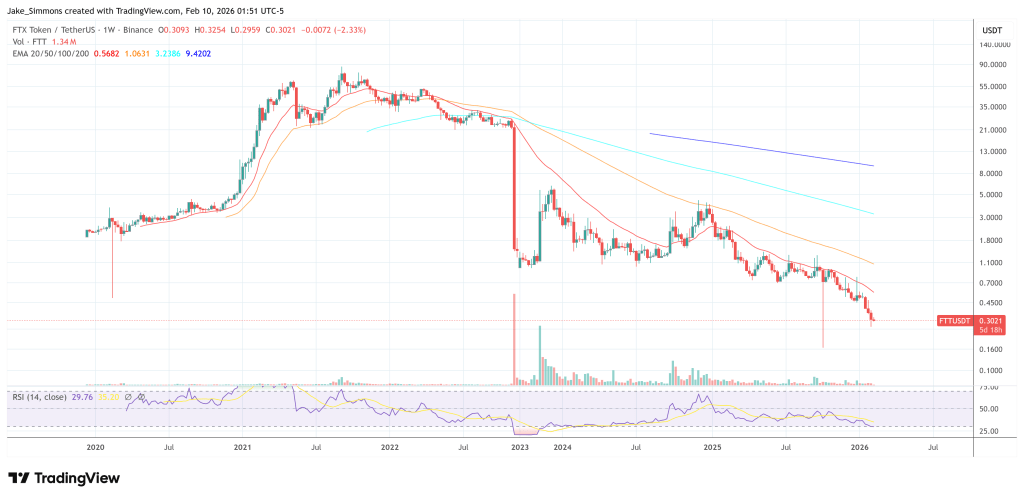
FTT continues its freefall, 1-week chart | Source: FTTUSDT on TradingView.com

Пов'язані питання

QWhat is the main argument in his recent X thread regarding his criminal case?

AHe argues that his criminal case is 'Biden's political lawfare,' claiming the Biden administration prevented him from presenting evidence and responding to the charges.

QWho did SBF specifically single out as being responsible for curtailing what the jury could hear in his trial?

AHe singled out Judge Lewis Kaplan, claiming the judge 'rubber-stamped everything Biden's DOJ wanted' and ensured he 'couldn't show the jury the truth.'

QWhat does SBF claim was the 'truth' about FTX that he was prevented from presenting in court?

AHe claims the 'truth' was that 'the money was always there and FTX was always solvent,' and he was prohibited from pointing this out or even mentioning lawyers.

QHow does SBF attempt to draw a parallel between his own case and that of former President Donald Trump?

AHe draws a parallel by claiming both were subjected to Biden's 'lawfare machine,' faced gag orders and pre-trial detention, and were prevented from presenting evidence, noting that Trump also had Judge Kaplan in one of his cases.

QHow did some industry figures interpret SBF's thread, according to the article?

AIndustry figures like trader Bob Loukas and attorney Ariel Givner interpreted it less as a legal critique and more as a political pitch, specifically an attempt to angle for a pardon from Donald Trump.

Пов'язані матеріали

Will the Next Crypto Bull Run Start with On-Chain Trading of SpaceX?

This article presents a scenario-based forecast for the crypto industry from 2026 to 2029, arguing that the next major cycle will be driven not by technological narratives but by legal access to real-world assets. The author predicts that by mid-2026, pre-IPO perpetual contracts for top private companies like SpaceX, OpenAI, and Anthropic on platforms like Hyperliquid will become the primary gateway for accessing quality assets, as most crypto-native tokens fail to capture real value. The much-hyped AI x Crypto intersection largely fails except for prediction markets, which thrive on betting on AI model supremacy. By 2027, public blockchain foundations are forced to choose between catering to retail speculation or building compliant infrastructure for institutions, with many opting for the latter. Growth in stablecoins and tokenized private credit/equity hits a "triple ceiling" due to regulatory and political uncertainty rather than market demand. The pivotal shift is forecast for 2028. A major liquidation event in pre-IPO perpetuals exposes the structural flaw of synthetic markets lacking a real underlying asset anchor. In response, regulatory changes finally allow the public solicitation of private securities resales to verified accredited investors. This creates a legitimate secondary market for real company equity, which then becomes the core asset class of the new bull market, relegating synthetic perps to a niche role. By 2029, the industry becomes "boring" but foundational. Tokens without claims on real cash flows or assets cease trading. Stablecoin growth is steady but politically capped. Crypto infrastructure fades from view as it gets absorbed into traditional finance backends. The article's central thesis is that the key bottleneck for crypto's next phase is legal and regulatory channels for real asset ownership, not technology.

marsbit1 год тому

Will the Next Crypto Bull Run Start with On-Chain Trading of SpaceX?

marsbit1 год тому

The Value Distribution of Stablecoins

**Summary: The Value Distribution of Stablecoins** The article argues that stablecoins are evolving from mere trading tools into broader channels for dollar access. It divides the stablecoin ecosystem into four layers to analyze how value is distributed: 1. **Issuance Layer:** Mints stablecoins, holds reserve assets, and captures the spread between reserve yield and user costs (e.g., Tether, Circle). This layer currently earns the largest profit margin. 2. **Infrastructure Layer:** Connects stablecoins to the traditional financial system, handling fiat on/off-ramps, banking integration, compliance (KYC/AML), and asset management (e.g., Bridge, BVNK). This is the "unglamorous" but critical work, building the essential bridges between crypto and real-world finance. 3. **Acquiring/Distribution Layer:** Integrates stablecoins into merchant systems, manages payment flows, and provides enterprise financial software (e.g., Stripe, Coinbase). They act as the access point for businesses. 4. **Application Layer:** The end-users and businesses that ultimately use stablecoins for payments, settlements, or as a store of value. They benefit from convenience but have little pricing power. The core thesis is that while the issuance layer currently dominates profits, the often-overlooked **infrastructure layer holds significant long-term potential**. The real challenge and barrier to mass adoption is not the on-chain transfer of stablecoins (which is simple), but the complex "last mile" integration into existing business workflows, banking systems, and regulatory frameworks across different countries. Companies in this layer are currently in a "land grab" phase, investing heavily to build networks, secure bank partnerships, and establish compliance pathways. While their position is currently pressured by the profitable issuers above and distribution platforms below, the article suggests that if stablecoins become a default financial rail for businesses, the infrastructure providers who have done the hard work of integration will ultimately gain strong pricing power and become entrenched, essential players.

marsbit7 год тому

The Value Distribution of Stablecoins

marsbit7 год тому

The Value Distribution of Stablecoins

The Value Distribution of Stablecoins The article argues that stablecoins are evolving from a mere trading tool into a broad "dollar channel." It analyzes the industry's value chain through four layers: 1. **Issuance Layer (e.g., Tether, Circle):** The top layer that mints stablecoins, holds reserve assets, and captures the thickest interest rate spread. 2. **Infrastructure Layer (e.g., Bridge, BVNK):** Connects stablecoins to the traditional financial system, handling critical but complex "dirty work" like fiat on/off-ramps, banking integration, compliance (KYC/AML), and cross-border settlement. 3. **Acquiring/Distribution Layer (e.g., Stripe, Coinbase):** Embeds stablecoins into merchant systems, manages payment flows, and integrates with enterprise software. 4. **Application Layer:** End-users and businesses that ultimately use stablecoins for payments, settlement, or storing value. The author posits that while the issuance layer currently captures the most profit, the most overlooked and potentially critical layer is infrastructure. The core challenge for stablecoin adoption isn't the on-chain transfer (which is simple), but bridging the gap between blockchain and the real-world financial system. This involves solving practical problems for businesses: fiat conversion, reconciliation, tax handling, and user onboarding. Infrastructure companies are currently in a difficult "land-grab" phase—building networks, securing banking relationships, and achieving compliance country-by-country. They face pressure from both the profitable issuance layer above and distribution platforms below. However, the author suggests this layer is building a crucial moat. Once stablecoins become a default business rail, the infrastructure players who have done the hard work of integration may gain significant, durable value and pricing power.

链捕手8 год тому

The Value Distribution of Stablecoins

链捕手8 год тому

Торгівля

Спот
Ф'ючерси
活动图片





