Contract Audit Passed, Thermometer Did Not: Polymarket's 'Physical Vulnerability' Moment

marsbitОпубліковано о 2026-04-23Востаннє оновлено о 2026-04-23

Анотація

According to reports, an individual manipulated temperature sensors at Paris Charles de Gaulle Airport (LFPG) on April 6th and 15th, causing brief, anomalous spikes of over 3°C. These events were allegedly orchestrated to profit from corresponding low-probability bets on the prediction market Polymarket, turning a small investment into approximately $34,000. The French national meteorological service, Météo-France, filed a criminal lawsuit after discovering signs of physical tampering. The attack required minimal technical skill; the perpetrator reportedly used a battery-powered hairdryer to briefly heat the publicly accessible sensor. Polymarket’s market for Paris temperature settles based on the day's highest recorded temperature from a data chain that runs from the physical sensor to Météo-France, to Weather Underground, and finally to its smart contract. In response, Polymarket did not void the profits or make an official statement. It silently changed the data source for its Paris market from LFPG to Le Bourget Airport (LFPB), a location with similarly unprotected sensors. This incident highlights a critical vulnerability: while the smart contracts are audited and secure, the physical data sources feeding them remain exposed and easy to manipulate.

Original Author: Sanqing, Foresight News

According to French media Le Monde, on April 6th and 15th, the meteorological sensors at Paris Charles de Gaulle Airport experienced two anomalies. The temperature surged by more than 3°C within minutes before quickly returning to normal, as if nothing had happened. Behind each anomaly, someone had placed bets on the corresponding low-probability temperature range on Polymarket in advance. From a principal of just tens of dollars, they collectively walked away with approximately $34,000 from these two incidents. The account that placed the first bet was created just two days before the anomaly occurred.
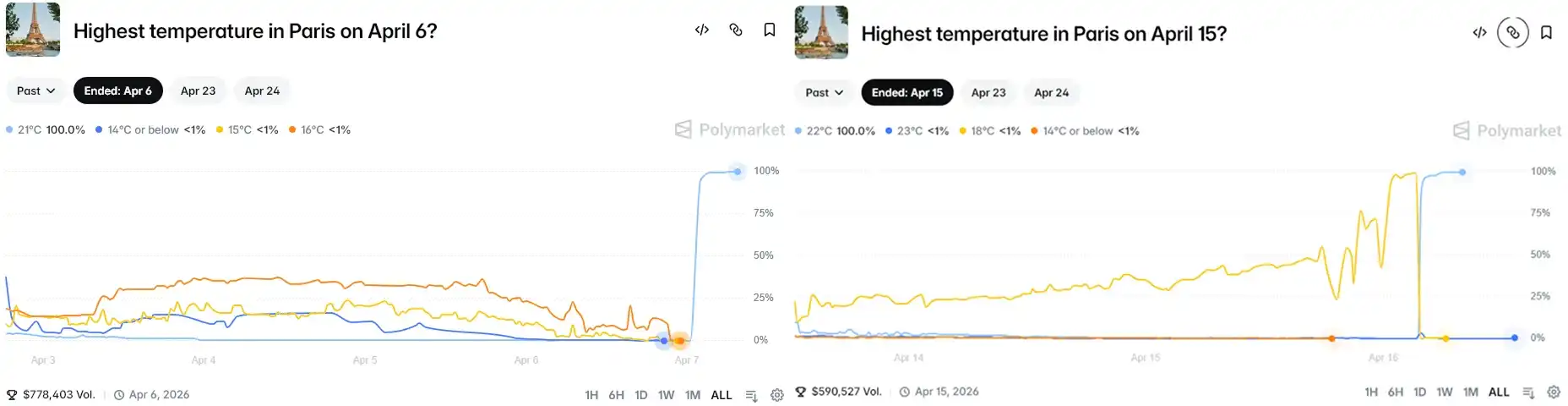
Météo-France subsequently conducted a physical inspection of the sensors and found signs of human intervention. They filed a criminal complaint with the Charles de Gaulle Airport Gendarmerie, with the charge being "interfering with an automated data processing system." According to an analysis in an AR15 forum post, based on Article 323-2 of the French Penal Code, and because Météo-France is a public institution, the related charges could carry a maximum penalty of 7 years imprisonment and a fine of 300,000 euros.

The Technical Sophistication of This Scam Is Approximately Zero

The settlement chain for Polymarket's Paris temperature market is as follows: Physical Sensor → Météo-France → Weather Underground → Polymarket Contract.

On this chain, the smart contract part is audited, data transmission is automated, and Weather Underground's data scraping is real-time. The only weak point is at the very beginning: a thermometer standing by the airport roadside, without fencing, without cameras, accessible to anyone who walks by.

All the attacker needed was a battery-powered heat gun/hairdryer.

Polymarket bases its settlement on the day's maximum temperature. This means that creating one brief temperature peak is enough to rewrite the official record for the day.

Acting in the evening or at night is more ideal, as the daytime high has usually already passed, making subsequent readings more likely to become the new record. Therefore, the suspect chose 7 PM on April 6th and 9:30 PM on April 15th.

The operational procedure was likely: buy the low-probability option in advance, walk to the sensor at night, turn on the heat gun, wait for the reading to cross the target temperature, stop, leave, and wait for on-chain settlement.

The entire operation required no technical skill whatsoever, just some understanding of the settlement mechanism and a willingness to walk to the edge of the airport.

Polymarket's Response: Quietly Swapped the Thermometer

Polymarket has not issued any official statement regarding this incident. The only thing it did was change the settlement data source for the Paris temperature market from Charles de Gaulle Airport (LFPG) to Le Bourget Airport (LFPB).
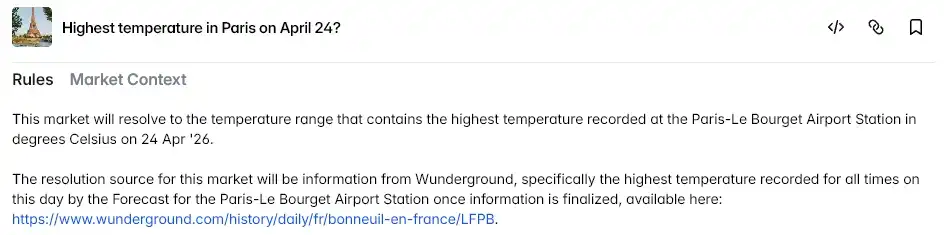
The profits from the two accounts were not revoked; the market settled normally according to the on-chain records.

The sensor at Le Bourget Airport is also placed outdoors, similarly without physical protection. They changed the address, but the problem remains entirely unchanged.

This is not Polymarket's first controversy. In October 2024, a French trader was accused of manipulating Trump election odds using 4 linked accounts, reportedly profiting $85 million; in March 2025, a whale used 5 million tokens to forcibly push through a UMA governance vote, settling a controversial market with a "Yes" outcome, involving $7 million; in January and March 2026, anomalous bets appeared in markets related to Venezuela and Iran respectively, with the latter already drawing attention from the US Congress...

Previous incidents at least required millions of dollars in capital or governance tokens; this time the cost was just a heat gun.

The Contract Was Audited, The Thermometer Was Not

This story has an absurd sense of humor. A prediction market running on the blockchain, touting decentralization and immutability, was thoroughly exploited twice by a battery-powered heat gun. Cryptography was of no help in this matter because it never verifies whether the input data is real.

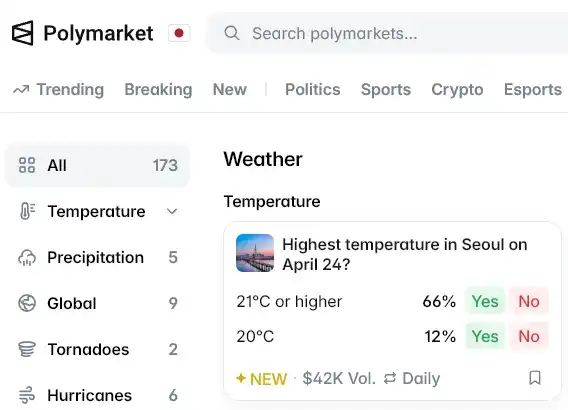
Polymarket currently has 173 active weather markets. The settlement basis for most of these markets is a single physical sensor in some location.
When a sensor is used as a meteorological tool, its credibility comes from the fact that no one has a motive to tamper with it. Polymarket gave it a new incentive structure but provided no new physical protection.

The Météo-France thermometer dutifully recorded the temperature it sensed. It just didn't know it had become a financial settlement terminal.


Пов'язані питання

QWhat was the key vulnerability exploited in the Polymarket Paris temperature market incident?

AThe physical vulnerability of the meteorological sensor at Charles de Gaulle Airport, which was unprotected and could be easily manipulated with a simple tool like a battery-powered hairdryer.

QHow did the attackers profit from manipulating the temperature sensor?

AThey placed bets on low-probability temperature ranges on Polymarket just before artificially spiking the temperature, turning a small investment of tens of dollars into approximately $34,000 in profits across two incidents.

QWhat was Polymarket's response to the temperature manipulation incidents?

APolymarket did not issue an official statement or reverse the profits. They silently changed the data source for the Paris temperature market from Charles de Gaulle Airport (LFPG) to Le Bourget Airport (LFPB), which had the same physical vulnerability.

QWhat legal consequences might the perpetrators face according to the article?

AUnder French law, specifically Article 323-2, and because Météo-France is a public institution, the charges for interfering with an automated data processing system could result in up to 7 years in prison and a €300,000 fine.

QWhat does the incident reveal about the limitations of blockchain-based prediction markets like Polymarket?

AIt highlights that while smart contracts are audited and the blockchain is secure, the system remains vulnerable if the real-world data inputs (oracles) are not physically secure and can be easily manipulated, undermining the integrity of the market.

Пов'язані матеріали

Qualcomm: AI Hype Subsides, When Will Smartphones Emerge from the Gloom?

Qualcomm reported its Q3 FY2026 results (ending June 2026), with revenue of $9.95B, down 4% YoY but above expectations. Gross margin declined to 53.1%, pressured by rising costs across manufacturing and memory. Key business segments showed mixed performance: Handset revenue fell 19.6% YoY to $5.09B, dragged by an 11% decline in non-Apple Android shipments and weaker high-end mix. Conversely, Automotive revenue surged 61% to $1.59B, and IoT grew 9% to $1.83B. Core operating profit dropped 41% YoY due to margin compression and higher expenses. Management's Q4 FY2026 guidance projects revenue of $9.7B-$10.5B, in line with consensus, but Non-GAAP EPS guidance of $2.05-$2.25 fell short of expectations. Amidst persistent weakness in its core handset market, Qualcomm is pursuing growth in AI, focusing on Edge AI (smartphones, PCs, automotive) and Data Center AI. Its data center strategy includes four pillars: AI accelerators (e.g., AI200), commercial CPUs (Dragonfly C1000), custom silicon, and connectivity solutions. While these initiatives initially boosted its stock, concerns over AI capital expenditure sustainability have since erased those gains. The company targets $5B in data center revenue for FY2027 and $15B for FY2029. The report concludes that with the traditional handset business still under pressure, the data center opportunity is currently viewed as a longer-term option, and a more conservative valuation based on core operations may be warranted until AI contributions materialize.

marsbit2 хв тому

Qualcomm: AI Hype Subsides, When Will Smartphones Emerge from the Gloom?

marsbit2 хв тому

From TPU to Self-Evolving Agents: How Jeff Dean Predicts the Next Step in AI

At the 2026 YC Startup School, Jeff Dean outlined his vision for AI's next phase, shifting focus from simply scaling models to building intelligent, autonomous systems. He believes AI's progress is no longer just about creating smarter models, but about integrating them into systems capable of long-term, iterative work, automated experimentation, and continuous learning. This evolution moves the competition from "who has the bigger model" to "who can best organize intelligence." Dean suggests AI capabilities are now comparable to a junior engineer, enabling the automation of complex workflows. However, the true challenge and opportunity lie in managing these AI "workers" at scale. He emphasizes the importance of **context engineering**—structuring tools, memory, and feedback loops—over raw model power. For startups, this means building deep expertise in niche domains where general models currently fail (near 0-1% success rates), leveraging proprietary data, specialized tools, and domain-specific evaluators. A recurring theme is re-examining fundamental constraints. Dean's past work, like moving Google's search index to memory or creating the TPU, stemmed from questioning outdated assumptions about hardware and cost. He sees similar inflection points today, particularly in **specialized inference hardware** to drastically reduce latency and energy consumption for real-time Agent operation. Notably, he points out that in modern AI systems, the dominant cost is often not computation but **data movement**. Reliable, long-running Agents require robust system design, borrowing concepts from distributed computing like checkpointing, state management, and parallel exploration to handle failures and maintain progress over days or weeks. As AI automates execution, the scarcest human skills will shift to **defining clear specifications**, **judging what problems are worth solving** (taste), and designing effective feedback loops. Ultimately, Dean's framework prioritizes understanding the problem deeply, identifying the true bottlenecks, and systematically building closed-loop systems where AI can not only perform tasks but also improve AI itself.

marsbit3 хв тому

From TPU to Self-Evolving Agents: How Jeff Dean Predicts the Next Step in AI

marsbit3 хв тому

Торгівля

Спот
活动图片




