Consumer Confidence Hits Bottom, Macro Correlations Simultaneously Break Down: How Much Longer Can the U.S. Stock Market's Solo Rally Last?

marsbitОпубліковано о 2026-05-28Востаннє оновлено о 2026-05-28

Анотація

The U.S. stock market is exhibiting a rare divergence: while consumer confidence hits historic lows and traditional macro asset correlations break down, major indices like the Nasdaq 100 and S&P 500 continue reaching record highs, fueled primarily by AI and semiconductor momentum. The rally is now highly concentrated, with strength rotating from giants like Nvidia to higher-beta plays within semiconductors, particularly memory chips. This surge occurs despite a significant split between pessimistic consumer sentiment and still-resilient actual spending behavior, partially supported by fiscal stimulus. Goldman Sachs traders highlight a critical structural fissure: correlations between the S&P 500 and key macro assets (rates, gold, VIX, oil) have deviated extremely from long-term historical norms. Concurrently, the market is in a negative Gamma regime, making it more sensitive to price moves, and hedge fund positioning in momentum and semiconductors is at crowded levels. The sustainability of this "solo rally" faces three main constraints: 1) Oil price volatility linked to Middle East geopolitical risks, 2) Extreme crowding in semiconductor and momentum trades, increasing vulnerability to disappointments, and 3) The breakdown of traditional macro correlations, suggesting the rally reflects a specific mix of factors rather than broad-based risk appetite. The key question is not if indices can rise further, but which variable—oil, rates, or semiconductor momentum—might trigger ...

Author: Li Jia

Source: Wall Street News

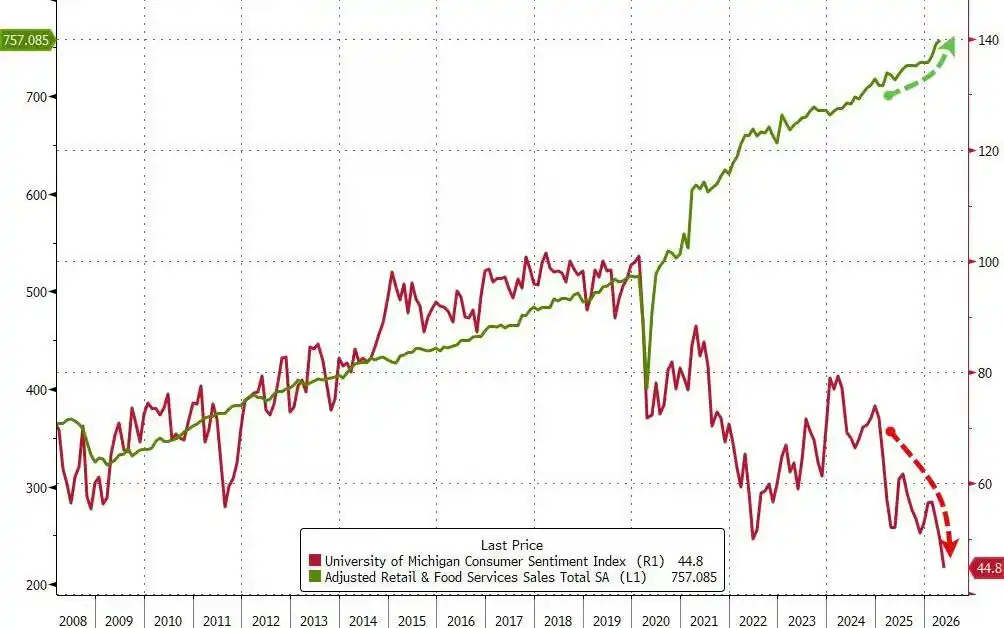
The U.S. stock market is currently displaying a rare split: on one side, consumer confidence has fallen to historic lows and correlations between macro assets have become completely distorted; on the other side, major stock indices continue to set new all-time highs driven by the AI and semiconductor rally. What the market is truly worried about is no longer whether the uptrend can continue, but how long this highly concentrated AI-driven rally can withstand the shocks from oil prices, interest rates, and crowded positioning.

Spurred by rising expectations for U.S.-Iran talks and a surge in the semiconductor sector, U.S. stocks hit new record highs again on Tuesday. The Nasdaq 100 Index surpassed 30,000 points for the first time, and the S&P 500 rose about 0.5%; meanwhile, a decline in oil prices led to lower U.S. Treasury yields, while a rebound in the dollar pressured the performance of gold and Bitcoin.

Semiconductors remain the core driver of this rally. After UBS Group significantly raised its target price for Micron Technology, trading sentiment for memory chips heated up rapidly, with the semiconductor sector rising 14% over the past five days. However, Nvidia has begun to underperform the overall semiconductor index, indicating that funds are shifting from the leader towards sectors with higher elasticity.

Nelson Armbrust, a Goldman Sachs trader, warned that the current correlations between the S&P 500 and interest rates, gold, the VIX, and oil prices have all deviated from their 20-year historical averages and entered extreme ranges. "One side of the market has to give," he said. "The stock indices are not reflecting the full reality of the market."
AI Theme Remains, But Driving Forces Rotate

The strongest driving force in the stock market currently comes from semiconductors, especially the memory chip segment. Goldman Sachs trader Pete Callahan pointed out that the semiconductor index has outperformed Nvidia by about 16.5 percentage points over the past five trading days, marking the largest five-day advantage for the SOX relative to Nvidia since 2018.

Notably, this rally is not being driven by a broad-based surge in mega-cap tech stocks. Large-cap tech stocks overall showed relative weakness, with Nvidia slightly lagging, indicating funds are rotating from the AI leader towards more elastic trading plays within the semiconductor sector. Memory chip-related stocks opened sharply higher, with DRAM ETF nominal trading volume reaching about $30 billion for the day, and Goldman Sachs' Meme-Stocks basket also rose noticeably.

AI remains the market's main theme. AI semiconductors, Agentic AI, and AI data center stocks led the market gains. Goldman Sachs noted that the strength in the momentum factor that day was almost entirely driven by long positions, with the best-performing stocks over the past 12 months continuing to significantly outperform.

Meanwhile, increasingly extreme structural signals are also appearing in the options market. SpotGamma data shows aggressive negative Delta flows in 0-DTE options, primarily driven by selling call options; and the combination of "rising volatility and rising spot prices" persists. This means the current rally is not a typical low-volatility expansion of risk appetite but is increasingly being driven by positioning squeezes and options trading structures.

Consumer Confidence Bottoms, But Behavior and Sentiment Diverge

Goldman Sachs trader Chris Hussey pointed out that many are puzzled: why are U.S. stocks still hitting new record highs when consumer confidence indicators have fallen to historic lows? His explanation is that what consumers "feel" and what they "actually do" are inconsistent. In other words, sentiment is pessimistic, but consumer behavior has not deteriorated in sync.

Meanwhile, fiscal stimulus is still supporting household cash flow. Chris Hussey mentioned that tax relief from the budget bill last July is improving household balance sheets, partially offsetting the pressure from rising gasoline prices.

U.S. macro data also shows clear divergence. The Chicago Fed National Activity Index rebounded sharply, the Conference Board Consumer Confidence Index beat expectations, and the Dallas Fed Manufacturing Index held steady; while the S&P CoreLogic Case-Shiller Home Price Index weakened and the Philadelphia Fed Manufacturing Index missed expectations. Overall, U.S. economic data maintains a state of "slightly stronger than expected."

This also explains the market's current contradiction: consumer sentiment is extremely weak, but economic data has not significantly deteriorated yet, and actual consumer behavior has not shown a synchronous decline. However, the AAII Bull-Bear Spread remains negative, indicating investor sentiment has not truly turned optimistic alongside the new stock market highs.

Macro Correlations Fail, Negative Gamma Intensifies: Goldman Sachs Warns of Structural Cracks in U.S. Stocks

Goldman Sachs trader Nelson Armbrust warned that current U.S. stock indices do not reflect the full reality of the market. Correlations between the S&P 500 and key macro assets have comprehensively deviated from long-term averages: correlation with interest rates is at a decade low, correlation with gold is at a decade high, correlation with the VIX is at a two-year high, and correlation with oil prices is at a decade low.

These are extremely rare levels even when viewed across a 20-year historical dimension. In other words, while U.S. stocks are still rising, their traditional联动 relationships with interest rates, volatility, commodities, and safe-haven assets are breaking down. For investors relying on historical correlations for asset allocation, hedging, and risk budgeting, this means model stability is declining.

Meanwhile, Gamma has turned negative. In a negative Gamma environment, the market becomes more sensitive to price fluctuations, and the state of "spot prices rising while volatility simultaneously increases" also means the current market action is not a typical low-volatility one-sided bull market, but increasingly driven by positioning and options structures.

Goldman Sachs HF Trend Monitor data shows hedge funds' current allocation to the momentum factor has risen to the 90th percentile, semiconductor positioning has reached a record 10%, while software positioning has fallen to its lowest since 2019. Highly crowded positioning implies that the rally may still continue upward in the short term driven by chasing funds, but once a reversal occurs, the pullback could also be more severe.

How Far Can U.S. Stocks Go? It Depends on Three Constraints

The first constraint comes from oil prices. Diplomatic progress can quickly depress geopolitical risk premiums, but cannot immediately repair the buffer capacity of shipping, insurance, refineries, and real supply chains. As long as uncertainty remains around the Strait of Hormuz situation and the prospects for a U.S.-Iran ceasefire, oil prices may fluctuate repeatedly between optimistic expectations and tail risks.

The second constraint comes from semiconductor positioning. The current U.S. stock rally relies increasingly on AI and semiconductors, especially memory chips and momentum long trades. If funds continue chasing this direction, indices may maintain strength; but the more crowded the positioning, the higher the market's sensitivity to earnings, guidance, or fund flow changes—any slight disappointment could be rapidly amplified.

The third constraint comes from correlation breakdowns. The simultaneous deviation of the S&P 500's relationship with interest rates, gold, the VIX, and oil prices from long-term averages means the current rally does not equate to a comprehensive easing of macro risks. More accurately, it is the result of a combination of declining geopolitical risk premiums, falling U.S. Treasury yields, AI/semiconductor momentum, and positioning squeezes.

Therefore, the U.S. stock market's "solo party" may continue, but the stability of the rally is declining. What truly matters is not whether the indices can set new highs, but which variables will force a repricing of this trading logic—whether oil prices will rise again, whether interest rates will re-ascend, whether semiconductor momentum will cool, and when those distorted correlations will revert.


Пов'язані питання

QWhat is the main contradiction in the current U.S. stock market as described in the article?

AThe main contradiction is that while consumer confidence is at a historical low and traditional macro correlations have broken down, major stock indices like the Nasdaq 100 and S&P 500 continue to hit record highs, driven primarily by a highly concentrated AI and semiconductor rally.

QWhich sector is identified as the core driving force of the current market rally, and what shift within it is observed?

AThe semiconductor sector is the core driving force. A shift is observed where capital is moving from the AI leader, Nvidia, towards more elastic segments within semiconductors, particularly memory chips, as evidenced by the outperformance of the broader semiconductor index.

QWhat warning does Goldman Sachs trader Nelson Armbrust issue regarding market correlations?

ANelson Armbrust warns that the correlations between the S&P 500 and key macro assets (interest rates, gold, VIX, and oil) have deviated to extreme levels from their 20-year historical averages. This means the market is not reflecting the full reality, and traditional models for asset allocation and hedging are losing stability.

QAccording to the article, what three main constraints could limit the continuation of the U.S. stock market's 'solo celebration'?

AThe three main constraints are: 1) Oil price volatility, influenced by geopolitical risks like the Strait of Hormuz situation and U.S.-Iran negotiations. 2) Overcrowded positioning in the semiconductor sector, making it vulnerable to any negative news. 3) The breakdown of traditional macro correlations, indicating the current rally's foundation is fragile and dependent on a specific mix of factors.

QHow does the article explain the divergence between low consumer confidence and strong stock market performance?

AThe article explains this divergence by highlighting a split between what consumers 'feel' and what they 'actually do.' While sentiment is pessimistic, actual consumer behavior has not deteriorated in sync, partly supported by fiscal stimuli like tax credits, and economic data remains 'slightly stronger than expected.'

Пов'язані матеріали

End of the 'Gray Era' for Hong Kong and US Stock Trading Accounts: Where Can Your Money Go Now?

Hong Kong and US stock “grey account opening era” ends, where can your money go? In a coordinated regulatory crackdown starting May 22nd, Hong Kong's SFC and China's securities regulator have targeted the previously common but legally ambiguous practice of mainland Chinese investors opening accounts with Hong Kong brokers to trade Hong Kong and US stocks. The SFC issued a stern circular after a review of 12 brokerages, citing major deficiencies including inadequate due diligence, acceptance of suspicious or forged documents, and weak management of cross-border relationships. New requirements mandate mainland clients to submit a written declaration confirming their investment funds originate from *outside* mainland China, the account has never been closed for using suspicious documents, and agreeing to information disclosure. Brokers must immediately close accounts opened with suspicious documents and dormant accounts. Simultaneously, Chinese authorities launched a two-year campaign to rectify illegal cross-border securities activities. Key internet brokers like Futu, Tiger Brokers, and Longbridge are facing penalties, with existing accounts allowed only to sell/withdraw funds, not add new ones. The impact is immediate. Reports from social media and financial news outlets confirm that individuals traveling to Hong Kong to open accounts are now required to sign the new declaration. However, even after signing, applications are frequently rejected. The declaration shifts compliance responsibility to the client and acts as a filter, as most mainland investors' funds do not legally meet the "from outside China" criterion. Major brokers like Futu and Tiger have stopped accepting new mainland clients. A few, such as uSmart Securities, Fosun Wealth, and Cheerful Investment, still offer limited channels, but approvals have tightened significantly. Crucially, funding must now come exclusively from the investor's own bank account in Hong Kong or a qualified jurisdiction, blocking previous workarounds like using money changers or stablecoins. For mainland investors, compliant pathways still exist but are narrower. Individuals with overseas status (students, work visa holders) and verifiable offshore funds may still qualify. Official channels like Stock Connect, QDII, and the Cross-boundary Wealth Management Connect remain fully compliant options, albeit with product and quota limitations. On-chain alternatives exist but carry their own regulatory uncertainties and often exclude mainland users. The crackdown signals the end of the lax expansion period for Hong Kong brokers targeting mainland clients. While investment opportunities persist, the era of easy, low-compliance access is over. Investors must now carefully assess their eligibility and understand that signing the new declaration carries personal legal liability.

Odaily星球日报11 хв тому

End of the 'Gray Era' for Hong Kong and US Stock Trading Accounts: Where Can Your Money Go Now?

Odaily星球日报11 хв тому

SpaceX's $1.75 Trillion IPO: A Quick Guide to 17 Related Stocks

**Title: SpaceX's $1.75 Trillion IPO: Analysis of 17 Related Stocks** SpaceX is set to IPO on Nasdaq with a $1.75 trillion valuation. The real value driver is Starlink, contributing 61% of Q1 revenue with high margins. Its valuation heavily depends on future execution, including user growth despite falling ARPU. Key stocks have already surged pre-IPO. Tesla (TSLA, +10%) is a primary beneficiary due to deep integration with SpaceX in chip design and AI. Rocket Lab (RKLB, +89%) is seen as a "mini-SpaceX," but faces risk from potential Neutron rocket delays. AST SpaceMobile (ASTS) competes in the same satellite-to-phone market as Starlink. Firefly (FLY, +70%) is a strong government contractor in lunar services. Partners like EchoStar (SATS), Planet Labs (PL), and T-Mobile (TMUS) will see revaluation. Suppliers like Qualcomm (QCOM, +57%) are critical ecosystem "picks and shovels." Investment vehicles like DXYZ (+80%) hold significant SpaceX stakes but trade at high premiums, which may collapse post-IPO. Redwire (RDW) is highlighted as an under-the-radar "pick and shovel" play in space components, with growth in defense contracts and microgravity pharmaceuticals. The article warns that much of the positive news is already priced in, and a post-IPO sell-off is possible. Large IPOs often underperform initially. Key risks include Starship delays, ARPU decline, and unforeseen black swan events affecting Elon Musk or space operations. Investors are advised to focus on companies with solid fundamentals and manage overall sector exposure carefully.

marsbit13 хв тому

SpaceX's $1.75 Trillion IPO: A Quick Guide to 17 Related Stocks

marsbit13 хв тому

Conversation with VanEck CEO: Memory Chip Stocks Are a Bubble, Bitcoin Will Stay but Token Ecosystems Will Disappear

In this podcast, VanEck CEO Jan van Eck discusses his investment outlook centered on three key long-term ("10-year macro") themes: AI-driven compute demand, India's economic rise, and excessive government debt in developed nations. Regarding AI and semiconductors, van Eck believes Nvidia has transformed into a foundational "host" for AI infrastructure, possessing deep moats in software, scale, and power efficiency, making it a core holding. However, he views the recent surge in memory chip stocks as a bubble driven by temporary supply-demand imbalances and pricing power, lacking Nvidia's competitive durability. On asset management, he emphasizes that while ETFs are scale-driven tools, the decisions on which ETFs to own and how to allocate remain highly active. He expresses greatest concern over fixed-income market illiquidity and the risk of a loss of confidence in government debt sustainability. Van Eck is bullish on gold's long-term role as a global monetary alternative and highlights the dramatic policy-driven growth in nuclear energy investment. He is strongly positive on India due to its demographic trends and pro-business reforms. Discussing crypto, he labels 2026 the "year of the corporate-controlled chain," where traditional finance adopts blockchain's best features (like 24/7 operation and programmability) but retains control. He predicts a permanent "crypto winter" for many projects, with only Bitcoin, stablecoins, and the core blockchain concept surviving long-term. He sees the U.S. stablecoin bill as marginally impactful, enabling tech firms to compete with, but not replace, banks. Finally, he views the upcoming SpaceX IPO as a significant, positive liquidity event for markets and advises investors to maintain a long-term, macro perspective when making asset allocation decisions.

marsbit24 хв тому

Conversation with VanEck CEO: Memory Chip Stocks Are a Bubble, Bitcoin Will Stay but Token Ecosystems Will Disappear

marsbit24 хв тому

In the Era of Agent Users, Where Does Crypto Value Flow?

Title: Who Makes Money from Agents? The rise of AI Agents as potential blockchain users raises a crucial question: if they become the next billion users, who will capture the value? Traditional crypto value capture theories—like "fat protocols" (where value accrues to the base layer) and "fat applications" (where value accrues to user-facing apps)—assume human users who value UX, brand, and convenience. Agents, however, operate differently: they interact via APIs, have no brand loyalty, and can switch services with near-zero cost. This shift could disrupt existing value flows. Applications might become "headless," offering their routing and infrastructure as APIs to Agents. Alternatively, Agents might bypass intermediaries entirely, allowing protocols to regain value capture ("fat protocols" reborn). A more extreme scenario is that Agents, being purely rational and cost-sensitive, could commoditize the entire stack, compressing margins toward marginal cost and turning crypto into a low-margin utility. However, Agents may not just amplify existing activities; they could enable entirely new ones—like continuous, sub-penny portfolio rebalancing, machine-to-machine commerce, and new market types only viable at automated speeds. This expands the economic pie rather than just redistributing it. Ultimately, the key question for builders is: what will make an Agent return to your service instead of a cheaper alternative? The answer may not be UX but factors like liquidity, latency, settlement guarantees, or a yet-unnamed business model. As humans and Agents will coexist as users, value capture may split: "fat apps" for human-facing services, and a new, evolving model for the Agent-dominated layer.

marsbit54 хв тому

In the Era of Agent Users, Where Does Crypto Value Flow?

marsbit54 хв тому

Base MCP, The Next Step for x402

Base has officially launched Base MCP, allowing users to connect their Base Account to AI Agents to perform actions like swaps, transfers, portfolio tracking, and transaction history queries through conversational commands. This move aligns with Base's strategic focus on AI, driven by the broader competition in the emerging Agent-to-Agent payment sector. The evolution of Agent payments has accelerated. In late 2024, the primary method involved insecure browser automation. By 2025, solutions like Coinbase's x402 (providing crypto wallets for Agents), Google's AP2, and Visa's token-based system emerged. x402 has since processed 176 million transactions totaling over $70 million, with a median value between $0.01 and $0.10. Stablecoins, particularly USDC, dominate these settlements due to their negligible transaction costs compared to traditional payment fees, which are prohibitive for micro-payments. Coinbase faces competition from Stripe, which has built a comparable infrastructure for Agent payments with its Tempo blockchain, Privy wallets, Bridge routing (acquired for $1.1B), and the recently launched MPP protocol. Both companies are now competing at the application layer. The core reason AI is central to Base's strategy is to expand the scenarios for Agent payments, ensuring more transactions occur on its network. By securing a dominant position and scale advantage in this nascent field, Coinbase aims to capture the future commercial potential of Agent-driven payments. The launch of Base MCP is thus a strategic step in this larger ambition.

marsbit1 год тому

Base MCP, The Next Step for x402

marsbit1 год тому

Торгівля

Спот
Ф'ючерси
活动图片