Compliant Stablecoin Competition Heats Up as Tether Launches USAT to Enter the US Market

Odaily星球日报Опубліковано о 2026-01-28Востаннє оновлено о 2026-01-28

Анотація

Tether, the dominant stablecoin issuer, has launched a new regulated dollar-pegged stablecoin called USAT, specifically designed for the U.S. market under the GENIUS Act framework. USAT is issued through the federally chartered Anchorage Digital Bank, with Cantor Fitzgerald serving as the custodian and primary dealer. Initially launched on Ethereum with a supply of $20 million, it is supported by exchanges including Bybit, Crypto.com, Kraken, OKX, and MoonPay—notably excluding Binance and Coinbase, which have ties to competing stablecoins. Tether will pursue a dual-track strategy: USAT will focus on compliant competition within the U.S., while USDT continues to serve as the global liquidity benchmark in offshore markets. USAT enters a highly competitive landscape, challenging incumbents like Circle’s USDC, World Liberty Financial’s USD1 (backed by the Trump family), PayPal’s PYUSD, and BlackRock’s USDtb. While Tether has substantial financial resources, it remains uncertain whether it will adopt aggressive incentive strategies to spur adoption, as the company has historically opposed yield-bearing models. The success of USAT will depend on Tether’s ability to compete as a regulated latecomer in a crowded market.

Original | Odaily Planet Daily (@OdailyChina)

Author | Azuma (@azuma_eth)
On January 27, stablecoin giant Tether officially announced that its new USD stablecoin, USAT, designed specifically for the US market and tailored to the GENIUS regulatory framework, has officially launched.

The promotion of USAT has been in the works for a long time. As early as when the GENIUS bill was being pushed through last year, Tether had already decided to launch a new USD stablecoin alongside USDT to compete directly with other stablecoins in the US market under a compliant system. Subsequently, Tether disclosed the development progress and design details of USAT several times. It was previously rumored to launch before the end of 2025 but was officially released in January this year.

USAT: A More Compliant USDT

With the official launch of USAT, the veil has been completely lifted on this new stablecoin.

According to Tether's official statement, USAT is tailor-made for the US market, and its design will fully comply with the new federal stablecoin regulatory framework established by the GENIUS bill (you can simply think of it as a compliant version of USDT). Specifically, Tether will issue USAT through the US federal chartered bank Anchorage Digital Bank, with Cantor Fitzgerald designated as the custodian of USAT's reserve funds and the preferred primary dealer. Bo Hines, former executive director of the White House Cryptocurrency Committee, will serve as CEO to directly oversee USAT's operations.

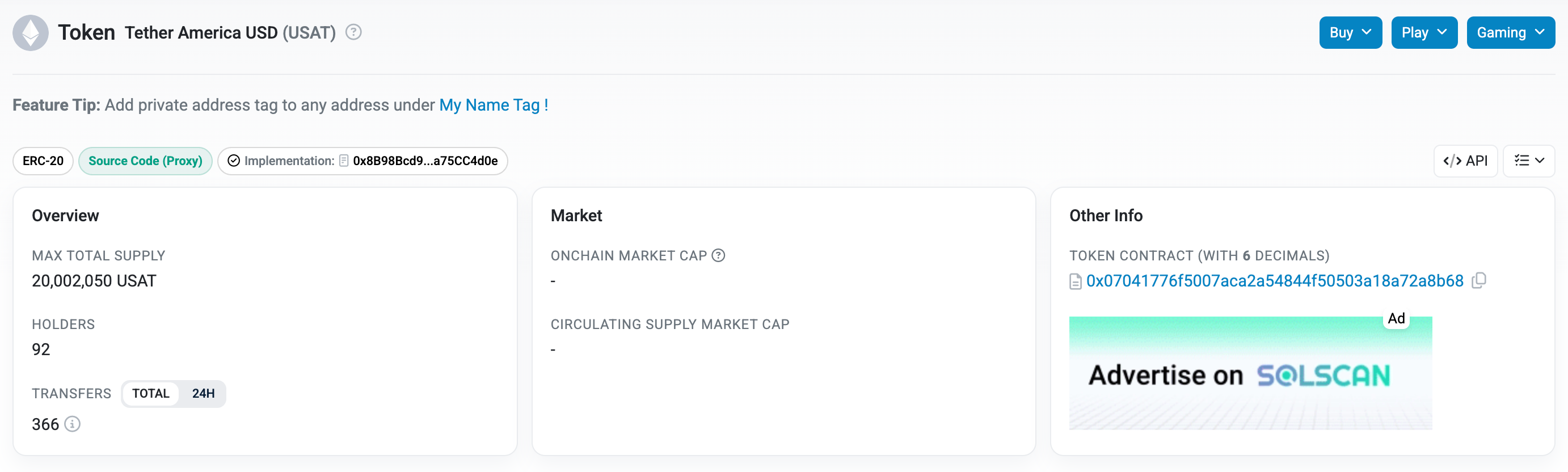
At the initial stage, USAT will only be issued on the Ethereum mainnet, with an initial issuance size of $20 million. The official contract address is 0x07041776f5007aca2a54844f50503a18a72a8b68.
In terms of distribution, Bybit, Crypto.com, Kraken, OKX, and Moonpay will become the first platforms to support USAT, with each platform having successively announced the launch of USAT. It is worth noting that Binance and Coinbase are not among the first batch of platforms. The former is currently flirting with World Liberty Financial (USD1), while the latter has long had interests tied to Circle (USDC). Choosing not to support USAT for now may involve certain strategic considerations.

Tether's Future: Dual-Track Parallel Development

The launch of USAT does not mean that USDT's position will be replaced.

In fact, Tether has repeatedly stated its stance on USDT and USAT, emphasizing that it will adopt a development model of two stablecoins operating in parallel in the future —— USAT will focus on the US market, competing directly with rivals like USDC within the compliant system to capture institutional clients in the traditional financial market; USDT will focus on offshore markets, continuing to serve as the liquidity cornerstone of the cryptocurrency market.

In yesterday's announcement about the issuance of USAT, Tether also mentioned USDT's gradual compliance strategy again: "USDT will continue to operate globally and lead the market as the most widely adopted stablecoin, while gradually moving towards compliance with the GENIUS bill."

In the short term, USDT will still be Tether's main business focus. It will be difficult for USAT to replace the former in terms of scale, but it is expected that Tether will allocate certain resources to USAT to boost the early growth of this stablecoin.

From First Mover to Latecomer, How Will Tether Break Through This Time?

After USAT enters the market, the competitive landscape of the stablecoin market in the US is destined to heat up again.

Considering the current development trends, Circle's (USDC) temporary leading position is not secure. The king of the global stablecoin market, Tether (USAT), World Liberty Financial (USD1) backed by the Trump family, internet giant representative Paypal (PYUSD), BlackRock-backed USDtb... various competitors are launching fierce attacks.

A typical case is that since Binance and USD1 launched a joint subsidy activity (including the ended current account financial management and the ongoing airdrop subsidies) on December 24 last year, USD1's supply scale has grown by more than $2 billion, while USDC's supply scale has shrunk by over $5 billion during the same period —— there is likely some correlation in this ebb and flow.
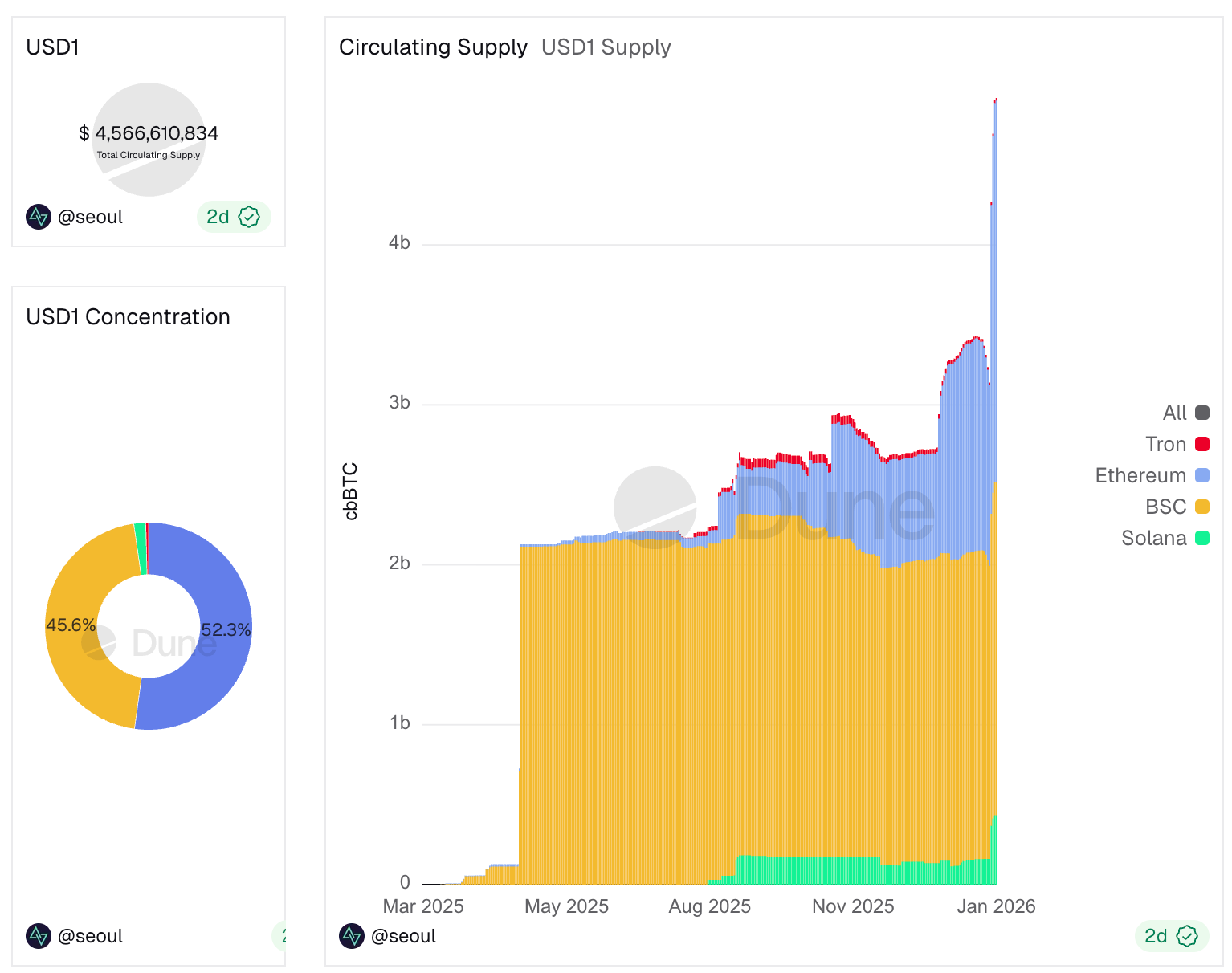
A similar case could also happen with USAT. As a latecomer stablecoin, if Tether wants to stimulate the growth of its supply, subsidies would obviously be the most efficient measure. As ordinary users, we naturally hope to see major stablecoins engage in incentive wars.

Tether's financial strength is undeniable. In 2025, Tether achieved profits of tens of billions of dollars in just three quarters. However, the problem here is that Tether has long been opposed to profit subsidies. Tether CEO Paolo Ardoino clearly expressed his disdain last year for the industry's pursuit of interest-bearing stablecoins, bluntly stating it was a "bad idea." Therefore, it remains unknown whether Tether will adopt a growth strategy similar to USD1 for USAT in the future.

This is an unresolved question for Tether —— in the development history of stablecoins, Tether used USDT to fully exploit first-mover advantages. This time, as a latecomer chasing the competition, Tether's strategy to break through is worth anticipating.


Пов'язані питання

QWhat is the name of the new stablecoin launched by Tether for the US market, and what regulatory framework is it designed to comply with?

AThe new stablecoin is called USAT, and it is designed to comply with the GENIUS regulatory framework.

QWhich institutions are involved in the issuance and custody of USAT's reserve funds?

AUSAT is issued through the US federal chartered bank Anchorage Digital Bank, and Cantor Fitzgerald is the designated custodian of the reserve funds and the preferred primary dealer.

QWhich major cryptocurrency exchanges are notably absent from the first batch of platforms supporting USAT, and what are their potential strategic reasons?

ABinance and Coinbase are notably absent from the first batch. Binance is reportedly involved with World Liberty Financial (USD1), and Coinbase has long-term interests tied to Circle (USDC), which are likely strategic reasons for not initially supporting USAT.

QHow does Tether plan to position USAT and USDT in the market moving forward?

ATether plans a dual-track development model: USAT will focus on the US market and compete with other stablecoins within the compliant system, while USDT will focus on offshore markets and continue to serve as the liquidity cornerstone of the cryptocurrency market.

QWhat challenge does Tether face as a latecomer with USAT in the competitive US stablecoin market, according to the article?

AThe challenge is whether Tether will adopt subsidy strategies, similar to its competitors like USD1, to stimulate the growth of USAT's supply, given that Tether's CEO has historically been opposed to the idea of yield-bearing subsidies for stablecoins.

Пов'язані матеріали

Anthropic's IPO Launch: Commercial Miracle or Valuation Bubble?

Anthropic has confidentially filed for an IPO, led by Morgan Stanley and Goldman Sachs, potentially going public by October. Following its latest $650 billion funding round, its pre-IPO valuation stands at $965 billion, with projections reaching up to $2 trillion at listing, which would make it the highest-valued private company ever. The article, written by Fu Sheng, addresses skepticism that this represents an AI bubble akin to the 2000 dot-com crash. It argues the current situation differs fundamentally. Unlike the internet bubble era, which relied on speculative narratives with little revenue, Anthropic's valuation is backed by unprecedented, measurable financial performance. Key data points include: * **Revenue Growth:** ARR skyrocketed from $10 billion in early 2025 to $470 billion by May 2026, targeting $100 billion by year-end—a growth curve unmatched in business history. * **Profitability:** It achieved operating profitability in Q2 2026 with an estimated $5.6 billion profit. * **Efficiency:** With ~3,000 employees and ~$470 billion ARR, its revenue per employee exceeds $10 million. Products like Claude Code, launched less than a year ago, already generate $25 billion in annualized revenue. * **Enterprise Adoption:** It boasts a strong enterprise client base, with 8 of the Fortune 10 and over 1,000 large firms spending over $1 million annually on Claude. The valuation is framed using a traditional SaaS model (e.g., a 10x Price-to-Sales multiple on $100 billion revenue). The author contends the core question for analysts has shifted from "How big could this be?" to "How much is it earning and will earn next quarter?" The discussion extends beyond Anthropic to a broader paradigm shift: the transition from a "carbon-based" to a "silicon-based" economy. Companies are increasingly prioritizing investment in compute and AI capabilities over human resources, as these directly scale productivity and competitive advantage. Anthropic's IPO is thus positioned not just as a corporate milestone, but as a price anchor for this new economic era.

链捕手2 год тому

Anthropic's IPO Launch: Commercial Miracle or Valuation Bubble?

链捕手2 год тому

Near Returns to the AI Stage: Transformation into a Public Chain Due to 'Payroll Difficulties,' Agent and Privacy Emerge as New Growth Narratives

NEAR Returns to AI Origins: From Payroll Struggles to Blockchain, Now Focusing on AI Agents and Privacy NEAR Protocol's journey began not with grand blockchain ambitions, but from a practical hurdle: its AI startup founders, including Transformer paper co-author Illia Polosukhin, couldn't efficiently pay international developers in 2017. This led them to pivot and build a high-performance, scalable blockchain. After years navigating various crypto narratives like sharding and cross-chain interoperability, NEAR is now leveraging its AI roots to re-enter the AI arena. A key driver is its "NEAR Intents" layer, which abstracts complex cross-chain transactions. Users simply state their goal (e.g., swap BTC for ETH), and a solver network finds the optimal route. This system has processed over $20B in cross-chain volume, generating significant fee revenue. A major growth area is private transactions via "Confidential Intents/Swaps," which hide trade details until settlement to protect against MEV and front-running. Remarkably, private swaps recently accounted for over 40% of NEAR's transaction volume, highlighting strong demand but also potential regulatory scrutiny. With its AI-founder pedigree, NEAR is positioning itself at the intersection of blockchain, AI agents, and privacy, aiming to become infrastructure for the emerging agent economy while navigating the challenges of its rapid adoption.

marsbit4 год тому

Near Returns to the AI Stage: Transformation into a Public Chain Due to 'Payroll Difficulties,' Agent and Privacy Emerge as New Growth Narratives

marsbit4 год тому

Торгівля

Спот
Ф'ючерси
活动图片




