Compliant Stablecoin Competition Heats Up as Tether Launches USAT to Enter the US Market

Odaily星球日报Опубліковано о 2026-01-28Востаннє оновлено о 2026-01-28

Анотація

Tether, the dominant stablecoin issuer, has launched a new regulated dollar-pegged stablecoin called USAT, specifically designed for the U.S. market under the GENIUS Act framework. USAT is issued through the federally chartered Anchorage Digital Bank, with Cantor Fitzgerald serving as the custodian and primary dealer. Initially launched on Ethereum with a supply of $20 million, it is supported by exchanges including Bybit, Crypto.com, Kraken, OKX, and MoonPay—notably excluding Binance and Coinbase, which have ties to competing stablecoins. Tether will pursue a dual-track strategy: USAT will focus on compliant competition within the U.S., while USDT continues to serve as the global liquidity benchmark in offshore markets. USAT enters a highly competitive landscape, challenging incumbents like Circle’s USDC, World Liberty Financial’s USD1 (backed by the Trump family), PayPal’s PYUSD, and BlackRock’s USDtb. While Tether has substantial financial resources, it remains uncertain whether it will adopt aggressive incentive strategies to spur adoption, as the company has historically opposed yield-bearing models. The success of USAT will depend on Tether’s ability to compete as a regulated latecomer in a crowded market.

Original | Odaily Planet Daily (@OdailyChina)

Author | Azuma (@azuma_eth)
On January 27, stablecoin giant Tether officially announced that its new USD stablecoin, USAT, designed specifically for the US market and tailored to the GENIUS regulatory framework, has officially launched.

The promotion of USAT has been in the works for a long time. As early as when the GENIUS bill was being pushed through last year, Tether had already decided to launch a new USD stablecoin alongside USDT to compete directly with other stablecoins in the US market under a compliant system. Subsequently, Tether disclosed the development progress and design details of USAT several times. It was previously rumored to launch before the end of 2025 but was officially released in January this year.

USAT: A More Compliant USDT

With the official launch of USAT, the veil has been completely lifted on this new stablecoin.

According to Tether's official statement, USAT is tailor-made for the US market, and its design will fully comply with the new federal stablecoin regulatory framework established by the GENIUS bill (you can simply think of it as a compliant version of USDT). Specifically, Tether will issue USAT through the US federal chartered bank Anchorage Digital Bank, with Cantor Fitzgerald designated as the custodian of USAT's reserve funds and the preferred primary dealer. Bo Hines, former executive director of the White House Cryptocurrency Committee, will serve as CEO to directly oversee USAT's operations.

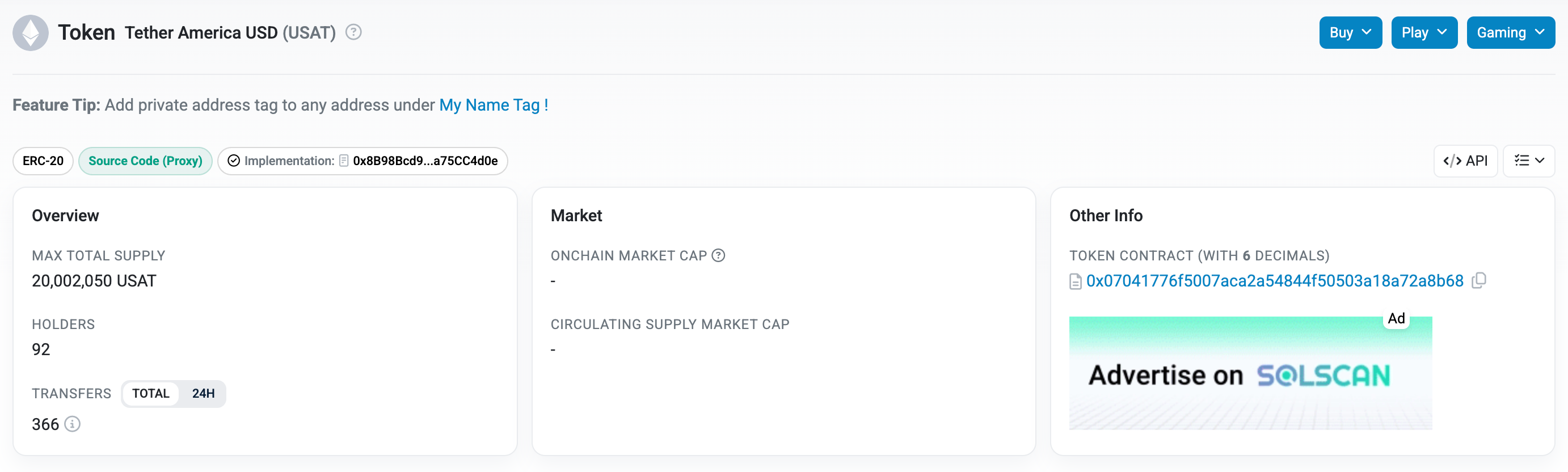
At the initial stage, USAT will only be issued on the Ethereum mainnet, with an initial issuance size of $20 million. The official contract address is 0x07041776f5007aca2a54844f50503a18a72a8b68.
In terms of distribution, Bybit, Crypto.com, Kraken, OKX, and Moonpay will become the first platforms to support USAT, with each platform having successively announced the launch of USAT. It is worth noting that Binance and Coinbase are not among the first batch of platforms. The former is currently flirting with World Liberty Financial (USD1), while the latter has long had interests tied to Circle (USDC). Choosing not to support USAT for now may involve certain strategic considerations.

Tether's Future: Dual-Track Parallel Development

The launch of USAT does not mean that USDT's position will be replaced.

In fact, Tether has repeatedly stated its stance on USDT and USAT, emphasizing that it will adopt a development model of two stablecoins operating in parallel in the future —— USAT will focus on the US market, competing directly with rivals like USDC within the compliant system to capture institutional clients in the traditional financial market; USDT will focus on offshore markets, continuing to serve as the liquidity cornerstone of the cryptocurrency market.

In yesterday's announcement about the issuance of USAT, Tether also mentioned USDT's gradual compliance strategy again: "USDT will continue to operate globally and lead the market as the most widely adopted stablecoin, while gradually moving towards compliance with the GENIUS bill."

In the short term, USDT will still be Tether's main business focus. It will be difficult for USAT to replace the former in terms of scale, but it is expected that Tether will allocate certain resources to USAT to boost the early growth of this stablecoin.

From First Mover to Latecomer, How Will Tether Break Through This Time?

After USAT enters the market, the competitive landscape of the stablecoin market in the US is destined to heat up again.

Considering the current development trends, Circle's (USDC) temporary leading position is not secure. The king of the global stablecoin market, Tether (USAT), World Liberty Financial (USD1) backed by the Trump family, internet giant representative Paypal (PYUSD), BlackRock-backed USDtb... various competitors are launching fierce attacks.

A typical case is that since Binance and USD1 launched a joint subsidy activity (including the ended current account financial management and the ongoing airdrop subsidies) on December 24 last year, USD1's supply scale has grown by more than $2 billion, while USDC's supply scale has shrunk by over $5 billion during the same period —— there is likely some correlation in this ebb and flow.
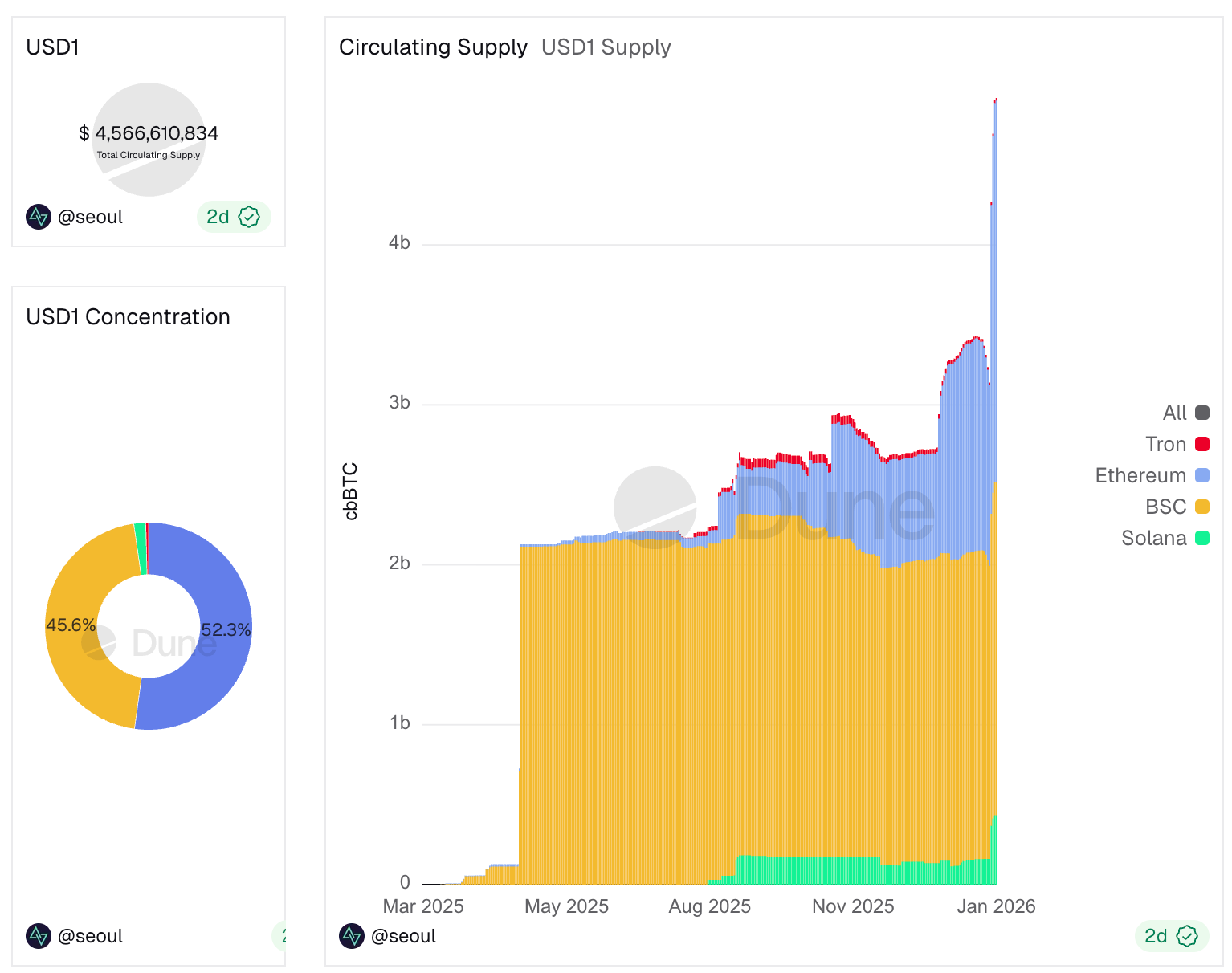
A similar case could also happen with USAT. As a latecomer stablecoin, if Tether wants to stimulate the growth of its supply, subsidies would obviously be the most efficient measure. As ordinary users, we naturally hope to see major stablecoins engage in incentive wars.

Tether's financial strength is undeniable. In 2025, Tether achieved profits of tens of billions of dollars in just three quarters. However, the problem here is that Tether has long been opposed to profit subsidies. Tether CEO Paolo Ardoino clearly expressed his disdain last year for the industry's pursuit of interest-bearing stablecoins, bluntly stating it was a "bad idea." Therefore, it remains unknown whether Tether will adopt a growth strategy similar to USD1 for USAT in the future.

This is an unresolved question for Tether —— in the development history of stablecoins, Tether used USDT to fully exploit first-mover advantages. This time, as a latecomer chasing the competition, Tether's strategy to break through is worth anticipating.

Пов'язані питання

QWhat is the name of the new stablecoin launched by Tether for the US market, and what regulatory framework is it designed to comply with?

AThe new stablecoin is called USAT, and it is designed to comply with the GENIUS regulatory framework.

QWhich institutions are involved in the issuance and custody of USAT's reserve funds?

AUSAT is issued through the US federal chartered bank Anchorage Digital Bank, and Cantor Fitzgerald is the designated custodian of the reserve funds and the preferred primary dealer.

QWhich major cryptocurrency exchanges are notably absent from the first batch of platforms supporting USAT, and what are their potential strategic reasons?

ABinance and Coinbase are notably absent from the first batch. Binance is reportedly involved with World Liberty Financial (USD1), and Coinbase has long-term interests tied to Circle (USDC), which are likely strategic reasons for not initially supporting USAT.

QHow does Tether plan to position USAT and USDT in the market moving forward?

ATether plans a dual-track development model: USAT will focus on the US market and compete with other stablecoins within the compliant system, while USDT will focus on offshore markets and continue to serve as the liquidity cornerstone of the cryptocurrency market.

QWhat challenge does Tether face as a latecomer with USAT in the competitive US stablecoin market, according to the article?

AThe challenge is whether Tether will adopt subsidy strategies, similar to its competitors like USD1, to stimulate the growth of USAT's supply, given that Tether's CEO has historically been opposed to the idea of yield-bearing subsidies for stablecoins.

Пов'язані матеріали

Soaring 20% Then Dropping 5%: When Will the Bottom of the Korean Stock Market Be?

"South Korean stocks face a turbulent period as the KOSPI index, after a 20% surge, fell 5% to 6257 points. The market is grappling with severe issues: over 500,000 leveraged retail accounts have been liquidated, and more than 24 trillion won has flowed from stocks into bank deposits for safety. This reflects a significant loss of market liquidity and shaken investor confidence. In response, Korean financial regulators are taking action. They have tripled the minimum保证金 (margin) requirement for single-stock leveraged ETF trades to 30 million won and are considering granting themselves "emergency intervention" powers. These could include capping leverage ratios and setting investment limits on these ETFs, seen by many as amplifying market volatility. Initial results show a 75% drop in these products' trading volume post-regulation. The market downturn has political repercussions, pushing President Yoon Suk-yeol's approval rating to a new low. Meanwhile, foreign investors made a record net purchase of 7.18 trillion won during a recent rebound, while domestic retail investors sold off massively. Morgan Stanley has upgraded South Korean stocks to "overweight," citing the ongoing "leverage unwinding" and potential for a 36% upside, with giants like Samsung Electronics and SK Hynix providing valuation support. However, analysts caution that the market's structure remains vulnerable to foreign capital flows, and the current low may not be the bottom."

marsbit10 хв тому

Soaring 20% Then Dropping 5%: When Will the Bottom of the Korean Stock Market Be?

marsbit10 хв тому

Goldman Sachs Stakes a Clear Position: This Is the Largest Capital Demand Cycle in Human History, and the Fed Is Just an Observer

Goldman Sachs argues that the world is entering the most capital-intensive investment cycle in history, driven by concurrent massive demands from AI infrastructure, reindustrialization, defense reinvestment, power grid rebuilding, supply chain realignment, and sovereign debt financing. This structural competition for capital is pushing its cost higher, fundamentally altering investment paradigms. Goldman's Mark Wilson states that the Federal Reserve is merely a "passenger, not the driver" in this shift, with rising yields rooted in these real economy demands rather than just monetary policy. While major indices appeared calm in July, underlying market movements were historic, featuring extreme stock dispersion and a severe momentum factor crash, leading to significant de-risking by fund managers. Wilson cautions against expecting a quick reversal in August, citing ongoing digestion of higher rates, disrupted risk models, and typically muted market performance ahead of US midterm elections. Corporate fundamentals remain robust with strong earnings, though growth rates are peaking in the US while accelerating in Europe. Notably, hyperscale cloud companies like Amazon and Microsoft are announcing staggering capital expenditure projections for 2027-2028, justified by explosive AI-related revenue growth and high returns. Amazon revealed its AI revenue run-rate exceeds $25 billion, growing triple-digits annually, and expressed confidence that AWS could become a trillion-dollar revenue business. The report concludes that a transitional period is underway, marked by a growing tension between aggressively investing private tech giants and increasingly capital-constrained sovereign governments. The AI super-cycle continues, with August likely being a consolidation phase.

marsbit15 хв тому

Goldman Sachs Stakes a Clear Position: This Is the Largest Capital Demand Cycle in Human History, and the Fed Is Just an Observer

marsbit15 хв тому

Outflow of Stablecoins from South Korea Continues for 18 Consecutive Months, Exceeding $360 Million in June

In June 2026, South Korea experienced a net outflow of stablecoins to overseas crypto exchanges, amounting to 560.3 billion won ($367 million). This represents approximately 78% of the net value of foreign stocks purchased by Korean investors in the same period. According to the Financial Supervisory Service (FSS), this marks the 18th consecutive month of net outflows, a trend ongoing since January 2025. The FSS reported that 2.76 trillion won ($1.8+ billion) in stablecoins were withdrawn from the country's five major exchanges to foreign platforms in June, while 2.2 trillion won ($1.4 billion) flowed back in. The second quarter of 2026 saw a significant net outflow of 1.69 trillion won (~$1.1 billion), surpassing net sales of foreign stocks in the same period. Analysts cite access to unavailable domestic financial instruments as a primary driver. Foreign platforms offer crypto derivatives, spot and futures products tied to major Korean stocks like Samsung and Hyundai, along with RWA tokenization, DeFi, staking, and leveraged products. Lawmaker Lee Jong-wook warned that the stablecoin outflows constitute capital flight, exposing investors to risks on unregulated foreign platforms. He called for accelerated regulatory reform and enhanced investor protection measures. The government is reportedly working on a digital assets law to foster the blockchain sector.

cryptonews.ru20 хв тому

Outflow of Stablecoins from South Korea Continues for 18 Consecutive Months, Exceeding $360 Million in June

cryptonews.ru20 хв тому

Торгівля

Спот
活动图片