Compliant Stablecoin Competition Heats Up as Tether Launches USAT to Enter the US Market

Odaily星球日报Опубліковано о 2026-01-28Востаннє оновлено о 2026-01-28

Анотація

Tether, the dominant stablecoin issuer, has launched a new regulated dollar-pegged stablecoin called USAT, specifically designed for the U.S. market under the GENIUS Act framework. USAT is issued through the federally chartered Anchorage Digital Bank, with Cantor Fitzgerald serving as the custodian and primary dealer. Initially launched on Ethereum with a supply of $20 million, it is supported by exchanges including Bybit, Crypto.com, Kraken, OKX, and MoonPay—notably excluding Binance and Coinbase, which have ties to competing stablecoins. Tether will pursue a dual-track strategy: USAT will focus on compliant competition within the U.S., while USDT continues to serve as the global liquidity benchmark in offshore markets. USAT enters a highly competitive landscape, challenging incumbents like Circle’s USDC, World Liberty Financial’s USD1 (backed by the Trump family), PayPal’s PYUSD, and BlackRock’s USDtb. While Tether has substantial financial resources, it remains uncertain whether it will adopt aggressive incentive strategies to spur adoption, as the company has historically opposed yield-bearing models. The success of USAT will depend on Tether’s ability to compete as a regulated latecomer in a crowded market.

Original | Odaily Planet Daily (@OdailyChina)

Author | Azuma (@azuma_eth)
On January 27, stablecoin giant Tether officially announced that its new USD stablecoin, USAT, designed specifically for the US market and tailored to the GENIUS regulatory framework, has officially launched.

The promotion of USAT has been in the works for a long time. As early as when the GENIUS bill was being pushed through last year, Tether had already decided to launch a new USD stablecoin alongside USDT to compete directly with other stablecoins in the US market under a compliant system. Subsequently, Tether disclosed the development progress and design details of USAT several times. It was previously rumored to launch before the end of 2025 but was officially released in January this year.

USAT: A More Compliant USDT

With the official launch of USAT, the veil has been completely lifted on this new stablecoin.

According to Tether's official statement, USAT is tailor-made for the US market, and its design will fully comply with the new federal stablecoin regulatory framework established by the GENIUS bill (you can simply think of it as a compliant version of USDT). Specifically, Tether will issue USAT through the US federal chartered bank Anchorage Digital Bank, with Cantor Fitzgerald designated as the custodian of USAT's reserve funds and the preferred primary dealer. Bo Hines, former executive director of the White House Cryptocurrency Committee, will serve as CEO to directly oversee USAT's operations.

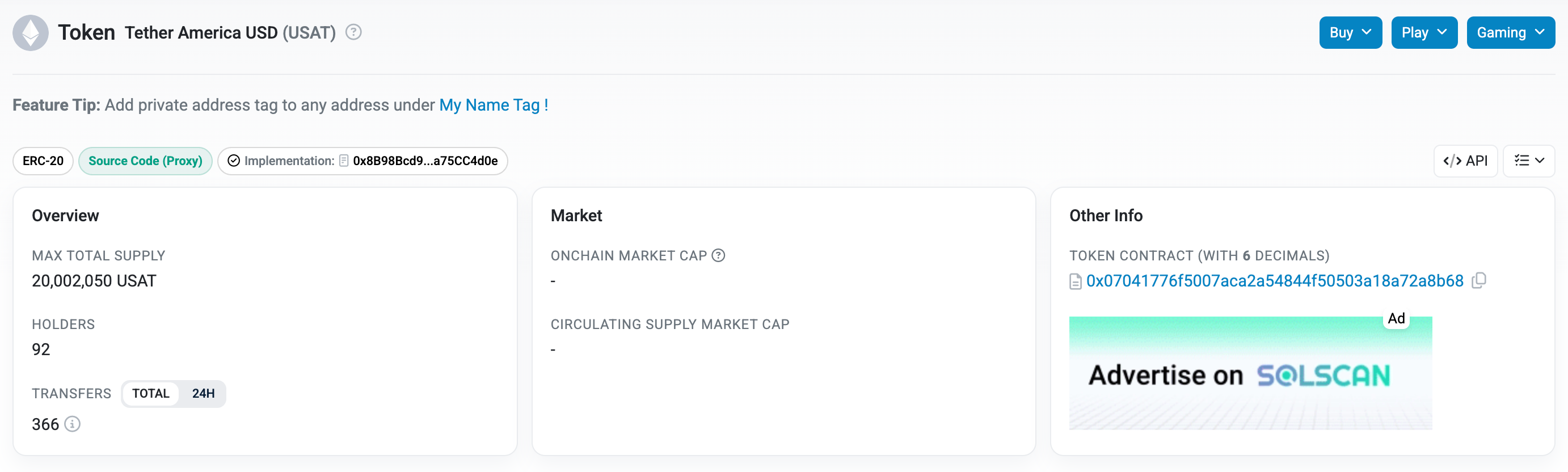
At the initial stage, USAT will only be issued on the Ethereum mainnet, with an initial issuance size of $20 million. The official contract address is 0x07041776f5007aca2a54844f50503a18a72a8b68.
In terms of distribution, Bybit, Crypto.com, Kraken, OKX, and Moonpay will become the first platforms to support USAT, with each platform having successively announced the launch of USAT. It is worth noting that Binance and Coinbase are not among the first batch of platforms. The former is currently flirting with World Liberty Financial (USD1), while the latter has long had interests tied to Circle (USDC). Choosing not to support USAT for now may involve certain strategic considerations.

Tether's Future: Dual-Track Parallel Development

The launch of USAT does not mean that USDT's position will be replaced.

In fact, Tether has repeatedly stated its stance on USDT and USAT, emphasizing that it will adopt a development model of two stablecoins operating in parallel in the future —— USAT will focus on the US market, competing directly with rivals like USDC within the compliant system to capture institutional clients in the traditional financial market; USDT will focus on offshore markets, continuing to serve as the liquidity cornerstone of the cryptocurrency market.

In yesterday's announcement about the issuance of USAT, Tether also mentioned USDT's gradual compliance strategy again: "USDT will continue to operate globally and lead the market as the most widely adopted stablecoin, while gradually moving towards compliance with the GENIUS bill."

In the short term, USDT will still be Tether's main business focus. It will be difficult for USAT to replace the former in terms of scale, but it is expected that Tether will allocate certain resources to USAT to boost the early growth of this stablecoin.

From First Mover to Latecomer, How Will Tether Break Through This Time?

After USAT enters the market, the competitive landscape of the stablecoin market in the US is destined to heat up again.

Considering the current development trends, Circle's (USDC) temporary leading position is not secure. The king of the global stablecoin market, Tether (USAT), World Liberty Financial (USD1) backed by the Trump family, internet giant representative Paypal (PYUSD), BlackRock-backed USDtb... various competitors are launching fierce attacks.

A typical case is that since Binance and USD1 launched a joint subsidy activity (including the ended current account financial management and the ongoing airdrop subsidies) on December 24 last year, USD1's supply scale has grown by more than $2 billion, while USDC's supply scale has shrunk by over $5 billion during the same period —— there is likely some correlation in this ebb and flow.
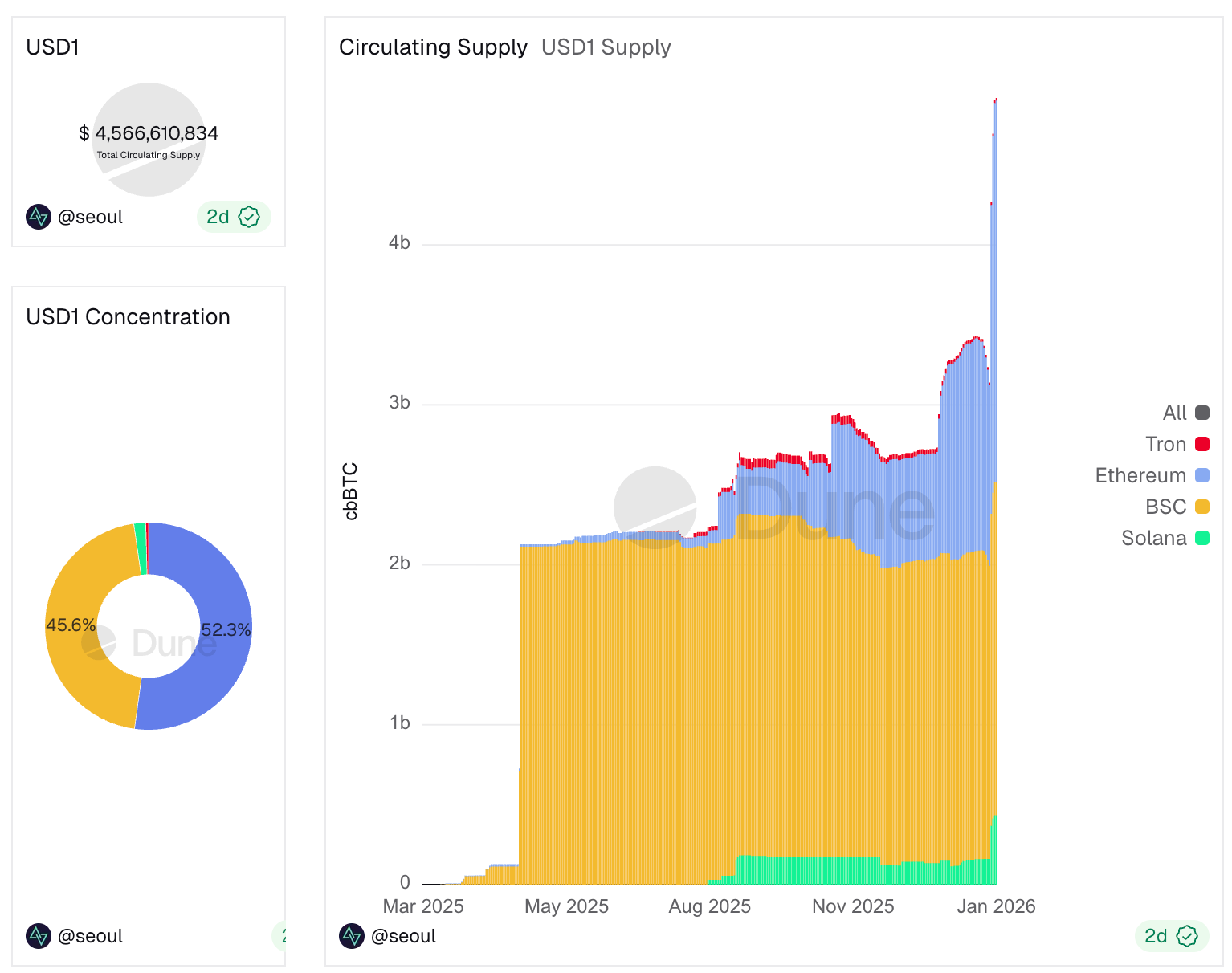
A similar case could also happen with USAT. As a latecomer stablecoin, if Tether wants to stimulate the growth of its supply, subsidies would obviously be the most efficient measure. As ordinary users, we naturally hope to see major stablecoins engage in incentive wars.

Tether's financial strength is undeniable. In 2025, Tether achieved profits of tens of billions of dollars in just three quarters. However, the problem here is that Tether has long been opposed to profit subsidies. Tether CEO Paolo Ardoino clearly expressed his disdain last year for the industry's pursuit of interest-bearing stablecoins, bluntly stating it was a "bad idea." Therefore, it remains unknown whether Tether will adopt a growth strategy similar to USD1 for USAT in the future.

This is an unresolved question for Tether —— in the development history of stablecoins, Tether used USDT to fully exploit first-mover advantages. This time, as a latecomer chasing the competition, Tether's strategy to break through is worth anticipating.

Пов'язані питання

QWhat is the name of the new stablecoin launched by Tether for the US market, and what regulatory framework is it designed to comply with?

AThe new stablecoin is called USAT, and it is designed to comply with the GENIUS regulatory framework.

QWhich institutions are involved in the issuance and custody of USAT's reserve funds?

AUSAT is issued through the US federal chartered bank Anchorage Digital Bank, and Cantor Fitzgerald is the designated custodian of the reserve funds and the preferred primary dealer.

QWhich major cryptocurrency exchanges are notably absent from the first batch of platforms supporting USAT, and what are their potential strategic reasons?

ABinance and Coinbase are notably absent from the first batch. Binance is reportedly involved with World Liberty Financial (USD1), and Coinbase has long-term interests tied to Circle (USDC), which are likely strategic reasons for not initially supporting USAT.

QHow does Tether plan to position USAT and USDT in the market moving forward?

ATether plans a dual-track development model: USAT will focus on the US market and compete with other stablecoins within the compliant system, while USDT will focus on offshore markets and continue to serve as the liquidity cornerstone of the cryptocurrency market.

QWhat challenge does Tether face as a latecomer with USAT in the competitive US stablecoin market, according to the article?

AThe challenge is whether Tether will adopt subsidy strategies, similar to its competitors like USD1, to stimulate the growth of USAT's supply, given that Tether's CEO has historically been opposed to the idea of yield-bearing subsidies for stablecoins.

Пов'язані матеріали

North Korean Hackers Loot $500 Million in a Single Month, Becoming the Top Threat to Crypto Security

North Korean hackers, particularly the notorious Lazarus Group and its subgroup TraderTraitor, have stolen over $500 million from cryptocurrency DeFi platforms in less than three weeks, bringing their total theft for the year to over $700 million. Recent major attacks on Drift Protocol and KelpDAO, resulting in losses of approximately $286 million and $290 million respectively, highlight a strategic shift: instead of targeting core smart contracts, attackers are now exploiting vulnerabilities in peripheral infrastructure. For instance, the KelpDAO attack involved compromising downstream RPC infrastructure used by LayerZero's decentralized validation network (DVN), allowing manipulation without breaching core cryptography. This sophisticated approach mirrors advanced corporate cyber-espionage. Additionally, North Korea has systematically infiltrated the global crypto workforce, with an estimated 100 operatives using fake identities to gain employment at blockchain companies, enabling long-term access to sensitive systems and facilitating large-scale thefts. According to Chainalysis, North Korean-linked hackers stole a record $2 billion in 2025, accounting for 60% of all global crypto theft that year. Their total historical crypto theft has reached $6.75 billion. Post-theft, they employ specialized money laundering methods, heavily relying on Chinese OTC brokers and cross-chain mixing services rather than standard decentralized exchanges. Security experts, while acknowledging the increased sophistication, emphasize that many attacks still exploit fundamental weaknesses like poor access controls and centralized operational risks. Strengthening private key management, limiting privileged access, and enhancing coordination among exchanges, analysts, and law enforcement immediately after an attack are critical to improving defense and fund recovery chances. The industry's challenge now extends beyond secure smart contracts to safeguarding operational security at the infrastructure level.

marsbit34 хв тому

North Korean Hackers Loot $500 Million in a Single Month, Becoming the Top Threat to Crypto Security

marsbit34 хв тому

Circle CEO's Seoul Visit: No Korean Won Stablecoin Issuance, But Met All Major Korean Banks

Circle CEO Jeremy Allaire's recent activities in Seoul indicate a strategic shift for the company, moving away from issuing a Korean won-backed stablecoin and instead focusing on embedding itself as a key infrastructure provider within Korea’s financial and crypto ecosystem. Despite Korea accounting for nearly 30% of global crypto trading volume—with a market characterized by high retail participation and altcoin dominance—Circle has chosen not to compete for the role of stablecoin issuer. Instead, Allaire met with major Korean banks (including Shinhan, KB, and Woori), financial groups, leading exchanges (Upbit, Bithumb, Coinone), and tech firms like Kakao. This approach reflects a broader industry transition: the core of stablecoin competition is shifting from issuance rights to systemic positioning. With Korean regulators still debating whether banks or tech companies should issue stablecoins, Circle is avoiding regulatory uncertainty by strengthening its role as a service and technology partner. The company is deepening integration with trading platforms, building connections, and promoting stablecoin infrastructure. This positions Circle to benefit regardless of which entity eventually issues a won stablecoin. Allaire also noted the potential for a Chinese yuan stablecoin in the next 3–5 years, underscoring a regional trend of stablecoins becoming more regulated and integrated with traditional finance. Ultimately, Circle’s strategy highlights that future influence in the stablecoin market will belong not necessarily to the issuers, but to the foundational infrastructure layers that enable cross-system transactions.

marsbit1 год тому

Circle CEO's Seoul Visit: No Korean Won Stablecoin Issuance, But Met All Major Korean Banks

marsbit1 год тому

SpaceX Ties Up with Cursor: A High-Stakes AI Gambit of 'Lock First, Acquire Later'

SpaceX has secured an option to acquire AI programming company Cursor for $60 billion, with an alternative clause requiring a $10 billion collaboration fee if the acquisition does not proceed. This structure is not merely a potential acquisition but a strategic move to control core access points in the AI era. The deal is designed as a flexible, dual-path arrangement, allowing SpaceX to either fully acquire Cursor or maintain a binding partnership through high-cost collaboration. This "option-style" approach minimizes immediate regulatory and integration risks while ensuring long-term alignment between the two companies. At its core, the transaction exchanges critical AI-era resources: SpaceX provides its Colossus supercomputing cluster—one of the world’s most powerful AI training infrastructures—while Cursor contributes its AI-native developer environment and strong product adoption. This synergy connects compute power, models, and application layers, forming a closed-loop AI capability stack. Cursor, founded in 2022, has achieved rapid growth with over $1 billion in annual revenue and widespread enterprise adoption. Its value lies in transforming software development through AI agents capable of coding, debugging, and system design—positioning it as a gateway to future software production. For SpaceX, this move is part of a broader strategy to evolve from a aerospace company into an AI infrastructure empire, integrating xAI, supercomputing, and chip manufacturing. Controlling Cursor fills a gap in its developer tooling layer, strengthening its AI narrative ahead of a potential IPO. The deal reflects a shift in AI competition from model superiority to ecosystem and entry-point control. With programming tools as a key battleground, securing developer loyalty becomes crucial for dominating the software production landscape. Risks include questions around Cursor’s valuation, technical integration challenges, and potential regulatory scrutiny. Nevertheless, the deal underscores a strategic bet: controlling both compute and software development access may redefine power dynamics in the AI-driven future.

marsbit1 год тому

SpaceX Ties Up with Cursor: A High-Stakes AI Gambit of 'Lock First, Acquire Later'

marsbit1 год тому

Торгівля

Спот
Ф'ючерси
活动图片




