Commodities Surge, Equities Steady, Crypto Falls Behind In 2025 Market Showdown

bitcoinistОпубліковано о 2025-12-22Востаннє оновлено о 2025-12-22

Анотація

The investment landscape of 2025 has delivered an unexpected outcome, with traditional commodities emerging as the clear winners while cryptocurrencies fell to the bottom of performance rankings. Data reveals a strong divergence between asset classes: silver leads with a 130% year-to-date gain, followed by gold (65%) and copper (35%). Equity indices like the Nasdaq and S&P 500 also posted positive returns. In stark contrast, the crypto market is the worst-performing asset class. Bitcoin is down 6%, Ethereum has declined 12%, and altcoins (excluding Ethereum) have plummeted approximately 42%. This marks a dramatic reversal from the mid-year rally, where Bitcoin, Ethereum, and XRP reached new all-time highs. The downturn began with a flash crash in October, leading to Bitcoin's worst Q4 performance in seven years, ultimately erasing earlier gains and cementing crypto's position at the bottom of the 2025 market.

The investment landscape in 2025 has delivered an unusual outcome that few would have anticipated at the start of the year. Assets traditionally viewed as slow movers have risen as the clear winners, while the cryptocurrency market has quietly slipped to the bottom of the performance rankings.

As the year draws to a close, data from across commodities, equities, and digital assets shows an imbalance in returns, revealing that cryptocurrencies now sit behind every major asset class in year-to-date performance.

Clear Split Between Traditional Assets And Crypto

The performance data for 2025 reveals a strong divergence between traditional markets and digital assets, with the gap widening as the year progressed. According to the figures revealed on the social media platform X by ‘Bull Theory,’ silver is the top-performing asset for 2025, posting gains of about 130% year-to-date. Gold is the second-best-performing asset of 2025, with an increase of about 65%, while copper has climbed close to 35%. These numbers reflect sustained strength across the commodities sector.

Equity markets are also currently trading in positive territory. The Nasdaq is up around 20% on the year, the S&P 500 has gained approximately 16%, and the Russell 2000 is higher by about 13%.

The only negative numbers are from the crypto industry. In contrast, the crypto market sits at the bottom of the performance rankings. Bitcoin is currently down by about 6% from its 2025 opening price, Ethereum has declined around 12%, and the entire altcoin market (removing Ethereum) has suffered a much deeper drawdown of about 42%. Therefore, the crypto market is now officially the worst-performing asset class in 2025.
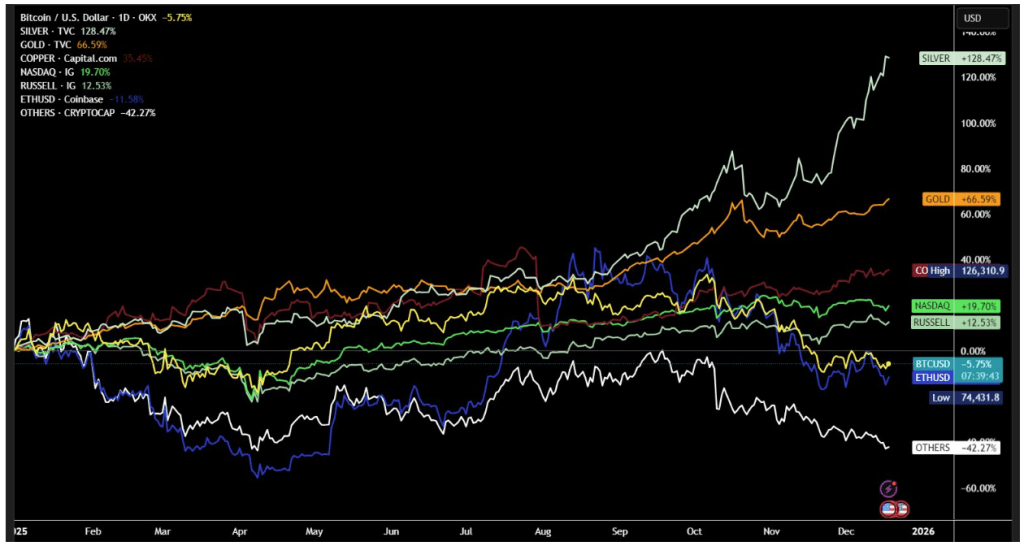
Chart Image From X. Source: @BullTheoryio

From Mid-Year Rally To Q4 Breakdown

The current weakness of the crypto market is very different from the optimism that dominated the beginning and middle of 2025. During that period, the crypto market experienced a powerful recovery that reignited bullish sentiment across the board. Bitcoin, Ethereum, XRP, and several large-cap tokens pushed to new all-time highs.

Bitcoin’s rally peaked in October, when it set its standing record of $126,000 after months of steady accumulation and strong momentum. Ethereum, on the other hand, registered a new all-time high of $4,946 in August, while XRP’s all-time high came earlier in July. XRP’s record price of $3.65 was the most notable, as it was its first time breaking into a new all-time high since 2018.

Total crypto market cap currently at $2.98 trillion. Chart: TradingView

That bullish trend began to unravel as the fourth quarter got underway, starting with the crypto market flash crash on October 10. The decline has extended since then, and Bitcoin and the broader crypto market have now fallen into negative territory from their 2025 opening levels.

Quarterly returns data shows that Bitcoin just recorded its worst fourth-quarter performance in seven years. The result is a year in which digital assets, despite a powerful mid-year rally, are closing out as the worst-performing major asset class.
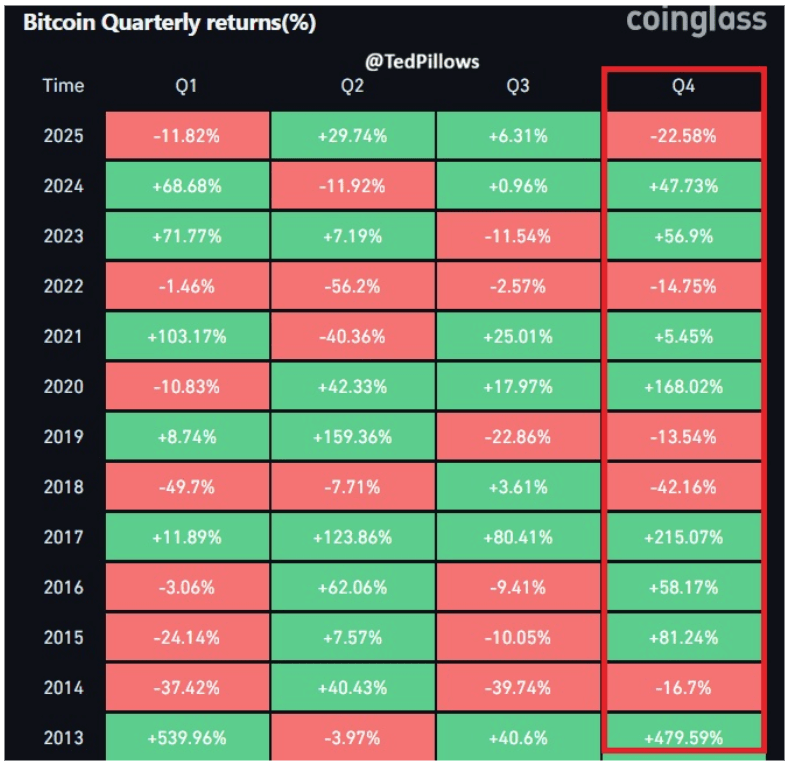
Bitcoin Quarterly Returns. Source: @TedPillows On X

Featured image from Unsplash, chart from TradingView

Пов'язані питання

QWhich asset class was the top performer in 2025 according to the data from 'Bull Theory'?

ACommodities, specifically silver, was the top-performing asset, posting gains of about 130% year-to-date.

QWhat are the year-to-date performance figures for Bitcoin and Ethereum in 2025 as described in the article?

ABitcoin is down by about 6% from its 2025 opening price, and Ethereum has declined around 12%.

QWhat significant event on October 10, 2025, contributed to the crypto market's decline in Q4?

AThe crypto market experienced a flash crash on October 10, which marked the beginning of the extended decline into negative territory for the year.

QWhat were the peak prices reached by Bitcoin and Ethereum during their 2025 rallies?

ABitcoin reached a peak of $126,000 in October, and Ethereum reached a new all-time high of $4,946 in August.

QHow does the performance of the entire altcoin market (excluding Ethereum) compare to the major cryptocurrencies in 2025?

AThe entire altcoin market (removing Ethereum) suffered a much deeper drawdown of about 42%, performing worse than both Bitcoin and Ethereum.

Пов'язані матеріали

Vitalik's Vision for the Next Evolution of On-Chain Finance: How to Reconstruct DeFi with an 'Options Mindset'?

Vitalik Buterin recently proposed a conceptual shift for DeFi: replacing traditional Collateralized Debt Positions (CDPs) and forced liquidations with an options-based mechanism. This aims to address key vulnerabilities in current DeFi lending. The traditional CDP model, foundational to protocols like MakerDAO and Aave, allows users to borrow against collateral but relies on real-time oracles and triggers sudden, mandatory liquidations during price volatility. This can cause cascading sell-offs, oracle manipulation risks, and significant MEV extraction, exacerbating market stress. Vitalik's alternative envisions splitting an asset like 1 ETH into two complementary components: one offering stable/index-like exposure and the other absorbing the opposite risk/reward. Instead of a hard liquidation threshold, a user's exposure to the target asset would gradually and smoothly deviate (following a near-quadratic curve) as the collateral price moves. The system would primarily depend on "slow oracles" for periodic settlement rather than instant price feeds. Key potential benefits include: the elimination of abrupt, forced liquidations; drastically reduced reliance on vulnerable real-time oracles; and inherent resistance to certain MEV exploits centered on liquidation auctions. The article posits that for Ethereum DeFi to maintain its relevance amid competition from faster, cheaper chains, it must compete on sophisticated financial engineering and robustness—not just transaction speed or yields. The core value proposition should shift towards offering users clearer, more manageable risk structures, greater autonomy, and resilience in extreme scenarios, moving DeFi from high-risk experimentation towards becoming reliable financial infrastructure.

marsbit15 хв тому

Vitalik's Vision for the Next Evolution of On-Chain Finance: How to Reconstruct DeFi with an 'Options Mindset'?

marsbit15 хв тому

AI Agent Completely Transforms Web3 Gaming: From the Rugpull Bakery Bot Controversy to the New 2026 Agent Paradigm

This article explores how the AI Agent paradigm is fundamentally transforming Web3 gaming, moving from a disruptive force to a core, legitimized element. It begins with the controversy in the competitive baking game Rugpull Bakery, where automated scripts caused fairness issues. Instead of banning them, the developers integrated AI Agents into the official gameplay by providing technical documentation (skill.md, agent.json), marking a shift towards "Agentic Gaming." The piece outlines three primary implementation models for AI Agents in Web3 games by 2026: 1. **Autonomous Competitors & Economic Entities:** AI Agents act as independent players with unique strategies. Examples include TEN Protocol's poker agents, AI Arena's trainable NFT fighters, and Satoshi Strike Force's "Digital Athletes" trained on player data. The Somnia blockchain is highlighted as a dedicated "Agentic L1" infrastructure supporting this model at scale. 2. **Modular Infrastructure & Programmable Environments:** This model, exemplified by EVE Frontier, allows AI Agents to program game world logic itself. Using "Smart Assemblies" (e.g., Smart Turrets, Smart Gates), Agents can modify shared economic and physical rules on-chain, creating dynamic, player/AI-built worlds. The ERC-8183 standard further enables these automated entities to hire other AI services for complex tasks. 3. **Hybrid Companions & Dynamic Adaptation:** Here, AI serves as a collaborative partner. In Parallel Colony, highly autonomous AI Avatars work alongside human players who provide high-level guidance. Illuvium plans to use AI to make NPCs dynamic and responsive, creating personalized, emergent narratives for each player. The conclusion posits that Web3 gaming has reached a "post-human" inflection point. Blockchains' transparency and programmability, combined with new standards and infrastructure like Somnia, make integrating and governing AI Agents not just viable but essential. The future lies in a symbiotic digital order where players transition from manual laborers to commanders and partners of algorithmic intelligence.

marsbit1 год тому

AI Agent Completely Transforms Web3 Gaming: From the Rugpull Bakery Bot Controversy to the New 2026 Agent Paradigm

marsbit1 год тому

Торгівля

Спот
Ф'ючерси
活动图片