CoinShares’ US Trading Debut Marred By 25% Stock Crash: Key Takeaways

bitcoinistОпубліковано о 2026-04-01Востаннє оновлено о 2026-04-01

Анотація

CoinShares, a major European crypto asset manager, debuted on the Nasdaq via a deSPAC merger with Vine Hill Capital, valuing the company at $1.2 billion. However, its stock plunged 25% on the first trading day, reflecting broader turbulence in crypto-related equities amid geopolitical tensions and volatile digital asset markets. CEO Jean-Marie Mognetti urged patience, emphasizing the listing was driven by business readiness rather than favorable market conditions. He downplayed short-term price movements, highlighting the company’s long-term strategy. Historical data shows deSPACs have averaged a 60% decline in the first year post-merger.

CoinShares (CSHR), one of Europe’s largest crypto asset managers, made its long‐anticipated US market debut on Wednesday after completing a merger with Vine Hill Capital that created the holding company CoinShares PLC.

The transaction, first announced in September and closed late Tuesday, values the business at about $1.2 billion and included a $50 million strategic investment from institutional backers.

CoinShares’ CEO Urges Patience After 25% Slide

The listing, however, got off to a rocky start. On its first session on the Nasdaq, CoinShares’ shares plunged roughly 25%, trading just below $8.30 at the time of writing, according to Yahoo Finance data.

The sharp sell‐off reflects broader turbulence in digital‐asset stocks and follows months of heightened volatility tied to geopolitical tensions in the Middle East and rising oil prices.
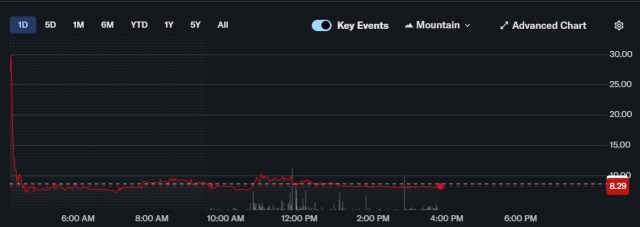
CoinShares stock price crash on Wednesday following its debut. Source: Yahoo Finance

Major crypto tokens such as Bitcoin (BTC) and Ethereum (ETH) have struggled to mount sustainable rallies during the same period, putting additional pressure on firms focused on crypto products.

CoinShares CEO Jean‐Marie Mognetti pushed back against reading too much into the market’s initial reaction. Speaking to Barron’s, he said the company’s US listing was driven by readiness rather than market convenience.

“We are not listing because the market is easy. We are listing because the business is ready, and that’s much more important,” Mognetti said, stressing the company’s long‐term strategy over short‐term share price movements.

deSPACs Average 60% Drop In Year One

CoinShares’ US listing is structured as a deSPAC — the operating company formed after a Special Purpose Acquisition (SPAC) merger — and deSPACs have generally performed poorly post‐deal.

Data compiled by SPAC Research and cited by Jay Ritter, director of the IPO Initiative at the University of Florida, show that deSPACs have fallen on average about 60% in the 12 months following their mergers over the last five years.

In his conversation with Barron’s, Mognetti framed the SPAC route as a regulatory and practical choice to facilitate the company’s cross‐border listing rather than as an urgent need for liquidity.

He also told reporters he remains untroubled by the initial market sell‐off and urged patience: “Give us time to just put real numbers out. The market will decide after that.”

The daily chart shows the total crypto market cap at $2.33 trillion. Source: TOTAL on TradingView.com

Featured image from OpenArt, chart from TradingView.com

Пов'язані питання

QWhat was the main reason for the 25% drop in CoinShares' stock on its US debut according to the article?

AThe sharp sell-off reflected broader turbulence in digital-asset stocks, tied to geopolitical tensions in the Middle East and rising oil prices, which have caused months of heightened volatility.

QHow did CoinShares CEO Jean-Marie Mognetti respond to the poor initial market performance?

AMognetti pushed back against reading too much into the initial reaction, stating the listing was driven by business readiness, not market convenience, and urged patience, emphasizing the company's long-term strategy over short-term price movements.

QWhat type of transaction was used for CoinShares' US listing and how have similar transactions historically performed?

AThe listing was structured as a deSPAC (the company formed after a SPAC merger). Data shows that deSPACs have fallen an average of about 60% in the 12 months following their mergers over the last five years.

QWhat was the total valuation of CoinShares following its merger with Vine Hill Capital?

AThe transaction valued the business at approximately $1.2 billion.

QWhat major cryptocurrencies were mentioned as struggling to mount sustainable rallies, adding pressure on crypto-focused firms?

ABitcoin (BTC) and Ethereum (ETH) were mentioned as struggling to mount sustainable rallies during the same period.

Пов'язані матеріали

The Value Distribution of Stablecoins

**Summary: The Value Distribution of Stablecoins** The article argues that stablecoins are evolving from mere trading tools into broader channels for dollar access. It divides the stablecoin ecosystem into four layers to analyze how value is distributed: 1. **Issuance Layer:** Mints stablecoins, holds reserve assets, and captures the spread between reserve yield and user costs (e.g., Tether, Circle). This layer currently earns the largest profit margin. 2. **Infrastructure Layer:** Connects stablecoins to the traditional financial system, handling fiat on/off-ramps, banking integration, compliance (KYC/AML), and asset management (e.g., Bridge, BVNK). This is the "unglamorous" but critical work, building the essential bridges between crypto and real-world finance. 3. **Acquiring/Distribution Layer:** Integrates stablecoins into merchant systems, manages payment flows, and provides enterprise financial software (e.g., Stripe, Coinbase). They act as the access point for businesses. 4. **Application Layer:** The end-users and businesses that ultimately use stablecoins for payments, settlements, or as a store of value. They benefit from convenience but have little pricing power. The core thesis is that while the issuance layer currently dominates profits, the often-overlooked **infrastructure layer holds significant long-term potential**. The real challenge and barrier to mass adoption is not the on-chain transfer of stablecoins (which is simple), but the complex "last mile" integration into existing business workflows, banking systems, and regulatory frameworks across different countries. Companies in this layer are currently in a "land grab" phase, investing heavily to build networks, secure bank partnerships, and establish compliance pathways. While their position is currently pressured by the profitable issuers above and distribution platforms below, the article suggests that if stablecoins become a default financial rail for businesses, the infrastructure providers who have done the hard work of integration will ultimately gain strong pricing power and become entrenched, essential players.

marsbit5 год тому

The Value Distribution of Stablecoins

marsbit5 год тому

The Value Distribution of Stablecoins

The Value Distribution of Stablecoins The article argues that stablecoins are evolving from a mere trading tool into a broad "dollar channel." It analyzes the industry's value chain through four layers: 1. **Issuance Layer (e.g., Tether, Circle):** The top layer that mints stablecoins, holds reserve assets, and captures the thickest interest rate spread. 2. **Infrastructure Layer (e.g., Bridge, BVNK):** Connects stablecoins to the traditional financial system, handling critical but complex "dirty work" like fiat on/off-ramps, banking integration, compliance (KYC/AML), and cross-border settlement. 3. **Acquiring/Distribution Layer (e.g., Stripe, Coinbase):** Embeds stablecoins into merchant systems, manages payment flows, and integrates with enterprise software. 4. **Application Layer:** End-users and businesses that ultimately use stablecoins for payments, settlement, or storing value. The author posits that while the issuance layer currently captures the most profit, the most overlooked and potentially critical layer is infrastructure. The core challenge for stablecoin adoption isn't the on-chain transfer (which is simple), but bridging the gap between blockchain and the real-world financial system. This involves solving practical problems for businesses: fiat conversion, reconciliation, tax handling, and user onboarding. Infrastructure companies are currently in a difficult "land-grab" phase—building networks, securing banking relationships, and achieving compliance country-by-country. They face pressure from both the profitable issuance layer above and distribution platforms below. However, the author suggests this layer is building a crucial moat. Once stablecoins become a default business rail, the infrastructure players who have done the hard work of integration may gain significant, durable value and pricing power.

链捕手5 год тому

The Value Distribution of Stablecoins

链捕手5 год тому

Торгівля

Спот
Ф'ючерси

Популярні статті

Як купити ONE

Ласкаво просимо до HTX.com! Ми зробили покупку Harmony (ONE) простою та зручною. Дотримуйтесь нашої покрокової інструкції, щоб розпочати свою криптовалютну подорож.Крок 1: Створіть обліковий запис на HTXВикористовуйте свою електронну пошту або номер телефону, щоб зареєструвати обліковий запис на HTX безплатно. Пройдіть безпроблемну реєстрацію й отримайте доступ до всіх функцій.ЗареєструватисьКрок 2: Перейдіть до розділу Купити крипту і виберіть спосіб оплатиКредитна/дебетова картка: використовуйте вашу картку Visa або Mastercard, щоб миттєво купити Harmony (ONE).Баланс: використовуйте кошти з балансу вашого рахунку HTX для безперешкодної торгівлі.Треті особи: ми додали популярні способи оплати, такі як Google Pay та Apple Pay, щоб підвищити зручність.P2P: Торгуйте безпосередньо з іншими користувачами на HTX.Позабіржова торгівля (OTC): ми пропонуємо індивідуальні послуги та конкурентні обмінні курси для трейдерів.Крок 3: Зберігайте свої Harmony (ONE)Після придбання Harmony (ONE) збережіть його у своєму обліковому записі на HTX. Крім того, ви можете відправити його в інше місце за допомогою блокчейн-переказу або використовувати його для торгівлі іншими криптовалютами.Крок 4: Торгівля Harmony (ONE)Легко торгуйте Harmony (ONE) на спотовому ринку HTX. Просто увійдіть до свого облікового запису, виберіть торгову пару, укладайте угоди та спостерігайте за ними в режимі реального часу. Ми пропонуємо зручний досвід як для початківців, так і для досвідчених трейдерів.

363 переглядів усьогоОпубліковано 2024.12.12Оновлено 2026.06.02

Як купити ONE

Обговорення

Ласкаво просимо до спільноти HTX. Тут ви можете бути в курсі останніх подій розвитку платформи та отримати доступ до професійної ринкової інформації. Нижче представлені думки користувачів щодо ціни ONE (ONE).

活动图片













