Coingecko 2025 Cryptocurrency Industry Report: Total Market Cap Plummets, What's Still Rising?

marsbitОпубліковано о 2026-01-18Востаннє оновлено о 2026-01-18

Анотація

CoinGecko's 2025 Crypto Industry Report reveals a year of significant market shifts. The total crypto market cap fell 10.4% to $3 trillion, marking the first annual decline since 2022. A historic $19 billion liquidation event in October triggered a major correction, yet high volatility pushed daily trading volume to a yearly high of $161.8 billion. Despite Bitcoin's 6.4% decline, which underperformed compared to gold's 62.6% surge, institutional adoption deepened. Digital Asset Treasury Companies (DATCos) deployed at least $49.7 billion, acquiring over 5% of Bitcoin and Ethereum's total supply. Key growth areas emerged: stablecoin market cap soared 48.9% to a record $311 billion, prediction market volume surged 302.7% to $63.5 billion, and both centralized and decentralized exchange perpetual trading volumes hit all-time highs, rising 47.4% ($86.2T) and 346% ($6.7T) respectively. This indicates robust infrastructure growth even amidst a bear market.

Author: CoinGecko

Compiled by: Deep Tide TechFlow

In the last quarter of 2025, the cryptocurrency market experienced a sharp correction, with the total market capitalization plummeting by 23.7% to close at $3 trillion. This marks the first annual decline for the crypto market since 2022, down 10.4% year-on-year. Although the quarter once hit a historic high of $4.4 trillion, a historic $19 billion liquidation event in October led to a significant price drop. Despite the price pullback, market volatility drove the average daily trading volume to an annual high of $161.8 billion, while the stablecoin market grew by 48.9% year-on-year, reaching a record high of $311 billion.

This year, the cryptocurrency market showed a decoupling trend from traditional assets, with gold rising by 62.6% and the U.S. stock market performing excellently, while Bitcoin fell by 6.4%. However, institutional adoption deepened further, with Digital Asset Treasury Companies (DATCos) deploying at least $49.7 billion in 2025 to acquire over 5% of the total supply of Bitcoin and Ethereum. Other highlights include a surge of 302.7% in prediction market trading volume and a record high annual perpetual futures trading volume of $86.2 trillion on centralized exchanges. These data indicate that even as prices fall, market infrastructure and utility continue to expand.

Our "2025 Annual Cryptocurrency Industry Report" comprehensively covers the panorama of the crypto market, in-depth analysis of Bitcoin and Ethereum, and also explores the decentralized finance (DeFi) and non-fungible token (NFT) ecosystems, while reviewing the performance of centralized exchanges (CEX) and decentralized exchanges (DEX).

Below are the key highlights of the report, but be sure to read the full 60-page report content.

Seven Highlights from CoinGecko's "2025 Annual Cryptocurrency Industry Report"

  1. The total cryptocurrency market capitalization fell by 10.4% in 2025, closing at $3 trillion
  2. Stablecoin market capitalization surged by $102.1 billion (+48.9%) in 2025, hitting a record high of $311 billion
  3. Gold performed outstandingly in 2025, rising by 62.6%, while Bitcoin lagged, falling by 6.4%; the U.S. dollar and oil also performed poorly
  4. Digital Asset Treasury Companies (DATCos) invested at least $49.7 billion in 2025, with about 50% concentrated in the third quarter
  5. Prediction market trading volume grew by 302.7% in 2025, reaching $63.5 billion
  6. Centralized exchange perpetual futures trading volume grew by 47.4% in 2025, reaching $86.2 trillion, a record high
  7. Decentralized exchange perpetual futures trading volume grew by 346% in 2025, reaching $6.7 trillion, another record high

1. Total Cryptocurrency Market Cap Plunged 23.7% in Q4 2025 (a decrease of $946 billion), Closing the Year at $3 Trillion
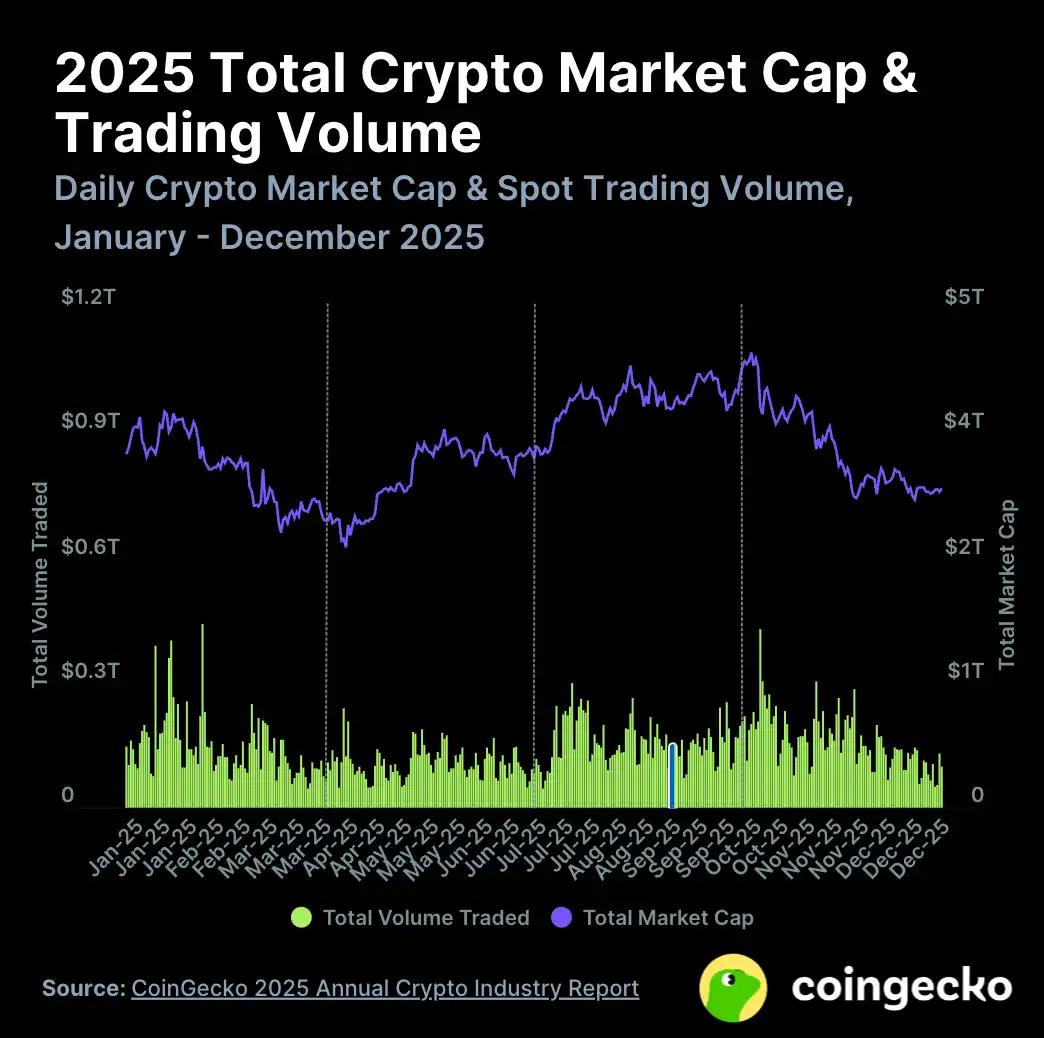
The total cryptocurrency market capitalization fell by 23.7% in the fourth quarter, a decrease of $946 billion, closing the year at $3 trillion, down 10.4% year-on-year. This is the first annual decline for the cryptocurrency market since 2022.

The fourth quarter of 2025 started strongly for the crypto market, with the total market cap once reaching a historic high of $4.4 trillion. However, this high did not last, as prices continued to fall until the end of November, then entered a volatile range until the end of the year. The trigger for this decline was the historic $19 billion liquidation event triggered by the U.S. announcement of 100% tariffs on China on October 10.

Meanwhile, the average daily trading volume in the fourth quarter grew to $161.8 billion, hitting an annual high, a quarter-on-quarter increase of 4.4%. This growth was mainly driven by the liquidation event and subsequent high volatility. However, as the market entered a volatile phase, trading volume gradually declined.

2. Stablecoin Market Cap Surged by $102.1 Billion (+48.9%) in 2025, Hitting a Record High of $311 Billion
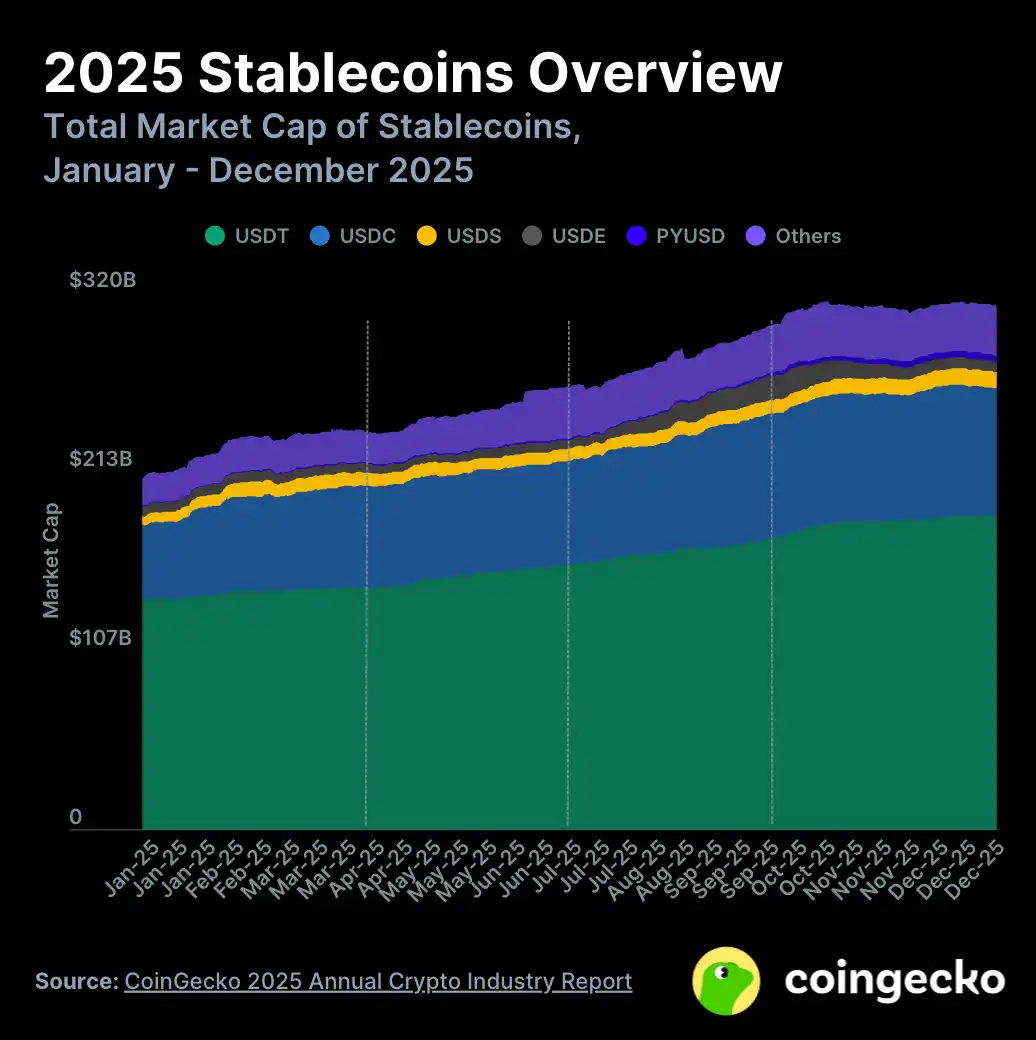
In the fourth quarter of 2025, the total stablecoin market capitalization grew by $6.3 billion, reaching a record high of $311 billion at the end of the quarter. For the full year, the stablecoin market grew by 48.9% year-on-year, adding $102.1 billion.

The biggest change in the fourth quarter came from the Ethereum ecosystem stablecoin Ethena's USDe, whose market capitalization plummeted by 57.3% (a decrease of $8.4 billion) after rapid deleveraging in mid-October. Due to a de-pegging event on the Binance platform, USDe's supply fell from a peak of nearly $15 billion to $6.3 billion, severely damaging investor confidence in high-yield circular strategies.

Meanwhile, PayPal's stablecoin PYUSD emerged strongly, with its market capitalization surging by 48.4% (an increase of $1.2 billion) to reach $3.6 billion, successfully becoming the fifth-largest stablecoin, replacing World Liberty Financial's USD1. Its growth was driven by YouTube's launch of a creator revenue payment feature and the approximately 4.25% yield offered by the Spark Savings Vault.

3. Gold Leads 2025: Up 62.6%, Bitcoin Lags, Down 6.4%, Dollar and Oil Also Weak
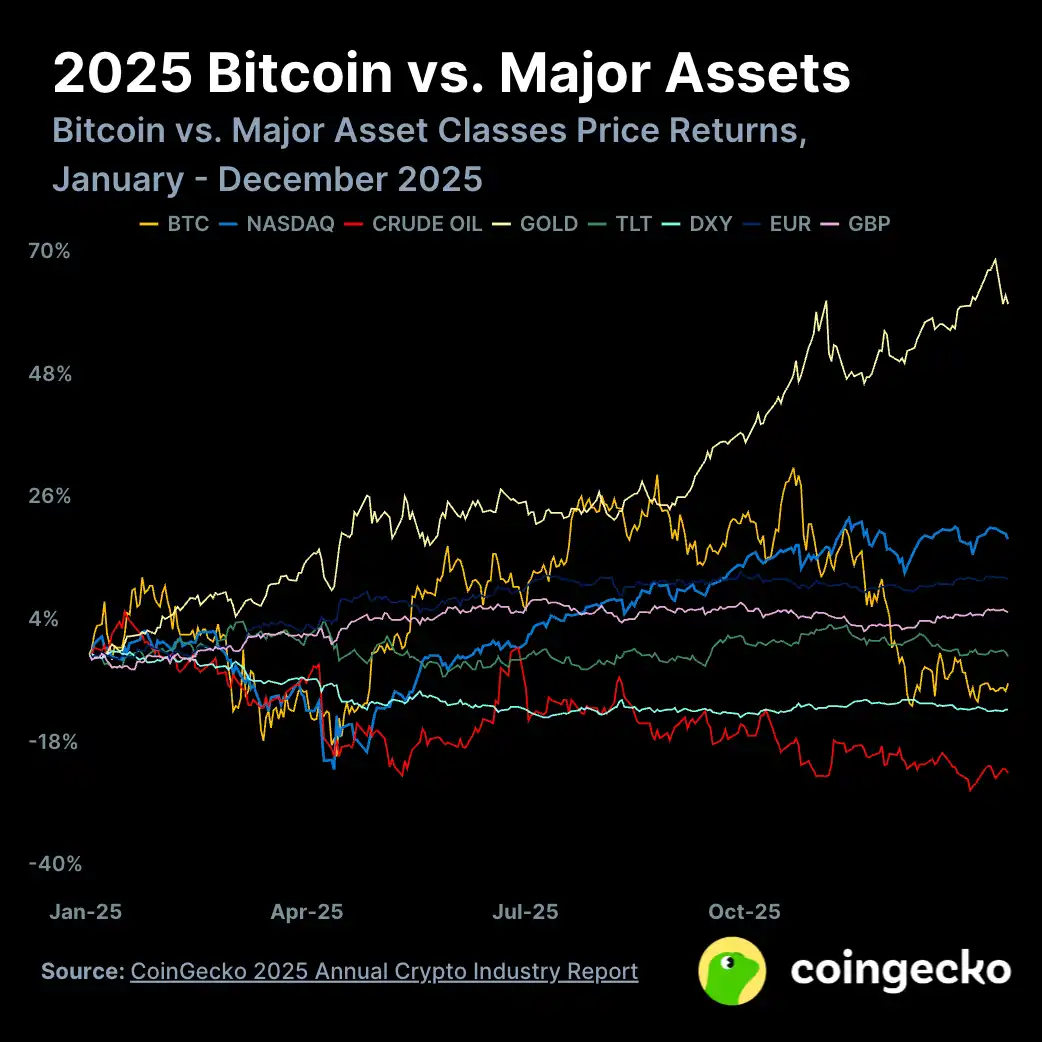
In 2025, gold was the standout performing asset, with a full-year increase of 62.6%. In contrast, Bitcoin performed poorly, falling by 6.4%, echoing the weak performance of the U.S. dollar and oil.

In 2025, gold performed particularly well, rising by 62.6% for the year. In the fourth quarter alone, gold grew by 11.4%, mainly driven by continued central bank purchases and tariff-related uncertainties. Following closely were U.S. stock markets, with the Nasdaq up 20.5% and the S&P 500 up 16.6%, benefiting from the ongoing AI narrative.

In contrast, while commodities and stocks performed strongly, Bitcoin (BTC) underperformed, falling by 6.4% for the year. Assets that performed worse than Bitcoin included the U.S. Dollar Index (down 10.0%, affected by interest rate cuts and political changes) and crude oil (down 21.5%, due to global oversupply and record production from non-OPEC countries).

4. Digital Asset Treasury Companies (DATCos) Invested at Least $49.7 Billion in 2025, with About 50% Concentrated in Q3
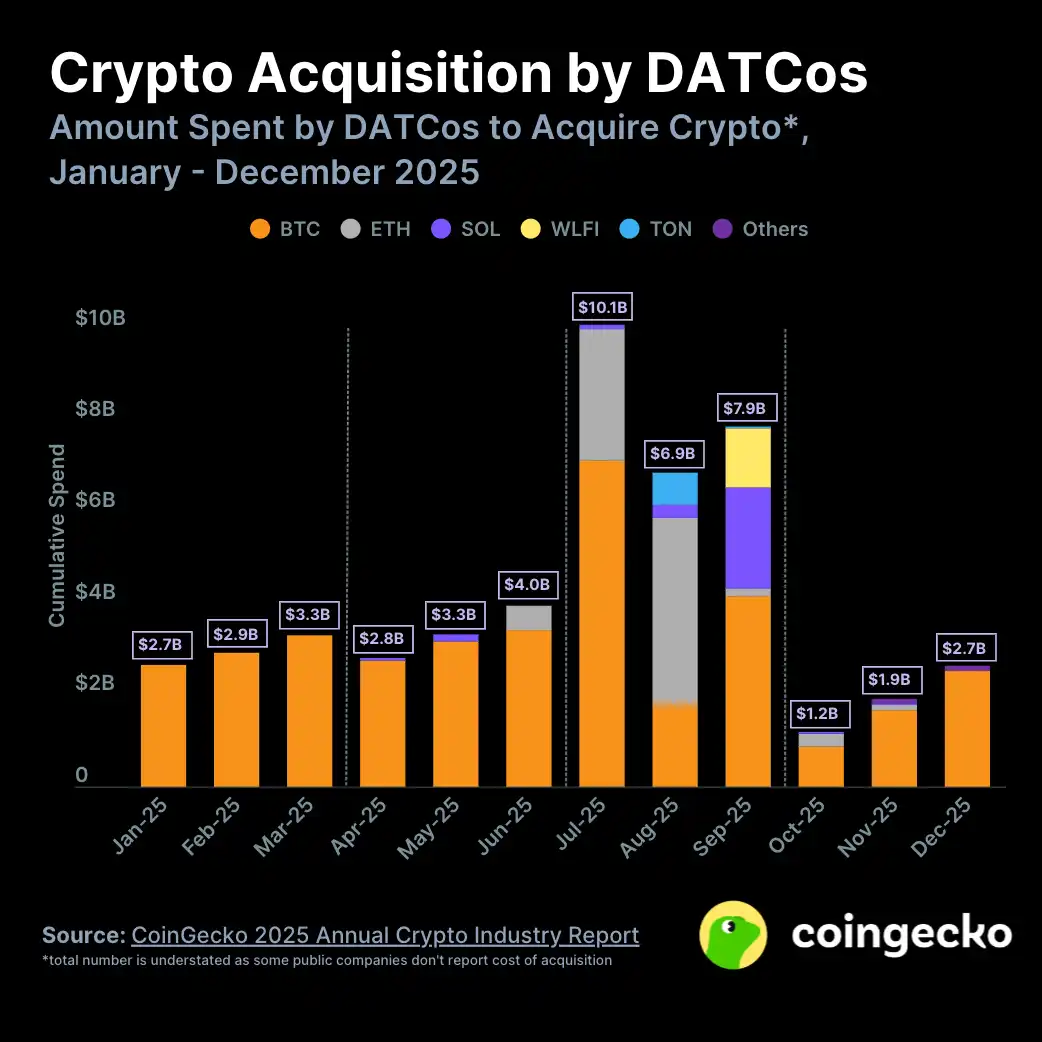
Digital Asset Treasury Companies (DATCos) became significant players in the market in 2025, investing a total of at least $49.7 billion in purchasing cryptocurrencies throughout the year. The third quarter was the peak of investment, accounting for half of the annual total, mainly due to a wave of emerging altcoin DATCos.

However, the pace of investment slowed significantly in the fourth quarter, with only $5.8 billion invested. The crypto market crash dragged down DATCos' stock prices, causing the adjusted net asset value (mNAV) of many DATCos to fall below 1.0. This forced them to use funds for stock buybacks rather than continuing to accumulate cryptocurrency.

As of January 1, 2026, DATCos collectively held $134 billion in crypto assets, a 137.2% increase from $56.5 billion on January 1, 2025. DATCos currently hold over 1 million Bitcoin and 6 million Ethereum, accounting for more than 5% of their total supply.

5. Prediction Market Trading Volume Surged 302.7% in 2025, Reaching $63.5 Billion
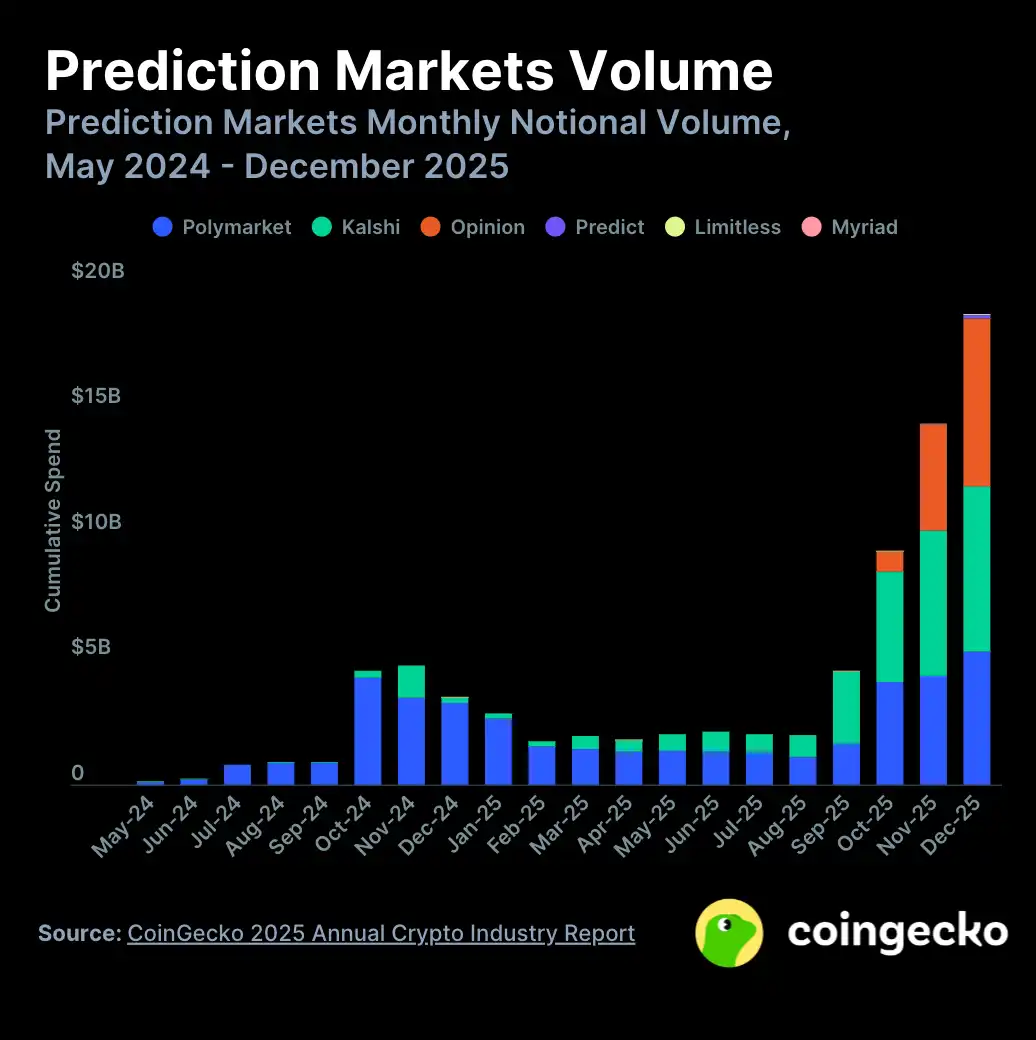
In 2025, prediction markets experienced explosive growth, with trading volume increasing by 302.7% year-on-year, reaching a record high of $63.5 billion.

Nominal trading volume in prediction markets surged from $15.8 billion in 2024 to $63.5 billion in 2025, a year-on-year increase of 302.7%.

At the beginning of 2025, Polymarket held an 85.6% market share in the first quarter but was overtaken by Kalshi in the fourth quarter. In Q4, Kalshi's market share reached 39.6%, while Polymarket ranked second with 32.4%. Meanwhile, Opinion, supported by Yzi Labs and based on the BNB Chain, launched in November, becoming a strong challenger to the existing markets. Opinion's trading volume reached $7 billion in December, on par with Kalshi, though current volume may be influenced by airdrop activities.

6. Centralized Exchange Perpetual Futures Trading Volume Grew 47.4% in 2025, Reaching $86.2 Trillion, a Record High
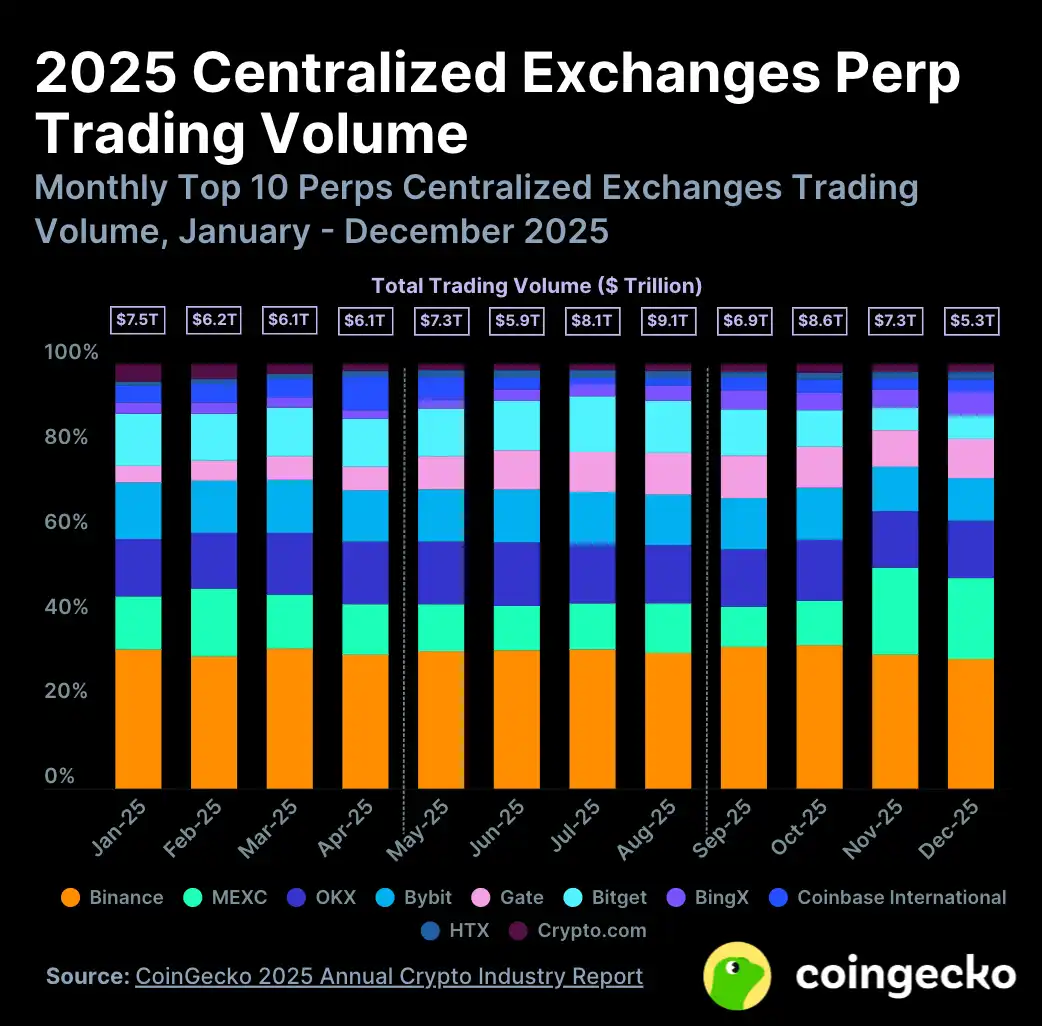
In the fourth quarter of 2025, the trading volume of the top ten centralized perpetual futures exchanges (Perp CEXes) recorded $21.2 trillion, down 12.0% from $24.0 trillion in the third quarter. The full-year trading volume reached $86.2 trillion, a 47.4% increase compared to 2024, setting a new historical record.

October 2025 became the second-highest trading volume month in history, after August, when Bitcoin hit its latest all-time high. In contrast, December was the quietest trading month of the year, with trading volume of only $5.3 trillion.

Throughout 2025, the market share of the top ten centralized perpetual futures exchanges remained relatively stable. The only significant change was MEXC's surge in trading volume in November and December, surpassing OKX, Bybit, and Bitget to become the second largest. Outside the top ten, KuCoin performed brightly in 2025, becoming the only non-top-ten perpetual futures exchange to break the $1 trillion trading volume mark.

7. Decentralized Exchange Perpetual Futures Trading Volume Grew 346% in 2025, Reaching $6.7 Trillion, Setting a New Record High
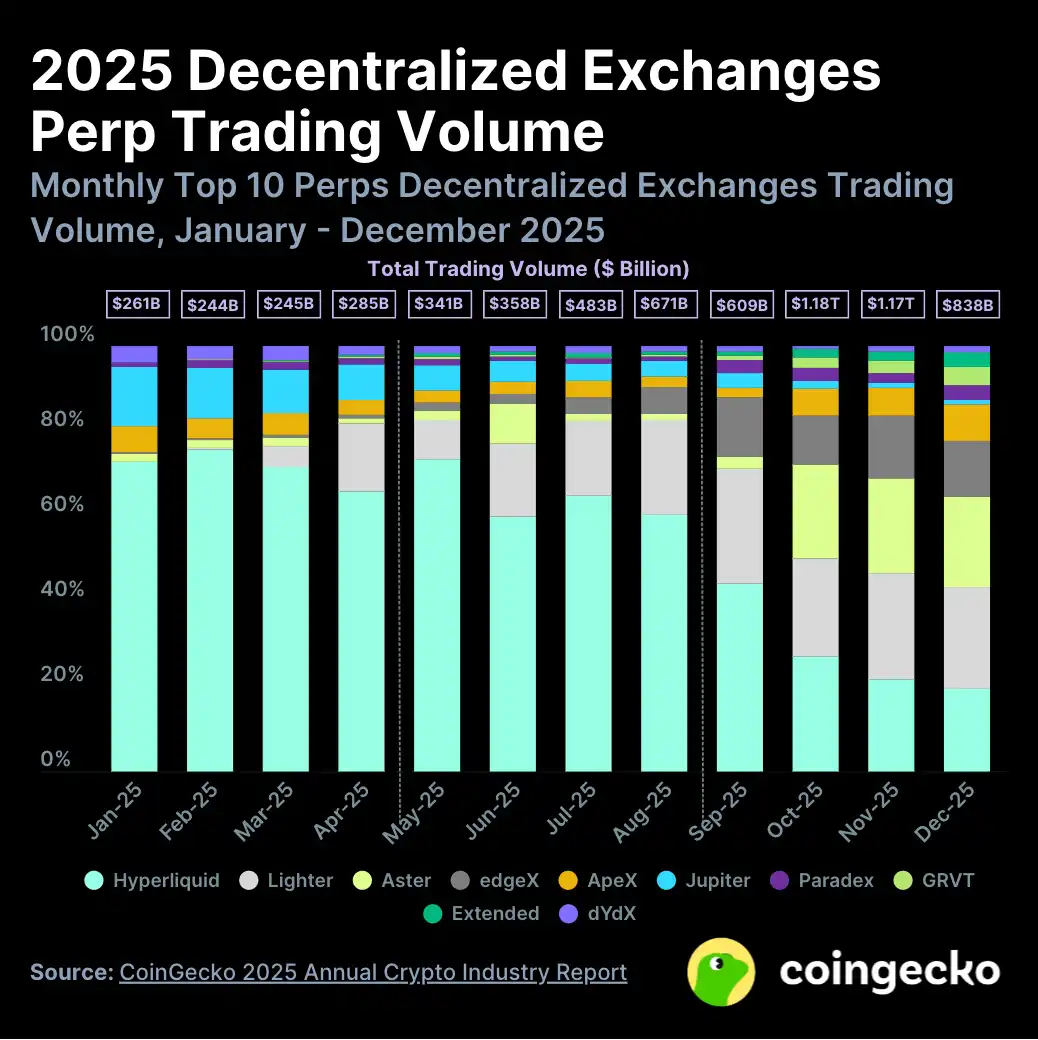
Decentralized perpetual futures exchange (Perp DEXes) trading volume grew by 80.8% in Q4 2025, from $1.8 trillion in Q3 to $3.2 trillion in Q4.

In 2025, the full-year trading volume of the top ten decentralized perpetual futures exchanges reached $6.7 trillion, a significant increase of 346% compared to $1.5 trillion in 2024. The ratio of Perp DEX to centralized perpetual futures exchange (CEX) trading volume jumped from 2.5% a year ago to 7.8%.

The growth in trading volume was mainly driven by incentives and airdrop activities provided by exchanges such as Lighter, Aster, edgeX, GRVT, and Paradex. Hyperliquid remained the most active perpetual decentralized exchange overall in 2025 but was overtaken by Lighter in the fourth quarter. Hyperliquid and Lighter have now entered the top ten perpetual futures exchanges by annual trading volume, recording $2.9 trillion and $1.3 trillion in trading volume, respectively.


Пов'язані питання

QWhat was the total cryptocurrency market capitalization at the end of 2025, and what was the percentage change from the previous year?

AThe total market capitalization at the end of 2025 was $3 trillion, representing a 10.4% decrease from the previous year.

QWhich asset was the top performer in 2025, and what was its annual growth rate?

AGold was the top-performing asset in 2025, with an annual growth rate of 62.6%.

QHow much did Digital Asset Treasury Companies (DATCos) invest in acquiring cryptocurrencies in 2025, and what percentage of the total Bitcoin and Ethereum supply do they now hold?

ADATCos invested at least $49.7 billion in 2025, and they now hold over 5% of the total supply of both Bitcoin and Ethereum.

QWhat was the annual growth rate for stablecoin market capitalization in 2025, and what was the new all-time high value?

AThe stablecoin market capitalization grew by 48.9% in 2025, reaching a new all-time high of $311 billion.

QWhich sector experienced a massive 302.7% surge in trading volume in 2025, and what was the total volume for the year?

AThe prediction market sector experienced a 302.7% surge in trading volume, reaching a total of $63.5 billion for the year.

Пов'язані матеріали

Has Hook Summer Truly Arrived? sato, Lo0p, FLOOD Ignite the New Uniswap v4 Narrative

With the broader market showing signs of recovery, a new wave of interest has emerged around Ethereum-based meme coins. Following ASTEROID, tokens like sato, sat1, Lo0p, and FLOOD, built upon the Uniswap v4 Hook protocol, are capturing market attention. Their market capitalizations range from millions to tens of millions of dollars, injecting much-needed focused liquidity into a market lacking narratives. This article explores whether this trend signifies an incoming "Hook Summer" and its potential impact on UNI's price. Hooks are essentially plug-in smart contracts for Uniswap v4 liquidity pools, allowing developers to inject custom logic at key points in a pool's lifecycle (like initialization, adding/removing liquidity, swaps). This transforms the AMM into programmable building blocks. Key highlighted projects include: * **sato**: Peaked over $38M market cap. It utilizes a v4 curve for minting/burning; buying locks ETH as reserve to mint new tokens, while selling redeems ETH from the reserve and burns tokens. * **sat1**: Market cap briefly exceeded $10M, promoted as an "optimized sato," but later declined significantly. * **Lo0p**: Reached nearly $6.6M. It's a lending AMM protocol where buying LO0P tokens locks them as collateral, allowing users to borrow ETH from the pool reserve at 40% LTV, aiming to improve capital efficiency for idle ETH in LPs. * **FLOOD**: Peaked near $6M. Its mechanism directs asset reserves from buys into Aave v3 to generate yield, with fees and interest retained in the pool to potentially influence the token's price long-term. In the long term, the development of the Hook ecosystem can attract users and liquidity to Uniswap v4, benefiting UNI's fundamentals—especially combined with the recent activation of the protocol fee switch, where a portion of fees is used to burn UNI. However, in the short term, these Hook-based tokens are unlikely to directly drive significant UNI price appreciation. Their impact is moderated by factors like token sustainability, price volatility, and broader market and regulatory conditions. Currently, Uniswap v4's TVL ($595M) still trails behind v2 and v3, indicating adoption and growth will take time. The article concludes that while the Hook ecosystem provides long-term "nourishment" for UNI, its short-term role is more of a "catalyst" than a "booster." Readers are cautioned that these are early-stage experimental tokens and may carry unknown risks.

Odaily星球日报1 хв тому

Has Hook Summer Truly Arrived? sato, Lo0p, FLOOD Ignite the New Uniswap v4 Narrative

Odaily星球日报1 хв тому

Interview with Michael Saylor: I Did Say I Would Sell Bitcoin, But Never a Net Sale

Interview with Michael Saylor: I Said We'd Sell Bitcoin, But Never Be a Net Seller In a recent podcast, MicroStrategy Executive Chairman Michael Saylor clarified the company's stance on potentially selling Bitcoin. Following MicroStrategy's earnings call statement about being prepared to sell BTC to fund dividends for its STRC (Strategic) credit product, Saylor emphasized the distinction between selling and being a "net seller." Saylor explained the core business model: MicroStrategy sells credit instruments like STRC and uses the proceeds to buy Bitcoin, which is viewed as "digital capital" expected to appreciate around 30-40% annually. A portion of these capital gains can then be used to pay the dividends on the credit products. He stressed that even if the company sells some Bitcoin for dividends, it simultaneously buys much more with new credit issuance. For example, after raising $3.2 billion from STRC sales in April, the dividend obligation was only $80-90 million, making the company a net buyer. The clarification aims to counter market narratives questioning the value of Bitcoin on MicroStrategy's balance sheet if it were never sold, and to dismiss claims of a "Ponzi scheme." Saylor reiterated his personal philosophy for investors: "Don't be a net seller of bitcoin" and ensure your Bitcoin holdings increase each year. Saylor also discussed Bitcoin's role as the foundation for "digital credit," noting that STRC has become the largest and most liquid preferred stock issue in the U.S., offering high risk-adjusted returns (Sharpe ratio). He highlighted Bitcoin's deep liquidity, stating that even large purchases by MicroStrategy do not move the market significantly, which is driven by macro factors, geopolitical tensions, and capital flows from ETFs and credit products. Finally, Saylor reflected on his early inspiration from sci-fi books, which motivated his path to MIT, and maintained his fundamental thesis on Bitcoin remains unchanged: it is superior digital capital enabling superior digital credit.

链捕手5 хв тому

Interview with Michael Saylor: I Did Say I Would Sell Bitcoin, But Never a Net Sale

链捕手5 хв тому

Beaten SK Hynix Employees in China: Year-end Bonus Less Than 5% of Korean Staff's

"SK Hynix Chinese Staff Hit Hard: Bonuses Less Than 5% of Korean Counterparts" Driven by the AI boom, South Korea's SK Hynix is experiencing record performance, with media reports predicting massive year-end bonuses for its employees, making them highly desirable in the matchmaking market. However, this prosperity starkly contrasts with the situation for the company's Chinese employees. According to reports, SK Hynix operates under a rule allocating 10% of operating profit for employee bonuses. While projections suggest Korean employees could receive bonuses reaching millions of RMB, a Chinese employee with over a decade of technical experience revealed the disparity: "If they get 3 million, Chinese staff get less than 5% of that." After adjustments based on KPI ratings, this employee's highest bonus was slightly over 100,000 RMB. Bonuses are paid annually in Korea but semi-annually in China. During the industry downturn in 2023-2024, Chinese employees received no bonus at all. The gap extends beyond bonuses. Recruitment posts for SK Hynix's Chinese factories (in Wuxi, Dalian, Chongqing) show engineer monthly salaries ranging from 10,000 to 35,000 RMB, with a 13th-month salary promised. Chinese employees also receive standard benefits like annual leave but lack stock incentives, which are reportedly unavailable to them. Furthermore, management positions in China are predominantly held by Korean personnel, though industry observers note a gradual increase in local middle managers over time. SK Hynix has confirmed the 10% bonus rule but cautioned that specific future bonus amounts remain unpredictable. The company forecasts strong demand for HBM and other high-value enterprise products for the next 2-3 years, driven by AI infrastructure investment. This focus on business-to-business markets may continue to constrain supply for consumer products, potentially prolonging price increases for components like memory.

链捕手19 хв тому

Beaten SK Hynix Employees in China: Year-end Bonus Less Than 5% of Korean Staff's

链捕手19 хв тому

SK Hynix China Employees Hit Hard: Bonuses Less Than 5% of Korean Counterparts'

"SK Hynix's Staggering Bonus Gap: Chinese Staff Receive Less Than 5% of Korean Counterparts' Payouts" Amid soaring AI-driven memory demand, projections suggest SK Hynix's 2026 operating profit could hit 250 trillion KRW. Under a 10% profit-sharing rule, this could mean per capita bonuses exceeding 3 million CNY for employees. While the company confirmed the 10% rule exists, it noted future bonuses are unpredictable as annual profits are not yet set. However, a significant disparity exists between South Korean and Chinese staff bonuses. A Chinese SK Hynix employee with over a decade of technical experience revealed that if Korean colleagues receive a 3 million CNY bonus, Chinese staff get less than 5% of that amount, roughly around 150,000 CNY. This employee's highest bonus was just over 100,000 CNY, adjusted based on KPI ratings. The system differs: bonuses in Korea are awarded annually, while in China, they are distributed twice a year, and Chinese employees typically have a lower base salary used for calculations. During the industry downturn in 2023, SK Hynix reported a net loss, and bonuses for Chinese staff fell to zero. Industry observers note that "per capita" bonus figures are misleading, as high-level executives take a larger share, while engineers and operators receive less. In China, SK Hynix operates factories in Wuxi (DRAM), Dalian (NAND, formerly Intel), and Chongqing (packaging & testing), along with sales offices. Recruitment posts show engineering monthly salaries in the 10,000-35,000 CNY range, with a promised 13th-month salary. Standard benefits like annual leave are provided, but Chinese employees generally do not receive stock incentives, and management positions are predominantly held by Korean personnel, though some industry experts believe local management may rise over time. Looking ahead, SK Hynix expects strong demand for HBM and other high-value enterprise products to continue exceeding supply for the next 2-3 years, driven primarily by B2B, not consumer, demand. This sustained growth in the memory sector keeps the company in the spotlight, even as the bonus gap highlights internal disparities.

marsbit39 хв тому

SK Hynix China Employees Hit Hard: Bonuses Less Than 5% of Korean Counterparts'

marsbit39 хв тому

Торгівля

Спот
Ф'ючерси

Популярні статті

Як купити T

Ласкаво просимо до HTX.com! Ми зробили покупку Threshold Network Token (T) простою та зручною. Дотримуйтесь нашої покрокової інструкції, щоб розпочати свою криптовалютну подорож.Крок 1: Створіть обліковий запис на HTXВикористовуйте свою електронну пошту або номер телефону, щоб зареєструвати обліковий запис на HTX безплатно. Пройдіть безпроблемну реєстрацію й отримайте доступ до всіх функцій.ЗареєструватисьКрок 2: Перейдіть до розділу Купити крипту і виберіть спосіб оплатиКредитна/дебетова картка: використовуйте вашу картку Visa або Mastercard, щоб миттєво купити Threshold Network Token (T).Баланс: використовуйте кошти з балансу вашого рахунку HTX для безперешкодної торгівлі.Треті особи: ми додали популярні способи оплати, такі як Google Pay та Apple Pay, щоб підвищити зручність.P2P: Торгуйте безпосередньо з іншими користувачами на HTX.Позабіржова торгівля (OTC): ми пропонуємо індивідуальні послуги та конкурентні обмінні курси для трейдерів.Крок 3: Зберігайте свої Threshold Network Token (T)Після придбання Threshold Network Token (T) збережіть його у своєму обліковому записі на HTX. Крім того, ви можете відправити його в інше місце за допомогою блокчейн-переказу або використовувати його для торгівлі іншими криптовалютами.Крок 4: Торгівля Threshold Network Token (T)Легко торгуйте Threshold Network Token (T) на спотовому ринку HTX. Просто увійдіть до свого облікового запису, виберіть торгову пару, укладайте угоди та спостерігайте за ними в режимі реального часу. Ми пропонуємо зручний досвід як для початківців, так і для досвідчених трейдерів.

409 переглядів усьогоОпубліковано 2024.12.10Оновлено 2025.03.21

Як купити T

Обговорення

Ласкаво просимо до спільноти HTX. Тут ви можете бути в курсі останніх подій розвитку платформи та отримати доступ до професійної ринкової інформації. Нижче представлені думки користувачів щодо ціни T (T).

活动图片