Coinbase to Launch Stock Futures, Why This Is Big For Crypto

bitcoinistОпубліковано о 2026-03-21Востаннє оновлено о 2026-03-21

Анотація

Coinbase, a major US cryptocurrency exchange, has announced the launch of stock perpetual futures for non-US traders. This expansion is a significant step in its "Everything Exchange" strategy, moving beyond crypto into traditional assets like stocks and ETFs. The new derivatives allow eligible traders to speculate on the price of major tech stocks (Apple, Microsoft, etc.) and index ETFs (SPY, QQQ) with up to 10x and 20x leverage, respectively, all settled in USDC. These contracts never expire, enabling 24/7 trading. This launch integrates traditional assets with crypto on a single platform, offering new trading and hedging opportunities but also introducing higher risks of volatility and liquidations.

Coinbase, one of the largest cryptocurrency centralized exchanges (CEX) in the United States, has just announced the launching of stock perpetual futures for non-US traders.

Coinbase Expands Beyond All Borders

The CEX’s expansion, announced today in a blog post on its official website, isn’t just about stepping beyond U.S. borders to give global traders ongoing leveraged exposure via perpetual futures. It also marks Coinbase’s push beyond crypto into traditional assets, turning this rollout into a fresh bet on the growing trend toward tokenized stocks and 24/7 markets, driven by both TradFi and DeFi players. Recently, Europe’s largest asset manager Amundi announced the launching of a tokenized fund on Ethereum and Stellar, as covered by Bitcoinist just today.

Coinbase frames this launch as part of its broader “Everything Exchange” strategy, aiming to bring crypto, traditional assets, and new tokenized products into one venue.

Today, Coinbase expands its global derivatives offering with the launch of stock perpetual futures, becoming one of the first major centralized venues to offer this product. This launch strengthens Coinbase’s position in international derivatives and advances our long-term strategy of building the Everything Exchange where traders can access crypto, traditional, and emerging assets side by side.

Over the past year, Coinbase has laid the regulatory and product runway for this leap. It first rolled out crypto perpetual futures to U.S. retail traders under CFTC oversight in mid‐2025, then pushed derivatives into Europe via a MiFID II license obtained through its Bux acquisition, reaching 26 countries in an earlier March 2026 expansion that landed alongside its stock index futures debut.

A 24/7 US stock market

The CEX itself describes perpetual futures as “a type of derivative contract that enables traders to speculate on the price of an asset (...) without needing to buy or own the underlying asset itself.” Unlike standard futures, never expire, so traders can keep positions open indefinitely as long as they meet the margin requirements.

At launch, contracts cover the “Magnificent Seven” tech stocks: Apple, Microsoft, Alphabet, Amazon, NVIDIA, Meta Platforms, and Tesla. In certain permitted jurisdictions, perpetual futures on benchmark ETFs tracking, the S&P 500 (SPY) and the tech‐heavy Nasdaq‐100 (QQQ), are also available.

Leverage goes up to 10x on individual stock perpetuals and up to 20x on ETF perpetuals. All contracts are settled in USDC, Coinbase’s preferred stablecoin. The platform uses unified margin across perpetual and spot positions, allowing more capital-efficient portfolio management and risk offsets.

What This Means For Traders

Coinbase is methodically weaving spot, futures, and now stock‐linked perpetuals into a single, always‐on risk platform that changes how both retail and institutions express views across markets. For traders, that unlocks new basis trades between spot stocks and perpetuals, tighter cross‐asset plays between crypto and U.S. equities, and more complex hedging around macro events and earnings.

The flip side is obvious: deeper leverage stacks mean a higher risk of cascading liquidations and sharper, event‐driven volatility when the Fed speaks, data prints hit, or Big Tech reports.
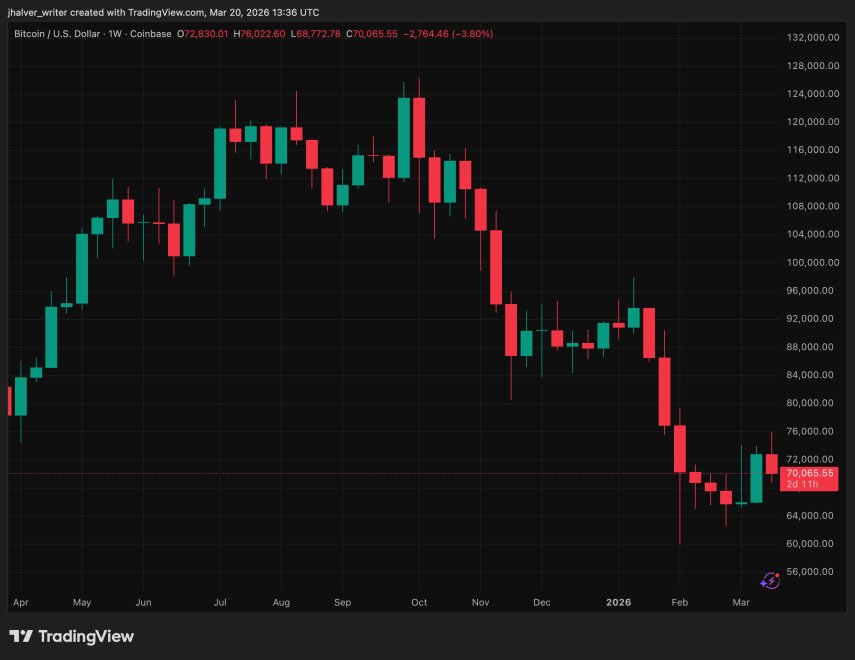
At the moment of writing, BTC trades barely above the $70k level on the daily chart, marking a downside trend. Source: BTCUSD on Tradingview

Cover image from Perplexity, BTCUSD chart from Tradingview

Пов'язані питання

QWhat new product has Coinbase announced for non-US traders?

ACoinbase has announced the launch of stock perpetual futures for non-US traders.

QWhich major tech stocks are covered by the new perpetual futures contracts?

AThe contracts cover the 'Magnificent Seven' tech stocks: Apple, Microsoft, Alphabet, Amazon, NVIDIA, Meta Platforms, and Tesla.

QWhat is the maximum leverage offered on individual stock perpetual futures?

ALeverage goes up to 10x on individual stock perpetual futures.

QIn what currency are all the new perpetual futures contracts settled?

AAll contracts are settled in USDC, which is Coinbase's preferred stablecoin.

QHow does Coinbase describe the broader strategy that this launch is a part of?

ACoinbase frames this launch as part of its broader 'Everything Exchange' strategy, aiming to bring crypto, traditional assets, and new tokenized products into one venue.

Пов'язані матеріали

From Gas Limit to 'Keyed Nonces', How to Understand the Next Step in Ethereum Scalability?

Ethereum’s scalability efforts are shifting toward a user-centric approach—focusing not only on higher TPS, but on translating technical upgrades into lower costs, smoother operations, and better wallet experiences. Two recent developments highlight this direction: - **Raising the Gas Limit to 200 million**: Following the Fusaka upgrade that increased it to 60 million, a consensus has formed around a potential future increase to 200 million. This would boost Ethereum’s execution capacity, but it is planned alongside other upgrades—such as ePBS, Block-Level Access Lists (BAL), and EIP-8037—to manage state growth and keep node operation viable for average participants. - **Keyed Nonces (EIP-8250)**: This proposal aims to improve how transactions are queued. Instead of a single linear nonce per account, it introduces multiple independent nonce domains. This prevents different types of transactions—such as private payments, session keys, or batch operations—from blocking each other. Vitalik Buterin views this as a foundational step toward better privacy support and more flexible state scalability. Together, these upgrades are part of a broader move to push complexity from wallets, DApps, and relays back into the protocol layer. For everyday users, this means future Ethereum interactions could become less congested, more intuitive, and safer—especially as core improvements in account abstraction, cross-L2 interoperability, and node decentralization continue to progress. Ultimately, Ethereum is evolving to handle not just more transactions, but more varied and complex on-chain use cases while preserving its decentralized foundation.

marsbit8 хв тому

From Gas Limit to 'Keyed Nonces', How to Understand the Next Step in Ethereum Scalability?

marsbit8 хв тому

Leaving OpenAI, How Much Has Their Net Worth Increased?

Former OpenAI employees have collectively accrued near-trillion dollar valuations through ventures and investments, charting AI's future. The article highlights two main paths: founding high-value companies like Anthropic and Perplexity, or applying insider insights as investors. Leopold Aschenbrenner exemplifies the investor path. After being fired from OpenAI, he leveraged firsthand knowledge of AI's massive energy demands to make hugely successful public market bets on nuclear and fuel cell companies, practicing "cross-industry cognitive arbitrage." Other alumni, like the Zero Shot VC fund founders, use their technical foresight for early-stage investing. Their key advantage lies not just in picking winners, but in knowing which technical approaches are likely dead ends—a "veto list" derived from internal OpenAI experience. Angel investing within the network, as seen with Mira Murati and Sam Altman, operates on deep, pre-existing understanding of a founder's capabilities, reducing due diligence to near zero. This creates an ecosystem bound by a shared belief in AGI's imminent arrival, differing from networks like the "PayPal Mafia" which were built on shared past struggles. The shift of these builders to investors signals a profound conviction: their situational awareness of the AI landscape is now so clear that deploying capital based on that judgment is more efficient than building themselves. They are allocating bets on the future they helped shape from the inside.

marsbit19 хв тому

Leaving OpenAI, How Much Has Their Net Worth Increased?

marsbit19 хв тому

Countdown to the AI Bull Market? Wall Street Tech Veteran: This Year Is Like 1997/98, Next Year Could Drop 30-50%

"AI Bull Market Countdown? Wall Street Veteran: This Year Feels Like 1997/98, Next Year Could Drop 30-50%" In an interview, veteran tech analyst Dan Niles draws parallels between the current AI boom and the 1997-98 period of the internet boom, suggesting the bull run isn't over yet. The core new driver is identified as "Agentic AI," which performs multi-step tasks and consumes vastly more computing power than conversational AI. This shift is expected to boost demand for cloud infrastructure and benefit CPU makers like Intel and AMD, potentially pressuring GPU leader Nvidia. However, Niles warns of significant short-term overbought conditions in semiconductors. His central warning is for a potential major market correction of 30-50% starting in early 2027. Drivers include a slowdown from high growth comparables, the outsized capital demands of companies like OpenAI, and a wave of massive tech IPOs sucking liquidity from the market. A J.P. Morgan survey of 56 global investors aligns with this view, finding that 54% expect a >30% U.S. stock correction by 2027. Among mega-cap tech, Niles favors Google due to its full-stack AI capabilities and cash flow, expresses concern about Meta's user growth, and sees potential for Apple's AI Siri and foldable iPhone. Niles advises investors to be nimble, hold significant cash, and closely monitor the conflicting signals from equities, oil prices, and bond yields, which he believes cannot all be correct simultaneously.

marsbit52 хв тому

Countdown to the AI Bull Market? Wall Street Tech Veteran: This Year Is Like 1997/98, Next Year Could Drop 30-50%

marsbit52 хв тому

Торгівля

Спот
Ф'ючерси

Популярні статті

Як купити ONE

Ласкаво просимо до HTX.com! Ми зробили покупку Harmony (ONE) простою та зручною. Дотримуйтесь нашої покрокової інструкції, щоб розпочати свою криптовалютну подорож.Крок 1: Створіть обліковий запис на HTXВикористовуйте свою електронну пошту або номер телефону, щоб зареєструвати обліковий запис на HTX безплатно. Пройдіть безпроблемну реєстрацію й отримайте доступ до всіх функцій.ЗареєструватисьКрок 2: Перейдіть до розділу Купити крипту і виберіть спосіб оплатиКредитна/дебетова картка: використовуйте вашу картку Visa або Mastercard, щоб миттєво купити Harmony (ONE).Баланс: використовуйте кошти з балансу вашого рахунку HTX для безперешкодної торгівлі.Треті особи: ми додали популярні способи оплати, такі як Google Pay та Apple Pay, щоб підвищити зручність.P2P: Торгуйте безпосередньо з іншими користувачами на HTX.Позабіржова торгівля (OTC): ми пропонуємо індивідуальні послуги та конкурентні обмінні курси для трейдерів.Крок 3: Зберігайте свої Harmony (ONE)Після придбання Harmony (ONE) збережіть його у своєму обліковому записі на HTX. Крім того, ви можете відправити його в інше місце за допомогою блокчейн-переказу або використовувати його для торгівлі іншими криптовалютами.Крок 4: Торгівля Harmony (ONE)Легко торгуйте Harmony (ONE) на спотовому ринку HTX. Просто увійдіть до свого облікового запису, виберіть торгову пару, укладайте угоди та спостерігайте за ними в режимі реального часу. Ми пропонуємо зручний досвід як для початківців, так і для досвідчених трейдерів.

314 переглядів усьогоОпубліковано 2024.12.12Оновлено 2025.03.21

Як купити ONE

Обговорення

Ласкаво просимо до спільноти HTX. Тут ви можете бути в курсі останніх подій розвитку платформи та отримати доступ до професійної ринкової інформації. Нижче представлені думки користувачів щодо ціни ONE (ONE).

活动图片