Coinbase Targets Crypto Crime, Freezing $3M Linked To Scam Operations

bitcoinistОпубліковано о 2026-06-05Востаннє оновлено о 2026-06-05

Анотація

Coinbase froze over $3 million in cryptocurrency linked to Southeast Asian scam networks as part of a multi-agency "Disruption Week" campaign. The operation, coordinated by the DOJ's Scam Center Strike Force, involved companies like Meta, Microsoft, and Starlink, and disrupted over 1.4 million scam accounts. The DOJ noted that investment fraud, including "pig butchering" scams, is among the fastest-growing threats, with crypto-related scams causing billions in losses. This action follows other recent crackdowns targeting scam infrastructure globally. Coinbase highlighted that blockchain provides a permanent transaction record, aiding investigations and countering the narrative that crypto is solely a tool for crime.

Coinbase moved to freeze more than $3 million in crypto linked to scam networks operating across Southeast Asia, a move that came as US authorities and private firms widened a joint campaign against fraud rings that have drained billions from Americans. The freeze was announced during Disruption Week, a coordinated push led by the DOJ’s Scam Center Strike Force.

Multi-Agency Push

According to Coinbase, the effort pulled in government agencies and private companies to hit the fraud chain at several points at once, from online accounts to money flows and physical sites. The exchange said no single company or agency could stop the crews on its own.

The company said the work involved social platforms, financial institutions, connectivity providers, and law enforcement working together, while the Justice Department framed the action as part of a broader strike against Southeast Asian criminal organizations. Officials said those groups have defrauded Americans of billions of dollars.
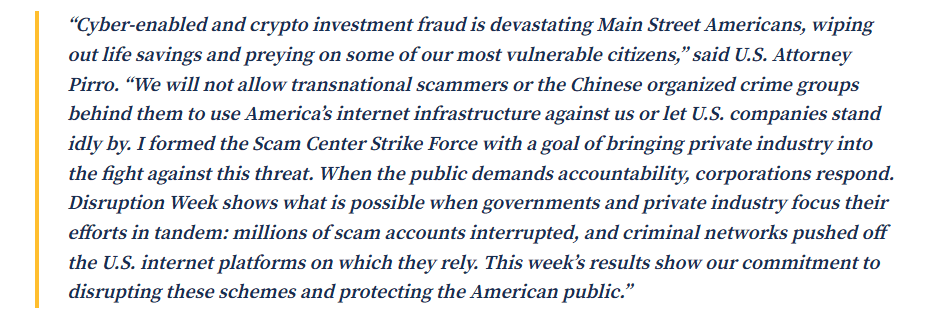
Source: US DOJ

Accounts, Servers, And Arrests

Meta, Microsoft, and Starlink were among the private firms named in the operation, helping take down servers and other hosting tools linked to the scam networks. Authorities also said more than 1.4 million social media and email accounts were disrupted, and the Royal Thai Police Anti-Cyber Scam Center made arrests tied to the effort.

The scam pattern is familiar, but the scale keeps climbing. The DOJ said investment fraud and pig butchering remain among the fastest-growing and most damaging scams aimed at Americans, and the FBI reported earlier this month that losses from crypto- and AI-related scams in 2025 topped $11 billion, with investment scams causing the most damage.

Total crypto market cap currently at $2.15 trillion. Chart: TradingView

Another part of the same push came in April, when the Scam Center Strike Force and its partners restrained more than $701 million in crypto tied to investment scams. Authorities have also carried out other crackdowns this year, including actions in Dubai and Albania, as pressure on scam infrastructure spread beyond Southeast Asia.

Crypto’s Place In The Crackdown

Coinbase also argued that blockchain gives investigators a permanent record of transactions, a point it used to push back on the idea that crypto is only a tool for crime. The coalition behind the operation included the FBI, the US Secret Service, and law enforcement partners in the UK, Australia, Canada, New Zealand, and Thailand.

The latest freeze fits a pattern of steady pressure on scam centers rather than one-off arrests. Officials have kept aiming at websites, messaging channels, servers, and the money trail itself, hoping to cut off the machinery that lets these fraud rings keep running.

Featured image from Unsplash, chart from TradingView

Пов'язані питання

QAccording to the article, how much cryptocurrency did Coinbase freeze that was linked to Southeast Asian scam networks?

ACoinbase moved to freeze more than $3 million in crypto linked to scam networks operating across Southeast Asia.

QWhat was the name of the coordinated law enforcement push during which this crypto freeze was announced?

AThe freeze was announced during Disruption Week, a coordinated push led by the DOJ's Scam Center Strike Force.

QWhich private companies were named as helping to take down servers linked to the scam networks?

AMeta, Microsoft, and Starlink were among the private firms named in the operation, helping take down servers and other hosting tools linked to the scam networks.

QWhat does the FBI report say about total losses from crypto- and AI-related scams in 2025?

AThe FBI reported earlier this month that losses from crypto- and AI-related scams in 2025 topped $11 billion, with investment scams causing the most damage.

QHow does Coinbase argue that blockchain technology can assist in fighting crime, according to the article?

ACoinbase argued that blockchain gives investigators a permanent record of transactions, pushing back on the idea that crypto is only a tool for crime.

Пов'язані матеріали

How Risky is the "Death Spiral" of MSTR and STRC?

Summary: This article explores the perceived "death spiral" risk between MicroStrategy (MSTR), its Bitcoin holdings, and its perpetual preferred stock (STRC), drawing comparisons to the LUNA-UST collapse. While both systems feature price anchors, high yields for holders, and potential feedback loops, their core mechanisms differ fundamentally. The MSTR-STRC structure relies on continuous financing to sustain its high dividend payouts, primarily through stock ATM offerings. A negative feedback cycle could occur: falling MSTR stock price makes raising equity capital harder, increasing pressure to sell Bitcoin, which undermines STRC confidence and further depresses MSTR. However, unlike LUNA-UST's automated, direct linkage, the MSTR-STRC loop is weaker and has brakes: STRC dividends can be deferred or rates lowered, and STRC holders have a $100/share liquidation preference in bankruptcy, providing a price floor. The company's sustainability hinges on its ability to continue financing. Its current ~$900 million USD reserves cover only about 6.3 months of its ~$1.71 billion annual interest/dividend burden. The next six months are critical, aligning with both the potential bottom in Bitcoin's four-year cycle and the depletion timeline of its reserves. While a LUNA-style catastrophic collapse is deemed highly unlikely due to structural differences, the key question is whether MicroStrategy can navigate this period through healthy deleveraging to restart its capital engine.

Foresight News10 хв тому

How Risky is the "Death Spiral" of MSTR and STRC?

Foresight News10 хв тому

How Much Debt Does Strategy Really Have? Is There a Risk of Implosion?

MicroStrategy's Debt Risk: A Turning Point in the "Never Sell" Strategy As of June 3, 2026, MicroStrategy holds 843,706 bitcoins (valued at ~$53.1B) but faces significant financial obligations. Its capital structure includes $6.75B in convertible notes and $15.48B in perpetual preferred stock (led by the $8.5B STRC series), creating an annual payout burden of ~$1.71B. With software revenue at only ~$500M, interest and dividend obligations far exceed operating income. A critical shift occurred in late May 2026 when the company sold 32 bitcoins for ~$2.5M to cover dividends, breaking CEO Michael Saylor's long-standing "never sell" pledge. This symbolic move triggered a sharp decline in both Bitcoin's price and MSTR stock, reflecting market fears about cash flow sustainability. The core of the strain is the STRC perpetual preferred stock, designed as a "permanent loan" with no maturity date but requiring high monthly dividends (currently 11.5%). Its business model relies on a three-part cycle: issuing new STRC shares, using proceeds to buy more Bitcoin and fund a USD reserve, and using that reserve to pay dividends. This cycle depends on continuous investor demand for STRC and Bitcoin's price appreciation. Analysis shows Bitcoin needs to appreciate at least 2.3% annually to cover the $1.71B in yearly obligations at current holdings. With Bitcoin price down ~22% from March 2026 highs, this pressure has intensified. The company's $900M USD reserve can only cover about 7 months of payments if STRC issuance stalls. Key risks are not immediate bankruptcy or forced Bitcoin liquidation (as BTC is not collateral), but rather: 1) The erosion of MSTR's premium to its Bitcoin holdings (mNAV), which would cripple its ability to raise cheap capital; 2) A vicious cycle where stagnant Bitcoin prices reduce STRC demand, draining the USD reserve and forcing BTC sales, further depressing prices. The period from February 2027 to September 2028 is a crucial test, with over $5.9B in convertible notes facing put options or maturity. In essence, MicroStrategy has evolved from a simple Bitcoin holder into a complex financial entity acting like a "private Bitcoin bank," leveraging its BTC holdings to create layered financial products. Its survival depends on maintaining Bitcoin's price trend, its stock premium, and market appetite for its preferred shares. The recent token sale marks not a betrayal of its Bitcoin thesis, but an admission that the leveraged strategy must eventually be paid for.

marsbit21 хв тому

How Much Debt Does Strategy Really Have? Is There a Risk of Implosion?

marsbit21 хв тому

Anthropic Cries Wolf: Is the AGI Threat Real, or Just an IPO Story?

Anthropic has published an article titled "When AI builds itself," discussing the emerging concept of "recursive self-improvement," where AI begins to actively participate in designing, training, testing, and optimizing its own subsequent versions. The company presents internal data showing that by May 2026, over 80% of code merged into its codebase was written by Claude, its AI model. Claude's capabilities have expanded to handling complex, open-ended engineering tasks, achieving a 76% success rate in such areas, and even contributing to research processes, such as optimizing code performance and conducting AI safety experiments. Anthropic outlines an evolution from human-driven development to AI-assisted workflows, culminating in the current stage where AI agents can autonomously write, run, and delegate code. The company cautions that the path toward a "closed loop," where AI continuously improves itself, is becoming visible. It calls for coordinated global mechanisms to potentially slow or pause frontier AI development to allow safety research and societal structures to catch up. However, the timing of this warning coincides with Anthropic's preparations for an IPO, framing the narrative not just as a safety concern but also as a demonstration of Claude's advanced capabilities and its integral role in accelerating Anthropic's own R&D—creating a potential "flywheel" effect for competitive advantage. This contrasts with OpenAI's recent, more policy-oriented discussion of the same risks, highlighting the competitive dynamics in the AI industry as companies position themselves in both the technological and regulatory landscape.

marsbit1 год тому

Anthropic Cries Wolf: Is the AGI Threat Real, or Just an IPO Story?

marsbit1 год тому

BIT Research: ETF Purchases Have Slowed, Strategy (MicroStrategy) Has Slowed, What Else Can Drive Bitcoin's Rise?

Market Refocus on Inflation and Rate Expectations Weighs on Bitcoin Currently, the market is in a phase of macro-repricing dominated by inflation and interest rate expectations. Bitcoin, which previously benefited from easy liquidity and low inflation, is seeing its core bullish drivers weaken. These drivers were market expectations for interest rate cuts and strong inflows from Bitcoin ETFs and institutions like MicroStrategy (referred to as "Strategy" in the text). The logic has shifted. Recent high inflation data (e.g., CPI hitting 3.8% in a May 2026 report) has caused the market to sharply reduce its rate cut expectations for 2025 and even price in potential hikes. This is a key constraint for Bitcoin, as it lacks cash flows and is highly sensitive to rate expectations. Concurrently, institutional capital flows have slowed significantly. Following the hot CPI data, Bitcoin ETFs saw accelerated outflows, with around $4.3 billion leaving over a period. MicroStrategy's ability to keep adding substantial Bitcoin to its balance sheet is also diminishing. Together, ETF and MicroStrategy holdings total roughly $110 billion, but their momentum as growth engines is cooling. In summary, Bitcoin's current pressure stems not from its own fundamentals but from a changing macro environment. As long as inflation stays elevated, Bitcoin is likely to remain in a consolidating phase. However, historically, inflation eventually peaks. Once it recedes and rate cut expectations rebuild, institutional capital could return, potentially fueling a new and more robust recovery phase for Bitcoin.

marsbit1 год тому

BIT Research: ETF Purchases Have Slowed, Strategy (MicroStrategy) Has Slowed, What Else Can Drive Bitcoin's Rise?

marsbit1 год тому

Торгівля

Спот
Ф'ючерси
活动图片





