Coinbase Secures Conditional OCC Approval For National Trust Charter – Details

bitcoinistОпубліковано о 2026-04-03Востаннє оновлено о 2026-04-03

Анотація

Coinbase, the largest US crypto exchange, has received conditional approval from the Office of the Comptroller of the Currency (OCC) to establish Coinbase National Trust Company. This marks a significant step toward becoming a federally regulated crypto custodian. The company clarified that this charter does not make it a commercial bank, and it will not take retail deposits or engage in fractional reserve banking. Instead, it aims to bring federal regulatory uniformity to its custody and market infrastructure business. This approval validates Coinbase's regulatory approach and allows it to expand its reach and conduct new business. It also signals a shift in the federal regulatory framework to align with the evolving crypto landscape. However, the move faces opposition from US banks and lawmakers, including the American Bankers Association and Senator Elizabeth Warren, who have raised concerns about regulatory arbitrage and called for delays until clearer rules are established. Coinbase joins other firms like Ripple, Circle, and Fidelity that have also received similar OCC approvals.

Coinbase, the largest crypto exchange in the US, has achieved a major milestone after securing a key approval from the main banking regulator, which could unlock a broader market for the company.

Coinbase Wins Major OCC Approval

On Thursday, Coinbase announced it received conditional approval from the Office of the Comptroller of the Currency (OCC) to charter Coinbase National Trust Company, marking a crucial step to becoming a federally regulated crypto custodian.

In the official statement, Coinbase outlined the scope of the charter, explaining that the company is not becoming a commercial bank and will not take retail deposits or engage in fractional reserve banking.

“This charter is about bringing federal regulatory uniformity to the custody and market infrastructure business we have been building for years. The OCC charter was designed precisely for this purpose — to provide clear oversight over assets in safekeeping — and that is exactly how we intend to use it,” the announcement read.

The conditional OCC approval allows Coinbase to “build the next chapter of finance,” the company noted, bolstered by the regulatory confidence, and validates its approach of “engaging with regulators, earning their trust, and operating to the highest standards.”

Moreover, the approval signals that the federal regulatory framework is transforming to align with the evolving landscape that crypto has been gradually shaping.

In an interview, Greg Tusar, Co-CEO of Coinbase Institutional, affirmed that “the ability to have a federal framework for our custody business is important,” adding that “this is about us growing our reach and being able to conduct new business that we may not have been able to before.”

Crypto Trust Banks Face Opposition

Coinbase applied for the charter last October and has now joined the list of firms that have received the main banking regulator’s approval. As reported by Bitcoinist, the OCC approved conditional bank charters for Ripple, Circle, BitGo, Paxos, and Fidelity in December.

In February, stablecoin platform Bridge, owned by Stripe, and crypto exchange Crypto.com announced they had also secured the OCC’s conditional approval to establish a national trust bank. However, US banks have raised concerns that the approvals could blur the lines between banking activities and lead to regulatory arbitrage.

Nearly two months ago, the American Bankers Association (ABA) asked the banking regulator to postpone its review of applications for crypto bank charters, suggesting that the approvals should wait until key regulatory uncertainties are resolved.

In its letter, ABA called for patience as emerging regulatory frameworks take shape, proposing that the review process continue when the US Congress completes the rules that will ultimately govern many recent applicants for the OCC’s charter.

The banking lobby cited uncertainty surrounding emerging business models, the need for increased transparency in the charter application and decision-making processes, and the absence of finalized federal oversight as key reasons for the proposed delay.

US Senator Elizabeth Warren also sent a letter to Comptroller Jonathan Gould asking the banking regulator to pause its review of the Trump Family’s main crypto venture, World Liberty Financial, which applied for a national trust charter in January.
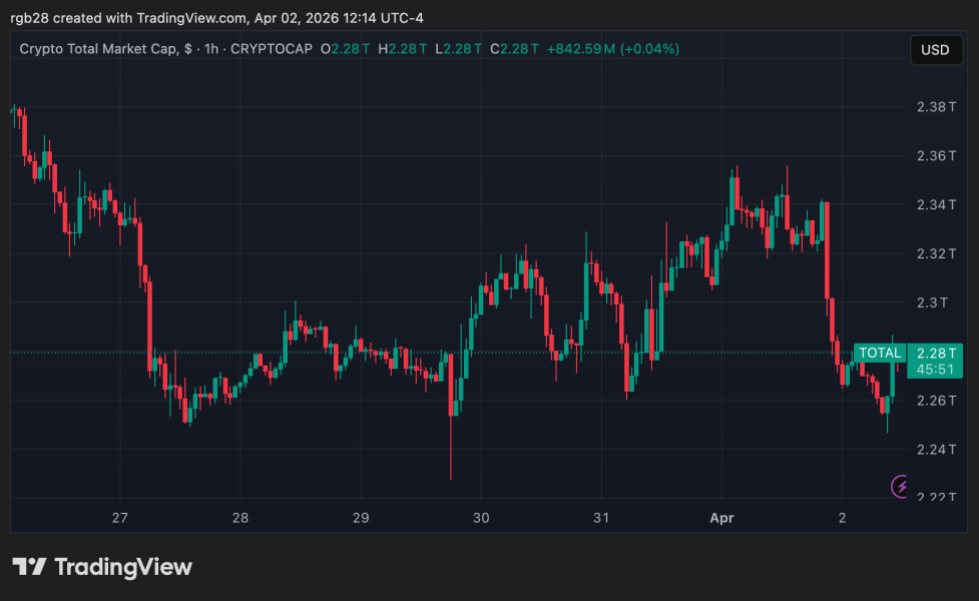
Total crypto market capitalization is at $2.28 trillion on the one-week chart. Source: TOTAL on TradingView


Пов'язані питання

QWhat is the significance of Coinbase securing conditional approval from the OCC?

AIt allows Coinbase to charter the Coinbase National Trust Company, marking a crucial step toward becoming a federally regulated crypto custodian and unlocking a broader market for the company.

QWhat does the OCC charter enable Coinbase to do, according to the company's statement?

AThe charter brings federal regulatory uniformity to Coinbase's custody and market infrastructure business, providing clear oversight over assets in safekeeping without engaging in commercial banking or taking retail deposits.

QWhich other companies have received conditional bank charters from the OCC, as mentioned in the article?

ARipple, Circle, BitGo, Paxos, Fidelity, Bridge (owned by Stripe), and Crypto.com have also secured conditional approval from the OCC for national trust bank charters.

QWhat concerns have US banks raised regarding the OCC's approval of crypto trust charters?

AUS banks are concerned that the approvals could blur the lines between banking activities and lead to regulatory arbitrage.

QWhy did the American Bankers Association (ABA) ask the OCC to postpone its review of crypto bank charter applications?

AThe ABA cited uncertainty surrounding emerging business models, the need for increased transparency in the application process, and the absence of finalized federal oversight as key reasons for the proposed delay.

Пов'язані матеріали

Anthropic's IPO Launch: Commercial Miracle or Valuation Bubble?

Anthropic has confidentially filed for an IPO, led by Morgan Stanley and Goldman Sachs, potentially going public by October. Following its latest $650 billion funding round, its pre-IPO valuation stands at $965 billion, with projections reaching up to $2 trillion at listing, which would make it the highest-valued private company ever. The article, written by Fu Sheng, addresses skepticism that this represents an AI bubble akin to the 2000 dot-com crash. It argues the current situation differs fundamentally. Unlike the internet bubble era, which relied on speculative narratives with little revenue, Anthropic's valuation is backed by unprecedented, measurable financial performance. Key data points include: * **Revenue Growth:** ARR skyrocketed from $10 billion in early 2025 to $470 billion by May 2026, targeting $100 billion by year-end—a growth curve unmatched in business history. * **Profitability:** It achieved operating profitability in Q2 2026 with an estimated $5.6 billion profit. * **Efficiency:** With ~3,000 employees and ~$470 billion ARR, its revenue per employee exceeds $10 million. Products like Claude Code, launched less than a year ago, already generate $25 billion in annualized revenue. * **Enterprise Adoption:** It boasts a strong enterprise client base, with 8 of the Fortune 10 and over 1,000 large firms spending over $1 million annually on Claude. The valuation is framed using a traditional SaaS model (e.g., a 10x Price-to-Sales multiple on $100 billion revenue). The author contends the core question for analysts has shifted from "How big could this be?" to "How much is it earning and will earn next quarter?" The discussion extends beyond Anthropic to a broader paradigm shift: the transition from a "carbon-based" to a "silicon-based" economy. Companies are increasingly prioritizing investment in compute and AI capabilities over human resources, as these directly scale productivity and competitive advantage. Anthropic's IPO is thus positioned not just as a corporate milestone, but as a price anchor for this new economic era.

链捕手2 год тому

Anthropic's IPO Launch: Commercial Miracle or Valuation Bubble?

链捕手2 год тому

Near Returns to the AI Stage: Transformation into a Public Chain Due to 'Payroll Difficulties,' Agent and Privacy Emerge as New Growth Narratives

NEAR Returns to AI Origins: From Payroll Struggles to Blockchain, Now Focusing on AI Agents and Privacy NEAR Protocol's journey began not with grand blockchain ambitions, but from a practical hurdle: its AI startup founders, including Transformer paper co-author Illia Polosukhin, couldn't efficiently pay international developers in 2017. This led them to pivot and build a high-performance, scalable blockchain. After years navigating various crypto narratives like sharding and cross-chain interoperability, NEAR is now leveraging its AI roots to re-enter the AI arena. A key driver is its "NEAR Intents" layer, which abstracts complex cross-chain transactions. Users simply state their goal (e.g., swap BTC for ETH), and a solver network finds the optimal route. This system has processed over $20B in cross-chain volume, generating significant fee revenue. A major growth area is private transactions via "Confidential Intents/Swaps," which hide trade details until settlement to protect against MEV and front-running. Remarkably, private swaps recently accounted for over 40% of NEAR's transaction volume, highlighting strong demand but also potential regulatory scrutiny. With its AI-founder pedigree, NEAR is positioning itself at the intersection of blockchain, AI agents, and privacy, aiming to become infrastructure for the emerging agent economy while navigating the challenges of its rapid adoption.

marsbit5 год тому

Near Returns to the AI Stage: Transformation into a Public Chain Due to 'Payroll Difficulties,' Agent and Privacy Emerge as New Growth Narratives

marsbit5 год тому

Торгівля

Спот
Ф'ючерси
活动图片




