Coinbase Secures Conditional OCC Approval For National Trust Charter – Details

bitcoinistОпубліковано о 2026-04-03Востаннє оновлено о 2026-04-03

Анотація

Coinbase, the largest US crypto exchange, has received conditional approval from the Office of the Comptroller of the Currency (OCC) to establish Coinbase National Trust Company. This marks a significant step toward becoming a federally regulated crypto custodian. The company clarified that this charter does not make it a commercial bank, and it will not take retail deposits or engage in fractional reserve banking. Instead, it aims to bring federal regulatory uniformity to its custody and market infrastructure business. This approval validates Coinbase's regulatory approach and allows it to expand its reach and conduct new business. It also signals a shift in the federal regulatory framework to align with the evolving crypto landscape. However, the move faces opposition from US banks and lawmakers, including the American Bankers Association and Senator Elizabeth Warren, who have raised concerns about regulatory arbitrage and called for delays until clearer rules are established. Coinbase joins other firms like Ripple, Circle, and Fidelity that have also received similar OCC approvals.

Coinbase, the largest crypto exchange in the US, has achieved a major milestone after securing a key approval from the main banking regulator, which could unlock a broader market for the company.

Coinbase Wins Major OCC Approval

On Thursday, Coinbase announced it received conditional approval from the Office of the Comptroller of the Currency (OCC) to charter Coinbase National Trust Company, marking a crucial step to becoming a federally regulated crypto custodian.

In the official statement, Coinbase outlined the scope of the charter, explaining that the company is not becoming a commercial bank and will not take retail deposits or engage in fractional reserve banking.

“This charter is about bringing federal regulatory uniformity to the custody and market infrastructure business we have been building for years. The OCC charter was designed precisely for this purpose — to provide clear oversight over assets in safekeeping — and that is exactly how we intend to use it,” the announcement read.

The conditional OCC approval allows Coinbase to “build the next chapter of finance,” the company noted, bolstered by the regulatory confidence, and validates its approach of “engaging with regulators, earning their trust, and operating to the highest standards.”

Moreover, the approval signals that the federal regulatory framework is transforming to align with the evolving landscape that crypto has been gradually shaping.

In an interview, Greg Tusar, Co-CEO of Coinbase Institutional, affirmed that “the ability to have a federal framework for our custody business is important,” adding that “this is about us growing our reach and being able to conduct new business that we may not have been able to before.”

Crypto Trust Banks Face Opposition

Coinbase applied for the charter last October and has now joined the list of firms that have received the main banking regulator’s approval. As reported by Bitcoinist, the OCC approved conditional bank charters for Ripple, Circle, BitGo, Paxos, and Fidelity in December.

In February, stablecoin platform Bridge, owned by Stripe, and crypto exchange Crypto.com announced they had also secured the OCC’s conditional approval to establish a national trust bank. However, US banks have raised concerns that the approvals could blur the lines between banking activities and lead to regulatory arbitrage.

Nearly two months ago, the American Bankers Association (ABA) asked the banking regulator to postpone its review of applications for crypto bank charters, suggesting that the approvals should wait until key regulatory uncertainties are resolved.

In its letter, ABA called for patience as emerging regulatory frameworks take shape, proposing that the review process continue when the US Congress completes the rules that will ultimately govern many recent applicants for the OCC’s charter.

The banking lobby cited uncertainty surrounding emerging business models, the need for increased transparency in the charter application and decision-making processes, and the absence of finalized federal oversight as key reasons for the proposed delay.

US Senator Elizabeth Warren also sent a letter to Comptroller Jonathan Gould asking the banking regulator to pause its review of the Trump Family’s main crypto venture, World Liberty Financial, which applied for a national trust charter in January.
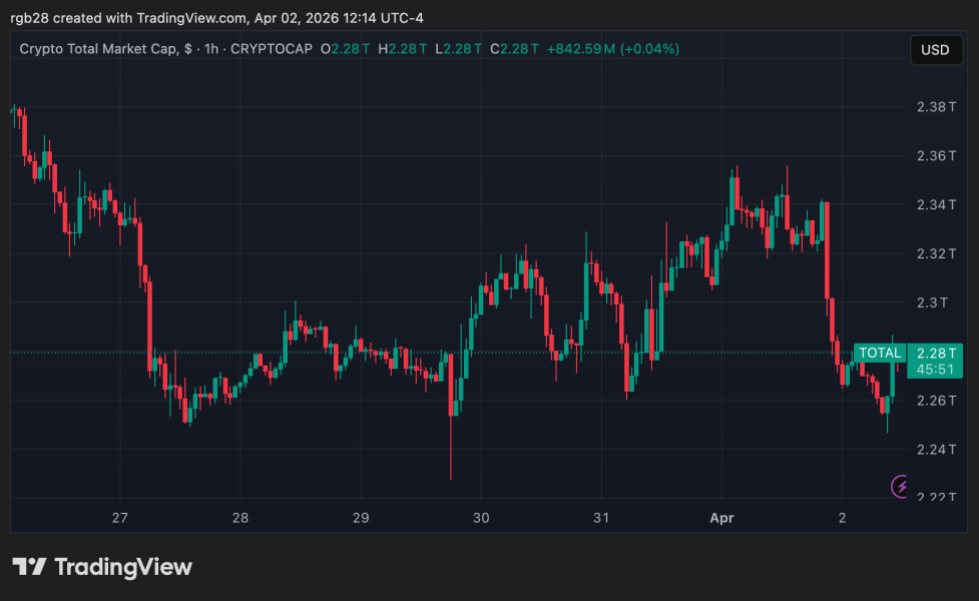
Total crypto market capitalization is at $2.28 trillion on the one-week chart. Source: TOTAL on TradingView


Пов'язані питання

QWhat is the significance of Coinbase securing conditional approval from the OCC?

AIt allows Coinbase to charter the Coinbase National Trust Company, marking a crucial step toward becoming a federally regulated crypto custodian and unlocking a broader market for the company.

QWhat does the OCC charter enable Coinbase to do, according to the company's statement?

AThe charter brings federal regulatory uniformity to Coinbase's custody and market infrastructure business, providing clear oversight over assets in safekeeping without engaging in commercial banking or taking retail deposits.

QWhich other companies have received conditional bank charters from the OCC, as mentioned in the article?

ARipple, Circle, BitGo, Paxos, Fidelity, Bridge (owned by Stripe), and Crypto.com have also secured conditional approval from the OCC for national trust bank charters.

QWhat concerns have US banks raised regarding the OCC's approval of crypto trust charters?

AUS banks are concerned that the approvals could blur the lines between banking activities and lead to regulatory arbitrage.

QWhy did the American Bankers Association (ABA) ask the OCC to postpone its review of crypto bank charter applications?

AThe ABA cited uncertainty surrounding emerging business models, the need for increased transparency in the application process, and the absence of finalized federal oversight as key reasons for the proposed delay.

Пов'язані матеріали

STRC Major De-pegging's First Financial Report, How Will Strategy Repair Its Capital Flywheel?

Bitcoin treasury company Strategy released its Q2 2026 earnings report on July 31. Despite a 6.9% year-over-year revenue increase to $122 million, the company recorded a net loss of $8.22 billion, largely due to $8.32 billion in unrealized losses from Bitcoin price fluctuations. As of quarter-end, Strategy holds 843,775 BTC with an average cost of $75,000 per coin, and Bitcoin per share increased. The report highlights a critical shift in Strategy's capital model following the de-pegging of its key financing tool, STRC (Strategic Coin), which fell below its $100 target. Management's top priority is restoring STRC to its target value, aiming for a recovery by September 8. They rule out discounted STRC issuances and plan to maintain its dividend yield at 12%, instead focusing on bolstering its $3.75 billion cash reserve. Strategy has moved from a one-way "buy-and-hold" Bitcoin strategy to active capital management. This new approach, part of its "Digital Credit Capital Framework," involves flexibly managing its balance sheet across four elements: BTC, USD cash, common stock (MSTR), and digital credit securities like STRC. This allows for BTC monetization (having sold $218.4 million in BTC so far), strategic repurchases of discounted securities, and debt optimization, as seen with a $1.5 billion convertible bond buyback. The company's future hinges on two key tests: successfully re-pegging STRC to restore market confidence in its digital credit system, and a long-term recovery in Bitcoin's price to ultimately support its growth thesis.

marsbit25 хв тому

STRC Major De-pegging's First Financial Report, How Will Strategy Repair Its Capital Flywheel?

marsbit25 хв тому

STRC's First Financial Report Post-Depegging, How is Strategy Restoring the Capital Flywheel?

On July 31, 2026, Bitcoin treasury company Strategy released its Q2 financial report. Despite a 6.9% year-over-year increase in revenue to $122 million, the company recorded a substantial net loss of $8.22 billion, primarily due to $8.32 billion in unrealized losses from Bitcoin holdings. While Strategy's core Bitcoin strategy remains intact—its holdings grew 11% to 843,775 BTC—the company is undergoing a fundamental shift in its capital model. Following the de-pegging of its key financing tool, the STRCoin (STRC), from its $100 target in May, Strategy has pivoted from a one-directional "raise funds, buy Bitcoin" cycle to a more dynamic, multi-asset capital management approach. A key part of this new framework is the "Monetization Program," through which Strategy has sold approximately $218.4 million worth of BTC to bolster liquidity. The company's top priority is repairing STRC's peg, committing not to issue discounted shares until it returns to its target range. It has initiated a $1 billion buyback program for discounted digital credit securities, having repurchased $28.9 million face value of STRC so far. Management aims to restore the peg around September 8, 2026. Strategy now actively manages a matrix of assets: Bitcoin (for accumulation or strategic sales), USD cash reserves (now at $3.75 billion), common stock (MSTR), and digital credit securities like STRC. This allows for tactical moves like repurchasing discounted debt or equity to capture value. The future success of Strategy's "capital flywheel" hinges on two factors: the short-term ability to successfully re-peg STRC to restore market confidence in its digital credit system, and the long-term price trajectory of Bitcoin, upon which its entire investment thesis ultimately depends.

Odaily星球日报30 хв тому

STRC's First Financial Report Post-Depegging, How is Strategy Restoring the Capital Flywheel?

Odaily星球日报30 хв тому

With Two Consecutive Quarters of Losses, Coinbase Must Rely on Paths Beyond Trading

Coinbase posted its second consecutive quarterly net loss of $359 million on $1.22 billion in revenue for Q2, highlighting its vulnerability to crypto market cycles where weaker prices and lower volatility reduce user trading. However, the report also reveals a strategic shift in its business model. Despite a 25% quarter-over-quarter decline in global spot trading volume, Coinbase increased its market share to a company-record 10.3%. This suggests its position as a compliant U.S. on-ramp is strengthening even in a cooler market. A key development is the diversification of revenue streams. Transaction revenue fell to $599 million, nearly equaling subscription and services revenue of $555 million. Stablecoin services, generating $292 million, are becoming a crucial revenue "floor." This income, derived from interest on the $20 billion average USDC balance held on its platform, is less tied to daily trading activity. Furthermore, while spot trading volume dropped significantly, derivatives volume held steady at $1.03 trillion. Coinbase is pushing to integrate spot, stablecoin, and derivatives liquidity to create a more interconnected and sticky ecosystem for users. The GAAP net loss includes non-cash expenses like stock-based compensation and crypto asset valuation changes. Its adjusted EBITDA remained positive at $208 million for the 14th straight quarter, indicating core operations can cover ongoing costs. The company is also reducing expenses to manage the downturn. The central question moving forward is whether Coinbase's growing market share, stablecoin revenues, and expanding product integration can sufficiently offset the inherent cyclicality of its core trading business during future market contractions.

marsbit45 хв тому

With Two Consecutive Quarters of Losses, Coinbase Must Rely on Paths Beyond Trading

marsbit45 хв тому

Торгівля

Спот
活动图片