Coinbase Launches Prediction Market Across US as SUBBD Explodes

bitcoinistОпубліковано о 2026-02-04Востаннє оновлено о 2026-02-04

Анотація

Coinbase has launched a U.S.-regulated prediction market platform, entering a space dominated by players like Polymarket and Kalshi. This move signals growing regulatory acceptance for event-based trading contracts. Meanwhile, attention is shifting toward utility-driven crypto projects like SUBBD Token ($SUBBD), which aims to decentralize the $85 billion content creator economy. SUBBD uses AI tools and Web3 payments to help creators monetize content more efficiently, bypassing high fees and restrictions from centralized platforms. Its ongoing presale has raised over $1.4 million, offering staking rewards and exclusive content access to token holders.

Coinbase just walked into the prediction market arena. By launching a U.S.-regulated platform for trading event contracts, the American crypto giant is taking a swing at emerging heavyweights like Polymarket and Kalshi.

This isn’t just about competition; it’s a signal. By running these contracts through its CFTC-regulated arm, Coinbase is essentially legitimizing a sector that’s spent years operating in DeFi’s gray zones.

It’s a bold move. Prediction markets used to be a niche curiosity, but recent volume on decentralized platforms proves there’s a massive appetite for betting on real-world outcomes, everything from Fed rates to election results.

Coinbase’s entry suggests infrastructure providers are finally comfortable with the regulatory landscape surrounding these ‘binary options.’ We aren’t just looking at asset speculation anymore; we’re moving toward functional markets where information, probability, and capital actually intersect.

But the democratization of markets isn’t stopping at financial derivatives. While Coinbase tackles the prediction vertical, a different shift is hitting the creator economy. Smart money is rotating into utility-driven protocols that solve actual headaches for non-financial users.

As the hype around prediction markets builds, liquidity is quietly flowing into projects that redefine content monetization. That’s where SUBBD Token ($SUBBD) steps in, a protocol aiming to dismantle the centralized monopolies choking the $85 billion content industry.

Check out the $SUBBD presale here.

SUBBD Token ($SUBBD) Redefining the $85 Billion Creator Economy

The digital content sector is facing a serious centralization problem. Platforms like OnlyFans and Patreon often take a 30% cut of earnings and hold the power to deplatform users on a whim. SUBBD Token ($SUBBD) uses a decentralized architecture to fix these inefficiencies, but it’s not just about lower fees.

By merging Web3 payments with advanced AI tools, the project offers a technological leap rather than just a financial band-aid.

The real differentiator here is the AI integration. According to the project’s whitepaper, SUBBD equips creators with an AI Personal Assistant for automated interactions and proprietary AI Voice Cloning tech.
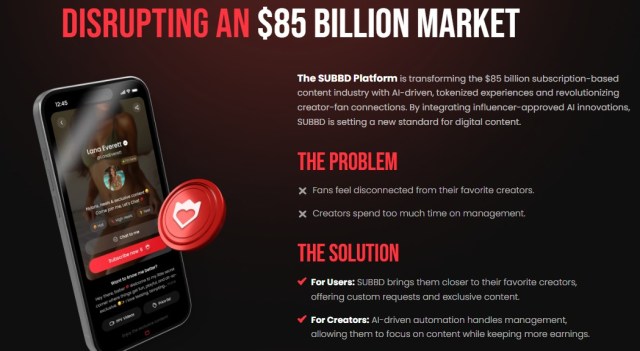
This allows for ‘AI Influencers’, autonomous personas that generate revenue 24/7. That matters. It shifts the creator economy from a labor-intensive grind to a scalable, asset-based model. Plus, by tokenizing access via Ethereum smart contracts, SUBBD ensures creators keep their data and revenue, not the platform.

The logic is simple: legacy platforms are struggling with payment restrictions and bloated fees, while decentralized alternatives offer better margins. SUBBD supports subscriptions, pay-per-view (PPV), and NFT sales, all governed by the token.

It’s a circular setup where the asset is needed for governance, staking, and premium features, theoretically driving demand as the user base grows.

Visit the $SUBBD presale.

Presale Surges Past $1.4M As Investors Seek Yield

You can see this rotation into utility tokens in the fundraising data. $SUBBD has raised over $1.4M in its ongoing presale, a figure that suggests serious conviction from early backers. With tokens currently priced at $0.05749, the entry point is still accessible relative to the roadmap.
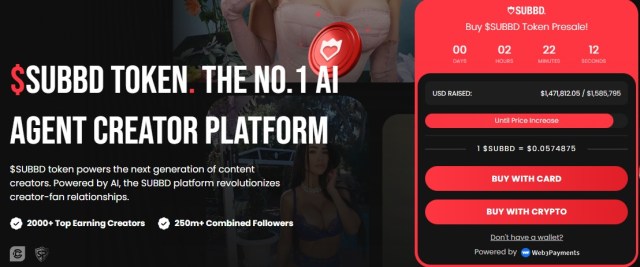
This steady inflow during a choppy market suggests investors are hedging against pure speculation by backing infrastructure plays with clear revenue models.

Staking incentives are also driving retention. SUBBD offers a fixed 20% APY for the first year to users who lock their tokens. That high-yield strategy does two things: rewards early adopters and takes supply off the table during the launch phase.

After that initial period, the model shifts to ‘platform benefit staking.’ Holding tokens then grants access to exclusive livestreams, ‘behind-the-scenes’ drops, and XP multipliers.

This structure makes the ecosystem sticky for active users. Unlike governance tokens that often lack immediate utility, $SUBBD functions as a license to operate within this new creator economy. As Coinbase validates decentralized prediction markets, projects like SUBBD are doing the same for content.

It points to a broader trend: blockchain tech finally replacing middleman-heavy industries.

Buy $SUBBD here.

Disclaimer: The content of this article is for informational purposes only and does not constitute financial advice. Cryptocurrency investments carry inherent risks, and you should perform your own due diligence before making any investment decisions.


Пов'язані питання

QWhat is the significance of Coinbase launching a U.S.-regulated prediction market platform?

ACoinbase's launch of a U.S.-regulated prediction market platform legitimizes a sector that has operated in DeFi's gray zones and signals that infrastructure providers are becoming comfortable with the regulatory landscape for binary options.

QHow does SUBBD Token ($SUBBD) aim to address problems in the content creator economy?

ASUBBD Token uses a decentralized architecture to reduce platform fees, prevent deplatforming risks, and integrates AI tools like an AI Personal Assistant and Voice Cloning to enable scalable, asset-based revenue models for creators.

QWhat fundraising milestone has the $SUBBD presale achieved, and what does it indicate?

AThe $SUBBD presale has raised over $1.4 million, indicating strong investor conviction in utility-driven protocols with clear revenue models during a volatile market.

QWhat staking incentives does SUBBD offer to its early adopters?

ASUBBD offers a fixed 20% APY for the first year to users who lock their tokens, rewarding early adopters and reducing supply during launch, followed by platform benefit staking for exclusive content access.

QHow does the integration of AI technology differentiate SUBBD from traditional content platforms?

ASUBBD's AI integration enables features like AI Influencers and automated interactions, shifting the creator economy from a labor-intensive model to a scalable, autonomous revenue-generating system.

Пов'язані матеріали

Agent Race Ends, Super Workbench Takes Over

The era of fragmented AI agents is ending. Over the past month, China's tech giants—Tencent, Alibaba, and ByteDance—have simultaneously shifted strategy: instead of launching new, standalone AI agents, they are consolidating their various agent projects into unified "super workbenches." Tencent integrated its QClaw teams into WorkBuddy, a strategic product hailed as a potential third flagship after QQ and WeChat. Alibaba is merging its QoderWork, Wukong, and MuleRun agents into a new "Qianwen Office" platform under DingTalk's leadership. ByteDance rebranded its TRAE SOLO coding agent to TRAE Work, signaling a broader focus on workflow collaboration. This convergence marks a pivotal industry consensus. The initial exploration phase, where companies rapidly built numerous overlapping agents for different scenarios, proved costly and inefficient. With open-source tools eroding technical barriers, competition has shifted from agent creation to resource consolidation and cost control. Historically, platform wars are won not by creating more products, but by simplifying them—as seen with browsers unifying web access and super-apps consolidating services. Now, the "super workbench" aims to become the unified AI entry point for work. This reflects a deeper market realization: the primary audience for AI is no longer just programmers (a market in the tens of millions) but all knowledge workers (a market of billions). The real opportunity lies in augmenting everyday tasks—managing emails, documents, data, and meetings—across the entire workday. The core battleground is becoming control over the primary AI entry point that employees use daily. Tencent's WorkBuddy leverages WeChat and Tencent Docs; Alibaba's Qianwen Office taps into DingTalk's organizational data; ByteDance's TRAE Work integrates with Feishu's workflows. Whoever owns this "super workbench" gains strategic control over orchestrating enterprise data and APIs. This shift is redefining enterprise software. Traditional SaaS applications, valued for their user interfaces, will recede into the background. Their core functionalities will be exposed as standardized "Skills" or APIs for the super workbench's agents to invoke. Software value will shift from selling user seats to charging based on API calls and outcomes delivered. The evolution of agents is moving through clear stages: first as novel standalone products, then as consolidated primary work entry points, and finally as pervasive, invisible capabilities embedded into the digital fabric. The recent moves by major tech firms signal the transition from the first stage into the second, accelerating toward the third. In the end, the most successful agent technology may become invisible—like electricity or the HTTP protocol—a fundamental, unnamed infrastructure powering work itself.

marsbit17 хв тому

Agent Race Ends, Super Workbench Takes Over

marsbit17 хв тому

Michael Saylor: 110 Reasons to Oppose BIP-110

Michael Saylor presents 110 arguments against Bitcoin Improvement Proposal (BIP) 110, a soft fork aimed at restricting certain non-monetary data storage uses (like inscriptions) on the Bitcoin blockchain. He acknowledges the proponents' valid concerns—such as node costs, fee pressure, and preserving Bitcoin's monetary focus—but fundamentally disagrees with the proposed solution. Saylor argues that BIP 110 represents a dangerous precedent of using consensus rules to enforce value judgments on transaction validity, moving away from Bitcoin's core principles of neutrality and permissionless innovation. His key objections are organized into eleven categories: 1) It violates neutrality and hard consensus by banning currently valid transactions. 2) It fails to meet the high burden of proof required for a consensus change, lacking concrete data on the alleged crisis. 3) Its seven bundled technical restrictions are overly broad, targeting generic script functionalities and blocking future upgrade paths. 4) It sacrifices compatibility and future optionality by closing off designed upgrade hooks. 5) Its temporary rules add significant complexity (grandfathering, expiry states) without sufficient justification. 6) The economic and security impacts, particularly on miner revenue and fee markets, are uncertain and unmodeled. 7) Superior, market-based tools (fee markets, relay/mining policies) already exist to manage blockchain load. 8) It stifles innovation by creating a chilling effect for developers. 9) Its modified activation mechanism (55% threshold, forced signaling) is aggressive and risks network splits. 10) The precedent it sets—using consensus to suppress disliked but legal uses—is more dangerous than the problem it aims to solve. 11) A better path exists: improving measurements, refining resource-based policies, and allowing market forces to work. Saylor concludes that Bitcoin's strength lies in its neutral rules, open markets, and hard consensus. Changing these foundational elements to target specific use cases is an unnecessary and risky "iatrogenic" intervention. He advocates for guarding Bitcoin's neutrality rather than acting as its redeemer.

marsbit32 хв тому

Michael Saylor: 110 Reasons to Oppose BIP-110

marsbit32 хв тому

Торгівля

Спот
活动图片

