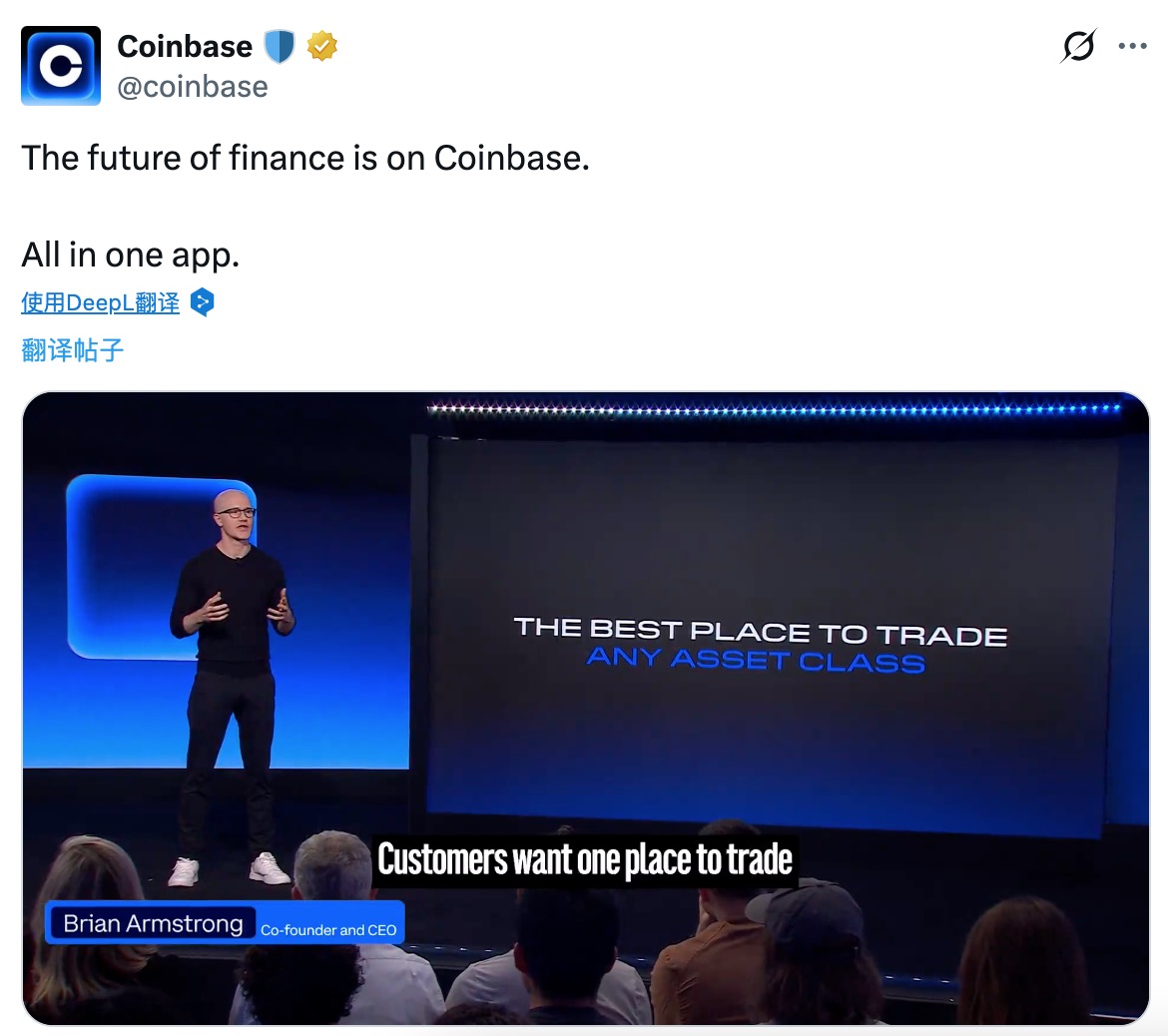
"The future of finance is on Coinbase. All in one app." With these two short sentences at today's System Update launch event, Coinbase charted a new course for its future in 2026 and even a decade beyond.
As an industry leader with a market cap exceeding $65 billion and the largest cryptocurrency trading platform in the United States, Coinbase has no intention of resting within its existing boundaries. It is initiating the most radical and disruptive product expansion in its 13-year history: breaking down the traditional compartments of the financial world to integrate crypto assets, stocks, derivatives, on-chain ecosystems, and even prediction markets into a single, seamless application experience. From partnering with Kalshi to launch prediction markets, to integrating Jupiter for seamless Solana DEX trading; from the introduction of zero-commission stock trading, to tailoring stablecoins for enterprises—these initiatives are not scattered product updates but are closely centered around a core strategy: building an "all-in-one exchange" that goes beyond cryptocurrency.
Pulling the perspective back reveals the full depth of this strategy. From the approval of its minority equity investment in CoinDCX by Indian regulators, to joining the U.S. "Tech Force" program to participate in the national fintech agenda; from launching the next-generation open protocol x402 V2 connecting AI and payments, to collaborating with traditional financial giants like Standard Chartered to explore institutional-grade digital asset services—Coinbase's year-end布局 has clearly outlined a strategic path: using cryptocurrency as a foundation and extending upwards, downwards, left, and right to weave a financial network covering retail and institutions, and blending centralized and decentralized services.
This heavyweight year-end launch undoubtedly sets the tone and raises the curtain for Coinbase's 2026 and beyond. A larger, more complex, and more ambitious Coinbase is emerging.
Six Business Pillars, Building the Foundation of the "All-in-One Exchange"
Coinbase's current expansion is a systematic restructuring of its financial product matrix. The six core businesses it released target different markets and user needs, collectively forming the solid foundation of the "all-in-one exchange."
Stock Trading: Opening the Door to Traditional Financial Markets
As a core move in this strategic expansion, Coinbase, through its FINRA-regulated subsidiary Coinbase Capital Markets Corp., officially offers U.S. users access to U.S. stock trading services. Furthermore, a company spokesperson clearly stated: "Zero-commission stock trading will be a permanent service on Coinbase." While the specific profit model for this aggressive pricing strategy has not been disclosed, it is clearly aimed at rapidly gaining market share and breaking down the commission barriers of traditional brokerages.
The breakthrough of the service lies not only in pricing but also in the integrated experience—users will be able to freely buy and sell stocks using USD or USDC within the same Coinbase account, achieving true integrated management of crypto assets and traditional financial assets. More notably, Coinbase will offer extended trading hours for select stocks—five days a week, 24 hours a day. This challenges the traditional financial market trading model and paves the way for a round-the-clock digital asset trading ecosystem. The company plans to add "thousands" of new listings in the coming months, significantly expanding the investable universe. Beyond spot trading, Coinbase is also laying the groundwork for deeper product innovation. The company is preparing the foundation for stock-linked perpetual futures, which will allow users outside the U.S. to gain continuous exposure to U.S. stocks through the higher capital efficiency of derivative forms. This product is planned to expand its coverage early next year, by which time Coinbase will have built a complete stock investment product line from spot to derivatives.
Furthermore, Coinbase has explicitly positioned this service as a strategic bridge to "asset tokenization." The company has announced plans to launch a dedicated "Coinbase Tokenize" platform in 2026, supporting the on-chain issuance and management of assets like stocks. Today's stock trading feature is precisely the key infrastructure being laid for tomorrow's global programmable asset market based on blockchain, reflecting Coinbase's long-term evolution path from a traditional financial access point to a future asset issuance platform.
Prediction Markets: Exploring Event-Driven Finance
While embracing traditional assets, Coinbase is also extending its reach into a more frontier area—prediction markets. Through a partnership with Kalshi, a leading platform regulated by the U.S. CFTC, Coinbase can introduce event contract trading—a niche but high-potential market—into its mainstream application. Holdings for these alternative investments are displayed alongside users' cryptocurrency, stock, and even cash balances in the same interface, achieving alternative diversification of the investment portfolio. The choice to partner with a licensed entity like Kalshi, rather than directly integrating with a decentralized protocol, also highlights Coinbase's prudent consideration of compliance frameworks when expanding into new businesses, aiming to establish a legal and credible market benchmark for such sensitive financial activities.
Starting with Solana, Embracing High-Activity Public Chain Ecosystems
As one of the world's largest centralized exchanges, Coinbase is acutely aware that its traditional listing processes struggle to match the agility of DEXs in capturing the explosive growth of emerging tokens. To address this, the company has taken a strategic step: directly integrating Jupiter, the largest DEX aggregator in the Solana ecosystem. This transforms its platform from a provider of a closed asset list into an aggregator of liquidity from open ecosystems. Users can seamlessly trade the vast array of newly minted tokens on Solana without leaving the app or managing complex wallets. All the complex cross-DEX routing and price discovery processes are handled by Jupiter in the background. This move cleverly "packages" the richness and liquidity of DeFi long-tail assets into the smooth user experience of a centralized platform. More importantly, it signals a shift in Coinbase's product philosophy from "we decide what you can trade" to "we help you trade everything." Coinbase stated that it plans to extend this integration model to other high-growth public chain networks in the future. A new paradigm may be taking shape, with Coinbase acting as a unified front-end interface aggregating liquidity from vast DEXs across multiple public chains.
Custom Stablecoins: Developing Enterprise-Grade Financial Services
In the stablecoin sector, a core track of the crypto economy, Coinbase has chosen to launch a "Custom Stablecoin" service, directly targeting the enterprise market. This service allows enterprise clients to use USDC as reserve assets to flexibly issue and customize their own branded stablecoins. This move puts Coinbase in direct competition with established issuance service providers like Paxos and Anchorage, opening up a new, high-margin "Finance-as-a-Service" business line for institutions. Beyond that, the deeper strategic significance of this new service lies in ecosystem building. Using USDC as the reserve asset will substantially strengthen USDC's position as the "base currency" within the stablecoin system. By attracting more enterprises to issue custom stablecoins based on USDC, Coinbase not only expands the application scenarios and market share of USDC but also builds a stablecoin ecosystem moat centered around itself, achieving the dual goals of business expansion and ecosystem strengthening.
According to Coinbase, early partners exploring the product include Flipcash, Solflare, and R2.
Simplified Derivatives Trading: Promoting the Popularization of Leverage Tools
Coinbase is making futures and perpetual contracts trading, previously aimed at professional users and mainly集中在 Coinbase Advanced, available to all U.S. traders through a redesigned, simplified interface. According to a Coinbase spokesperson, the new interface mimics the intuitive spot trading experience, significantly lowering the cognitive and operational barriers to leveraged products, enabling a broader range of retail users to easily participate in derivatives trading.
This strategic shift reflects Coinbase's keen insight into market demand. In an environment where spot market volatility may narrow, providing easy-to-use leveraged products can meet users' needs for capital efficiency and diverse strategies, and is also an important move for the platform to seek new revenue growth points. By "democratizing" professional financial tools, Coinbase can not only increase user stickiness and platform activity but also carve out a crypto-native competitive path in a derivatives market dominated by traditional brokers.
Comprehensive Support: AI Assistant, Developer Platform, and Business Services
Coinbase's current expansion is not just an enrichment of its product lines but also a comprehensive upgrade of its platform infrastructure. While expanding the categories of tradable assets, the company is building a multi-faceted support system covering individual investors, developers, and enterprise customers, providing all-around service support for its "all-in-one exchange" vision.
For individual users, the AI assistant "Coinbase Advisor" can provide personalized asset allocation advice and investment strategy analysis based on the user's specific holdings and real-time market data, offering intelligent, scalable advisory services traditionally reserved for high-net-worth individuals to every ordinary investor. Meanwhile, Base App, the on-chain "universal app" for ordinary users, has ended its Beta phase and launched in over 140 countries worldwide; at the developer ecosystem level, the upgraded developer platform provides a complete API suite covering custody, payments, trading, and stablecoins. Currently, companies including Deel, Papaya, Routable, and dLocal are using Coinbase's Payments API; in terms of business services, "Coinbase Business" currently provides compliant companies in the U.S. and Singapore with complete crypto-native financial solutions, including core functions such as global payments, digital asset management, USDC balance yield, and financial process automation. It is particularly noteworthy that Coinbase stated that business customers will gain access to fully synchronized trading function expansions, including all new asset classes like stocks and derivatives.
These three levels of support form an organic whole, collectively transforming Coinbase from a mere trade execution platform into comprehensive financial infrastructure integrating investment management, ecological innovation, and institutional services. This transformation not only enhances the platform's user stickiness and commercial value but also builds a complete business闭环 for Coinbase, from individuals to enterprises, from applications to ecosystems.
Summary
Coinbase's large-scale expansion of its product matrix marks a critical step in its formal transition from a specialized cryptocurrency exchange to a comprehensive "all-in-one exchange." By combining stocks, derivatives, on-chain assets, and even prediction markets with its traditional crypto business, and building a multi-faceted support system covering AI assistants, developer platforms, and enterprise-grade services, Coinbase is creating a truly integrated one-stop platform that merges traditional finance with the crypto ecosystem.
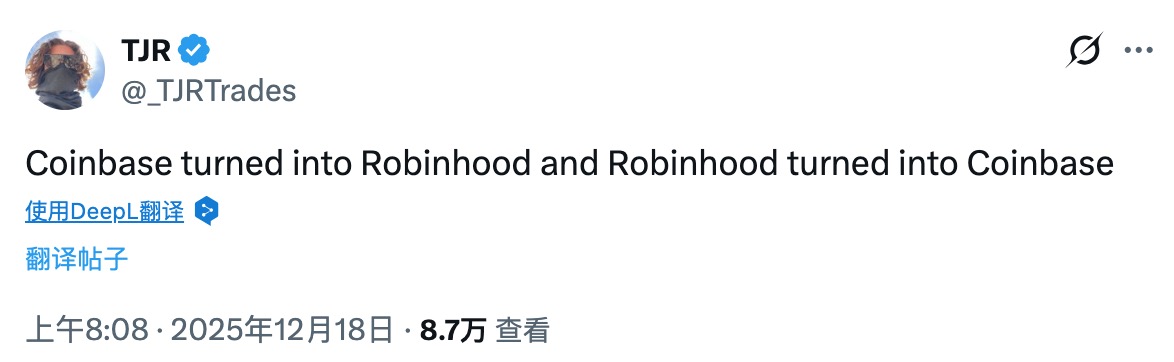
Of course, the industry has offered evaluations from different perspectives on this strategic shift. Adherents of decentralized ideals have expressed skepticism, viewing this move as a deviation from Crypto's original purpose. Other market observers, from the perspective of industry evolution, point out that the boundaries of fintech services are increasingly blurring—"Coinbase is becoming Robinhood, and Robinhood is becoming more like Coinbase."
In essence, Coinbase is blurring the boundaries between centralized and decentralized finance. It packages DeFi liquidity into a smooth centralized experience, accesses traditional assets through compliance frameworks, and simultaneously lowers the barrier to on-chain participation through Base App. This path of "wanting both centralized experience and decentralized innovation" reflects the convergence trend in fintech development.
As Coinbase declared at the launch event—"The future of finance is on Coinbase. All in one app"—this statement is both a declaration of its own ambition and an apt description of the major trend towards integration and convergence in financial services in the digital age. Whether Coinbase can successfully realize this grand vision remains to be seen, but undoubtedly, it has already set a new benchmark worthy of attention and consideration for the entire industry.


















