Coinbase ‘cautiously optimistic’ on 2026 as crypto nears institutional inflection point

cointelegraphОпубліковано о 2025-12-19Востаннє оновлено о 2025-12-19

Анотація

Coinbase Institutional's 2026 outlook is cautiously optimistic, forecasting a potential institutional inflection point for crypto driven by regulatory clarity, stablecoin adoption, and an improving macro backdrop. The report highlights key U.S. policy developments, including stablecoin legislation and market structure bills, as crucial for institutional integration. It projects the stablecoin market could grow to $1.2 trillion by 2028. Bitcoin's volatility has moderated, now resembling high-growth tech stocks, with 90-day historical volatility declining to 35-40% by end-2025. Despite 2025's price swings and leverage-induced corrections, Bitcoin is now seen as an established part of the global financial conversation.

After a year of unexpected turbulence for crypto markets, 2026 could mark a turning point driven by regulatory clarity, accelerating stablecoin adoption and an improving macroeconomic backdrop, according to a new outlook from Coinbase Institutional.

In its 70-page report, Coinbase Institutional said digital assets have evolved “from a niche market to an emerging pillar of global market infrastructure,” even as price volatility and uneven liquidity defined much of 2025.

Looking ahead, Coinbase’s institutional arm expects clearer global regulatory frameworks to provide stronger policy guardrails, supporting innovation and long-term market maturation.

Rather than another retail-driven boom-and-bust cycle, 2026 is framed as a year of institutional integration and regulatory maturity, with clearer rules enabling deeper participation from traditional financial players.

In the United States, Coinbase Institutional pointed to landmark policy developments, including progress on stablecoin legislation such as the GENIUS Act and momentum toward a broader crypto market structure bill, as key factors shaping the next phase of adoption.

These efforts are expected to influence everything from risk management and compliance standards to institutional portfolio strategies.
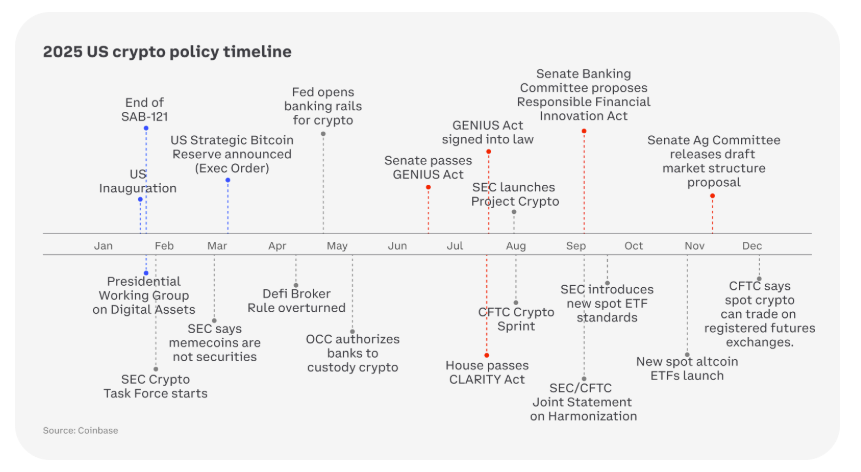
Coinbase Institutional flags the evolution of US crypto policy as a key driver of a potentially transformative 2026. Source: Coinbase Institutional

Stablecoins remain one of crypto’s most established use cases, with Coinbase Institutional projecting significant expansion in the years ahead. Its model forecasts that the stablecoin market could grow to about $1.2 trillion by 2028, driven by increased use in payments, settlement, payroll and cross-border remittances.
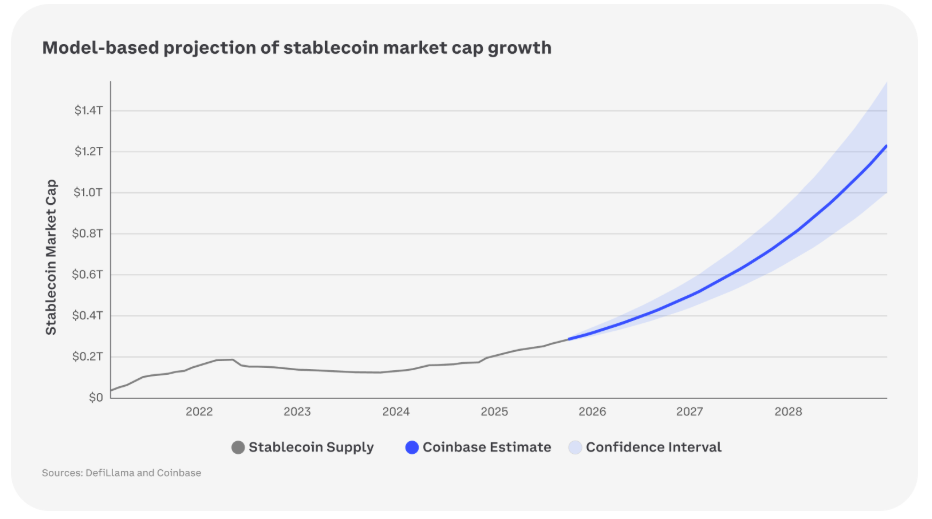
After years of rapid expansion, Coinbase Institutional’s model forecasts that the stablecoin market could reach $1.2 trillion by 2028. Source: Coinbase Institutional

Still, the outlook stops short of outright optimism. Coinbase Institutional described its macroeconomic expectations as “cautiously optimistic,” arguing that while economic growth may remain uneven, the US economy has shown greater resilience than recent data implies.

Persistent inflation risks and the timing of potential interest rate cuts remain key variables that could influence crypto market recovery heading into 2026.

Related: US banks may soon issue stablecoins under FDIC plan to implement GENIUS Act

Bitcoin’s volatility profile is shifting

One of Coinbase Institutional’s key observations is that Bitcoin’s volatility profile has gradually evolved. Rather than standing out as an extreme outlier among major asset classes, Bitcoin’s volatility now resembles that of high-growth technology stocks, the report said.

Coinbase pointed to Bitcoin’s (BTC) 90-day historical volatility, which declined to about 35% to 40% by the end of 2025, down from levels above 60% in mid-2024. The moderation occurred even as the market absorbed major structural changes, including the approval and rollout of spot Bitcoin exchange-traded funds.
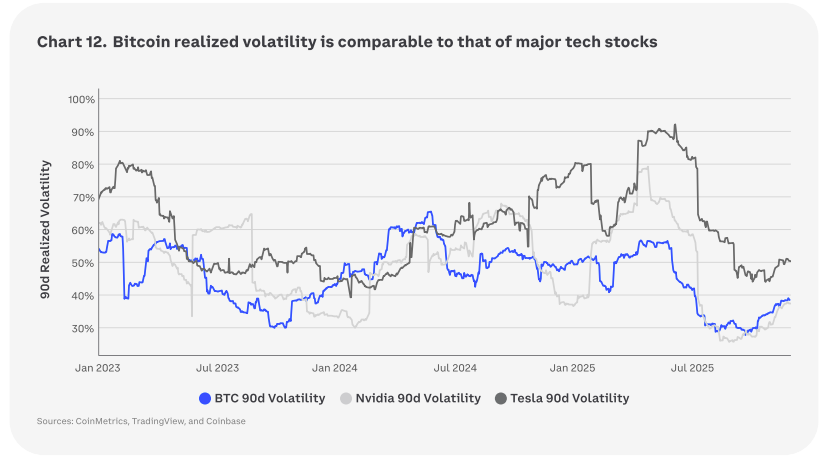
Bitcoin’s volatility profile is now comparable to major technology stocks. Source: Coinbase Institutional

Still, 2025 proved to be a volatile and emotionally charged year for Bitcoin holders. The asset experienced sharp price swings, reaching new cycle highs before undergoing a steep correction later in the year amid elevated leverage and forced liquidations across crypto markets.

While such moves have renewed debate around Bitcoin’s role as a safe-haven asset, Coinbase Institutional said that 2025 ultimately marked a milestone year. The report described Bitcoin as having been “firmly established as a critical component of the global financial conversation,” even as it remains subject to the growing pains of a maturing asset class.

Related: Why the ‘great China Bitcoin mining crackdown’ fell short of early claims

Пов'язані питання

QWhat is Coinbase Institutional's overall outlook for the crypto market in 2026?

ACoinbase Institutional is 'cautiously optimistic' about 2026, framing it as a potential turning point driven by regulatory clarity, accelerating stablecoin adoption, and an improving macroeconomic backdrop, rather than another retail-driven boom-and-bust cycle.

QWhat key US policy developments does the report highlight as factors shaping the next phase of crypto adoption?

AThe report highlights landmark policy developments, including progress on stablecoin legislation such as the GENIUS Act and momentum toward a broader crypto market structure bill.

QWhat is the projected growth for the stablecoin market by 2028 according to Coinbase's model?

ACoinbase Institutional's model forecasts that the stablecoin market could grow to about $1.2 trillion by 2028.

QHow has Bitcoin's volatility profile changed, according to the report?

ABitcoin's volatility profile has evolved to resemble that of high-growth technology stocks, with its 90-day historical volatility declining to about 35% to 40% by the end of 2025, down from levels above 60% in mid-2024.

QWhat are the key macroeconomic variables that could influence the crypto market recovery heading into 2026?

APersistent inflation risks and the timing of potential interest rate cuts remain key variables that could influence the crypto market recovery.

Пов'язані матеріали

Bitcoin Withdrawals Continue: 8 Years of Storage in a Coldcard Cold Wallet Ended in Zero

Coldcard Hardware Wallet Hacked: Losses Mount Due to Vulnerable Seed Generation A critical vulnerability in Coldcard hardware wallets has led to a continued wave of fund thefts. According to Galaxy Research, the total stolen has reached 1,367.05 BTC (approx. $88.6 million) from 4,585 addresses, a significant increase from the initial 594.5 BTC reported on July 30, 2026. Most of the stolen funds remain on the attackers' addresses. The issue is not with the current firmware, which Coinkite has updated, but with seed phrases generated on vulnerable devices between March 2021 and the release of fixed firmware versions. Due to a programmer error, devices switched from using a hardware random number generator to the software-based Yasmarang generator, which was initialized with publicly accessible data like the chip's serial number. This made the seed phrases predictable through offline brute-force attacks, meaning wallets remain at risk until funds are moved to a new wallet generated with the patched firmware. Affected devices include Mk2/Mk3 with firmware 4.0.1–4.1.9 (and up to 5.0.3), Mk4/Mk5 up to version 5.6.0, and Q models up to 1.5.0Q. The only exceptions are seeds created with a high-entropy method like at least 50 independent dice rolls or a strong unique BIP-39 passphrase. All other owners must generate a new seed on the fixed firmware and transfer their assets. A case highlighting the human impact involves a 39-year-old long-term investor who lost 2 BTC (approx. $130,000) in minutes. He had accumulated the Bitcoin over eight years through physical labor, viewing it as a financial lifeline and a retirement plan in a country suffering from hyperinflation. His story underscores that even conservative "buy and hold in cold storage" strategies can be compromised by such underlying technical flaws. From a technical perspective, this incident echoes historical failures where weak random number generators undermined cryptographic security, challenging the assumption that offline storage is automatically foolproof.

cryptonews.ru1 год тому

Bitcoin Withdrawals Continue: 8 Years of Storage in a Coldcard Cold Wallet Ended in Zero

cryptonews.ru1 год тому

Торгівля

Спот
活动图片





