Coinbase ‘cautiously optimistic’ on 2026 as crypto nears institutional inflection point

cointelegraphОпубліковано о 2025-12-19Востаннє оновлено о 2025-12-19

Анотація

Coinbase Institutional's 2026 outlook is cautiously optimistic, forecasting a potential institutional inflection point for crypto driven by regulatory clarity, stablecoin adoption, and an improving macro backdrop. The report highlights key U.S. policy developments, including stablecoin legislation and market structure bills, as crucial for institutional integration. It projects the stablecoin market could grow to $1.2 trillion by 2028. Bitcoin's volatility has moderated, now resembling high-growth tech stocks, with 90-day historical volatility declining to 35-40% by end-2025. Despite 2025's price swings and leverage-induced corrections, Bitcoin is now seen as an established part of the global financial conversation.

After a year of unexpected turbulence for crypto markets, 2026 could mark a turning point driven by regulatory clarity, accelerating stablecoin adoption and an improving macroeconomic backdrop, according to a new outlook from Coinbase Institutional.

In its 70-page report, Coinbase Institutional said digital assets have evolved “from a niche market to an emerging pillar of global market infrastructure,” even as price volatility and uneven liquidity defined much of 2025.

Looking ahead, Coinbase’s institutional arm expects clearer global regulatory frameworks to provide stronger policy guardrails, supporting innovation and long-term market maturation.

Rather than another retail-driven boom-and-bust cycle, 2026 is framed as a year of institutional integration and regulatory maturity, with clearer rules enabling deeper participation from traditional financial players.

In the United States, Coinbase Institutional pointed to landmark policy developments, including progress on stablecoin legislation such as the GENIUS Act and momentum toward a broader crypto market structure bill, as key factors shaping the next phase of adoption.

These efforts are expected to influence everything from risk management and compliance standards to institutional portfolio strategies.
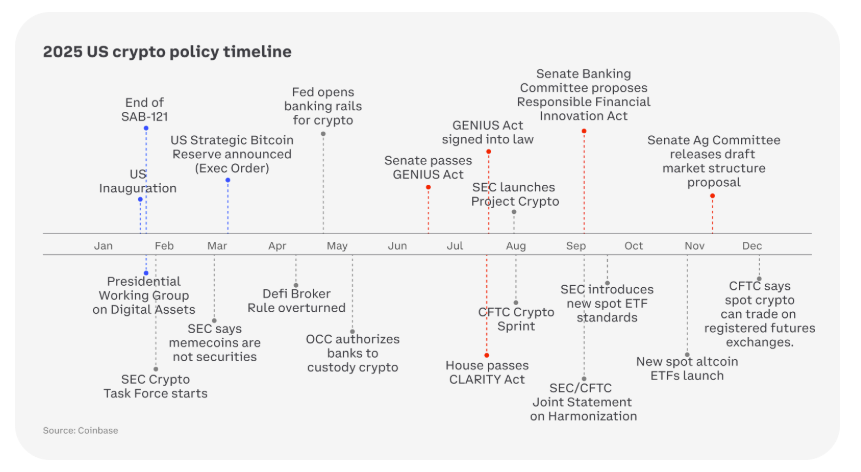
Coinbase Institutional flags the evolution of US crypto policy as a key driver of a potentially transformative 2026. Source: Coinbase Institutional

Stablecoins remain one of crypto’s most established use cases, with Coinbase Institutional projecting significant expansion in the years ahead. Its model forecasts that the stablecoin market could grow to about $1.2 trillion by 2028, driven by increased use in payments, settlement, payroll and cross-border remittances.
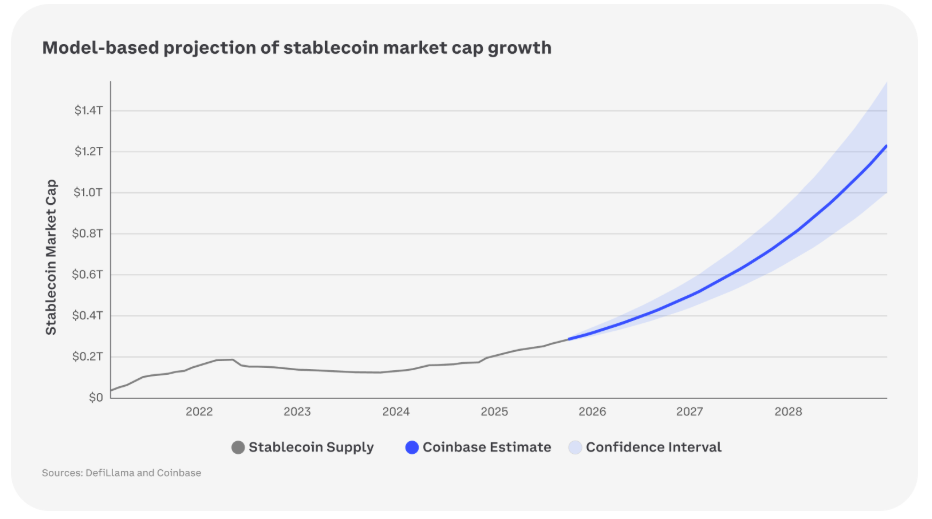
After years of rapid expansion, Coinbase Institutional’s model forecasts that the stablecoin market could reach $1.2 trillion by 2028. Source: Coinbase Institutional

Still, the outlook stops short of outright optimism. Coinbase Institutional described its macroeconomic expectations as “cautiously optimistic,” arguing that while economic growth may remain uneven, the US economy has shown greater resilience than recent data implies.

Persistent inflation risks and the timing of potential interest rate cuts remain key variables that could influence crypto market recovery heading into 2026.

Related: US banks may soon issue stablecoins under FDIC plan to implement GENIUS Act

Bitcoin’s volatility profile is shifting

One of Coinbase Institutional’s key observations is that Bitcoin’s volatility profile has gradually evolved. Rather than standing out as an extreme outlier among major asset classes, Bitcoin’s volatility now resembles that of high-growth technology stocks, the report said.

Coinbase pointed to Bitcoin’s (BTC) 90-day historical volatility, which declined to about 35% to 40% by the end of 2025, down from levels above 60% in mid-2024. The moderation occurred even as the market absorbed major structural changes, including the approval and rollout of spot Bitcoin exchange-traded funds.
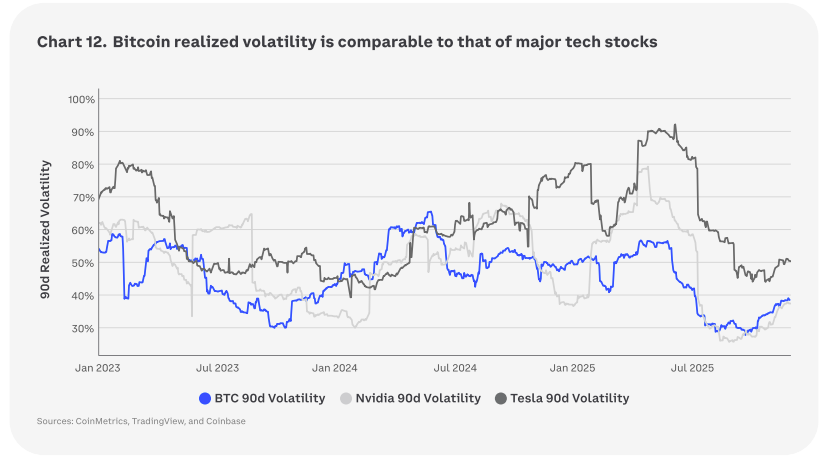
Bitcoin’s volatility profile is now comparable to major technology stocks. Source: Coinbase Institutional

Still, 2025 proved to be a volatile and emotionally charged year for Bitcoin holders. The asset experienced sharp price swings, reaching new cycle highs before undergoing a steep correction later in the year amid elevated leverage and forced liquidations across crypto markets.

While such moves have renewed debate around Bitcoin’s role as a safe-haven asset, Coinbase Institutional said that 2025 ultimately marked a milestone year. The report described Bitcoin as having been “firmly established as a critical component of the global financial conversation,” even as it remains subject to the growing pains of a maturing asset class.

Related: Why the ‘great China Bitcoin mining crackdown’ fell short of early claims

Пов'язані питання

QWhat is Coinbase Institutional's overall outlook for the crypto market in 2026?

ACoinbase Institutional is 'cautiously optimistic' about 2026, framing it as a potential turning point driven by regulatory clarity, accelerating stablecoin adoption, and an improving macroeconomic backdrop, rather than another retail-driven boom-and-bust cycle.

QWhat key US policy developments does the report highlight as factors shaping the next phase of crypto adoption?

AThe report highlights landmark policy developments, including progress on stablecoin legislation such as the GENIUS Act and momentum toward a broader crypto market structure bill.

QWhat is the projected growth for the stablecoin market by 2028 according to Coinbase's model?

ACoinbase Institutional's model forecasts that the stablecoin market could grow to about $1.2 trillion by 2028.

QHow has Bitcoin's volatility profile changed, according to the report?

ABitcoin's volatility profile has evolved to resemble that of high-growth technology stocks, with its 90-day historical volatility declining to about 35% to 40% by the end of 2025, down from levels above 60% in mid-2024.

QWhat are the key macroeconomic variables that could influence the crypto market recovery heading into 2026?

APersistent inflation risks and the timing of potential interest rate cuts remain key variables that could influence the crypto market recovery.

Пов'язані матеріали

The Verdict in Choi Tae-won's Divorce Case: Revealing the Inheritance Undercurrent Behind SK Hynix's Trillion-Won Empire

SK Group Chairman Chey Tae-won's high-profile divorce case, involving a record 1.38 trillion won settlement, has drawn attention to the succession plans for Korea's second-largest conglomerate, especially its crown jewel, SK hynix. Unlike traditional chaebol scripts centered on the eldest son, Chey's three children from his marriage to former President Roh Tae-woo's daughter, Roh Soh-yeong, are carving distinct, non-traditional paths. Eldest daughter Chey Yun-jung (b. 1989) is seen as the most evident successor. With a scientific and consulting background, she holds executive roles at SK bioscience and SK Inc.'s growth support department, focusing on future strategy and biopharma. Her marriage is to an AI infrastructure entrepreneur, not a traditional business alliance. Second daughter Chey Min-jung (b. 1991) took a unique route, voluntarily serving as a South Korean naval officer, including an anti-piracy deployment. She later worked on policy and strategy for SK hynix in Washington D.C. before co-founding an AI-driven healthcare startup. She married a former U.S. Marine Corps officer, connecting her to U.S. defense and policy circles—networks crucial for a global semiconductor giant. The only son, Chey In-geun (b. 1995), who studied physics like his father, worked briefly at SK E&S before joining McKinsey. Despite fitting the traditional "heir" profile as the eldest son, he remains silent and holds no public position or shares in SK, suggesting the old succession playbook is obsolete. As SK hynix's valuation soars, becoming a geopolitical asset in the AI era, the heirs' legitimacy is no longer automatic. They must prove themselves in fields like AI biotech, global policy, and strategic consulting. Their marriages also reflect new elite networks in tech and defense, not old political alliances. Their inheritance is the complex challenge of navigating a globalized, tech-driven world, not just a corporate throne.

marsbit6 год тому

The Verdict in Choi Tae-won's Divorce Case: Revealing the Inheritance Undercurrent Behind SK Hynix's Trillion-Won Empire

marsbit6 год тому

From OpenSea to OpenRouter: Is Alex Atallah Repeating His 'Exit at the Peak' Playbook?

From OpenSea to OpenRouter: Is Alex Atallah Repeating His "Exit at the Peak" Playbook? According to the Wall Street Journal, payments giant Stripe is in talks to acquire the AI model aggregation platform OpenRouter in a potential deal valuing the company near $100 billion. This would mark founder Alex Atallah's second creation of a company reaching a $100 billion valuation, following his co-founding of NFT marketplace OpenSea. OpenRouter, founded just over three years ago, has grown rapidly by acting as a unified gateway for developers to access over 400 AI models. It currently has about 10 million users and processes over 200 trillion tokens monthly. While the platform's annualized revenue is around $50 million, its valuation has skyrocketed from $1.3 billion in March 2026. The potential acquisition by Stripe, a company OpenRouter's founder once likened it to, represents a major expansion into AI infrastructure for the payments leader. This move echoes Atallah's previous timing with OpenSea, where he departed before the NFT market's significant downturn. For OpenRouter, selling now may be strategic. Despite its scale, its business model—charging a 5-5.5% fee on AI inference calls—faces pressure from competition, open-source models, and potential price wars among model providers, limiting its profitability narrative for an IPO. A key asset for potential acquirers like Stripe is OpenRouter's vast repository of real-world AI usage data, which offers unique insights into model performance and developer preferences that are difficult to replicate. Whether this potential deal signifies a new valuation benchmark for AI infrastructure or another market peak signal remains to be seen.

链捕手7 год тому

From OpenSea to OpenRouter: Is Alex Atallah Repeating His 'Exit at the Peak' Playbook?

链捕手7 год тому

Торгівля

Спот
活动图片





