Coinbase-Backed Stand With Crypto Discloses Political Plan For 2026 Midterm Elections

bitcoinistОпубліковано о 2026-03-27Востаннє оновлено о 2026-03-27

Анотація

Coinbase-backed advocacy group Stand With Crypto has announced its first endorsements for the 2026 U.S. midterm elections and launched an online voter hub to mobilize pro-crypto voters. The group endorsed six incumbent lawmakers from both major parties and will focus on competitive House races where crypto issues may be decisive. The voter hub provides information on candidates' positions, including scorecards based on public statements and legislative records. With over 2.7 million advocates, the group aims to turn crypto supporters into a influential voting bloc. A survey revealed that 59% of crypto owners are swing voters, and 80% are highly motivated to vote. Nearly two-thirds would support candidates backing the crypto industry, and 74% favor those supporting clearer regulations.

Stand With Crypto, an advocacy group backed by crypto exchange Coinbase (COIN), has unveiled its first endorsements for the upcoming midterm elections in the United States and unveiled a new online voter hub aimed at mobilizing pro-crypto voters.

Stand With Crypto Builds Voter Tools

In a Thursday press release, the organization said it will back six incumbent lawmakers from both major parties and focus resources on a set of competitive House contests where it believes crypto issues could be decisive.

The voter hub, the group said, will compile up-to-date information on congressional candidates’ positions on digital assets, including scorecards that rate candidates’ favorability based on public statements, legislative records, and responses to a Stand With Crypto questionnaire.

The group described the hub as a tool to equip its network — more than 2.7 million advocates nationwide — with the information needed to cast informed ballots in November.
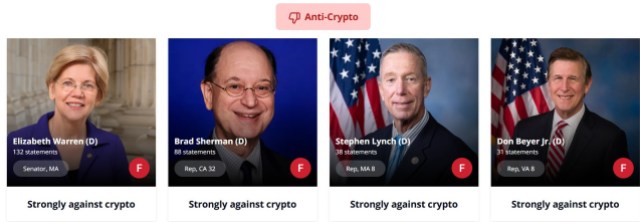
Stand With Crypto’s scorecard for each candidate

Mason Lynaugh, executive director of the Coinbase-backed group, framed the initiative as an effort to convert crypto supporters into an influential voting bloc, stating:

This year, crypto voters are poised to play a powerful and decisive role at the ballot box — our goal is to equip our more than 2.7 million advocates across the country with the tools they need to make informed choices this November.

Lynaugh added that the organization’s priority races are intended to help ensure that the 120th Congress is “the most pro-crypto session in America’s history,” and that the initial slate of endorsed candidates already has a record of supporting clear, pragmatic policies that foster innovation.

Stand With Crypto named six members of Congress in its first endorsement round: Representative Zach Nunn (R-Iowa), Rep. Susie Lee (D-Nevada), Rep. Mike Lawler (R-New York), Rep. Don Davis (D-North Carolina), Rep. Greg Landsman (D-Ohio), and Rep. Rob Borsellino Bresnahan (R-Pennsylvania).

Majority Of Crypto Owners Want Clearer Rules

The group also reported that among 1,000 crypto owners and advocates polled, 59% of crypto owners and 77% of Stand With Crypto advocates are heterogeneous voters who do not reliably vote for a single party.

The group noted that nearly a third of these voters are persuadable in their respective US Senate contests, suggesting that candidates’ positions on cryptocurrencies could sway outcomes.

Survey results also suggest crypto owners are highly motivated to vote: nearly 80% described themselves as “almost certain” to vote in 2026, and more than 75% said they were enthusiastic about participating in the general election — figures Stand With Crypto said outpace the broader adult population.

A majority (64%) of crypto owners said they would be enthusiastic about supporting candidates who back the cryptocurrency industry, and about 47% said they could back a candidate who agreed with them on crypto even if they disagreed on other policy areas.

Importantly for ongoing congressional negotiations on the anticipated CLARITY Act, 74% of crypto owners said they would be more likely to support candidates who favor clearer regulatory frameworks for the sector, with 31% saying they would be much more likely to do so.

The daily chart shows Coinbase’s stock dropping near $170 on Thursday trading session. Source: COIN on TradingView.com

Featured image from OpenArt, chart from TradingView.com

Пов'язані питання

QWhat is the main goal of Stand With Crypto's new political initiative for the 2026 midterm elections?

AThe main goal is to mobilize pro-crypto voters by providing them with information and tools, and to help ensure that the 120th Congress becomes 'the most pro-crypto session in America's history'.

QHow many advocates does Stand With Crypto claim to have in its nationwide network?

AStand With Crypto claims to have more than 2.7 million advocates in its nationwide network.

QWhich six incumbent lawmakers did Stand With Crypto endorse in its first round?

AThe endorsed lawmakers are Rep. Zach Nunn (R-Iowa), Rep. Susie Lee (D-Nevada), Rep. Mike Lawler (R-New York), Rep. Don Davis (D-North Carolina), Rep. Greg Landsman (D-Ohio), and Rep. Rob Borsellino Bresnahan (R-Pennsylvania).

QAccording to the group's survey, what percentage of crypto owners are 'almost certain' to vote in the 2026 election?

ANearly 80% of the crypto owners surveyed described themselves as 'almost certain' to vote in the 2026 election.

QWhat key piece of legislation is mentioned in relation to the survey results on regulatory frameworks?

AThe anticipated CLARITY Act is mentioned, with 74% of crypto owners saying they would be more likely to support candidates who favor clearer regulatory frameworks for the sector.

Пов'язані матеріали

OpenAI Post-Training Engineer Weng Jiayi Proposes a New Paradigm Hypothesis for Agentic AI

OpenAI engineer Weng Jiayi's "Heuristic Learning" experiments propose a new paradigm for Agentic AI, suggesting that intelligent agents can improve not just by training neural networks, but also by autonomously writing and refining code based on environmental feedback. In the experiment, a coding agent (powered by Codex) was tasked with developing and maintaining a programmatic strategy for the Atari game Breakout. Starting from a basic prompt, the agent iteratively wrote code, ran the game, analyzed logs and video replays to identify failures, and then modified the code. Through this engineering loop of "code-run-debug-update," it evolved a pure Python heuristic strategy that achieved a perfect score of 864 in Breakout and performed competitively with deep reinforcement learning (RL) algorithms in MuJoCo control tasks like Ant and HalfCheetah. This approach, termed Heuristic Learning (HL), contrasts with Deep RL. In HL, experience is captured in readable, modifiable code, tests, logs, and configurations—a software system—rather than being encoded solely into opaque neural network weights. This offers potential advantages in explainability, auditability for safety-critical applications, easier integration of regression tests to combat catastrophic forgetting, and more efficient sample use in early learning stages, as demonstrated in broader tests on 57 Atari games. However, the blog acknowledges clear limitations. Programmatic strategies struggle with tasks requiring long-horizon planning or complex perception (e.g., Montezuma's Revenge), areas where neural networks excel. The future vision is a hybrid architecture: specialized neural networks for fast perception (System 1), HL systems for rules, safety, and local recovery (also System 1), and LLM agents providing high-level feedback and learning from the HL system's data (System 2). The core proposition is that in the era of capable coding agents, a significant portion of an AI's learned experience could be maintained as an auditable, evolving software system.

marsbit57 хв тому

OpenAI Post-Training Engineer Weng Jiayi Proposes a New Paradigm Hypothesis for Agentic AI

marsbit57 хв тому

Your Claude Will Dream Tonight, Don't Disturb It

This article explores the recent phenomenon of AI companies increasingly using anthropomorphic language—like "thinking," "memory," "hallucination," and now "dreaming"—to describe machine learning processes. Focusing on Anthropic's newly announced "Dreaming" feature for its Claude Agent platform, the piece explains that this function is essentially an automated, offline batch processing of an agent's operational logs. It analyzes past task sessions to identify patterns, optimize future actions, and consolidate learnings into a persistent memory system, akin to a form of reinforcement learning and self-correction. The article draws parallels to similar features in other AI agent systems like Hermes Agent and OpenClaw, which also implement mechanisms for reviewing historical data, extracting reusable "skills," and strengthening long-term memory. It notes a key difference from human dreaming: these AI "dreams" still consume computational resources and user tokens. Further context is provided by discussing the technical challenges of managing AI "memory" or context, highlighting the computational expense of large context windows and innovations like Subquadratic's new model claiming drastically longer contexts. The core critique argues that this strategic use of human-centric vocabulary does more than market products; it subtly reshapes user perception. By framing algorithms with terms associated with consciousness, companies blur the line between tool and autonomous entity. This linguistic shift can influence user expectations, tolerance for errors, and even perceptions of responsibility when systems fail, potentially diverting scrutiny from the companies and engineers behind the technology. The article concludes by speculating that terms like "daydreaming" for predictive task simulation might be next, continuing this trend of embedding the idea of an "inner life" into computational processes.

marsbit59 хв тому

Your Claude Will Dream Tonight, Don't Disturb It

marsbit59 хв тому

Торгівля

Спот
Ф'ючерси
活动图片





