Coinbase-Backed Stand With Crypto Discloses Political Plan For 2026 Midterm Elections

bitcoinistОпубліковано о 2026-03-27Востаннє оновлено о 2026-03-27

Анотація

Coinbase-backed advocacy group Stand With Crypto has announced its first endorsements for the 2026 U.S. midterm elections and launched an online voter hub to mobilize pro-crypto voters. The group endorsed six incumbent lawmakers from both major parties and will focus on competitive House races where crypto issues may be decisive. The voter hub provides information on candidates' positions, including scorecards based on public statements and legislative records. With over 2.7 million advocates, the group aims to turn crypto supporters into a influential voting bloc. A survey revealed that 59% of crypto owners are swing voters, and 80% are highly motivated to vote. Nearly two-thirds would support candidates backing the crypto industry, and 74% favor those supporting clearer regulations.

Stand With Crypto, an advocacy group backed by crypto exchange Coinbase (COIN), has unveiled its first endorsements for the upcoming midterm elections in the United States and unveiled a new online voter hub aimed at mobilizing pro-crypto voters.

Stand With Crypto Builds Voter Tools

In a Thursday press release, the organization said it will back six incumbent lawmakers from both major parties and focus resources on a set of competitive House contests where it believes crypto issues could be decisive.

The voter hub, the group said, will compile up-to-date information on congressional candidates’ positions on digital assets, including scorecards that rate candidates’ favorability based on public statements, legislative records, and responses to a Stand With Crypto questionnaire.

The group described the hub as a tool to equip its network — more than 2.7 million advocates nationwide — with the information needed to cast informed ballots in November.
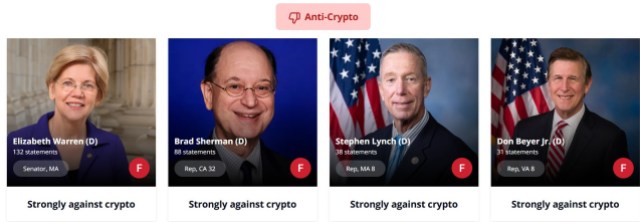
Stand With Crypto’s scorecard for each candidate

Mason Lynaugh, executive director of the Coinbase-backed group, framed the initiative as an effort to convert crypto supporters into an influential voting bloc, stating:

This year, crypto voters are poised to play a powerful and decisive role at the ballot box — our goal is to equip our more than 2.7 million advocates across the country with the tools they need to make informed choices this November.

Lynaugh added that the organization’s priority races are intended to help ensure that the 120th Congress is “the most pro-crypto session in America’s history,” and that the initial slate of endorsed candidates already has a record of supporting clear, pragmatic policies that foster innovation.

Stand With Crypto named six members of Congress in its first endorsement round: Representative Zach Nunn (R-Iowa), Rep. Susie Lee (D-Nevada), Rep. Mike Lawler (R-New York), Rep. Don Davis (D-North Carolina), Rep. Greg Landsman (D-Ohio), and Rep. Rob Borsellino Bresnahan (R-Pennsylvania).

Majority Of Crypto Owners Want Clearer Rules

The group also reported that among 1,000 crypto owners and advocates polled, 59% of crypto owners and 77% of Stand With Crypto advocates are heterogeneous voters who do not reliably vote for a single party.

The group noted that nearly a third of these voters are persuadable in their respective US Senate contests, suggesting that candidates’ positions on cryptocurrencies could sway outcomes.

Survey results also suggest crypto owners are highly motivated to vote: nearly 80% described themselves as “almost certain” to vote in 2026, and more than 75% said they were enthusiastic about participating in the general election — figures Stand With Crypto said outpace the broader adult population.

A majority (64%) of crypto owners said they would be enthusiastic about supporting candidates who back the cryptocurrency industry, and about 47% said they could back a candidate who agreed with them on crypto even if they disagreed on other policy areas.

Importantly for ongoing congressional negotiations on the anticipated CLARITY Act, 74% of crypto owners said they would be more likely to support candidates who favor clearer regulatory frameworks for the sector, with 31% saying they would be much more likely to do so.

The daily chart shows Coinbase’s stock dropping near $170 on Thursday trading session. Source: COIN on TradingView.com

Featured image from OpenArt, chart from TradingView.com

Пов'язані питання

QWhat is the main goal of Stand With Crypto's new political initiative for the 2026 midterm elections?

AThe main goal is to mobilize pro-crypto voters by providing them with information and tools, and to help ensure that the 120th Congress becomes 'the most pro-crypto session in America's history'.

QHow many advocates does Stand With Crypto claim to have in its nationwide network?

AStand With Crypto claims to have more than 2.7 million advocates in its nationwide network.

QWhich six incumbent lawmakers did Stand With Crypto endorse in its first round?

AThe endorsed lawmakers are Rep. Zach Nunn (R-Iowa), Rep. Susie Lee (D-Nevada), Rep. Mike Lawler (R-New York), Rep. Don Davis (D-North Carolina), Rep. Greg Landsman (D-Ohio), and Rep. Rob Borsellino Bresnahan (R-Pennsylvania).

QAccording to the group's survey, what percentage of crypto owners are 'almost certain' to vote in the 2026 election?

ANearly 80% of the crypto owners surveyed described themselves as 'almost certain' to vote in the 2026 election.

QWhat key piece of legislation is mentioned in relation to the survey results on regulatory frameworks?

AThe anticipated CLARITY Act is mentioned, with 74% of crypto owners saying they would be more likely to support candidates who favor clearer regulatory frameworks for the sector.

Пов'язані матеріали

Once-Popular Web3 Enters Wave of Layoffs

The once-hot Web3 industry is experiencing a severe wave of layoffs. While many companies attribute job cuts to AI-driven restructuring, the primary reason is often financial pressure. The Web3 sector, at the intersection of tech and finance, has been hit particularly hard. Employees at major cryptocurrency exchanges report sudden, impersonal layoffs—often with system access revoked overnight—and minimal or no severance. Common tactics include setting impossible performance targets or terminating employees for minor policy violations. The working atmosphere has become toxic, marked by intense monitoring, excessive meetings, and management obsessed with control and internal politics rather than product innovation. The industry's core business model is collapsing. Exchange revenue from trading fees and listing charges has plummeted due to a decline in quality projects and retail investor exodus. Events like the massive forced liquidation on October 10th further shattered confidence. Competition from on-chain derivatives platforms and prediction markets is intensifying the downturn. As layoffs continue, displaced workers struggle to find new opportunities. Many transition to the AI sector, but face significant bias from traditional finance and even some AI firms, which view crypto industry experience with suspicion. The current downturn appears more structural than cyclical, driven by unsustainable practices, internal strife, and a failure to innovate, raising questions about the industry's future trajectory.

marsbit49 хв тому

Once-Popular Web3 Enters Wave of Layoffs

marsbit49 хв тому

Sales Drop 26% But Prices Rise? Xiaomi's Dilemma

Xiaomi, facing a significant 26.3% year-on-year decline in global smartphone shipments in Q2 2026, has implemented its third price hike of the year. On August 2nd, prices were raised for nine models, including the flagship Mi 17 series (up 400-500 yuan) and Redmi K90/Turbo 5 series (up 300 yuan). This move completes a pattern where cost pressure, originating from surging memory chip prices, has climbed from entry-level to mid-range and now flagship products. The primary driver is a severe supply squeeze on consumer-grade DRAM and NAND flash memory, as major manufacturers like Samsung shift advanced capacity to more profitable HBM for AI applications. According to Xiaomi President Lu Weibing, memory prices for the same configuration have skyrocketed nearly fourfold since Q1 2025, adding roughly 1500 yuan to the cost of a mainstream 12GB+512GB phone. IDC estimates consumer memory costs have risen nearly 300% year-on-year. While the price increases hurt demand and contributed to the sales slump, Xiaomi's strategy of reducing entry-level models and upgrading its product mix also played a role. Domestically, its market share in China fell to 12% (5th place), while leaders Huawei and Apple saw shipments grow over 24%. To mitigate future risks, Xiaomi is accelerating its in-house "Surge" chip development and optimizing memory configurations across its lineup. Xiaomi is not alone; major brands like OPPO, vivo, and Apple have already raised prices in 2026, with industry insiders predicting another round of increases (200-800 yuan) in the second half. A full-scale industry-wide涨价 cycle is underway, forcing both manufacturers and consumers to recalibrate their strategies and purchasing decisions amid sustained cost pressures.

marsbit1 год тому

Sales Drop 26% But Prices Rise? Xiaomi's Dilemma

marsbit1 год тому

Торгівля

Спот
活动图片