Cloudflare Introduces AI-Based Wallets Designed for Unmanned Purchases

cryptonews.ruОпубліковано о 2026-08-05Востаннє оновлено о 2026-08-05

Анотація

Cloudflare has announced AI-powered "Wallets X" designed to enable autonomous agent commerce. The system addresses a key barrier: AI agents currently cannot easily identify themselves or pay for API access and digital content on their own, often requiring human intervention. The solution involves two linked wallets. "Account wallets" are owned and funded by humans, who set spending rules. "Agent wallets" are owned by the AI agents themselves and operate via API keys. Each agent wallet has a spending limit drawn from its linked human account, acting as a safety net—e.g., a $100 weekly limit for AI computations. This allows agents to independently explore and pay for services within their budget. The payment technology is based on the x402 protocol, which attaches micropayments in stablecoins directly to standard web requests. This works with Cloudflare's recently announced Monetization Gateway, aiming to create a "driverless marketplace" for AI services. To solve the identity problem, Cloudflare introduces `cloudflare.pay`, a system linking a wallet to an account. This allows an agent to optionally identify itself (e.g., `research.example.cloudflare.pay`), helping merchants distinguish between bots, AI agents, and humans. The identity system builds on the existing Web Bot Auth technology. Cloudflare cites the growing volume of bot traffic as a key driver, betting that equipping AI agents with wallets, spending limits, and optional identity will smooth the transition to mor...

The company announced Cloudflare Wallets X on its blog, describing a tool that allows users to obtain a wallet ID for their account and soon use this wallet to pay for APIs and digital content. An API, or Application Programming Interface, is a set of rules that allows one software to interact with another. Companies often charge for access to their APIs, and until now, an AI agent had no simple way to pay for this access itself.
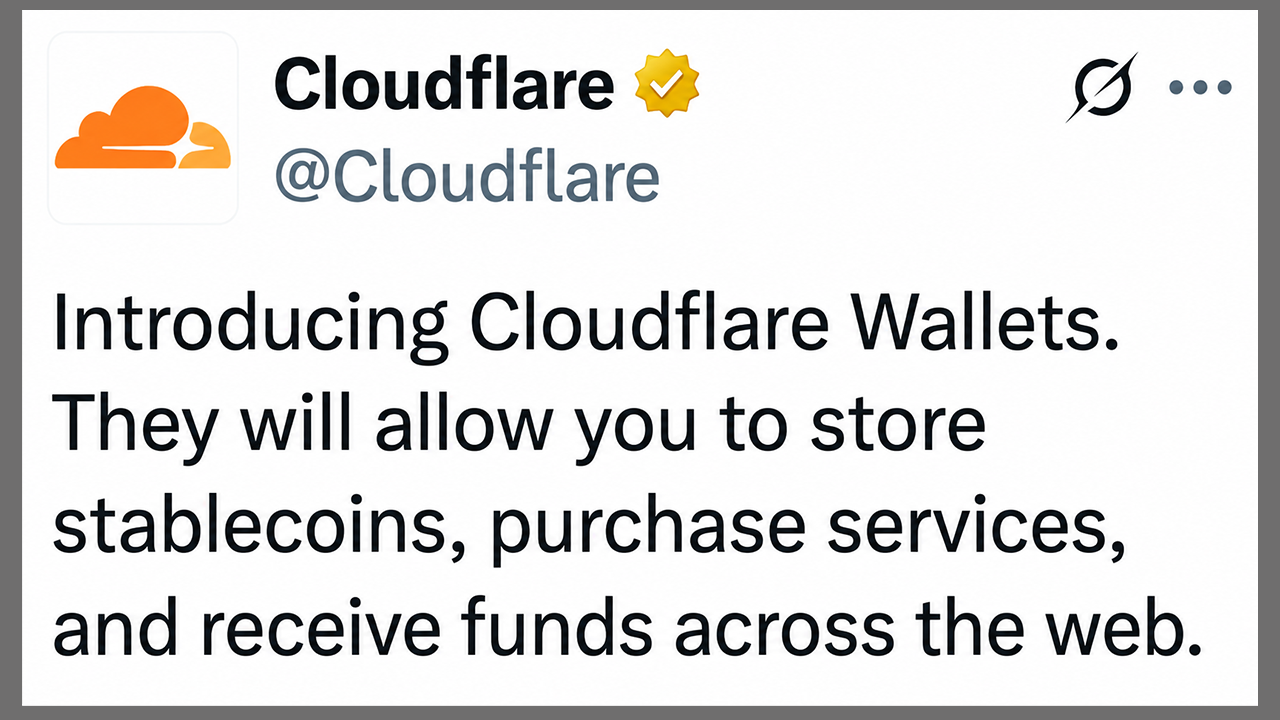
Image source: X

This gap was a real obstacle. When an AI agent wants to try a new service, it typically lands on a login page designed for a human, not a machine. The agent has no simple way to verify its identity or make a payment. Faced with this barrier, agents usually stop and ask a human to complete the task. Cloudflare notes that these obstacles slow the growth of so-called "agent commerce"—the use of software that independently makes purchasing decisions.

Two Wallets, One Goal: Enabling Agents to Act Independently

Cloudflare's solution splits the system into two parts. "Account Wallets" belong to people. A person funds the wallet, sets rules, and can withdraw money at any time. Virtual wallets belong to the agents themselves and operate via API keys rather than a login screen. An agent spending funds from a virtual wallet can only spend what its owner permits, as each virtual wallet has a limit defined by its associated account wallet.

This limit is the "safety net." For example, an employer could give each employee a virtual wallet with a $100 weekly limit for AI compute—that is, the computational work an artificial intelligence (AI) model performs to generate responses. If an agent tries to spend more than this limit, it needs to ask a human to manually override the limit. Cloudflare views these limits more as a form of freedom than a restriction. An agent responsible for $10 can be trusted to explore dozens of low-cost services independently, while an agent responsible for $1,000 needs closer supervision.

Micro-Payments Tied to Web Requests

The payment technology underpinning the wallets is called x402—a protocol that ties micropayments in stablecoins directly to standard web requests. Stablecoins are digital currencies designed to maintain a stable value, typically pegged to the US dollar. Cloudflare timed the wallet launch with its Monetization Gateway—a tool announced earlier this month that allows website and app owners to charge for their content or APIs without having to build separate payment infrastructure.

Together, these two tools aim to create what Cloudflare calls a "driverless marketplace," where AI agents can browse, test, and pay for services without human involvement in every transaction.

Giving Machines an Identity That Merchants Can Trust

Payment alone doesn't solve all the problems agents face on the web. Companies still have virtually no way to determine exactly who is generating traffic on their site: a human, a bot, or an AI agent acting on behalf of a real customer. Cloudflare addresses this with cloudflare.pay—a system that links a wallet to an account, allowing an agent to optionally identify itself, for example, as an agent operating for research.example.cloudflare.pay. Disclosing identity will be voluntary, and merchants themselves will decide whether to treat identified agents differently from anonymous ones.

According to Cloudflare, this system builds upon Web Bot Auth—an existing technology that allows agents to register their identity using a cryptographic key pair. The wallet ID converts this key pair into a form a human can read and remember.

Why This Matters Right Now

Cloudflare pointed to one metric driving the urgency of the launch: most traffic on the internet is now generated by bots, not people. As AI agents take on more tasks like shopping, searching for information, and booking, the company is betting that giving them a wallet, spending limits, and optional identity will make this transition smoother for both sides of the transaction.

The company stated it will start with simple funding and withdrawal methods in supported regions, giving users the ability to self-fund wallets using stablecoins.

What to Expect Next

Cloudflare has not yet published a full schedule for enabling payments across all x402-compatible sites. Companies and developers can already register a wallet ID; more details will become available as the identification standards developed by the x402 Foundation evolve.

end-content

Пов'язані питання

QWhat is Cloudflare Wallets X and what problem does it aim to solve?

ACloudflare Wallets X is a tool announced by Cloudflare that provides AI agents with a wallet identifier for their account. It is designed to allow these agents to autonomously pay for APIs and digital content. The core problem it solves is that AI agents previously had no simple way to confirm their identity or make payments when encountering human-centric login pages or payment systems, which hindered the growth of 'agentic commerce'.

QHow does the Cloudflare Wallets system separate the roles of humans and AI agents in terms of wallet management?

AThe Cloudflare Wallets system divides the architecture into two parts. 'Account wallets' belong to humans, who fund the wallet, set rules, and can withdraw money. 'Virtual wallets' belong to the AI agents themselves and operate via API keys, not login screens. A virtual wallet's spending is governed by a limit set by its linked human account wallet, acting as a safeguard.

QWhat payment protocol and digital currency does Cloudflare Wallets X use for its micro-payments?

AThe wallets use a protocol called x402, which ties micropayments directly to standard web requests. These payments are made in stablecoins, which are digital currencies designed to maintain a stable value, typically pegged to the US dollar.

QHow does Cloudflare's system, `cloudflare.pay`, help establish identity for AI agents online?

AThe `cloudflare.pay` system links a wallet to an account, enabling an AI agent to optionally identify itself (e.g., as an agent working for 'research.example.cloudflare.pay'). This identity is based on the existing Web Bot Auth technology, which allows agents to register their identity using a cryptographic key pair. The wallet identifier converts this key pair into a human-readable form.

QAccording to the article, why is launching this wallet system particularly urgent right now?

ACloudflare cites that most internet traffic is now generated by bots rather than humans. As AI agents take on more purchasing, information search, and booking tasks, the company is betting that providing them with wallets, spending limits, and optional identity will make the transition smoother for both sides of a transaction in the emerging automated marketplace.

Пов'язані матеріали

Crypto Bull Is Back, Which Assets Bounced the Hardest?

The cryptocurrency market experienced a significant surge last week, with Bitcoin rallying over 26% to nearly $79,500, its strongest weekly gain since March 2023, fueling discussions of a renewed bull market. This rebound highlighted several key market dynamics. First, short-term directional shifts are increasingly tied to U.S. policy cycles. The rally was driven by two major catalysts: the U.S. Treasury's announcement to increase long-term bond buybacks, easing macro liquidity pressures, and former President Trump's push for clearer crypto legislation, boosting regulatory certainty and risk appetite. Second, Bitcoin spot ETFs solidified their role as a leading market indicator. In the week ending August 21, U.S. Bitcoin and Ethereum spot ETFs saw a combined net inflow of $2.6 billion, the highest since October 2025, signaling strong institutional re-entry. Third, the rally followed a clear capital rotation pattern: Bitcoin's breakout ignited broader gains, with Ethereum (up nearly 30%), major altcoins, and meme coins sequentially posting larger percentage increases. Analysis of the top performers among the top 50 altcoins by market cap revealed the week's biggest gainers: ENA (Ethena) led with a 100.75% surge, fueled by a Coinbase partnership. It was followed by PUMP (Pump.fun, up 88-99%), STX (Stacks, up 82-94%), TRUMP (Official Trump, up 79-91%), and ZEC (Zcash, up 75.15%), which uniquely reached a new all-time high. Meme coins like BOME on Solana also saw explosive gains, exemplifying the high-risk, high-reward sentiment. The rally illustrated a clear path: Bitcoin set the stage, major coins like Ethereum led the charge, and altcoins/meme coins delivered the most explosive returns, mapping the gradient of returning market enthusiasm.

marsbit11 хв тому

Crypto Bull Is Back, Which Assets Bounced the Hardest?

marsbit11 хв тому

Wuhan is About to Witness Its Largest IPO in History

Wuhan is poised for its largest-ever IPO as Yangtze Memory Technologies Co., Ltd. (YMTC) has officially applied for a listing on the Shanghai Stock Exchange's STAR Market, seeking to raise 33 billion yuan. The domestic leader in 3D NAND flash memory chips completed its IPO辅导 (tutoring) process in a record three months, with market expectations valuing the company at 300 billion yuan or higher. YMTC's roots trace back to 2006 with the founding of Wuhan Xinxin. After surviving the global financial crisis and periods of operational difficulty, the company was formally established in 2016 through a joint investment involving Tsinghua Unigroup, the National Integrated Circuit Industry Investment Fund (the "Big Fund"), and local Hubei government funds. With a distinct "national team" background, its major shareholders include provincial and municipal state-owned assets committees and the Big Fund. Based in Wuhan's Optics Valley (East Lake High-tech Development Zone), YMTC's potential listing highlights the region's rise as a tech hub. Optics Valley is already home to 72 listed companies and has ambitious plans to exceed 100 by 2030. The zone recently established four industry-focused母基金 (mother funds) totaling 18 billion yuan to further boost sectors like integrated circuits and optoelectronics. YMTC's IPO would complete the "Optics Valley Seven Stars," a group of leading local optoelectronic and communication giants.

marsbit11 хв тому

Wuhan is About to Witness Its Largest IPO in History

marsbit11 хв тому

Banks and Regulators Join Pilot Project to Test Quantum-Resistant Crypto Transfers

Banks and financial regulators from Europe, the Middle East, and Asia have joined a pilot project to test quantum-resistant crypto infrastructure for digital asset wallets and on-chain transactions. The initiative, announced by the Responsible Fintech Institute and infrastructure provider Safeheron, will use NEAR's quantum-resistant testnet. It will employ the ML-DSA-65 post-quantum digital signature standard, recently finalized by the U.S. National Institute of Standards and Technology (NIST). Participating regulators include the Abu Dhabi Global Market, Bhutan's Gelphu Financial Services Authority, and Malta's Financial Services Authority. Financial institutions involved are Bison Bank and DK Bank. In the pilot, banks will test wallet creation and transactions in a unified application environment, while regulators will initially observe and later contribute to governance mechanisms. The organizers plan to publish a technical paper detailing the research, protocol design, and test results, eventually open-sourcing the core technology. This effort comes as financial authorities prepare for the advent of quantum computers, which threaten current public-key cryptography. For instance, the Hong Kong Monetary Authority aims for the territory's banking sector to be fully prepared for quantum-related security risks by 2030. The Bank for International Settlements (BIS) also recommended in a 2025 document that financial institutions begin a coordinated, phased transition to post-quantum systems.

cryptonews.ru13 хв тому

Banks and Regulators Join Pilot Project to Test Quantum-Resistant Crypto Transfers

cryptonews.ru13 хв тому

Торгівля

Спот
活动图片