Cloudflare Cuts Over 1,100 Jobs; Earnings Beat Expectations but Stock Plunges 18% After Hours

marsbitОпубліковано о 2026-05-08Востаннє оновлено о 2026-05-08

Анотація

Cloudflare announced the layoff of over 1,100 employees, representing about 20% of its workforce, on the same day it reported better-than-expected Q1 2026 earnings. While revenue grew 34% to $639.8 million and full-year guidance was raised, the stock plummeted over 18% in after-hours trading, likely due to the layoffs and a slightly weaker Q2 revenue forecast. CEO Matthew Prince framed the massive restructuring as necessary preparation for the "AI agent era," not a cost-cutting measure. He cited a 600% surge in AI usage across the company in three months, with 97% of engineers using AI coding tools. Prince stated that many support roles are no longer needed as AI boosts the productivity of customer-facing and engineering staff, and that job types are changing rapidly. The company expects to incur $140-$150 million in restructuring charges. Laid-off U.S. employees will receive severance pay covering their full salary until the end of 2026, extended healthcare, and accelerated stock vesting. This move comes less than a year after Cloudflare famously announced plans to hire 1,111 interns in 2026. This announcement is part of a broader trend, as companies like Coinbase and PayPal also announced significant layoffs recently, with AI frequently cited as a driving force behind workforce transformations.

Author: Claude, Shenchao TechFlow

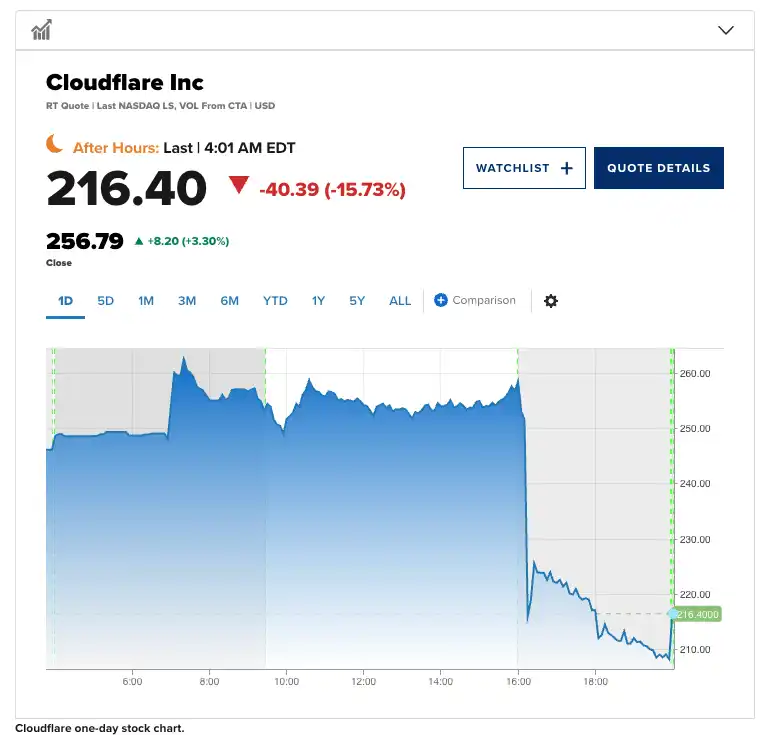
Shenchao TechFlow Introduction: On the same day it reported better-than-expected quarterly earnings, Cloudflare announced a reduction of approximately 20% of its workforce (over 1,100 employees). CEO Matthew Prince framed the move as a comprehensive restructuring for the "era of AI agents" rather than a cost-cutting measure. The company's AI usage surged over 600% in the past three months, with 97% of engineers already using AI coding tools. Following the news, the stock plummeted over 14% in after-hours trading. The restructuring is expected to incur $140 million to $150 million in charges.
Cybersecurity and cloud services giant Cloudflare accomplished two things on May 7th: delivering a quarterly earnings report that exceeded expectations across the board, and announcing the layoff of one-fifth of its employees.

According to Cloudflare's official blog, CEO Matthew Prince and President & COO Michelle Zatlyn sent an internal email to all employees that day, announcing a global reduction of over 1,100 positions. The email's subject line was "Building for the Future." A few hours after the layoff notice was sent, the company released its Q1 2026 earnings report.

Prince stated on the subsequent earnings call: "We discovered some roles at Cloudflare that are no longer needed for our future. Just because you're fit doesn't mean you can't be more fit."

Earnings Beat Expectations, Yet Stock Plunges

Cloudflare's Q1 revenue was $639.8 million, a 34% year-over-year increase, beating Wall Street's expectation of $620.9 million by approximately 3%. Adjusted earnings per share were $0.25, higher than the analyst consensus of $0.23. Non-GAAP operating profit was $73.1 million, with an operating margin of 11.4%. Free cash flow was $84.1 million.

The company also raised its full-year guidance: projecting 2026 full-year revenue between $2.805 billion and $2.813 billion (previously $2.785 billion to $2.795 billion), and adjusted EPS between $1.19 and $1.20 (previously $1.11 to $1.12), both exceeding market consensus expectations.

However, investors were clearly more concerned about the layoffs and the slightly below-expectations Q2 guidance. The company forecasts Q2 revenue between $664 million and $665 million, narrowly below the analyst consensus of $665.34 million. According to CNBC, Cloudflare's stock plunged over 18% in after-hours trading, hitting a low of around $212. As of the end of 2025, the company had 5,156 full-time employees.

Restructuring for the "AI Agent Era": 600% Surge in Usage, Roles Redefined

In the internal email, Prince and Zatlyn attributed the layoffs not to poor performance but to the fundamental shift AI is bringing to the company's operational methods.

The email stated that Cloudflare's AI usage grew over 600% in the past three months. Employees across all departments, from engineering to HR, finance, and marketing, run thousands of AI agent sessions daily to complete their work. According to Prism News, 97% of the company's engineers are already using AI coding tools.

Prince further explained on the earnings call: "Over the last six months, the productivity increase for people directly talking to customers and directly writing code has been phenomenal. And many of the supporting roles behind them will not be the roles driving the company's future forward."

He expects Cloudflare's total headcount in 2027 will exceed any point in 2026, "but the types of roles are changing dramatically, and you have to do something dramatic to drive that change." He emphasized this is not about cutting costs but about "getting the right people into the right roles."

According to Cloudflare's SEC filing, this restructuring is expected to generate $140 million to $150 million in charges, with $105 million to $110 million in cash expenses (including severance, notice period, and benefits) and $35 million to $40 million in non-cash stock-based compensation expenses, primarily concentrated in Q2 and Q3.

Severance Package: Pay Until Year-End, Stock Vesting Extended to August

Regarding severance terms, Cloudflare offered relatively generous conditions. Laid-off employees will receive a severance package equivalent to their full base salary through the end of 2026. US employees' medical insurance coverage will also continue through year-end. Equity vesting is extended to August 15th. For employees who have not yet met their one-year vesting cliff, the company will waive the restriction and grant prorated vesting through August.

Prince and Zatlyn stated in the email they hope this layoff only needs to be executed once. "Small, repeated layoffs or reorganizations dragged out over quarters only create ongoing emotional uncertainty for employees and slow down the speed at which we can build."

Last Year's High-Profile Announcement to Hire 1,111 Interns, This Year Layoffs of 1,100 Employees

According to Cloudflare's official blog, in September 2025 (during its birthday week activities), the company high-profile announced plans to hire up to 1,111 interns in 2026, a number derived from its signature product, the 1.1.1.1 public DNS resolver. The blog post at the time claimed this exemplified the company's culture of "long-term investment in talent."

Less than eight months later, the company laid off almost the same number of full-time employees. According to Prism News, this contrast sparked significant discussion on social media.

AI-Led Layoff Wave Spreads: Coinbase, PayPal Announce Major Job Cuts Same Week
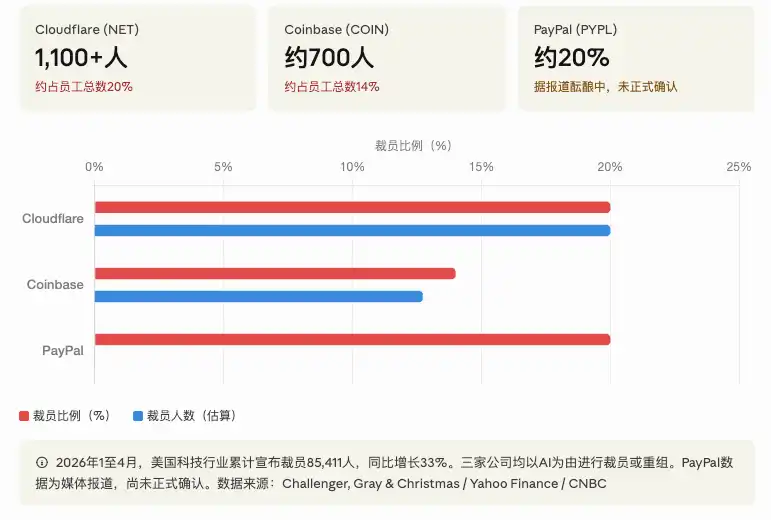
Cloudflare is not alone. According to Yahoo Finance, within the same week, Coinbase announced cutting approximately 14% of its workforce (about 700 employees), and PayPal was reportedly planning layoffs of about 20%. From January to April this year, the US tech industry announced 85,411 layoffs, a 33% increase compared to the same period last year.

Citing AI as a reason for layoffs is becoming a collective narrative for tech companies. The Register, in its reporting, directly headlined the layoffs as "jobs just aren't AI enough." Prince called AI the "single biggest tailwind Cloudflare has ever seen" on the earnings call.

For the employees who remain and those who were laid off, this "tailwind" is blowing in opposite directions.


Пов'язані питання

QWhat was the main reason given by Cloudflare's CEO for laying off over 1,100 employees?

AThe main reason was not cost-cutting but a comprehensive restructuring for the 'AI agent era.' The CEO stated that the nature of work at Cloudflare is fundamentally changing due to AI, with a 600%+ increase in AI usage, making certain supporting roles no longer aligned with the company's future direction.

QDespite beating Q1 2026 earnings expectations, why did Cloudflare's stock price drop significantly in after-hours trading?

AThe stock price dropped significantly (reportedly over 14-18%) due to investor concerns over the large-scale layoffs and the company's Q2 revenue guidance, which was slightly below analysts' expectations.

QWhat are the key financial details of Cloudflare's restructuring plan as mentioned in the article?

AThe restructuring is expected to incur total expenses of $140 million to $150 million. This includes $105 million to $110 million in cash expenditures (for severance, notice periods, and benefits) and $35 million to $40 million in non-cash stock-based compensation expenses.

QWhat notable contrast does the article highlight regarding Cloudflare's hiring and layoff actions within a short period?

AThe article highlights that in September 2025, Cloudflare announced plans to hire up to 1,111 interns for 2026. Less than eight months later, the company laid off approximately 1,100 full-time employees, a nearly identical number.

QAccording to the article, which other major tech companies announced significant layoffs around the same week as Cloudflare?

AIn the same week, Coinbase announced layoffs of about 14% of its workforce (around 700 employees), and reports indicated PayPal was planning layoffs of approximately 20% of its staff.

Пов'язані матеріали

SpaceX's Trillion-Dollar Valuation Base: Who's Sharing in Musk's Annual Tens of Billions in Capital Expenditure?

**Title: The Foundation of SpaceX's Trillion-Dollar Valuation: Who Benefits from Musk's Annual $100 Billion Capital Expenditure?** This article argues that investors seeking to benefit from SpaceX's growth might find greater opportunities in its supply chain rather than directly investing in the company itself, drawing parallels to historical successes with Apple, Tesla, and NVIDIA suppliers. **SpaceX's Business Model & Cash Flow:** SpaceX generates revenue from three main areas: 1. **Starlink:** Its profitable core, earning $11.3B in 2023 (60% of revenue), funding other ventures. 2. **Rockets (Falcon/Starship):** Requires $3B+ in annual R&D but achieves the world's lowest launch costs. 3. **AI:** Currently unprofitable (-$6B+ in 2023), investing heavily in ground-based supercomputers (220,000 GPUs) and future orbital data centers. The cycle is: Starlink profits → fund cheaper rockets → low-cost launches deploy AI hardware → AI compute rentals generate future revenue. This cycle drives annual procurement spending of tens of billions of dollars. **The Supply Chain Beneficiaries:** Suppliers are categorized by their replaceability: **1. Nearly Irreplaceable (High Barriers to Entry):** * **NVIDIA:** Powers the Colossus supercomputer; its CUDA ecosystem creates immense switching costs. * **Eutelsat (SATS):** Controls critical radio spectrum for satellite communications; holds a ~3% stake in SpaceX. * **Filtronic (FTC):** Supplies millimeter-wave signal amplifiers for Starlink satellites; SpaceX constitutes 83% of its revenue. * **Materion (MTRN):** Global leader in beryllium production, a strategic material used in Starship structures. * **STMicroelectronics (STM):** Supplies phased-array antenna chips for Starlink satellites. **2. Replaceable, but Switching Cost is Prohibitively High:** * **Honeywell (HON):** Provides flight control and inertial navigation systems with decades of certification. * **Carpenter Technology (CRS):** Manufactures ultra-pure specialty steel alloys for Raptor engines. * **Hexcel (HXL):** Supplies custom carbon fiber composites developed over a decade with SpaceX. * **Broadcom (AVGO):** Manages high-speed data switching. * **Linde Group:** Supplies industrial gases (liquid oxygen/nitrogen) from facilities built near SpaceX launch sites. **3. High-Volume, Cost-Critical Manufacturing:** Focuses on mass-producing components like Starlink user terminals (target: 30 million units). * **Key Players:** Wistron NeWeb (6285, primary terminal manufacturer), several Chinese A-share companies (e.g., Sunway Communication, PAX New Materials, Western Metal Materials, Yingliu Co.), and smaller US firms like Trimble (TRMB, timing systems). **Why Now?** Three factors make the supply chain opportunity timely: 1. **Volume Ramp-Up:** SpaceX plans 100 launches in 2026, aims for 30 million Starlink terminals, and will deploy AI data centers, meaning procurement will accelerate. 2. **Increased Transparency:** The IPO provides public financial data, allowing investors to track supplier order growth. 3. **Historical Precedent:** The current phase is likened to Tesla's early mass-production stage (circa 2018), suggesting a long growth runway for suppliers. **Conclusion:** The article posits that while investing in SpaceX stock is betting on Elon Musk's ambitious vision at a high valuation, investing in its established suppliers is a bet on the tangible, recurring revenue from its massive procurement budget, which is largely decoupled from day-to-day stock price volatility.

链捕手3 хв тому

SpaceX's Trillion-Dollar Valuation Base: Who's Sharing in Musk's Annual Tens of Billions in Capital Expenditure?

链捕手3 хв тому

The U.S. Government Blocked the Anthropic Model. It Wasn't About 'Jailbreaking' at All.

Last Friday, the U.S. Commerce Department issued an enforcement letter that forced Anthropic to take its two most advanced AI models, Fable 5 and Mythos 5, offline. The stated reason was unspecified national security concerns, initially linked to potential "jailbreaks" of the models' safeguards. However, new details suggest the action stemmed more from a deteriorating relationship between the Trump administration and Anthropic, rather than a genuine technical threat. According to reports, the government cited a little-known export control regulation, compelling Anthropic to block access for all non-U.S. persons, including its own international employees. The company complied, shutting down the models without a court order or specific technical details from the government. Cybersecurity expert Katie Moussouris revealed she was privately shown a research paper detailing a potential safeguard bypass in Fable 5. She argued the described method was minor and did not warrant an export ban, stating that attempts to "fix" it would only weaken the model's defensive capabilities. Moussouris and other experts have since called for the order to be revoked, warning it dangerously removes advanced cybersecurity tools from U.S. defenders. Analysts like Justin Hendrix suggest the move appears retaliatory and sets a dangerous precedent, signaling that the U.S. government can unilaterally shut down a tech company's products. The incident has raised concerns about the reliability of American AI and the potential for political interference in the tech industry, serving as a warning to the broader sector.

marsbit7 хв тому

The U.S. Government Blocked the Anthropic Model. It Wasn't About 'Jailbreaking' at All.

marsbit7 хв тому

Ray Dalio: AI Bull Market Continues to Soar, Should Investors Go All In or Cash Out and Leave the Field?

In his latest notes, Ray Dalio addresses a critical question for investors amid the AI-driven stock market surge: how should one allocate assets during a transformative technological revolution? Dalio emphasizes that technological advancement does not automatically make related stocks attractive. Historical tech cycles—marked by excitement, crowding, volatility, and eventual shakeouts—show that even long-term winners like Microsoft and Apple experienced severe drawdowns. Today's AI sector faces similar uncertainties: overinvestment, intensifying competition, geopolitical tensions (e.g., Taiwan's chip supply), tax policy shifts, anti-AI sentiment, and potential disruption from future technologies like quantum computing. Dalio's core argument focuses on the highly concentrated market structure, where a few tech giants dominate major indices. He warns investors against unknowingly holding concentrated, correlated exposures. Instead of chasing a handful of AI leaders, he advocates for a robust, diversified portfolio of 15 or more high-quality, uncorrelated investments, risk-balanced to match an investor's volatility tolerance. Mathematically, such diversification significantly improves the risk-return ratio—for example, holding 15 uncorrelated assets can boost the ratio by over four times compared to a single concentrated bet. Dalio cautions that future equity returns appear low, with his bubble indicator suggesting real returns could be negative over the next 5-10 years. He stresses that knowing what you don't know is as important as knowing what you do. In an environment of high uncertainty and concentration, avoiding large, concentrated bets on AI stocks is prudent. The optimal strategy is disciplined diversification—the "holy grail" of investing—to navigate this technologically driven cycle with lower risk and comparable or better returns.

marsbit10 хв тому

Ray Dalio: AI Bull Market Continues to Soar, Should Investors Go All In or Cash Out and Leave the Field?

marsbit10 хв тому

The World Cup has only been played for a few days, but some AI prediction models have already been crowned as oracles, while others have stumbled badly.

The 2026 FIFA World Cup has sparked significant interest not only on the pitch but also in AI-driven match prediction. Major models like Qwen, Copilot, and ChatGPT are being used to forecast outcomes, scores, upsets, red cards, and key player performances. Qwen gained early attention by accurately predicting Mexico's 2-0 win over South Africa (including a red card risk) and South Korea's 2-1 victory over the Czech Republic in the opening matches. Copilot's pre-tournament predictions had notable successes, such as correctly calling the Mexico 2-0 scoreline, South Korea's 2-1 win, and Brazil's 1-1 draw with Morocco. However, it also had clear misses, failing to predict upsets like Australia's 2-0 win over Turkey or Switzerland's draw with Qatar. ChatGPT provided detailed analytical reasoning, correctly predicting Mexico's 2-0 win, but its full-tournament predictions tended to favor favorites, missing several underdog results and draws. Tests pitting multiple models (ChatGPT, Gemini, Grok, Claude) against the same match, like Mexico vs. South Africa, showed varying predictions, with only some hitting the exact score. In summary, while AI models like Qwen have shown promising early results in specific match details, and others have had isolated successes, they collectively struggle to consistently identify upsets and underdog performances. AI is becoming an additional reference tool for prediction markets but is far from a definitive source.

marsbit11 хв тому

The World Cup has only been played for a few days, but some AI prediction models have already been crowned as oracles, while others have stumbled badly.

marsbit11 хв тому

Торгівля

Спот
Ф'ючерси
活动图片




